Santiago de Compostela Rainy Day
AEMET's own climate data for Santiago de Compostela shows why a rainy-day plan matters here: this is one of the wettest cities in Spain, and most of its best sightseeing survives a downpour.
Short answer
On a rainy day in Santiago de Compostela, start inside the free-entry Cathedral, add the Cathedral Museum (EUR9-23 depending on ticket) or the rooftop tour (EUR15, reduced EUR12), eat along Rua do Franco under the arcades, and finish with a covered walk through the old town's stone colonnades. Almost nothing worth seeing requires an umbrella.
Santiago de Compostela receives on the order of 1,690-1,890mm of rain a year, depending on the station and year measured, according to AEMET's climate record for station 1475X at Labacolla. That is more than double what Madrid gets in a normal year, and it is spread across every season, wetter from October to March and driest in July and August. A pilgrim arriving from the dry Castilian meseta sometimes meets their first real Galician rain on the final descent into the city, under an Atlantic sky that can produce four seasons in a single afternoon.
The good news is that this city was built for rain. The old town is a dense knot of granite arcades, covered passageways and church naves, and the single most important building, the Cathedral, costs nothing to enter. A wet day in Santiago de Compostela is not a lost day. It is often the day the city feels most like itself: flagstones dark and gleaming, incense and candle wax indoors, and the sound of water running off the Berenguela tower's stonework.
This itinerary from the Santiago de Compostela Travel Guide editors lays out a full wet-weather day: what stays open and free, where the cover is, what to eat, whether to keep or cancel a day trip, and how the rain changes arrival logistics for pilgrims. Every price and figure below comes from the city's own published sources, and where a detail is not verified, this page says so instead of guessing.
How Wet Does Santiago de Compostela Actually Get?
Santiago de Compostela has a temperate oceanic climate that is wet year-round, wetter from October to March, and driest in July and August, with annual precipitation on the order of 1,690-1,890mm depending on the station and year measured. AEMET's data for station 1475X at Labacolla is the source for those figures. No month-by-month normals table has been verified in this guide's research, so this page works in seasons and ranges rather than monthly numbers.
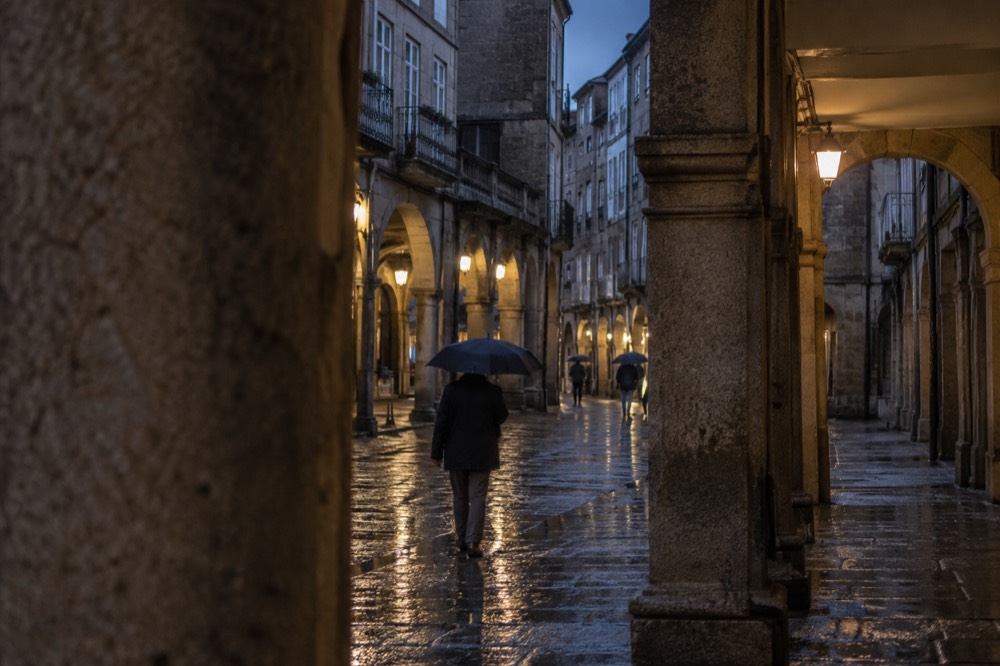
What that means practically: rain in Santiago de Compostela is rarely the all-day torrent of a tropical storm. It is more often a cycle of showers, drizzle, a bright hour, then more showers. Locals plan around it rather than against it, which is why almost every route through the old town has an arched or covered alternative.
| Season | Rain character in Santiago de Compostela | What it means for your day |
|---|---|---|
| October to March | Wettest period, frequent showers, cool temperatures | Plan indoor anchors, keep the arcades between them |
| April to June | Showers mixed with bright spells | Layers and a compact umbrella cover most of it |
| July and August | Driest months, but Atlantic rain never fully stops | Rain is a surprise, not a plan; still carry a light shell |
| September | Transitional, showers returning after summer | A rain jacket earns its place in the daypack again |
The Alameda park's viewpoint over the old town is worth a short dash in light rain, but it is the granite colonnades of Praza das Casas do Cabido and the covered walks off Praza da Quintana that make this city walkable in genuinely wet weather. The old town area guide maps the covered connections in detail.
What Can You Still See Outside In The Rain In Santiago de Compostela?
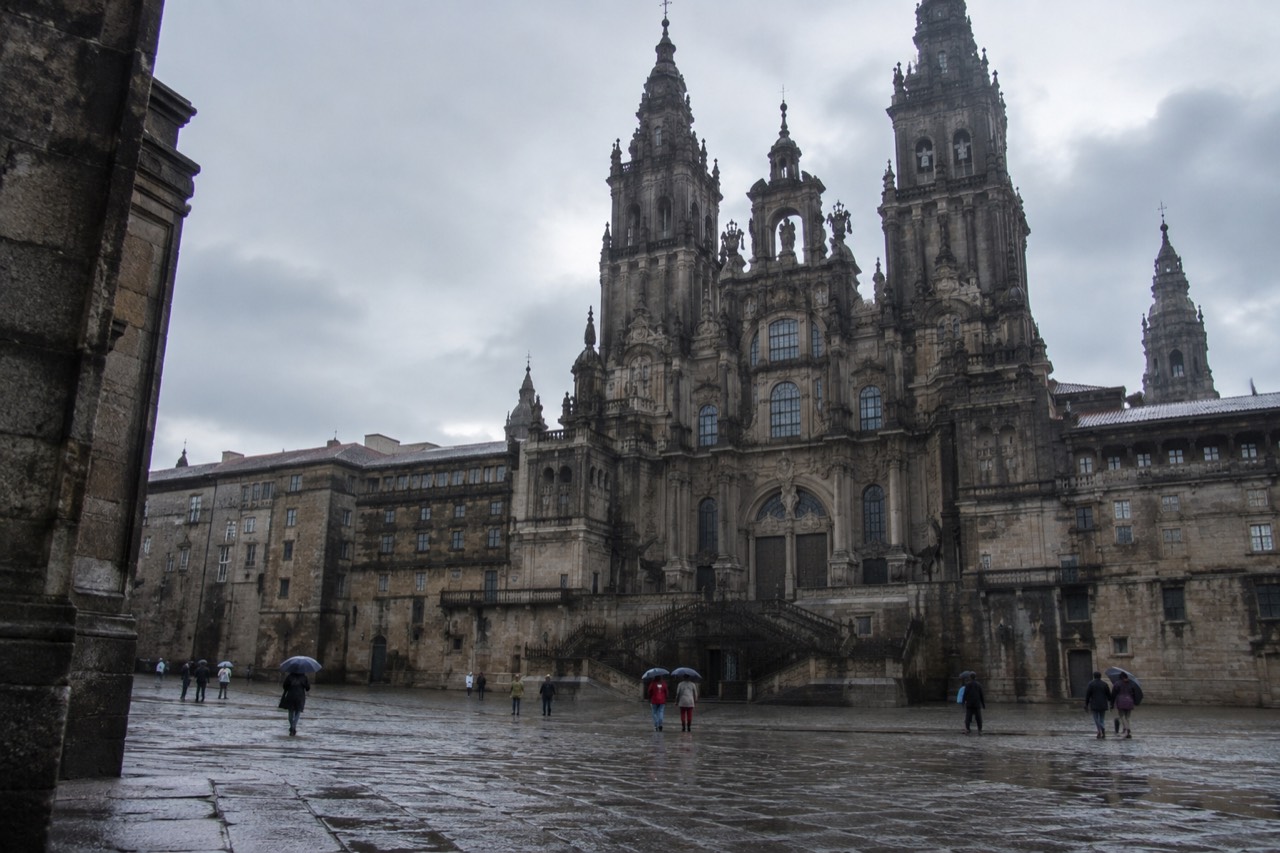
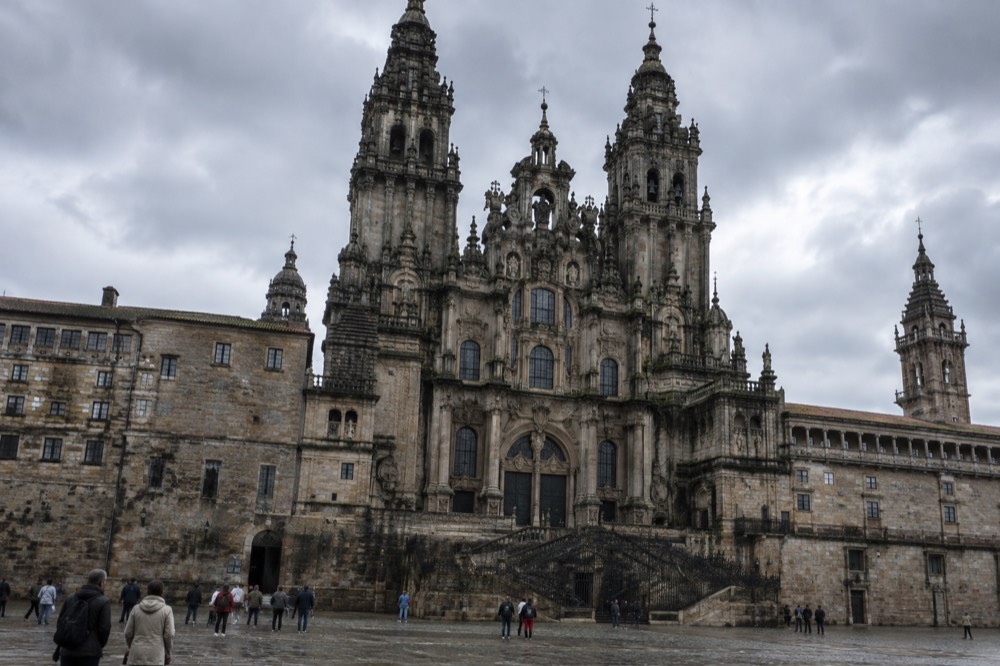
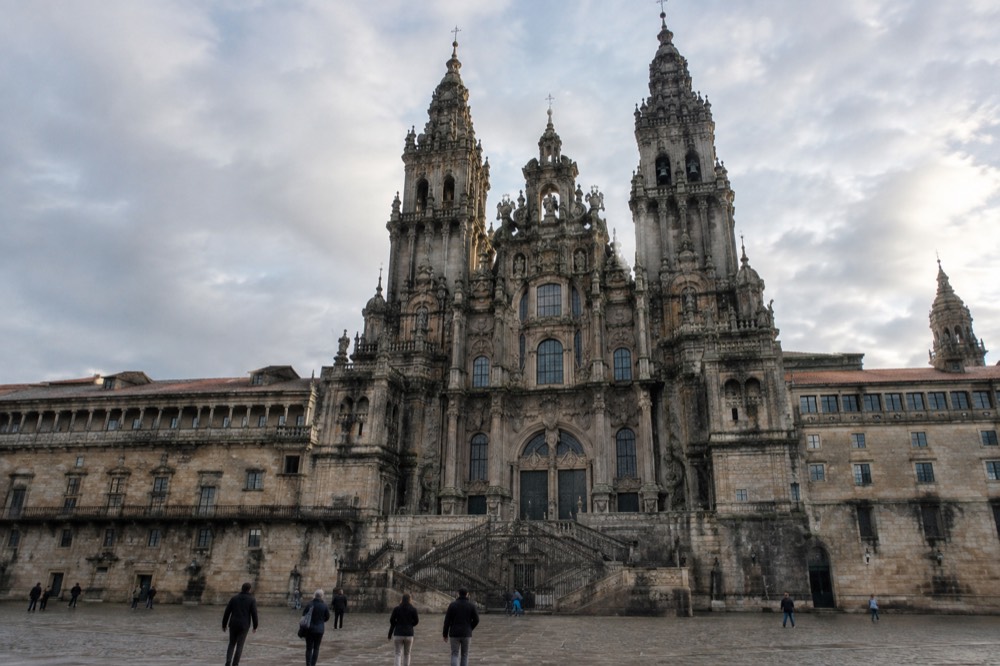
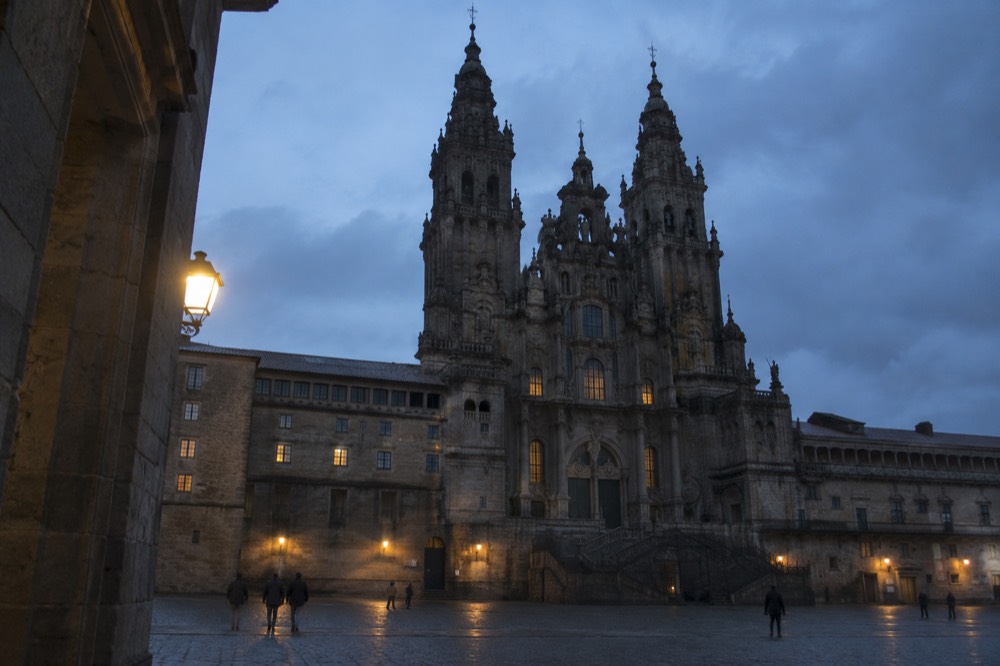
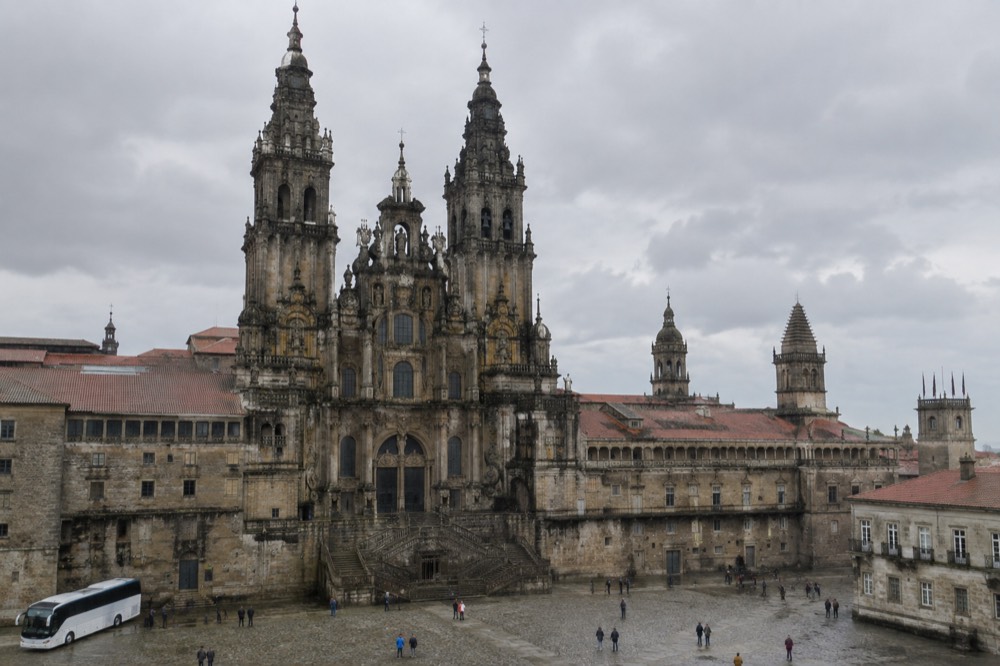
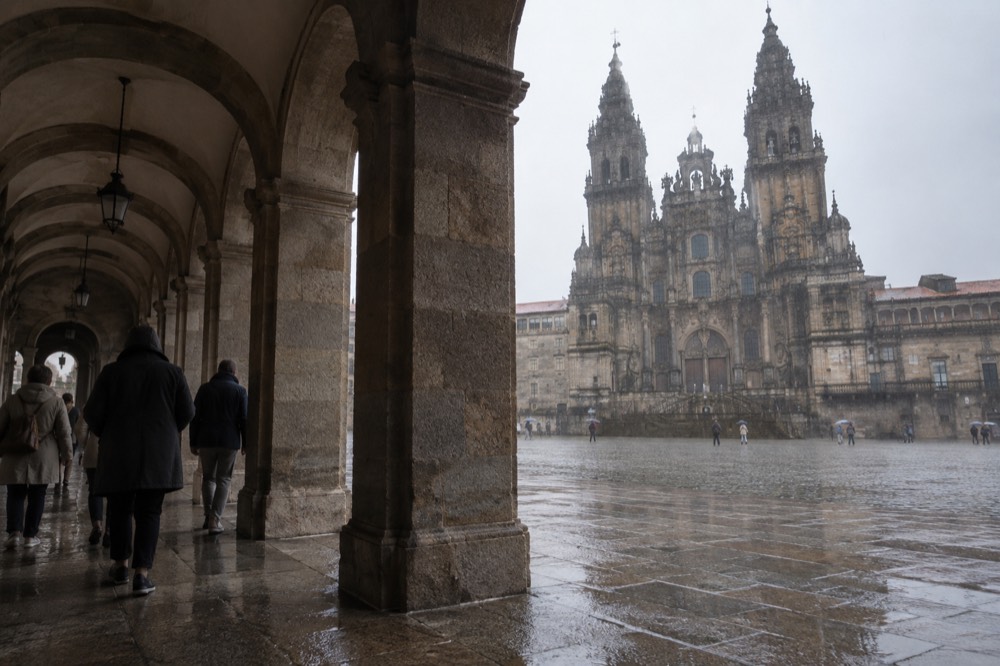
The most rewarding outdoor sight in rain is the old town's architecture itself: the Baroque facades of Praza do Obradoiro, the arcaded side of Praza da Quintana with its Holy Door, and the colonnaded stretch of Rua do Franco all stay impressive in showers, and the Cathedral's exterior stonework reads best when wet. None of it requires a ticket. The city centre is compact enough that dashes between covers stay short.
Rain transforms granite. The facades of Hostal dos Reis Catolicos and San Martino Pinario, which can look pale grey in flat summer light, go dark and dramatic with water on them, and photographers know this. If you want the postcard Praza do Obradoiro shot with a moody sky, a wet afternoon often beats a sunny one.

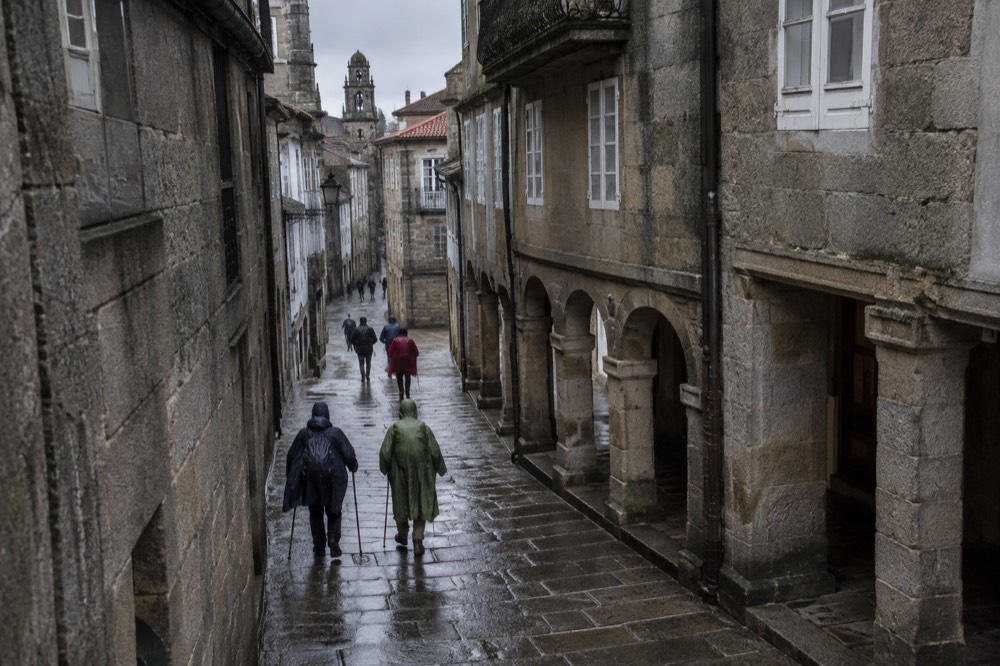
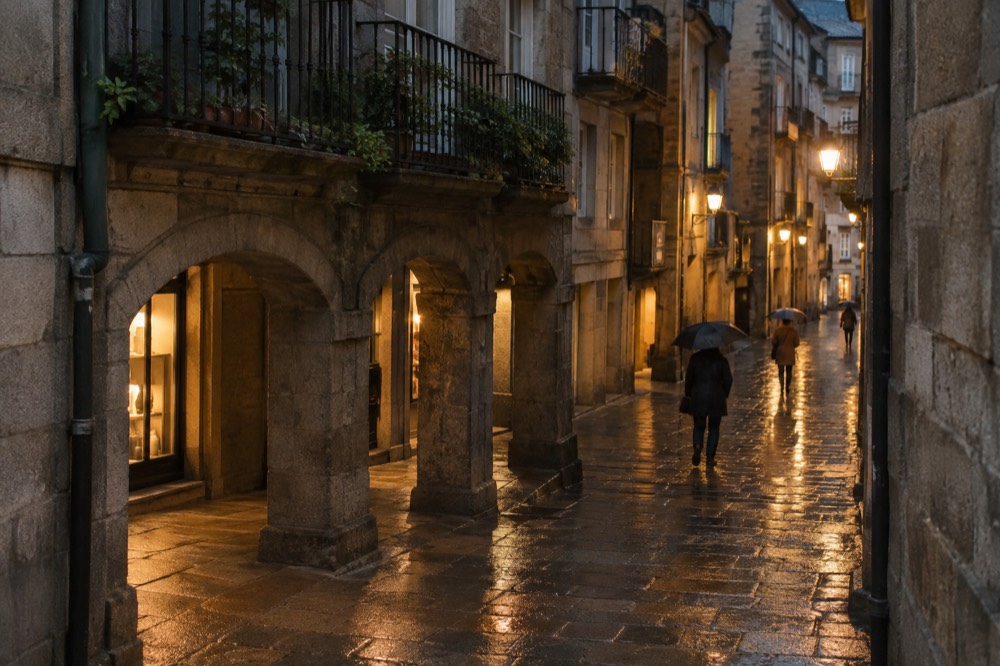
Two outdoor rules make a wet walk pleasant here. First, the arcades are not decoration: on the east side of the cathedral complex and along several stretches of the medieval streets, you can walk a hundred paces under stone cover between open squares. Second, the slopes matter: the old town steps down from Praza do Obradoiro toward Rua do Franco, so water runs off downhill, and the polished granite steps get slick. Footwear with grip matters more than the umbrella.
A guided walk keeps you moving and keeps the commentary coming even in drizzle. The Hidden City Walking Tour, from $17 per person and rated 5 from 13 reviews on the operator's live listing, is a low-commitment option, and there is a solo pick for it below in the day-trip section of this page. For those building a longer stay, the one-day itinerary adapts well to wet conditions by swapping the park segments for indoor stops.
Between showers, the Praza da Quintana's Holy Door is worth standing in front of whatever the sky is doing. The door opens only in Holy Years, and the next one is 2027: the Holy Door is scheduled to open on 31 December 2026 and stay open through 31 December 2027, because 25 July 2027 falls on a Sunday. Until then, the closed door and its rain-darkened frame are still one of the most photographed stone surfaces in Galicia.
Which Indoor Stops Fill A Rainy Day In Santiago de Compostela?
The core indoor set is the Cathedral itself, free to enter and open roughly 7:00am to 9:00pm, the Cathedral Museum with permanent collection at EUR9-23 depending on ticket type, and the guided rooftop and Carraca Tower tour at EUR15 general or EUR12 reduced, roughly 60 minutes and about 140 steps up to around 72m of height. Museum hours at other city museums are not verified in this guide's research, so hours should be checked on each venue's own site.
Start with the nave. The Cathedral's interior holds the Apostle's tomb and the famous embrace of St. James statue, and general entry is free, through the Praterias door. Rain outside makes the nave feel more like what it has always been: a working pilgrimage church where people arrive wet, in walking gear, and queue to touch the pillar behind the statue. The Cathedral guide covers what to look for.
| Indoor stop | Entry cost (verified figures only) | Why it suits a rainy day |
|---|---|---|
| Cathedral nave and tomb | Free | The city's reason for existing, dry and vast |
| Cathedral Museum and Gelmirez Palace | EUR9-23 depending on ticket type | Cloisters, tapestries, stonework, an hour or more of cover |
| Rooftop and Carraca Tower guided tour | EUR15 general, EUR12 reduced | Views in rain-clear windows between showers; 140 steps |
| Crypt of the Portico da Gloria | Included with museum ticketing options | The carved Portico da Gloria, visited on a timed indoor basis |
The rooftops deserve a note of honesty. The Cubiertas tour is the Cathedral's own product, guided, timed, and bookable online through the cathedral's official ticket site, and the fresh-researched price is EUR15 general or EUR12 reduced, with English-language visits a flat 15. Reduced rates apply to accredited pilgrims, students, over-65s and several other groups with proof. In steady rain the upper platforms are exposed, so the smart play is to book the rooftop for the first clear window and keep the museum as the fallback: the museum ticket structure and the rooftop tour guide explain the combinations.
One caution that matters on this page: the Botafumeiro, the giant swinging censer that many visitors hope to see, is currently out of action. The Cathedral confirmed in writing on 5 September 2026 that scaffolding for the cimborrio restoration covers its hanging mechanism, and no return date has been published. It normally swings on 12 fixed solemnities a year, from Epiphany on 6 January through the Transfer of the Apostle on 30 December, but that schedule is suspended for now, and this page will not promise a date.
Beyond the Cathedral complex, the indoor list continues with San Martino Pinario, the former monastery facing the cathedral across Praza da Imaculada, and the Museo do Pobo Galego, the Galician ethnography museum. Specific hours and any free-admission days for those venues are not officially published, so check each venue's own site before setting out; treat any "free on Sundays" claim you read elsewhere as unconfirmed until the venue itself says it.
Mercado de Abastos, the city's stone market, is partly covered and one of the most atmospheric places in a drizzle, but its opening hours are likewise unverified in this research, so confirm on the market's own listing before building a morning around it. The Mercado de Abastos guide describes what to look for if you go.
Where Do You Eat And Drink Through A Wet Afternoon In Santiago de Compostela?
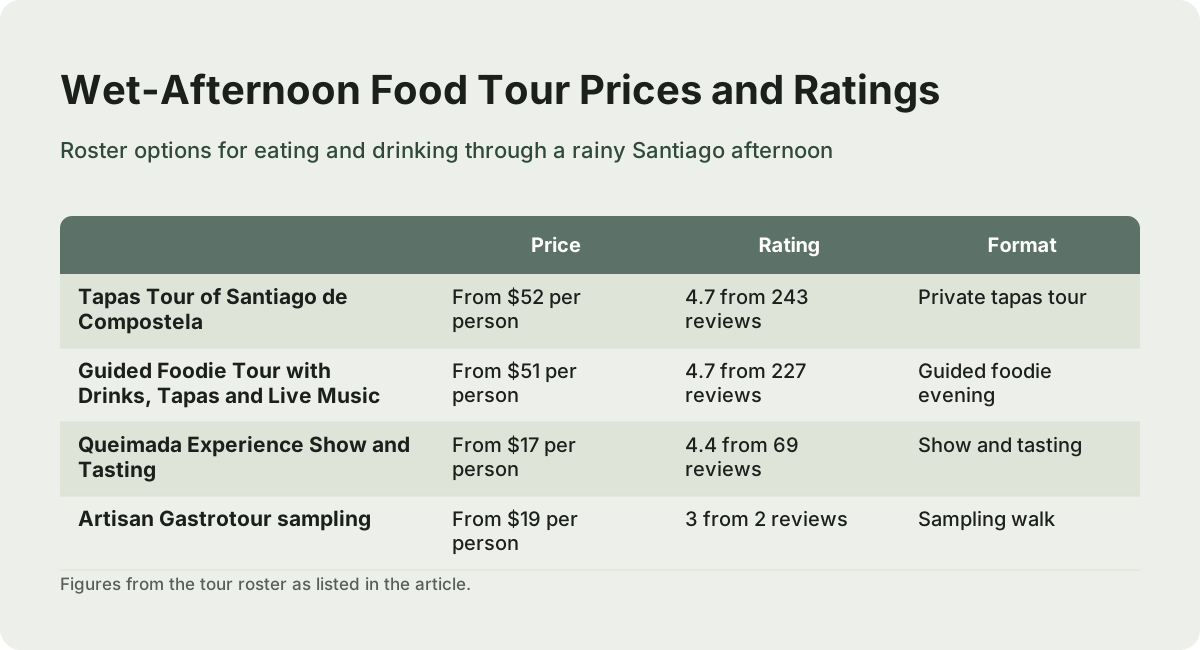
Rua do Franco and the streets running off it hold the densest run of bars and restaurants in the old town, and several sit behind glass or in deep interiors a short walk from the Cathedral. A tapas or food tour is the most reliable wet-afternoon structure: the roster's options run from about $17 per person for a Queimada show and tasting to about $52 per person for a private tapas tour, and a full food tour with drinks, tapas and live music starts around $51.
Rain does not slow the eating in this city. The Galician repertoire, pulpo a la gallega, Padron peppers, Tarta de Santiago, with local Albarino or Ribeiro beside it, is served at tables a few minutes' walk from every major sight, and the compact centre means you are never far from a doorway. Rua do Franco is the obvious spine, and the where-to-eat coverage on this site goes deeper into specific dishes.
For something structurally different, the Queimada experience deserves a look. Queimada is the Galician ritual drink of orujo spirits, set alight with sugar and often recited over, and the show-and-tasting format turns a wet evening into something with theatre in it. One version on the roster is the Queimada Experience Show and Tasting, from $17 per person and rated 4.4 from 69 reviews on its listing. The numbers on any given date are the listing's to confirm, not this page's to promise.
| Wet-afternoon eating option | Roster price | Rating | Format |
|---|---|---|---|
| Tapas Tour of Santiago de Compostela | From $52 per person | 4.7 from 243 reviews | Private tapas tour |
| Guided Foodie Tour with Drinks, Tapas and Live Music | From $51 per person | 4.7 from 227 reviews | Guided foodie evening |
| Queimada Experience Show and Tasting | From $17 per person | 4.4 from 69 reviews | Show and tasting |
| Artisan Gastrotour sampling | From $19 per person | 3 from 2 reviews | Sampling walk |
The low review count on the artisan gastrotour is stated plainly because it is what the listing publishes; a small sample is a small sample. The tapas tours, by contrast, carry review volumes in the hundreds, which is what you want when booking something for a specific evening.
A food-anchored afternoon also pairs well with the free-walking-tour layer of this city. GuruWalk runs several, including Free Tour Santiago Essential, rated 4.91 from 4,797 reviews, tip-based rather than priced, and rain rarely cancels them. Naming the platform and the guide here is the honest way to describe a free walk: the price is what you choose to tip.
Should You Cancel A Day Trip When It Rains In Santiago de Compostela?
Most day trips from Santiago de Compostela should be kept, not cancelled, because Atlantic coastal and river-valley weather often differs sharply from the city's, and the major routes run in modern coaches with indoor stops at wineries, monasteries and a lighthouse-adjacent cafe culture. The roster's full-day trips run from about $45 to about $101 per person depending on destination. The one honest exception is a trip booked purely for photography: coastal cliffs in heavy rain deliver mood, not views.
The Costa da Morte, the Coast of Death west of the city, is the classic example. Cabo Vilan, Fisterra's lighthouse and Muxia's sanctuary are exposed headlands, and a serious Atlantic front can swallow them in cloud. But the same front can clear within an hour, and a coach tour with multiple stops can chase the gaps. The related pick for this page is the Costa da Morte tour with a Cabo Vilan stop, from $60 per person and rated 4.8 from 267 reviews on its listing, a full-day trip with seven-stop depth on its sister versions.
The Rias Baixas route south is even more rain-tolerant, because its anchors are indoors: an Albarino winery in the Cambados area and an optional mussel-boat cruise on the Ria de Arousa. The winery visit is the constant; the boat is the weather-dependent add-on. The full-day winery trip with optional mussel boat runs from $54 per person and carries a 4.8 rating from 322 reviews, with a boat-plus-winery variant from $53 rated 4.7 from 482 reviews.
| Day trip from Santiago de Compostela | Roster price | Rating | Rain tolerance |
|---|---|---|---|
| Costa da Morte with Cabo Vilan stop, full day | From $60 | 4.8 from 267 reviews | High: multiple stops, coach cover, dramatic in any weather |
| Finisterre, Muxia and Costa da Morte, 7 stops, full day | From $60 | 4.8 from 1,714 reviews | High for the same reasons |
| Rias Baixas winery with optional mussel boat, full day | From $54 | 4.8 from 322 reviews | Very high: winery anchor is fully indoors |
| Ribeira Sacra cruise, monasteries and Ourense, full day | From $68 | 4.6 from 166 reviews | Mixed: river cruise depends on the day; Ourense stops are indoor |
| Fisterra and Muxia Express, half day | From $45 | 4.4 from 50 reviews | Moderate: express format leaves less time to wait out a front |
| Cies Islands full-day visit | From $101 | No rating published | Low for rain: a beach-and-hiking island in bad weather |
The Ribeira Sacra option, a Sil River cruise through the canyons with monastery stops and Ourense's old quarter, is the quiet rain-tolerant sleeper on this list: the cruise portion wants decent weather, but the canyon walls give partial shelter and the monastery and Ourense segments are stone-interior visits.
If the day is genuinely soaked, the answer to which trip to keep is the best day trip from Santiago de Compostela question this site answers in depth, and the winery route is the usual winner in wet months.
Cancellation terms matter more than the forecast when you book on a rainy week. Every tour card above links to the operator's live listing, where the current free-cancellation window is stated per product; this page does not quote cancellation windows because they change by product and date.
What If You Are Arriving On The Camino In The Rain?
A rainy final stage changes nothing about the certificate: the Compostela requires the last 100km walked or on horseback, or the last 200km cycled, on a recognized route, with at least two stamps per day in your credencial from official stamping points, and it is issued in person only at the Pilgrim's Office at Rua das Carretas 33. The office issued 530,987 Compostelas in 2025, a record year, so wet-weather arrivals are routine.
Pilgrims arrive in this city soaked several times a week from October to March, and the machinery is built for it. The Pilgrim's Office queue moves faster on wet days than on 25 July, and the office closes only on 25 December and 1 January, with hours varying seasonally. The full rules, and the common mistakes that cost people their certificate, are laid out in the Compostela certificate guide.
One dated change matters to pilgrims attending mass rather than collecting paperwork. Pilgrim masses at the Cathedral's High Altar continue until 15 October 2026. From 16 October 2026, the 9:30am, noon and 7:30pm masses relocate to the nearby Church of San Agustin while main-chapel works proceed ahead of the 2027 Holy Year, and only the 7:30am mass stays in the Cathedral's own Communion chapel. A pilgrim who walks in from Sarria in November 2026 should know that the mass they attend will most likely not be in the cathedral nave itself. The pilgrim mass guide tracks this, and the rest-day-after-the-Camino itinerary is built for exactly the wet, stiff-legged morning after arrival.
For pilgrims still on the route, the practical answer to rain is the credencial itself: two stamps a day, and albergue and church stamping points are dry by definition. The question of how long the Camino takes has a wet-weather footnote: few people shorten stages for rain, but many slow down on the granite descents, which is the correct instinct.
How Do You Get Around And Home When It Pours In Santiago de Compostela?
Getting around the centre in rain needs no vehicle: the old town is a ten-minute walk end to end. For leaving it, the airport is about 12km away, and line 6A with Tussa charged 1 EUR to the driver as of late September 2026, with a new Monbus contract near 6 EUR expected in autumn 2026, so the fare is subject to change. Trains reach Madrid in roughly 3-4 hours and Vigo in about 1 hour; there is no direct line to Porto, you change via Vigo.
The airport figure deserves the caution it gets here. The distance from the airport to the old town is written as about 12km because sources disagree between roughly 11 and 15km depending on the measured point, and this site does not pretend to a precision the sources lack. The fare situation is genuinely transitional: santiago.es's transport page listed the Tussa 6A at 1 EUR cash as of its 23 September 2026 update, while flagging the Monbus reorganisation expected to start in autumn 2026, possibly by December, at an unsubsidised fare near 6 EUR one-way. Check the live fare before assuming either number.
| Practical item | Verified status for Santiago de Compostela |
|---|---|
| Airport distance | About 12km, a 20-30 minute drive depending on traffic |
| Airport bus, late September 2026 | Line 6A, Tussa, 1 EUR to the driver, 0.36 EUR by card |
| Airport bus, autumn 2026 onward | New Monbus contract expected, fare near 6 EUR, subject to change |
| Train to Madrid | Direct high-speed services, roughly 3-4 hours |
| Train to Vigo | Direct services, roughly 1 hour |
| Train to Porto | No direct line; change via Vigo |
| Tourist tax | Santiago de Compostela has charged a municipal tourist tax since 1 October 2025: per person per night (max 5 nights), from 1 EUR in private albergues, campsites and tourist apartments to 2.50 EUR in five-star hotels; under-18s and stays in Xunta-run public albergues exempt |
| Emergency number | 112, EU-wide, applies in Spain |
Taxis and private transfers exist as the faster, drier option and cost significantly more than the bus; Travelpayouts-linked transfer and hotel prices change by date and demand, so this page never prints a from-price for them. The airport guide covers the full picture, and the centre's transport options are simple enough that a dedicated guide is barely needed for a city this size.
On the tax row, honesty is the policy: Santiago de Compostela has charged a municipal tourist tax since 1 October 2025, a surcharge on Galicia's tourist-stay tax, ranging from 1 EUR to 2.50 EUR per person per night for up to 5 nights, with under-18s and stays in Xunta-run public albergues exempt.
A Full Rainy-Day Plan For Santiago de Compostela, Hour By Hour
A wet day in Santiago de Compostela works as a three-block plan: a free Cathedral nave and paid museum or rooftop block from mid-morning, an arcaded walk and long lunch through early afternoon, and a food tour, queimada show or night walk from late afternoon onward. The blocks are modular, each survives a forecast change, and none of them requires more than a ten-minute uncovered walk between stops.
The morning block begins at the Praterias door. The nave is free, opens around 7:00am, and an early start in rain is actually the quiet way to see it, because tour groups cluster later and in better weather. Move from the nave to the museum, EUR9-23 depending on ticket type, where the Gelmirez Palace cloister alone justifies an hour of dry time. If the sky breaks, swap the second museum hour for the rooftop tour, EUR15 general or EUR12 reduced, roughly 60 minutes with about 140 steps.
Lunch is the Rua do Franco spine, or a tapas tour if the afternoon is to be the event rather than a gap. The early-afternoon walk, Praza do Obradoiro to Praza da Quintana to the Alameda viewpoint and back under the arcades, takes under an hour in any weather and is the city's best free hour in rain, when the granite is at its most photogenic.
The evening block is where the roster earns its place: a foodie tour with drinks and live music from around $51, a queimada show from around $17, or the Secrets of Compostela night tour, from $17 and rated 4.9 from 74 reviews, which does the old town's legends in the dark, when rain and lamplight suit the material. Anyone weighing whether a wet day dims the city at all should read the honest answer to is Santiago de Compostela worth visiting.
For a longer wet stay, the two-day itinerary and three-day itinerary both compress gracefully: this page's indoor blocks slot into their afternoons, and their outdoor mornings hold up in drizzle. Families have a variant too, and the with-kids itinerary keeps small children under cover more than any other plan on the site.
Common Questions About Rainy Days In Santiago de Compostela
Does it rain a lot in Santiago de Compostela?
Yes, by Spanish standards it rains a lot: AEMET's station at Labacolla records on the order of 1,690-1,890mm a year, wet year-round, wetter from October to March, and driest in July and August. No verified month-by-month table exists in this guide's research, so plan by season rather than by a specific monthly figure.
Is Santiago de Compostela worth visiting in the rain?
Yes. The Cathedral nave is free, the museum and rooftop tour are indoors or short-exposure, the old town's arcades cover the walks between them, and the granite architecture photographs better wet than flat-grey dry. The Botafumeiro is currently suspended, so no visit, wet or dry, should be planned around seeing it swing.
What is the best indoor thing to do on a rainy day in Santiago de Compostela?
The Cathedral and its museum complex: free entry to the nave, roughly 7:00am to 9:00pm, and a museum ticket at EUR9-23 depending on type, which includes the Gelmirez Palace. The rooftop and Carraca Tower guided tour at EUR15, reduced EUR12, about 140 steps, fits a dry window between showers.
Do day trips from Santiago de Compostela run in bad weather?
The full-day coach trips generally run as scheduled, and the winery-based Rias Baixas routes are the most weather-proof because their anchor stops are indoors. Coastal Costa da Morte trips run in rain and can be spectacular or socked in with cloud; express versions leave the least room to wait out a front.
Does rain affect the Compostela certificate?
No. The rules are about distance and stamps: the last 100km walked or on horseback, or the last 200km cycled, with at least two stamps per day, collected in person at Rua das Carretas 33. Rain changes none of that, and the 530,987 Compostelas issued in 2025 included plenty of soaked pilgrims.
Is the Botafumeiro running when it rains?
The Botafumeiro is not running at all at present, in any weather: the Cathedral confirmed in writing on 5 September 2026 that dome-restoration scaffolding covers its mechanism, with no return date. It normally swings on 12 solemnities a year, but that schedule is suspended, and no visitor should plan a trip around it.
A rainy day in Santiago de Compostela is not the city at a disadvantage. It is the city at its most Galician, dark stone, candle smoke, a bar with wet jackets on the hooks, and the walk home under arcades that have been handling this weather for eight centuries.