Mercado de Abastos Santiago de Compostela
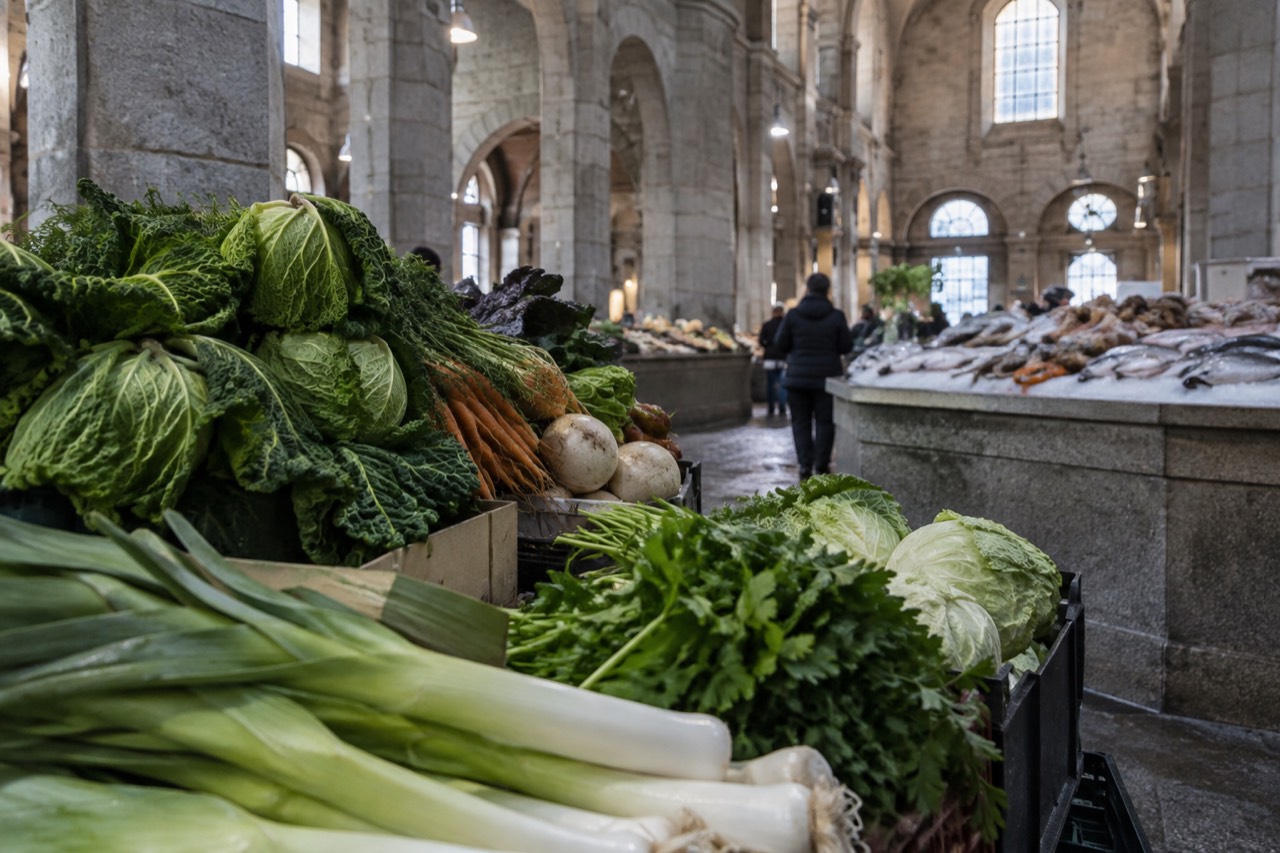
Mercado de Abastos is the working food market where Santiago de Compostela actually shops, a short walk south of the Cathedral, and the single best place in the city to see Galician produce, seafood and everyday life side by side.
Short answer
Mercado de Abastos is Santiago de Compostela's main covered food market, a cluster of market halls a few minutes' walk south of the Cathedral, where fishmongers, cheesemongers, butchers and produce stalls sell to locals most of the week. Opening hours are unverified in this site's research, so check the venue's own listing before going; entry is free and the city has charged a municipal tourist tax since 1 October 2025, from 1 EUR to 2.50 EUR per person per night for up to 5 nights.
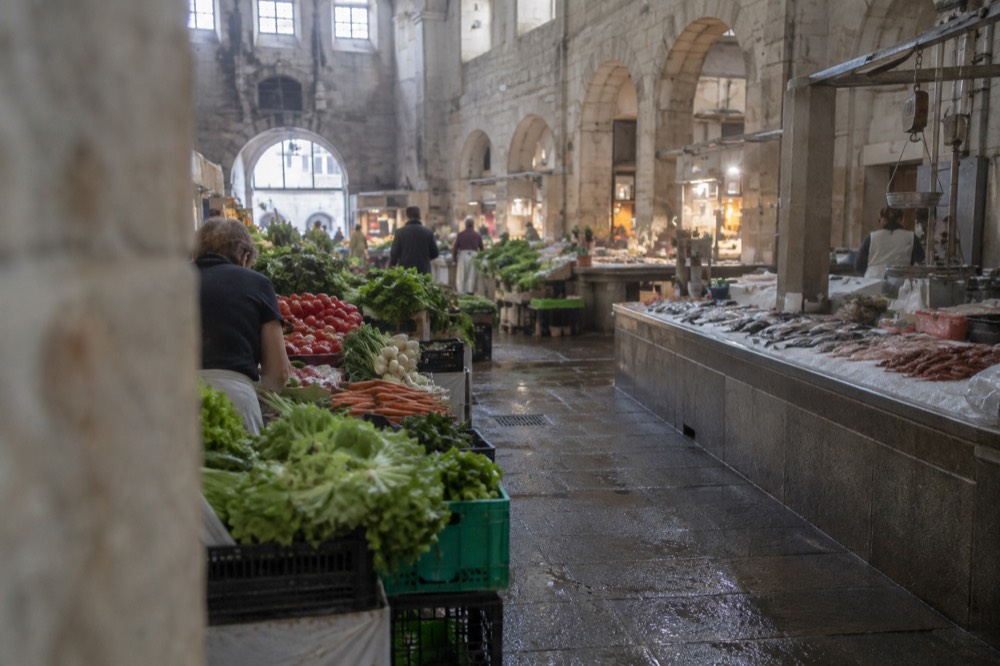
Mercado de Abastos is the place where Santiago de Compostela buys its dinner. Pilgrims finish their walk at the Cathedral, tourists circle Praza do Obradoiro, and a few streets south the city's fishmongers, butchers and greengrocers carry on a trade that has fed the old town for generations. It is a covered market of stone halls and open-air stall rows, the second-most-visited spot in the city after the Cathedral by the accounts of the city's own tourism material, and unlike almost everything else in the historic centre it is not a monument. It is a workplace, and that is exactly why it rewards a visit. Santiago de Compostela Travel Guide covers the Cathedral and the Camino in depth elsewhere; this page is about the market itself, what it sells, and how to fit it into a day.
What Is The Mercado de Abastos In Santiago de Compostela?
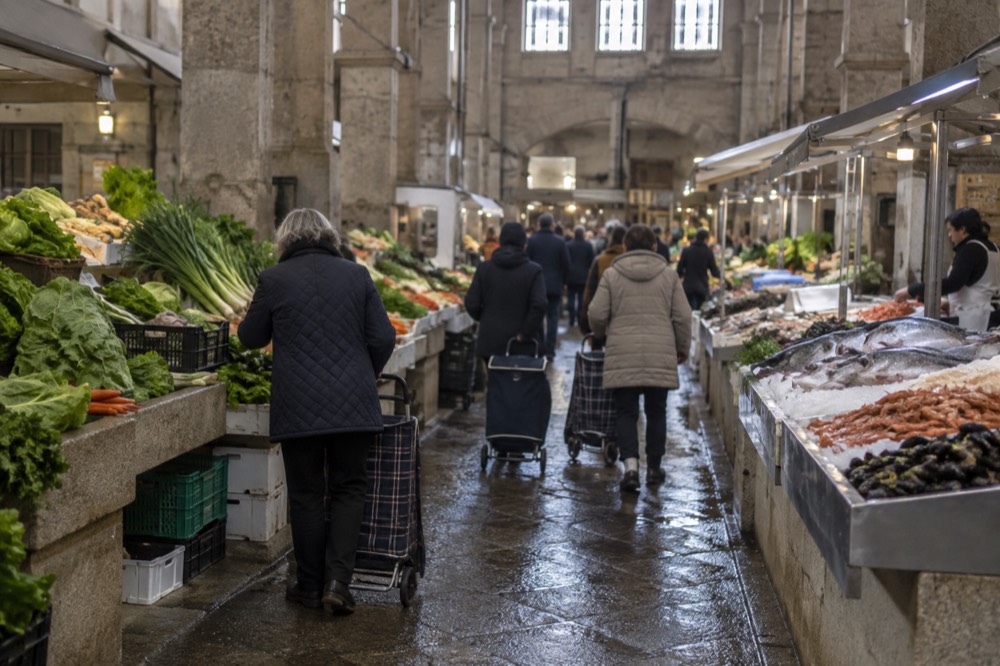
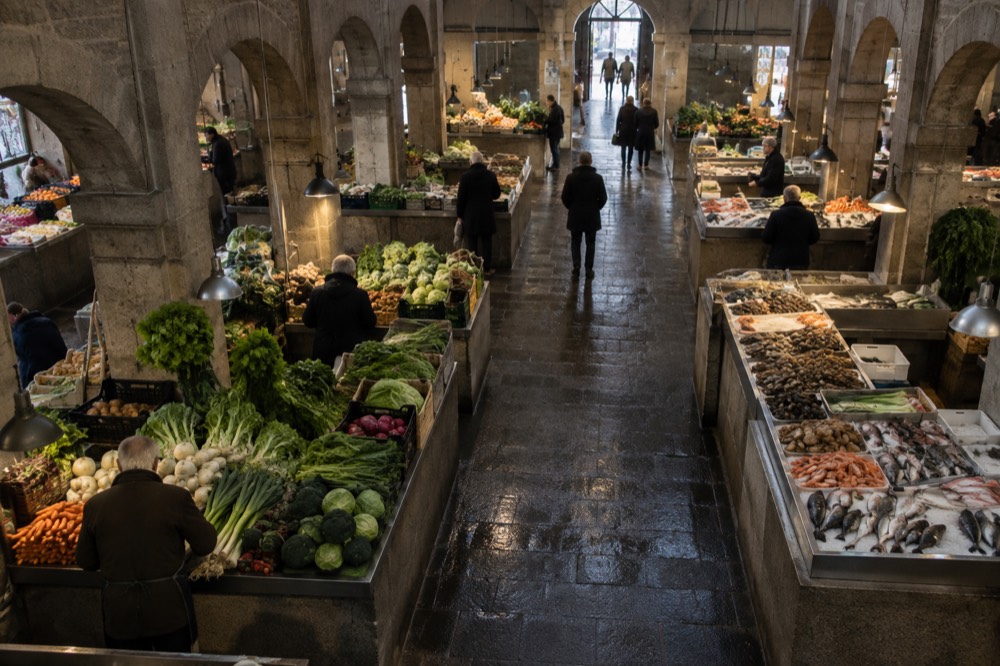
The Mercado de Abastos de Santiago is the city's principal covered food market, a complex of market buildings and stall lines a few minutes' walk south of the Cathedral in the UNESCO-listed Old Town, where independent stallholders sell fish, shellfish, meat, cheese, bread, fruit and vegetables directly to the public. It is a commercial market rather than a museum, run for residents first, and entry costs nothing. Specific opening hours have not been verified in this site's research, so treat any hour you read elsewhere, including on a printed city map, as unconfirmed and check the venue's own listing before setting out.
That distinction matters. Many European cities have gentrified their central markets into food halls aimed squarely at visitors, with souvenir olive oil and laminated menus in five languages. Santiago's market has not gone that way. Galicia is one of Spain's great seafood regions, sitting on the Atlantic with the Rias Baixas estuaries to the south and the Costa da Morte to the west, and the market is where that catch, along with the region's beef, cheeses and garden produce, reaches the city's kitchens. The old town around it, inscribed by UNESCO in 1985 as a separate listing from the Camino routes inscription of 1993, supplies the granite backdrop.
What Will You Find At The Stalls Inside The Mercado de Abastos?
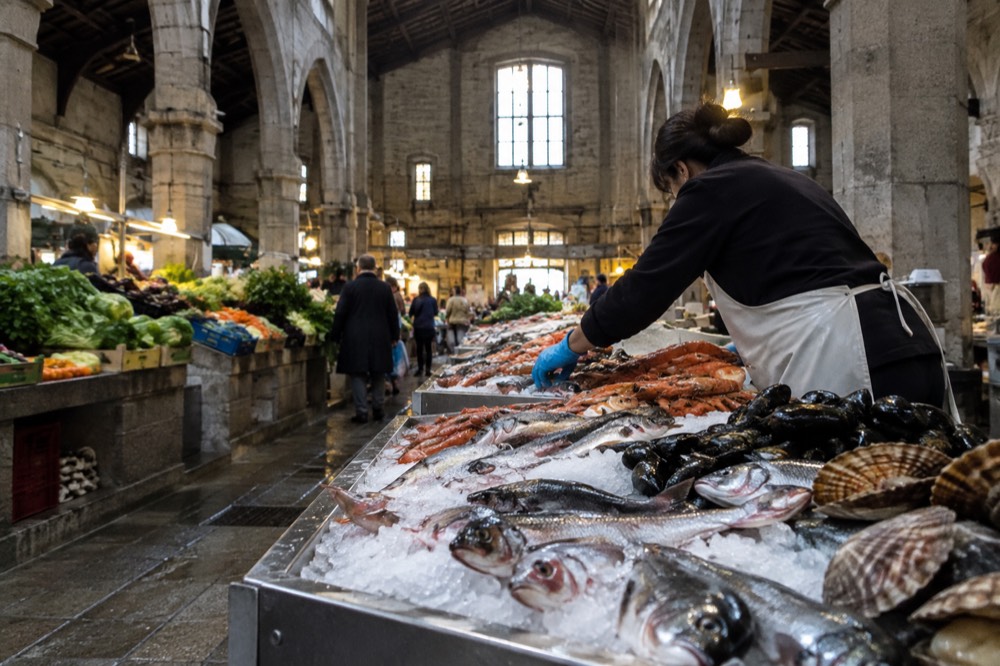
The stalls divide broadly into fish and shellfish, meat and cured products, cheese, bread and pastry, fruit and vegetables, and a handful of flower and specialty sellers, with Galician seafood the unmissable category: percebes, navajas, octopus, spider crab and whatever the Rias Baixas fleets landed that morning. Padrón peppers appear in season, the small green peppers the region is famous for, alongside tetilla cheese, Galician beef, empanada, and cured pork products. Prices at individual stalls are set by each seller and are not published centrally, so treat any figure you see online as a snapshot rather than a rule, and ask at the counter.
The shellfish counters are the ones visitors remember. Galicia's percebes, goose barnacles harvested from rocks on the Costa da Morte and around Fisterra, are among the most prized shellfish in Spain, and the market's fish rows give a fair picture of what the coast actually produces: hake, line-caught octopus for pulpo a la gallega, barnacles, clams, scallops and crab. The market's rhythm belongs to its traders and shoppers, and stallholders are generally happy to answer a short question between customers, though mid-morning rush is not the moment for a long conversation about barnacle biology.
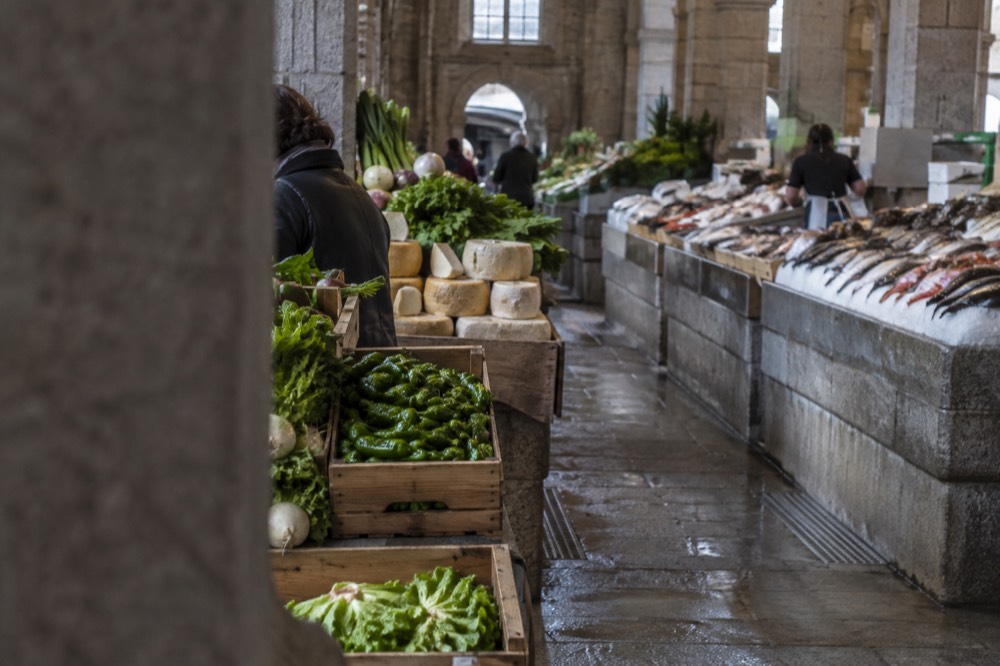
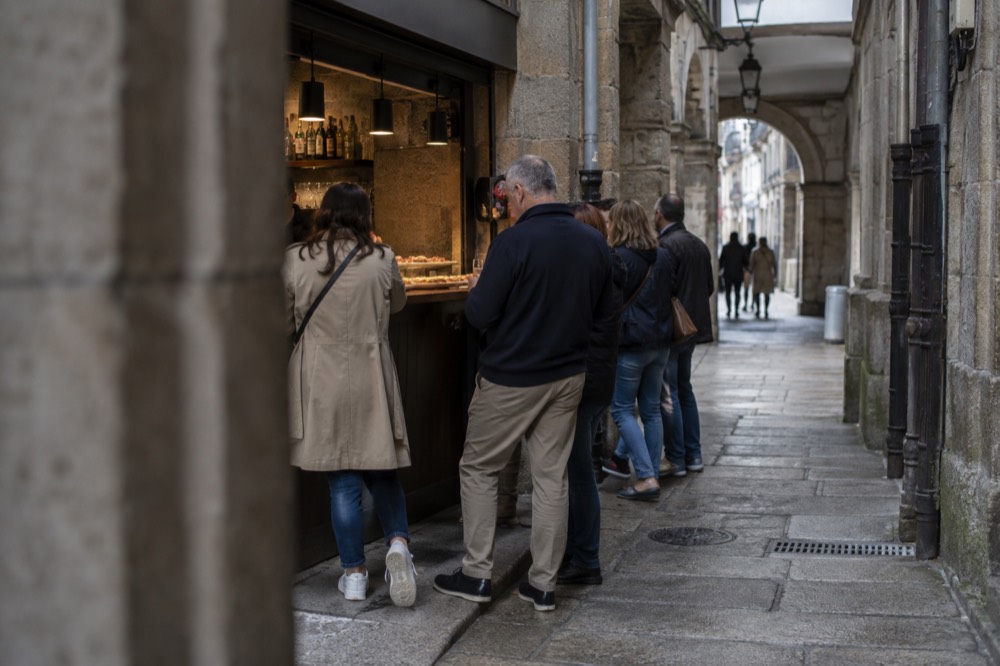
A reasonable way to spend a market morning is to walk the full circuit once without buying, then return to the counters that interested you. The classic move for visitors is assembling a picnic: bread, tetilla cheese, Padrón peppers or empanada, some fruit, and a bottle of something local. Albarino, the white wine of the Rias Baixas, is the region's flagship, and the surrounding streets hold small grocers and wine shops if the market itself does not have what you want. The tapas bars of Rua do Franco and the wider old town are the natural next stop, since the market is a buy-and-cook or buy-and-picnic place rather than a sit-down restaurant itself.
| Stall category | What you'll see | Notes for visitors |
|---|---|---|
| Fish and shellfish | Whole fish on ice, octopus, percebes, clams, crab | The market's strongest category; arrive early in the day for the fullest counters |
| Meat and charcuterie | Galician beef, pork, cured sausages | Butcher stalls serve residents; ask before photographing |
| Cheese | Tetilla and other Galician cheeses | Sold by the wedge; a picnic staple |
| Bread and pastry | Loaves, empanada, tarta de Santiago | Empanada varies by stall, savoury fillings in bread or pastry |
| Fruit and vegetables | Seasonal Galician produce, Padrón peppers in season | Peppers are summer-into-autumn; availability changes weekly |
| Flowers and specialty | Cut flowers, odds and ends | A working-market detail, not a craft stall row |
Where Is The Mercado de Abastos And How Do You Get There?
The Mercado de Abastos sits south-east of the Cathedral in Santiago de Compostela's old town, roughly a five-minute walk from Praza do Obradoiro, and nearly every visitor reaches it on foot because the entire UNESCO-listed historic centre is compact and pedestrian-friendly. From the Cathedral, the walk drops through the old town's granite streets in a few blocks; the exact gate you use matters less than the direction, south and slightly east, and any city map or street sign for "Abastos" will get you there. There is no precise verified walking time for every route in this site's research pack, so use the map rather than a quoted minute-count.
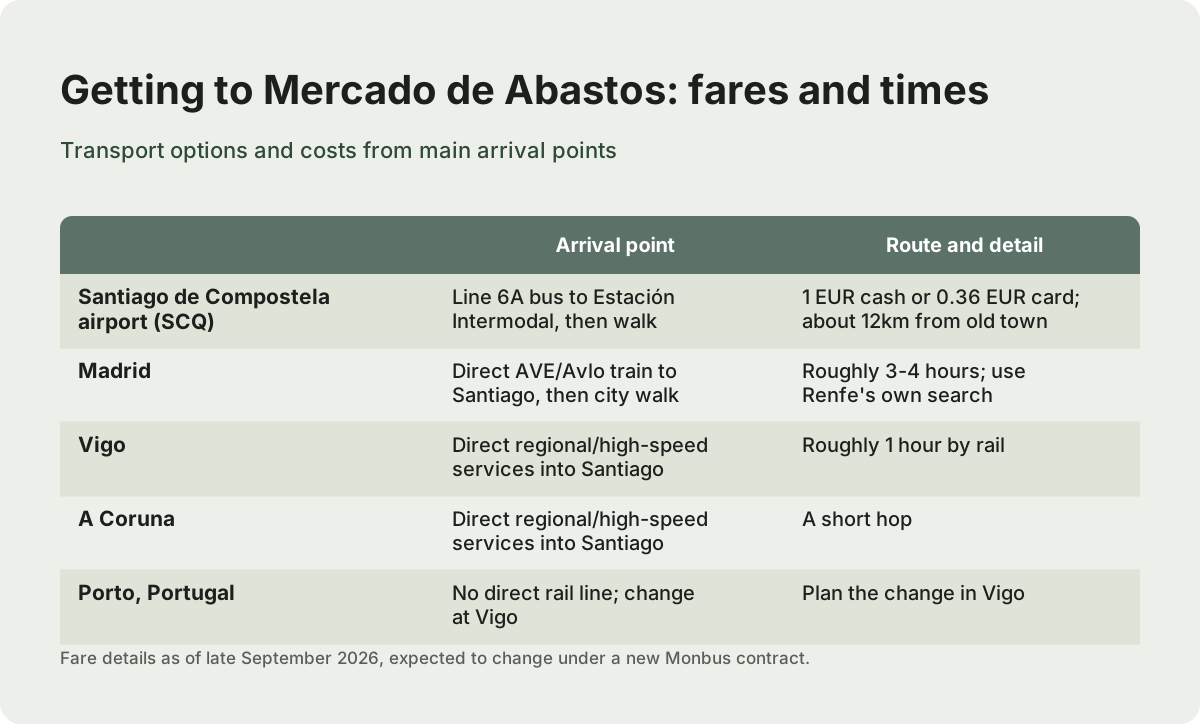
If you are arriving from further out, the practical pattern is the same one the city's transport page lays out for visitors generally. Santiago de Compostela airport lies about 12km from the old town, and line 6A, the Tussa urban bus, runs between the airport and the city's Estación Intermodal for a 1 EUR fare paid to the driver, or 0.36 EUR per trip on a rechargeable card as of late September 2026. That fare is subject to change: a new Monbus contract with a proposed fare near 6 EUR was expected to begin in autumn 2026, possibly by December, so check the city transport page rather than assuming the 1 EUR fare still holds on your travel date. From the intermodal station the market is a short city walk.
| Arrival point | Route to the market | Verified detail |
|---|---|---|
| Cathedral / Praza do Obradoiro | On foot through the old town | Short walk south; the historic centre is pedestrian-scale |
| Santiago de Compostela airport (SCQ) | Line 6A bus to Estación Intermodal, then walk | 1 EUR cash fare or 0.36 EUR card fare as of late September 2026, expected to change under a new Monbus contract |
| Madrid | Direct AVE/Avlo train to Santiago, roughly 3-4 hours, then city walk | No precise minute-count verified; use Renfe's own search |
| A Coruna or Vigo | Direct regional/high-speed services into Santiago | Vigo is roughly 1 hour by rail; A Coruna is a short hop |
| Porto, Portugal | No direct rail line; change at Vigo | Confirmed by rail-route references; plan the change in Vigo |
A quiet point worth knowing: because the market is a working retail space rather than a ticketed attraction, there is no entry fee, no queue for admission and no timed slot. That makes it one of the few central sights that costs nothing at all, in a city where the Cathedral's interior is also free but its museum and rooftop tours are paid, timed visits. Santiago de Compostela has charged a municipal tourist tax since 1 October 2025, a surcharge on Galicia's tourist-stay tax, from 1 EUR per person per night in private albergues, campsites and tourist apartments up to 2.50 EUR in five-star hotels, for a maximum of 5 nights, with under-18s and stays in Xunta-run public albergues exempt.
When Should You Visit The Mercado de Abastos?
Mornings are the market's real hours: fish counters are fullest early in the day, the produce is at its best, and the halls thin out toward early afternoon, but the exact opening hours of Mercado de Abastos de Santiago are unverified in this site's research, so check the venue's own site before you plan a visit around a specific time. No day-of-week schedule, weekend arrangement or closing day has been confirmed from an official source for this market in the research behind this page. Any published hour should be treated the same way: unconfirmed until checked against the venue's own listing.
What the details below do give is climate. AEMET's data for station 1475X, Santiago de Compostela / Labacolla, shows a temperate oceanic climate, wet year-round, wetter from October to March, driest in July and August, with annual precipitation on the order of 1,690 to 1,890mm. A covered market is a genuinely useful thing in a city with that much rain; it is one of the best wet-weather stops in the old town, and a rainy October or March morning in the market is a very Santiago de Compostela experience. The trade-off is that the peak dry months of July and August coincide with the highest pilgrim and visitor numbers, so the market is busiest exactly when the weather is best.
Late July deserves a specific note. The Feast of St James falls on 25 July every year and the city marks it with a Pontifical Mass, the national offering to the Apostle, fireworks, concerts and folk events, so a market visit that week sits inside the city's biggest annual celebration. And the calendar matters beyond one day: 2026 is not a Holy Year, 2027 is the next Xacobeo, with the Holy Door opening solemnly on the evening of 31 December 2026 and the Holy Year running through 31 December 2027. Anyone planning a trip around the 2027 celebrations should expect a markedly busier city in every season, market included.
| Season | Climate per AEMET | Market consideration |
|---|---|---|
| July-August | Driest months of the year | Peak visitor and pilgrim numbers; fullest atmosphere, most crowded stalls |
| September-October | Transition into the wetter half of the year | Seafood season in full flow; rain becomes more likely, market is covered |
| November-March | Wet and cool, the wettest stretch of the year | Market at its most local; excellent rainy-day stop |
| April-June | Between the wet and dry halves | Good balance of weather and thinner crowds |
| Late July (25th) | Feast of St James, city-wide festivities | Busiest single week of the year, Holy Years excepted |
| 2027 Holy Year | Holy Door opens 31 Dec 2026, Holy Year to 31 Dec 2027 | Plan well ahead for any 2027 visit, market and everything else |
What Should You Buy And Eat Around The Mercado de Abastos?
Buy what Galicia does best: Padrón peppers in season, tetilla cheese, empanada, tarta de Santiago, Galician beef, and above all shellfish and fish from the Atlantic, then either picnic in the nearby Alameda park or carry your purchases to a bar that will cook them, a common arrangement around Galician markets where stallholders point regulars to kitchen bars nearby. Stall prices are set individually and are not centrally published, so ask at the counter rather than trusting a number printed on a blog.
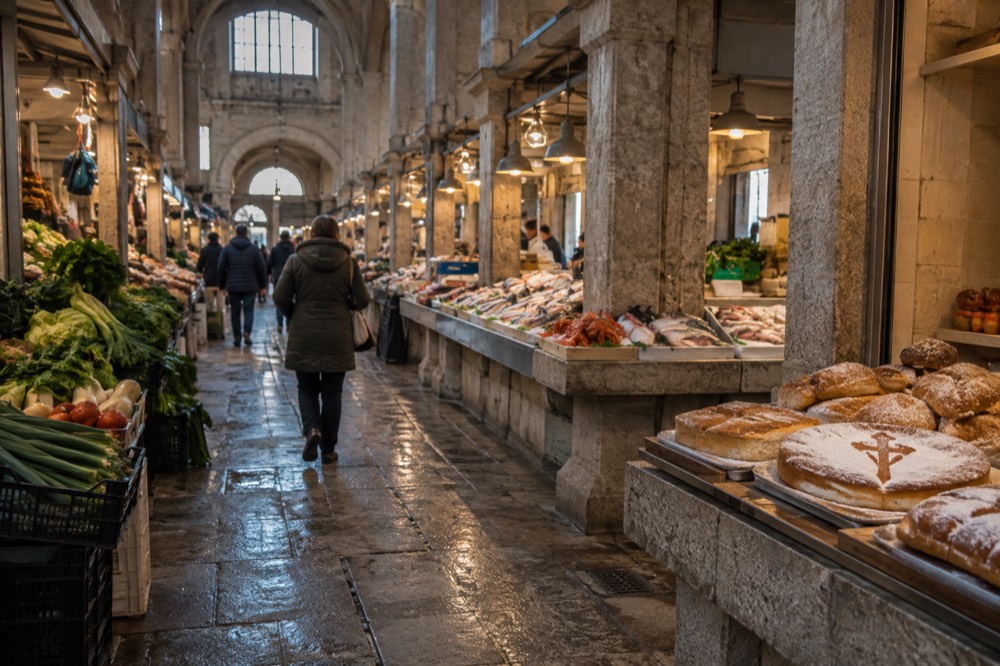
The items with the strongest Galician identity are well documented on this site's own food pages. Padrón peppers are small green peppers fried in oil and salted, and the running joke, famous across Spain, is that most are mild while the occasional one is hot; they appear in the market in season, roughly summer into autumn. Pulpo a la gallega, octopus boiled and served with olive oil, coarse salt and paprika on a wooden plate, is Galicia's signature dish, and the market's octopus counters supply both homes and restaurants. Tarta de Santiago, the almond cake stamped with the cross of Saint James, travels well and makes the easiest market souvenir that is actually food.
| Classic Galician buy | What it is | Best for |
|---|---|---|
| Padrón peppers | Small green frying peppers, mostly mild | Picnic or a bar snack; seasonal availability |
| Pulpo a la gallega | Boiled octopus with oil, salt and paprika | Buy octopus raw, or eat it cooked at a nearby bar |
| Tetilla cheese | Soft, pear-shaped cow's milk cheese with PDO status | Picnic cheese; travels a day |
| Empanada | Savoury pie, commonly tuna, cod or meat | The classic market lunch |
| Tarta de Santiago | Almond flour cake with the cross of St James | The best edible souvenir; keeps well |
| Percebes | Goose barnacles from the Atlantic rocks | A splurge shellfish, prized in Galicia |
| Albarino | White wine from the Rias Baixas | The pairing for all of the above |
For visitors who want the market's raw material turned into a meal without doing the cooking, a guided food walk is the bridge between the stalls and the city's kitchens. A food and tapas experience around Santiago de Compostela takes in the market neighbourhood and the bars that cook from it, which suits anyone who wants context, portions chosen for them, and a guide who knows which counter sells what. The Alameda park a short walk west of the market is the classic picnic spot for what the stalls sell you. For the eating half of the equation, a tapas-focused guided walk of the city, such as the Tapas Tour of Santiago de Compostela, from $52 per person and rated 4.7 from 243 reviews, or the Guided Foodie Tour with Drinks, Tapas and Live Music, from $51 per person and rated 4.7 from 227 reviews, both cover the market quarter's kitchens. Details are on each operator's live listing.
How Does The Market Fit Into A Day In Santiago de Compostela?
Pair the market with the Cathedral in one morning: the Cathedral's interior is open daily roughly 7:00am to 9:00pm with free general entry, and a market-first route south from Praza do Obradoiro, back up through the old town, and into the Cathedral takes in the city's two essential stops in a single walk, with the market best done early while the fish counters are at their fullest. The Cathedral's paid visits, the museum at EUR9-23 depending on ticket type and the rooftop Cubiertas tour at EUR15 general or EUR12 reduced, are timed and worth booking ahead in busy months, but the free interior visit needs no ticket.
The old town makes this easy because everything is close. The Cathedral of Santiago de Compostela anchors the north-west of the historic centre, the market sits a few blocks south, and between them run the granite streets, café squares and small churches that give the city its texture. Two current works are worth knowing about so they do not surprise you. The Botafumeiro, the great censer that normally swings on 12 solemnities a year including the Feast of St James, is currently out of action: scaffolding for the cimborrio restoration covers its mechanism, the Cathedral confirmed this in writing on 5 September 2026, and no return date has been published. And pilgrim masses move from 16 October 2026, when the 9:30am, noon and 7:30pm masses relocate from the High Altar to the nearby Church of San Agustin, with only the 7:30am mass remaining in the Cathedral's Communion chapel.
A full day built around the market can run like this: Cathedral interior early, market mid-morning, a picnic or a bar lunch from what the stalls sold you, the Cathedral museum or rooftop tour on a timed ticket in the afternoon, and the old town's squares in the evening. Visitors with more time can add a Camino de Santiago context stop, since the market sits squarely on the pilgrim city's everyday side, and the question of how many days to spend in Santiago de Compostela usually resolves to at least two once the market, the museums and the surrounding coast are counted. The record 530,987 Compostelas issued in 2025 by the Pilgrim's Office give a sense of how many people now finish their walk in this small city every year, and the market is one of the places that stays genuinely local despite those numbers.
| Day-part | Stop | Verified detail |
|---|---|---|
| Early morning | Cathedral interior, free entry | Open daily roughly 7:00am-9:00pm, general entry free |
| Mid-morning | Mercado de Abastos | Free entry; hours unverified, check the venue's own site |
| Lunch | Picnic from market stalls or a nearby bar | The market is a buying place, not a restaurant |
| Afternoon | Cathedral Museum or rooftop tour | Museum EUR9-23 by ticket type; rooftop tour EUR15 general, EUR12 reduced, timed tickets |
| Late afternoon | Old town streets and squares | UNESCO Old Town inscription, 1985 |
| Evening | Bars around the market quarter | Galician seafood and Albarino; live listings for prices |
Which Guided Tours And Experiences Pair Well With A Market Visit?
The market pairs best with food and walking experiences: a queimada show connects the Galician drinking ritual to the region's food culture, a hidden-city walking tour covers the streets between the market and the Cathedral, and a Rias Baixas winery day trip shows where the market's shellfish and Albarino actually come from. The Queimada Experience Show and Tasting, from $17 per person and rated 4 from 70 reviews, is the closest thematic match; the Santiago de Compostela City Walking Tour, from $17 per person and rated 5 from 13 reviews, covers the old town side; the Excursion to Rias Baixas with Winery and optional mussel boat, from $54 per person, rated 4.8 from 322 reviews and a full day, connects the coast to the counter.
The Rias Baixas connection deserves spelling out. The mussel platforms of the Arousa estuary, the Albarino vineyards around Cambados and the fishing ports of the southern Galician coast supply a real share of what the market sells, and seeing the estuaries themselves gives the market's shellfish counters a geography. The full-day options from Santiago de Compostela run to the wineries and the mussel-boat routes, with the From Santiago tour to Rias Baixas with Boat Trip and Winery, from $53 per person and rated 4.7 from 482 reviews, the largest of them by review count. Anyone weighing a coastal day against a city day can start from the question of the best day trip from Santiago de Compostela; the Costa da Morte and Fisterra options sit west, the Rias Baixas options south.
Common Questions About The Mercado de Abastos
Is there an entrance fee for the Mercado de Abastos?
Yes. It is a working retail market rather than a ticketed attraction, so there is no admission charge and no timed entry. Individual stalls set their own prices, and Santiago de Compostela has charged a municipal tourist tax since 1 October 2025 (per person per night for up to 5 nights, from 1 EUR in private albergues, campsites and tourist apartments up to 2.50 EUR in five-star hotels, with under-18s and stays in Xunta-run public albergues exempt).
What are the opening hours of the Mercado de Abastos?
Specific opening hours have not been verified from an official source in this site's research, and no day-of-week schedule or closing day is confirmed. Check the venue's own site or listing before planning your visit, and expect a working market's rhythm: fullest counters early in the day, thinning toward early afternoon.
Can you eat at the Mercado de Abastos or only shop?
The market is primarily a place to buy food rather than a sit-down food hall. The classic visitor move is a picnic from the stalls, or carrying purchases, especially fish and shellfish, to nearby bars that will cook what you buy, a common arrangement around Galician markets. For a guided eating experience, tapas and food tours of the old town cover the market quarter's kitchens.
How far is the Mercado de Abastos from the Cathedral?
The market sits a few blocks south-east of the Cathedral in the compact, pedestrian-scale old town, a short walk from Praza do Obradoiro. No exact minute-count is verified for every route in this site's research, so use a city map; the entire UNESCO-listed historic centre, inscribed in 1985, is small enough that the walk is a minor part of the visit.
What food is Galicia famous for that you can buy at the market?
Galicia's signature foods include octopus for pulpo a la gallega, Padrón peppers, percebes and other Atlantic shellfish, tetilla cheese, empanada, tarta de Santiago and Albarino wine from the Rias Baixas. The market's counters carry most of these, with produce and shellfish availability changing with the seasons and the day's landings.
Is the Mercado de Abastos worth visiting in the rain?
Yes, and in Santiago de Compostela that is a practical point. AEMET's climate data for the city shows a wet, temperate oceanic climate, wetter from October to March and driest in July and August, with annual precipitation on the order of 1,690 to 1,890mm. A covered market is one of the old town's best wet-weather stops.
The Mercado de Abastos is the side of Santiago de Compostela that the postcards leave out: the city feeding itself, in granite halls a few steps from the pilgrim route's endpoint. Go early, buy what the coast landed that morning, and let the stalls set the agenda for at least one meal of your stay.