Santiago de Compostela Old Town
The Santiago de Compostela Old Town is a UNESCO-listed granite maze of squares, arcades and pilgrim streets that has been the end point of the Camino de Santiago for over a thousand years. Here is how it is laid out, what to see on foot, and what to know before arriving in 2026 and 2027.
Short answer
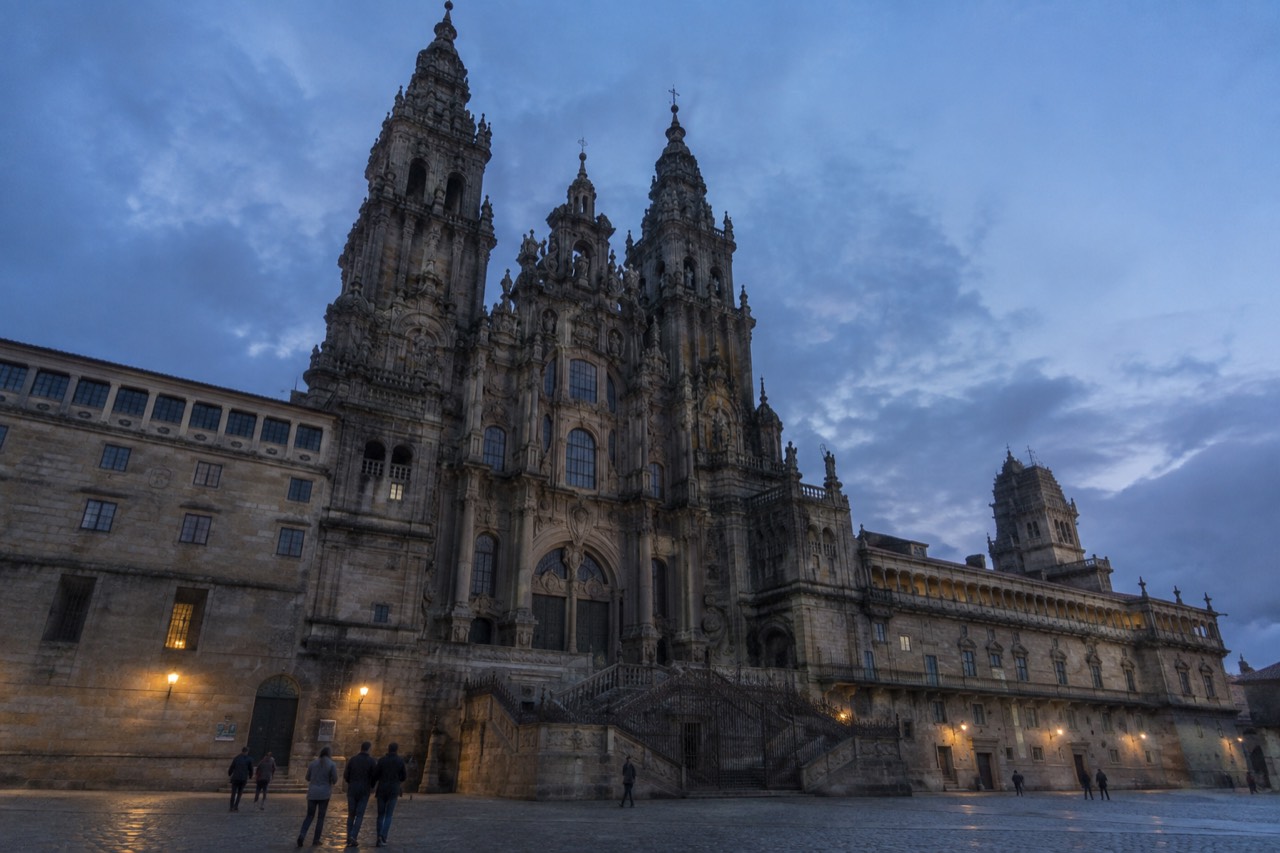
The Santiago de Compostela Old Town is the UNESCO World Heritage historic core built around the Cathedral of Santiago de Compostela, inscribed in 1985. It centers on Praza do Obradoiro and spans a compact web of granite streets, four main squares and pilgrim approaches like Rua do Franco, all walkable in a day.
Praza do Obradoiro has been the finish line of the Camino de Santiago for centuries, and the Santiago de Compostela Old Town that wraps around it is one of the most complete medieval cores in Spain. UNESCO inscribed the Old Town of Santiago de Compostela on the World Heritage List in 1985, a separate inscription from the 1993 listing of the Camino routes themselves, and the two designations together explain why an estimated 530,987 pilgrims collected the Compostela certificate here in 2025, a record year according to figures reported from the Oficina del Peregrino. The whole area is granite, worn smooth by rain and by feet, and small enough that its four great squares sit within a few minutes' walk of one another. This guide walks through the layout square by square, the tours that cover it best, where to eat, when to come, how pilgrims arrive, and what lies beyond it for a day trip.
What Is The Santiago de Compostela Old Town?
The Santiago de Compostela Old Town is the UNESCO World Heritage historic core of the pilgrim city in Galicia, northwest Spain, inscribed in 1985 and built around the Cathedral of Santiago de Compostela and the Apostle's tomb, covering a compact web of granite streets centered on four main squares, Praza do Obradoiro, Praza da Quintana, Praza das Praterías and Praza da Inmaculada, all fully walkable in a day, with a second separate UNESCO inscription covering the Camino routes in 1993.
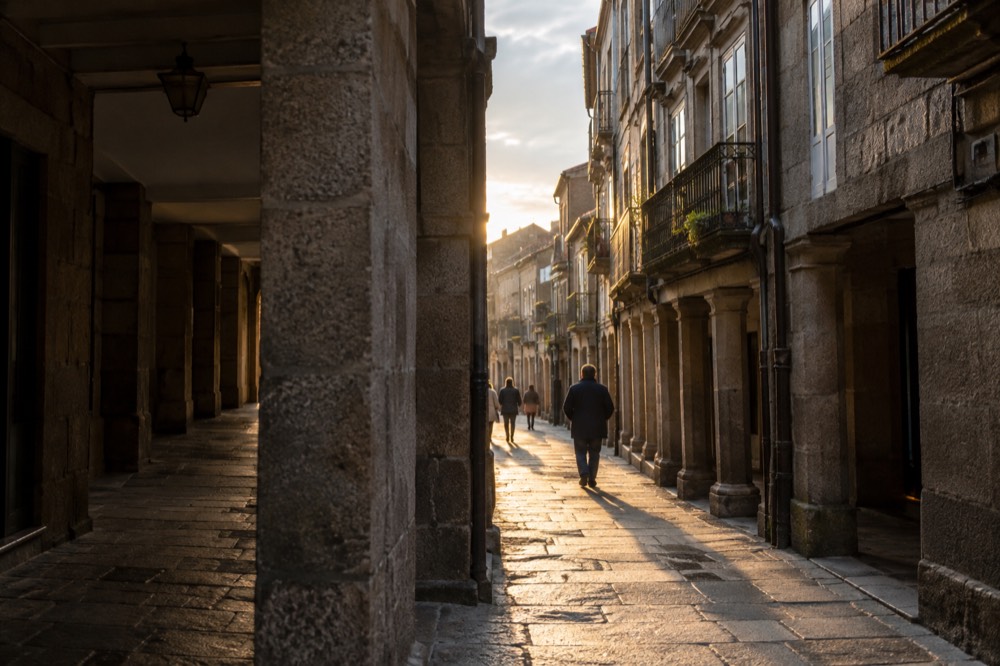
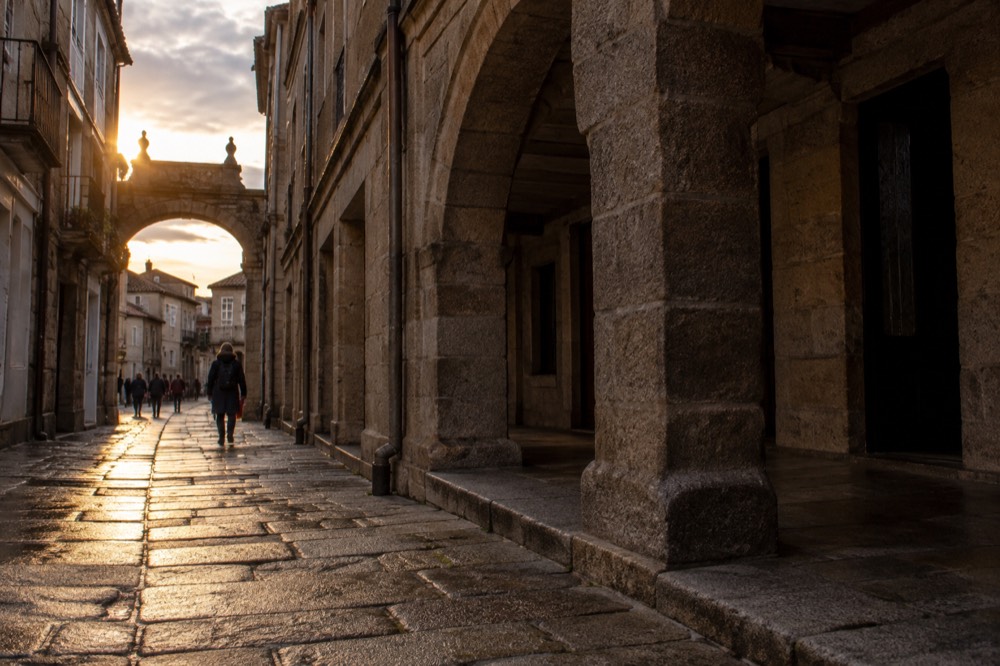
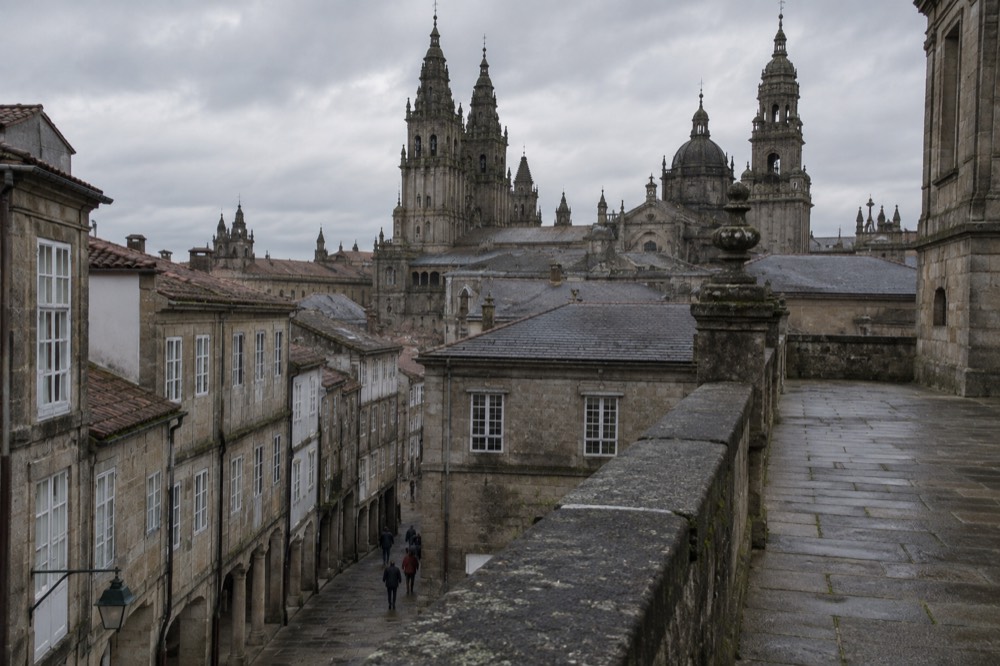
The Old Town's shape still follows its medieval logic. Streets radiate out from the Cathedral like spokes, and the pilgrim routes arrived along specific corridors that are still identifiable today. Rua do Franco, the historic street of inns and taverns where medieval pilgrims were fed, still carries restaurants, and the Porta Faxeira and Porta de Mazarelos arches mark where the old walls once funneled travelers inside. Almost nothing in the core is wider than a lane, and the granite that paves the streets is the same stone that builds the Cathedral, the cloisters and the rooftops overhead.
The scale matters for planning. This is not a district you commute into; it is the destination. Most of what a visitor wants to see in Santiago de Compostela sits inside a rectangle roughly a kilometer on its longest side, which is why so many people find that one full day is enough for the core and two or three days allow the museums, rooftops and a day trip. The surrounding city grows outward downhill in rings, with the Alameda park on the west and the modern districts beyond, but the Old Town keeps its own atmosphere: quieter at 8am, dense with tour groups at midday, and near empty again late at night.
Where Are The Main Squares Of The Santiago de Compostela Old Town?
The Santiago de Compostela Old Town is arranged around four main squares, each facing a different face of the Cathedral: Praza do Obradoiro, the main west-front square holding the Hostal dos Reis Católicos and the town hall; Praza da Quintana behind, with the Holy Door and the San Martino Pinario monastery; Praza das Praterías on the south side, named for its silversmiths; and Praza da Inmaculada north of the Cathedral. All four lie within a two-minute walk of each other, and walking the full circuit of them takes under half an hour at a slow pace.
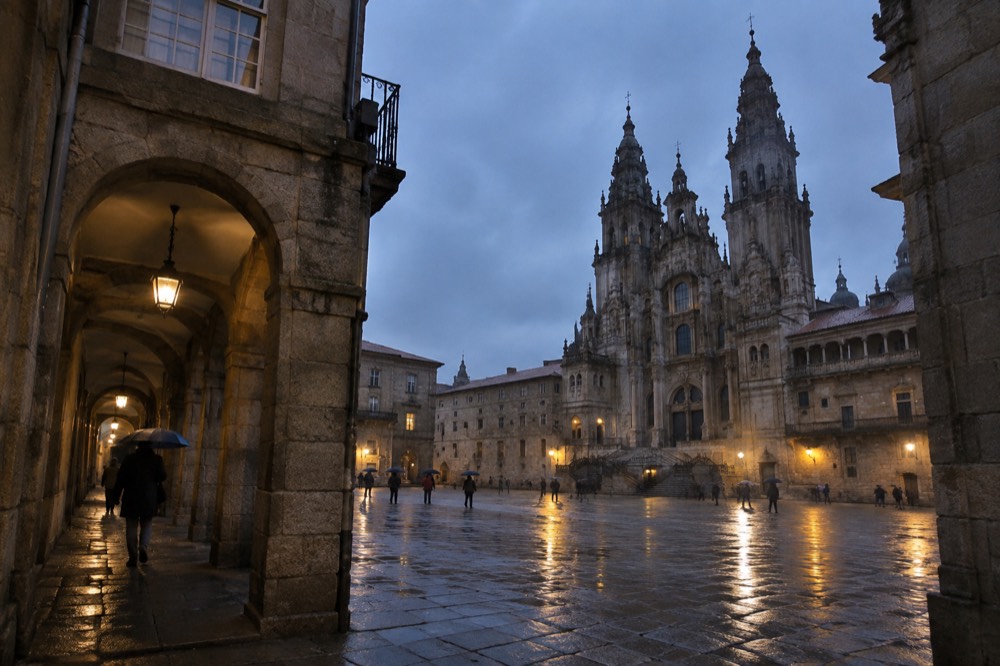
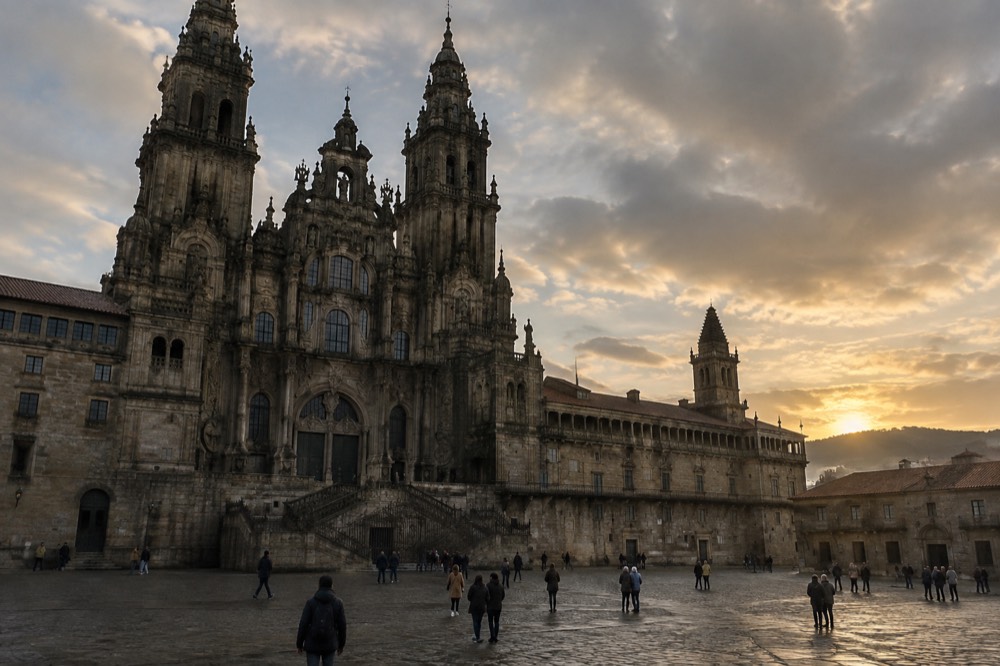
Praza do Obradoiro is the square everyone recognizes. The Cathedral's baroque Obradoiro facade fills the east side, the former pilgrim hospital now Hostal dos Reis Católicos Parador faces it, the Colexio de San Xerome and the Pazo de Raxoi close the other two sides. The square is paved, open and often full, and the town hall occupies Raxoi. From here the streets drop away westward toward the Alameda viewpoint, which looks back at the whole Cathedral group across the trees.
Praza da Quintana is quieter and steeper, a triangular space at the back of the Cathedral where the Holy Door sits. That door opens only in Holy Years, and the next one, the 2027 Xacobeo, begins when the door is opened on 31 December 2026. The long wall of the Mosteiro de San Martino Pinario runs along the square's edge, and its church is one of the largest baroque buildings in Galicia. Praza das Praterías is the smallest of the main squares, ornamented with a fountain and horse-chestnut trees, reached from the Obradoiro side by the Praza da Inmaculada, where the long palace of the Cathedral museum stands in the shadow of the Berenguela clock tower.
Between and around these four squares run the Old Town's working streets. Rua do Vilar and Rua Nova form an elegant arcaded pair lined with bookshops, jewelers and cafés, the classic promenade of the local bourgeoisie. Rua do Franco and Rúa da Raíña carry the eating houses, and the streets south of the Cathedral climb through the funnel toward Praza de Cervantes and the Mercado de Abastos. The market sits just outside the old core's edge, and it remains the working food market of the city, with hours that should be checked on the venue's own site rather than assumed.
Here is the square-by-square layout at a glance:
| Square | Cathedral face | Main buildings | Character |
|---|---|---|---|
| Praza do Obradoiro | West (Obradoiro facade) | Cathedral, Parador, Pazo de Raxoi, San Xerome | Grandest, busiest, the classic view |
| Praza da Quintana | East (Holy Door) | San Martino Pinario, Holy Door wall | Quietest, historic back door of pilgrims |
| Praza das Praterías | South | Silversmiths' square, fountain, chestnut trees | Smallest, sculptural detail |
| Praza da Inmaculada | North | Hostal facade, museum palace, Berenguela tower | Shaded, museum quarter |
| Praza de Cervantes | Between | Casa do Cabido, older inns | Crossroads of the inner streets |
And the streets that tie them together:
| Street | Role in the Old Town | What you find today |
|---|---|---|
| Rua do Franco | Medieval pilgrims' eating street | Tapas bars and restaurants, constant bustle |
| Rúa do Vilar / Rua Nova | Classic arcaded promenade | Bookshops, cafés, jewelers under arches |
| Rúa da Raíña | Extension of the eating quarter | Restaurants and small bars |
| Porta de Mazarelos | Surviving gate of the city walls | Arch on the western approach, university quarter beyond |
| Rúa do Preguntoiro | Commercial link downhill from Obradoiro | Shops and cafés toward the Alameda |
Which Tours Show The Santiago de Compostela Old Town Best?
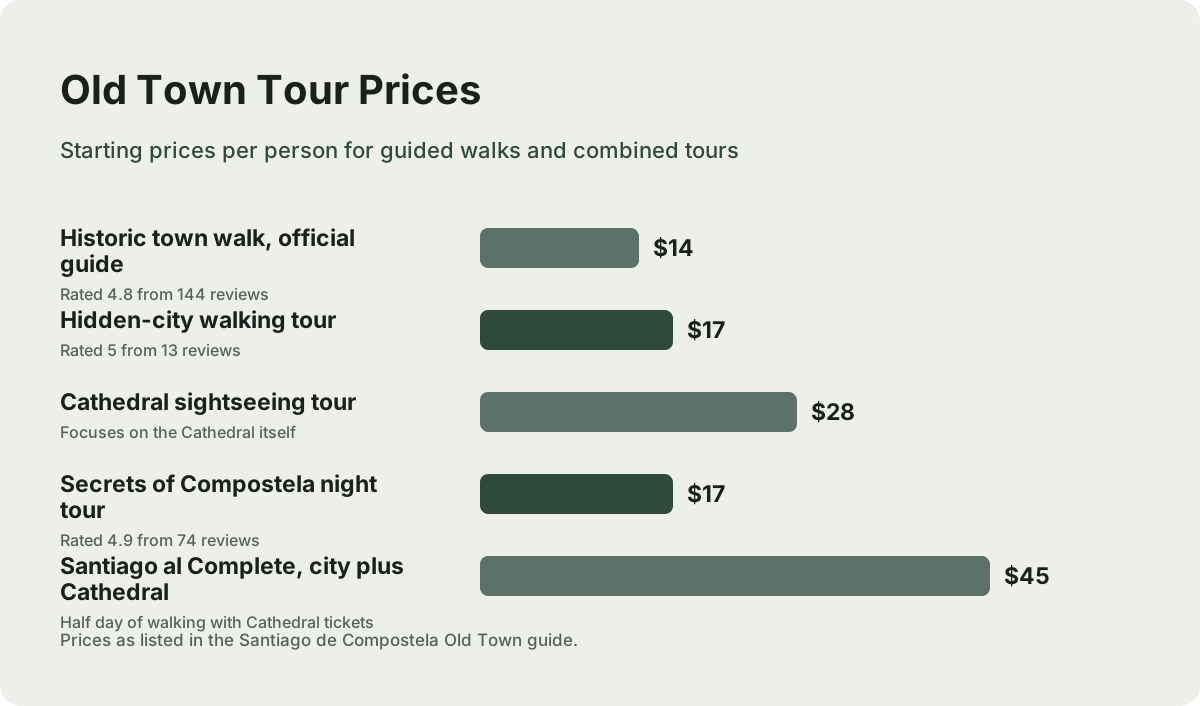
The best-value Old Town tours are walking tours led by official local guides, running from roughly $12 to $29 per person: a $14 historic town walk with an official guide rated 4.8 from 144 reviews, a $17 hidden-city walking tour rated 5 from 13 reviews, and free GuruWalk tip-based walks such as the 4.95-rated Free Tour Santiago Fundamental with 6,342 reviews, where you pay nothing upfront and tip what you choose. Prices and ratings are taken from the operators' live listings, so confirm current figures at booking.
A guided walk earns its cost in the Old Town more than in most cities, because the layer that matters here is invisible. The guide's explanation of the Obradoiro facade, the meaning of the Holy Door, the shell motifs carved into buildings and the way the four squares were assembled layer by layer over many generations turns a pretty granite maze into a legible medieval machine. Official guides in Santiago de Compostela are licensed by the region, and the tour products listed here all use them or comparable local guides.
For travelers who want the streets plus the Cathedral in one morning, combined tours cover both. The Cathedral of Santiago de Compostela itself is free to enter, but skip-line guided visits and museum combinations add context and cut queuing, and the Cathedral's own rooftop tour costs EUR15 general or EUR12 reduced for a guided hour on the Cubiertas with about 140 steps and views from around 72 meters. The rooftop price is the official one from the Cathedral's own ticket site, bookable online with timed slots.
The trio above spans the two most useful shapes of Old Town tour: pure walking tours of the streets, and combined city-plus-Cathedral packages with tickets included. The $45 Santiago al Complete option bundles a half day of walking with Cathedral tickets, while the $28 Cathedral sightseeing tour focuses on the building itself.
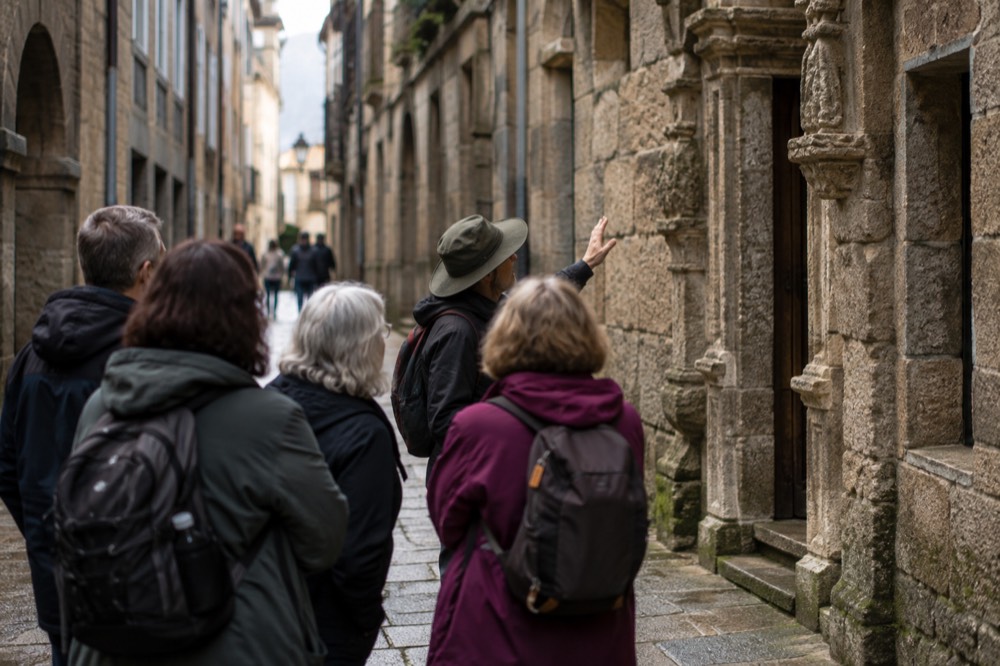
One evening option deserves separate mention. The Secrets of Compostela night tour, a $17 specialty walk rated 4.9 from 74 reviews, moves the same streets to a different register: lantern-lit granite, legends and the squares emptied of daytime crowds. Santiago de Compostela's old core is genuinely atmospheric after dark, and the night tours are the structured way to experience it. Beside that, if a self-guided pace matters more, the hidden-city walking tour from $17 is the flexible pick, with a Check availability link on its own tour page alongside this guide's fuller description.
Booking either shape is low-commitment: the guided walks run most days in season, and the listing pages show the free-cancellation terms before you pay. Locking a morning walk in advance also protects the day, because the afternoon slots fill first once coaches arrive and the shaded squares empty out.
A quick comparison of the main guided shapes:
| Tour type | Typical starting price | What it covers | Best for |
|---|---|---|---|
| Free GuruWalk tip-based walk | Free, tip based | Core squares and legends, about 2 hours | Budget travelers, first orientation |
| Historic town walk, official guide | $14 per person | Old Town streets with licensed guide | History and context |
| Combined city + Cathedral tickets | $45 per person, half day | Streets plus Cathedral entry | One-morning completeness |
| Night tour of the old core | $17 per person | Legends and lit squares after dark | Atmosphere and a second angle |
What Should You Eat And Drink In The Old Town?
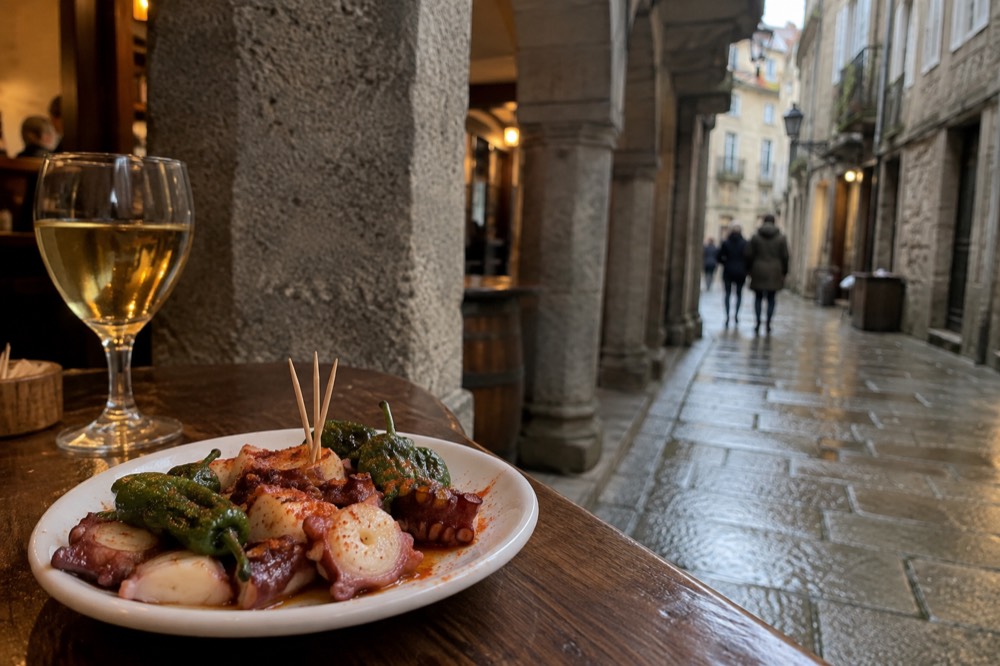
The Old Town's food identity is Galician rather than international: pulpo a la gallega, octopus with paprika and olive oil, served on wooden plates; Padrón peppers, famously hot one in ten; empanada; Tarta de Santiago, the almond cake stamped with the Cross of Santiago; and Queimada, the flaming orujo ritual you can watch as a $17 tasting experience rated 4.4 from 69 reviews on its live listing. Tapas tours from $51 and $52 per person bundle several bars into one evening with a guide.
Rua do Franco is the historic eating street, and its reputation is both its charm and its trap: the concentration of restaurants within a hundred meters of the Obradoiro facade means convenience and, on some corners, tourist pricing. The where to eat question in the old core answers itself if you walk one street further, since Rúa da Raíña and the lanes between Rúa do Vilar and the market quarter hold quieter kitchens with the same menus. Pulpo is the dish to anchor a Galician trip on, and the local habit is octopus at lunch with a glass of white from the Rías Baixas wine country south of the city, where the Albariño grape makes the region's signature crisp whites.
The Queimada experience deserves a specific note because it is theater as much as food. The drink is orujo, a Galician spirit, set alight in an earthenware pot while an incantation is recited to ward off witches, a modern folk ritual rather than ancient custom, and the show-and-tasting format runs as a bookable experience in the Old Town. The tapas tours go deeper, moving between several bars with drinks included, which is the efficient way to sample the whole spread of small plates in one evening without having to choose venues yourself.
For a sense of how the locals actually shop and eat, the Mercado de Abastos sits just south of the old core, and it is the city's working food market. Its exact hours are unverified in current sources, so check the venue's own site before planning a visit around them. Around the market a cluster of bars cooks whatever the stalls sold that morning, which is the most honest food experience in the city.
| Dish or drink | What it is | Where to try it |
|---|---|---|
| Pulpo a la gallega | Octopus, paprika, olive oil, coarse salt, wooden plate | Tapas bars on Rúa da Raíña, market-side kitchens |
| Padrón peppers | Small green peppers, pan-fried, salt | Any tapas bar in the Old Town |
| Tarta de Santiago | Almond cake, Cross of Santiago stencil | Bakeries and cafés throughout the core |
| Queimada | Flaming orujo with recited spell | The bookable show-and-tasting experience |
| Albariño | Dry white from the Rías Baixas | Wine bars, or a winery day trip |
When Is The Best Time To Walk The Old Town Streets?
The best time to walk the Old Town is early morning between 8am and 10am, when the tour groups have not yet arrived, the granite is quiet, and the Cathedral's interior is open and free from about 7:00am; the worst is midday in July and August, when crowds peak, and the wettest stretch runs October to March, since AEMET's station data for Santiago de Compostela shows a temperate oceanic climate, wet year-round and wettest in those months, with July and August the driest.
The rhythm of a day in the core is predictable enough to plan around. At 8am the streets belong to locals buying bread, a handful of pilgrims finishing the Camino and the cleaners washing down bar fronts. By 11am the coaches have emptied into Praza do Obradoiro and the queues at the Cathedral's ticketed spaces form. Late afternoon slackens again, and after about 9pm the restaurants refill and the squares go quiet and lantern-lit. Anyone photographing the Obradoiro facade should be out before 10am, both for the light and for the emptiness. The wider set of guides lives on Santiago de Compostela Travel Guide.
Seasonally, the trade-offs are between weather and crowds, and AEMET's climate data for the city, measured at station 1475X at Labacolla, describes the deal plainly: annual precipitation runs on the order of 1,690 to 1,890mm, wet and cool from October to March, driest in July and August. No month-by-month table is verified in current sources, so treat those as ranges rather than a monthly chart. Rain in Galicia is a design feature of the place, not an anomaly, and the Old Town handles it well, with arcades on Rúa do Vilar and covered porticos giving a dry walking line through much of the core. July brings the Feast of St. James on the 25th, the city's biggest annual celebration with Mass, fireworks and concerts, and it is both the most atmospheric and most crowded week of the year.
The year-level picture matters too. The next Holy Year, the 2027 Xacobeo, opens when the Holy Door is solemnly opened on the evening of 31 December 2026 and runs through 31 December 2027. Pilgrim volumes in Holy Years surge, so 2027 will be busier than 2026 across the Old Town, from the Pilgrim's Office queues on Rua das Carretas to hotel prices. Travelers wanting the Holy Door without the peak crowds should aim for the first weeks of January 2027 rather than the spring.
| Period | Crowds | Weather | Notes |
|---|---|---|---|
| Early morning, any day | Low | Cool, often damp | Best light, empty squares |
| Midday, July-August | Peak | Driest, warm | Long queues at ticketed spaces |
| October-March | Moderate | Wettest, cool | Rain gear essential, arcades help |
| 25 July, any year | Very high | Summer | Feast of St. James, Mass and fireworks |
| 31 Dec 2026 - 31 Dec 2027 | Rising to peak | Winter to winter | 2027 Holy Year, Holy Door open |
How Do Pilgrims Arrive In The Old Town?
Pilgrims arrive in the Old Town by walking in from Monte do Gozo on the city's eastern edge, then descending through the Porta Faxeira arch into Rua do Franco toward Praza do Obradoiro, following the marked Camino route into the core; the Compostela certificate then requires the last 100km walked or 200km cycled, with at least two stamps per day on the pilgrim passport, collected in person at the Oficina del Peregrino at Rua das Carretas 33.
That final approach is the emotional spine of the whole city. Pilgrims come down from the Monte do Gozo hill, where a monument marks the point where the Cathedral first becomes visible, and enter the Old Town through the same funnel of streets their medieval predecessors used. The route markers, yellow shells and arrows, thread through the core's lanes and past the San Martino Pinario before spilling onto the Obradoiro. Pilgrims who want the practical arrival picture in more detail can read how long it takes to walk the Camino de Santiago and the guide to Camino routes, since the Old Town is the fixed endpoint of all of them.
The Pilgrim's Office itself sits just inside the old core on Rua das Carretas 33, and the office's own FAQs set the rules plainly: the last 100km on foot or horseback, or the last 200km by bicycle, on a recognized route, continuous, with two stamps per day minimum in the credencial, and the certificate is issued in person only. Hours vary by season, so check the office's own site before going. In 2025 the office issued a record 530,987 Compostelas according to press reporting of its figures, a number that has grown year after year and that explains the pressure on the Old Town's streets and beds in the busy season.
Arriving by air, pilgrims and ordinary visitors land at Santiago-Rosalía de Castro airport, about 12km from the old core. Line 6A, run by Tussa, currently costs EUR1 paid to the driver, or EUR0.36 per trip on a rechargeable card, but a new Monbus contract with a fare around EUR6 is expected in autumn 2026, so treat the EUR1 fare as subject to change and check the city's transport page before flying. The full arrival picture, including flights, is covered in the Santiago de Compostela airport guide.
One 2026 change affects anyone planning to attend a pilgrim mass. Until 15 October 2026 the daily masses, at 7:30am, 9:30am, noon and 7:30pm, are held at the Cathedral's High Altar. From 16 October 2026, because of main chapel works preparing for the 2027 Holy Year, the 9:30am, noon and 7:30pm masses relocate to the nearby Church of San Agustin, with only the 7:30am mass staying in the Cathedral's own Communion chapel. The Cathedral's liturgy page is the primary source, and any visit planned around mass should check it.
Where Can You Go Beyond The Old Town In A Day?
The strongest day trips from the Old Town run west along the coast: full-day Finisterre, Muxía and Costa da Morte tours from $59 to $60 per person, the best-rated of them at 4.8 from 1,714 reviews, plus Rías Baixas winery and mussel-boat trips from $45 to $54, and inland options to Lugo's Roman walls and the Playa de las Catedrais beach from $68 to $75, all day tours returning the same evening, with prices from the operators' live listings.
The Atlantic coast to the west is what most visitors underestimate. Fisterra, the Galician name for the cape the Spanish call Finisterre, was regarded in antiquity as the end of the known world, and the Costa da Morte, the Coast of Death, wraps it in lighthouses, shipwreck beaches and fishing villages. A full-day tour typically stacks Fisterra's lighthouse, the sanctuary at Muxía and several coastal stops into one loop, which is far more practical than self-driving the coast in a single day. Travelers weighing whether to extend the Camino on foot can read is the walk from Santiago to Finisterre worth it before committing to either option.
The Rías Baixas, the drowned river inlets south of the city, are the food-and-wine counterpart: Albariño wineries in Cambados, mussel rafts in the Arousa estuary and the arcaded old port of Combarro. The winery trips with optional mussel-boat cruises run about a full day from roughly $45 to $54 per person, and they pair naturally with the Old Town's tapas culture as the same regional larder seen at its source. Inland, Lugo offers the only fully walkable Roman walls in the world, and the combined excursions that pair it with the Playa de las Catedrais, the beach of rock arches on the north coast, run full days from $68 to $75.
For those with more than a weekend, the one week Galicia road trip question frames the trade-off between deep time in the Old Town and time on the coast, and the practical answer for most first-time visitors is two or three nights in the core plus one or two nights touring. The Old Town's position, an hour or so from the coast by road, makes it the natural base either way.
| Day trip | Region | Tour type | Starting price | Rating |
|---|---|---|---|---|
| Finisterre, Muxía & Costa da Morte | Atlantic coast west | Full day, 7 stops | $60 per person | 4.8, 1,714 reviews |
| Fisterra & Muxía Express | Atlantic coast west | Half day express | $45 per person | 4.4, 50 reviews |
| Rías Baixas winery, optional mussel boat | Rías Baixas south | Full day, winery | $54 per person | 4.8, 322 reviews |
| Arousa Island, Combarro & mussel boat | Rías Baixas south | Full day, boat | $45 per person | 4.7, 30 reviews |
| Lugo & Cathedrals Beach | Inland and north coast | Full day, guided | $68 to $75 per person | 4.6 to 4.9 |
How Do You Plan A Visit Around The Cathedral's Works And Tickets?
Plan around three facts: Cathedral interior entry is free and open daily roughly 7:00am to 9:00pm; the Cathedral Museum and its combined tickets run from EUR9 to EUR23 depending on type, open about 10:00am to 8:00pm; and the official rooftop tour, Cubiertas plus Torre de la Carraca, costs EUR15 general or EUR12 reduced, about 60 minutes with roughly 140 steps and views from around 72 meters, bookable online with timed slots on the Cathedral's own ticket site.
The current restoration picture, as of late September 2026, is less dramatic than it sounds. The naves, the Apostle's tomb and the embrace area remain fully open with normal hours, and there are no closures affecting the museum, the towers or the Portico da Gloria beyond normal timed ticketing and conservation limits. The visible works are the cimborrio scaffolding inside the crossing, which has grounded the Botafumeiro with no return date, and exterior work on the Berenguela clock tower spanning 2026 and 2027, which does not affect visits. The Portico's own major restoration was completed in 2018, and visits there are time-limited for preservation, which is the main reason to book a timed ticket rather than chance the queue.
Ticketing strategy follows from the price structure. The basilica interior itself is free and needs no ticket, so a budget visit can see the tomb, the nave and the High Altar altar for nothing. The paid layer starts with the museum at EUR9 to EUR23 and peaks with the rooftop tour at EUR15, and the rooftop option also grants seven-day access to the museum's permanent collection, the Gelmirez Palace and the associated spaces, one use each. Guided tour products that bundle skip-line Cathedral entry with a walk of the Old Town streets sit between $26 and $47 per person, and the Cathedral rooftops tour guide here covers the official option in full. Advance booking is the rule in peak season, since timed slots sell out, and the Cathedral tickets and opening hours page carries the practical detail.
| Cathedral space | Entry cost | Notes |
|---|---|---|
| Basilica interior, naves and tomb | Free | Open daily, roughly 7:00am to 9:00pm |
| Cathedral Museum, permanent collection | EUR9 to EUR23 by ticket type | About 10:00am to 8:00pm, ticket office closes earlier |
| Rooftops, Cubiertas and Torre de la Carraca | EUR15 general, EUR12 reduced | Guided, about 60 minutes, about 140 steps, about 72m height |
| Portico da Gloria | Timed, conservation-limited visits | Restoration completed 2018 |
| Pilgrim mass attendance | Free | Times change from 16 October 2026, see above |
Common Questions About The Santiago de Compostela Old Town
The questions below are the ones visitors most often ask about the Santiago de Compostela Old Town, answered directly from the facts on this site: how much time it needs, whether it is walkable, how the squares connect, when the crowds peak, and what the 2026 works actually close. Each answer stands alone, so you can jump straight to the one you need.
Can you see the Santiago de Compostela Old Town in one day?
Yes. The four main squares sit within a few minutes of each other, the core is roughly a kilometer on its longest side, and a single full day covers the squares, a Cathedral visit and the main streets. Two or three days allow the museums, the rooftops and a day trip, but the core itself fits comfortably in one day.
Is the Santiago de Compostela Old Town walkable for older visitors?
Largely yes, with one caveat: the core is steep in places, and the cobbled granite is uneven and often damp. The main squares connect by manageable routes, the arcades on Rúa do Vilar offer a covered line, and there is a fuller discussion in the site's guide to walking the Camino at seventy, since the same questions apply.
Can a 70 year old walk the Camino and arrive in the Old Town?
Many do, with preparation. The Compostela rules are distance-based, the last 100km on foot, not age-based, and the site's dedicated answer on whether a 70 year old can walk the Camino covers training, route choice and where to start. The Old Town itself is the gentlest part of any Camino.
Does the Botafumeiro swing during a visit to the Old Town?
Not currently. The Botafumeiro is suspended while cimborrio restoration scaffolding covers its hanging mechanism, confirmed in writing by the Cathedral on 5 September 2026 with no published return date. It normally flies on 12 fixed solemnities a year, so check the Cathedral's own liturgy page before assuming anything for a future date.
Is there a tourist tax when staying in the Old Town?
Yes: Santiago de Compostela has charged a municipal tourist tax since 1 October 2025, a surcharge on Galicia's tourist-stay tax, from 1 EUR per person per night (private albergues, campsites and tourist apartments) up to 2.50 EUR in five-star hotels, for a maximum of 5 nights; under-18s and stays in Xunta-run public albergues are exempt.
Which square should you stay near in the Old Town?
Praza do Obradoiro and its immediate streets put everything within a five-minute walk, at the highest prices; the streets around Praza da Quintana and the San Martino Pinario side are quieter and still central. The site's where to stay in Santiago de Compostela guide breaks the neighborhoods down in more detail.
The Old Town rewards the unhurried. Arrive before the coaches, walk the squares in their order of grandeur, eat where the market feeds the kitchens, and time the Cathedral's paid spaces rather than queuing for them, and the UNESCO-listed core of Santiago de Compostela gives back far more than its compact map suggests.