Santiago de Compostela Airport
Santiago de Compostela Airport, known as SCQ or Santiago-Rosalia de Castro, sits about 12km from the old town and connects the pilgrim capital of Galicia to Madrid, other Spanish cities and a handful of European destinations.
Short answer
Santiago de Compostela Airport (SCQ) is about 12km from the old town. Public bus line 6A costs 1 EUR to the driver as of late September 2026, but a new Monbus contract with a fare near 6 EUR is expected in autumn 2026, so check the live fare before you fly.
Santiago de Compostela Airport, officially Santiago-Rosalia de Castro and coded SCQ, is the small airport that serves the cathedral city at the end of the Camino de Santiago and the wider region of Galicia in northwestern Spain. The Oficina del Peregrino's own figures show why this modest terminal punches above its size: 530,987 Compostela certificates were issued in 2025, a record year, and a large share of those pilgrims either flew out of SCQ after finishing or landed there to begin a route. The airport sits about 12km from the old town, a 20-30 minute drive, and the city's transport page lists a public bus connection that is, as of late September 2026, one of the cheapest airport transfers in Spain. That fare is about to change, which is the single most important thing to know before you land.
This guide from the Santiago de Compostela Travel Guide editors covers what the airport actually is, how the bus and transfer options work right now, what the fare change means, how SCQ connects to Madrid, Porto and the rest of Galicia, and how to plan your first hours in the city once you are through arrivals. It also answers the practical questions pilgrims ask most, from where the Pilgrim's Office is to whether you can start walking the same day you land.
What Is Santiago de Compostela Airport And Where Exactly Is It?
Santiago de Compostela Airport, officially named Santiago-Rosalia de Castro and coded SCQ, is Galicia's main airport, located about 12km from the old town of Santiago de Compostela, roughly a 20-30 minute drive, and it handles both domestic Spanish routes and a small set of international and seasonal European connections. It is a single-terminal regional airport, small enough that walking from gate to exit takes minutes rather than the marathon treks of Madrid or Barcelona.
The airport sits in the municipality of Santiago itself, out towards the Labacolla area. The distance figure deserves a caveat: sources disagree between roughly 11 and 15km depending on which point is measured from, so treat "about 12km" as the honest planning number rather than a surveyed constant. What is not in dispute is the drive time, which runs 20-30 minutes to the old town in normal traffic.
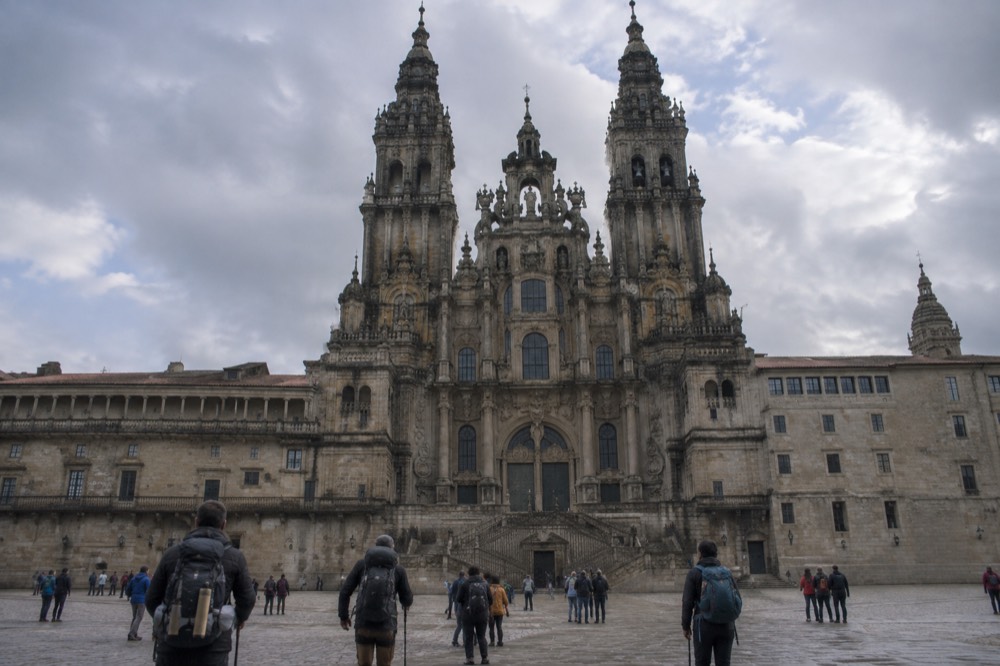
Because the city it serves is the endpoint of the Camino de Santiago, the airport's passenger mix is unusual for its size. In summer and around the Feast of St. James on 25 July, the terminal fills with pilgrims in walking boots, and the arrivals hall regularly sees complete Camino groups collecting luggage stuffed with the previous five weeks of dust. The record 530,987 Compostelas issued by the Pilgrim's Office in 2025, reported in press citing the office's own figures, gives a sense of the flow SCQ absorbs and dispatches each year.
For anyone weighing arrival airports for a Camino, the question of whether SCQ is the right choice has its own detailed treatment on this site, including the 2026 closure question, in will the airport be closed in 2026 and in the comparison of the best airport to fly into to walk the Camino.
How Do You Get From Santiago de Compostela Airport To The City Centre?
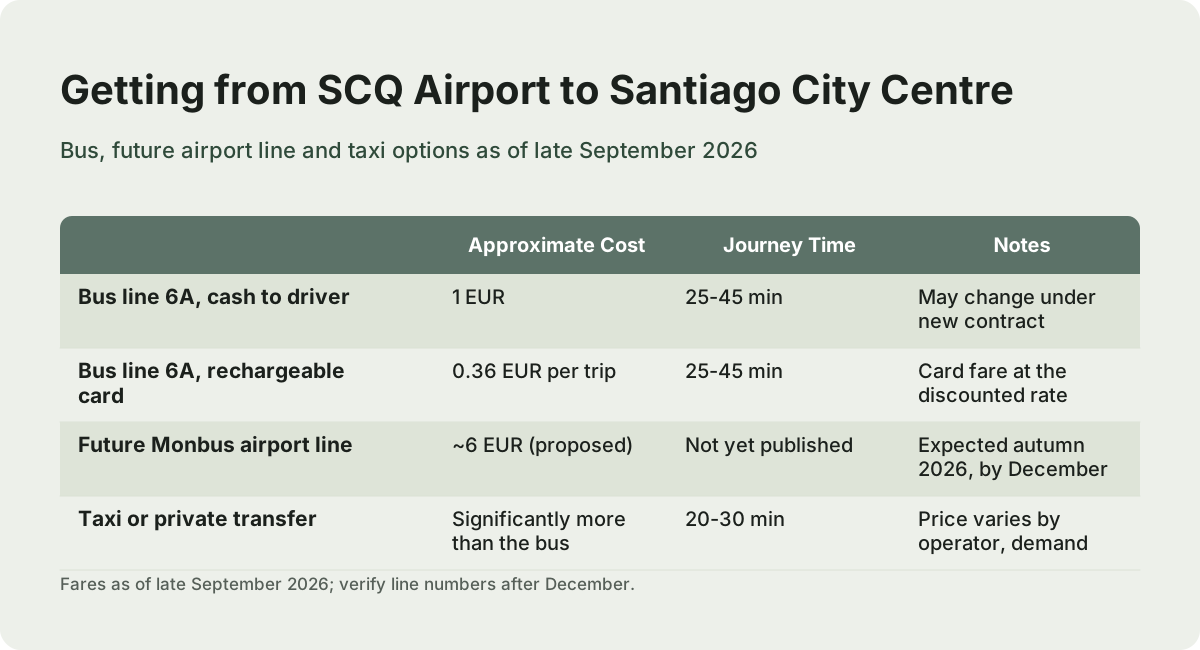
As of late September 2026, public bus line 6A, operated by Tussa, runs from the airport to the city centre and Estacion Intermodal, costing 1 EUR paid to the driver or 0.36 EUR per trip on a rechargeable card, with a journey of roughly 25-45 minutes and a frequency of about every 30 minutes from around 06:30-07:00 until about 00:30. The city's own transport page still lists this service as active, and it is, for now, one of the cheapest airport-to-centre transfers anywhere in Spain.
The mechanics are simple. Tickets are bought on board, with cash or contactless payment accepted, and the bus terminates at the Estacion Intermodal on Rua do Horeo, which is a short walk from the old town's eastern edge. Children aged 4-14 often travel free with a card, and other concessions apply. The journey time varies between roughly 25 and 45 minutes depending on traffic and the exact stop.
The honest caveat is that this fare is in its final months. A new contract was awarded to Monbus, operating under the "Estela" network, in mid-2026, and the reorganised service is expected to start in autumn 2026, potentially by December, with a dedicated airport line at a proposed unsubsidised fare of around 6 EUR one-way. The city's transport page itself advises verifying line numbers after December. Anyone publishing or reading a "1 EUR airport bus" claim as a permanent fact is reading stale information, so check the live fare on the operator or city site before you fly.
| Option | Approximate Cost | Journey Time | Notes |
|---|---|---|---|
| Bus line 6A, cash to driver | 1 EUR | 25-45 min | Subject to change under the new contract |
| Bus line 6A, rechargeable card | 0.36 EUR per trip | 25-45 min | Card fare at the discounted rate |
| Future Monbus airport line | ~6 EUR (proposed) | Not yet published | Expected autumn 2026, possibly by December |
| Taxi or private transfer | Significantly more than the bus | 20-30 min | Price varies by operator and demand, confirm before booking |
Taxis and pre-booked private transfers exist as alternatives and cost significantly more than the bus, but no verified taxi tariff is available, so no specific figure belongs here. If you book a transfer through a third-party link, prices change by date and demand, so check the live price on the linked page rather than trusting any "from X EUR" claim.
Should You Book A Transfer Or Take The Bus From SCQ?
For most travellers landing at Santiago de Compostela Airport, the bus is the sensible default because it runs about every 30 minutes from early morning to about 00:30 and costs 1 EUR to the driver as of late September 2026, but a pre-booked transfer or taxi wins if you arrive with a group, heavy bike boxes, or late at night when the bus frequency thins out. The decision is really about luggage, arrival time and how many people you are moving.
Pilgrims walking out of Santiago the same day, for example those heading to Sarria to start the classic last-100km stretch described in the Sarria to Santiago guide, often prefer the transfer because they are racing a same-day bus or train connection onwards. Cyclists bringing boxed bikes face a different constraint again: a boxed bicycle on a crowded urban bus is awkward at best, and a transfer absorbs it without argument.
The bus also stops usefully. Its route touches the Estacion Intermodal, which is where you change to trains towards Madrid, A Coruna and Vigo, so a bus-plus-train itinerary from the airport is a single-hop affair, and the city-side of that handoff is straightforward once you know the old town's layout.
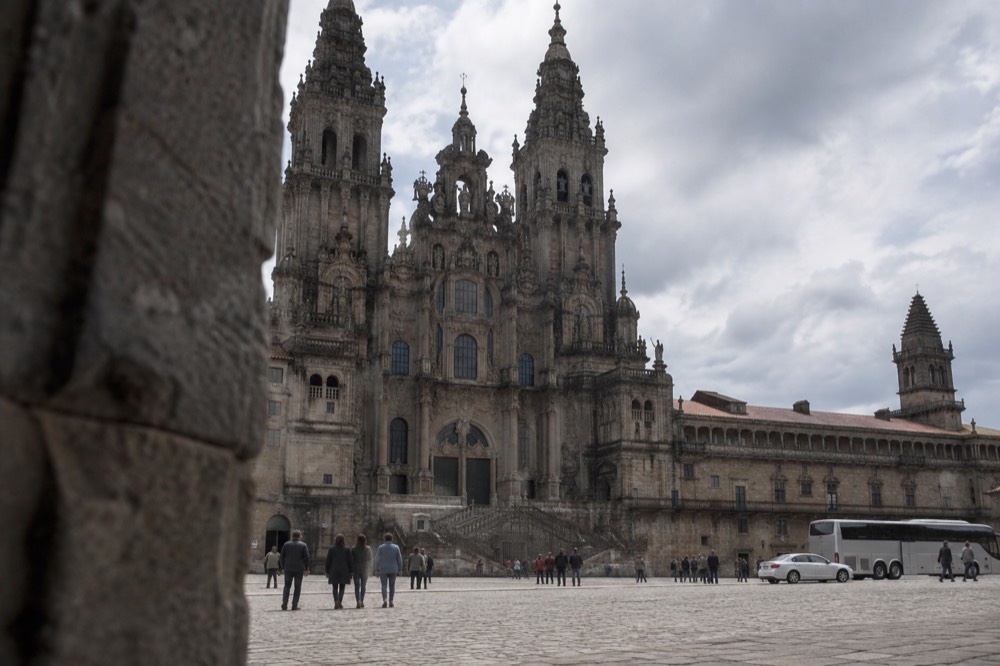
One planning note that first-time visitors miss: the airport is close enough to the city that even a "bad" transfer choice costs you 20-30 minutes, not hours. The real time sink at SCQ is not the ground transfer, it is arriving at 22:00 and discovering the next bus is the last one, or that your hotel is deep in the pedestrianised old town where vehicles cannot reach the door. Pack for a short walk at the end.
How Does Santiago de Compostela Airport Connect To Madrid, Porto And The Rest Of Galicia?
Santiago de Compostela Airport connects directly to Madrid with AVE and Avlo high-speed rail services from the city's Estacion Intermodal taking roughly 3-4 hours, while A Coruna is a short direct hop by train, Vigo is roughly 1 hour away, and there is no direct rail line to Porto, so travellers to Portugal change via Vigo. The airport itself is the aviation half of this network, and the train station in the city is the other half.
The rail geography matters because many visitors combine Santiago with a second city. Madrid is the main long-haul gateway: if your flight into Spain lands there, the Madrid to Santiago de Compostela train guide covers the high-speed connection in detail. Portugal is the awkward one. There is no direct line from Santiago to Porto, so the standard route is a regional service to Vigo, roughly an hour, then onward, a sequence the Porto to Santiago de Compostela guide walks through in both directions.
| Route | Connection | Typical Journey Time |
|---|---|---|
| Santiago to Madrid | Direct AVE/Avlo high-speed | Roughly 3-4 hours |
| Santiago to A Coruna | Direct regional/high-speed | A short hop |
| Santiago to Vigo | Direct Media Distancia/regional | Roughly 1 hour |
| Santiago to Porto | No direct rail, change via Vigo | Two legs, no single figure verified |
These are ranges, not timetabled minutes, and exact journey times should be re-checked against the operator's own timetable search before you plan a tight connection. The pattern is stable though: Galicia's rail network funnels through Santiago, which is why the airport and the Estacion Intermodal together make the city the region's practical hub.
For Camino planning, the same network defines where you can start walking the day you land. The Camino de Santiago routes overview and the Camino de Santiago map show how the French, Portuguese, Norte, Primitivo and Ingles routes all converge on the city, and how the train lines shadow several of them.
What Should Pilgrims Do In Their First Hours After Landing At SCQ?
Pilgrims landing at Santiago de Compostela Airport should plan around three first-hours tasks: reaching the old town by bus or transfer, collecting a pilgrim passport if starting a route, and, if finishing the Camino instead, queueing at the Pilgrim's Office at Rua das Carretas 33 where the Compostela certificate is issued in person only. The order depends on which direction of the Camino you are travelling.
If you are starting a route, the pilgrim passport, the credencial, is the document that matters, and the pilgrim passport guide explains the two-stamps-per-day requirement that the Oficina del Peregrino's FAQs spell out. The certificate rules are strict and verified: the last 100km must be walked, or the last 200km cycled, on a recognised route, continuously, with at least two stamps per day from official stamping points. The office issues the Compostela in person only, and its hours vary seasonally, roughly 8/9/10am to 7/8pm, closed on 25 December and 1 January.
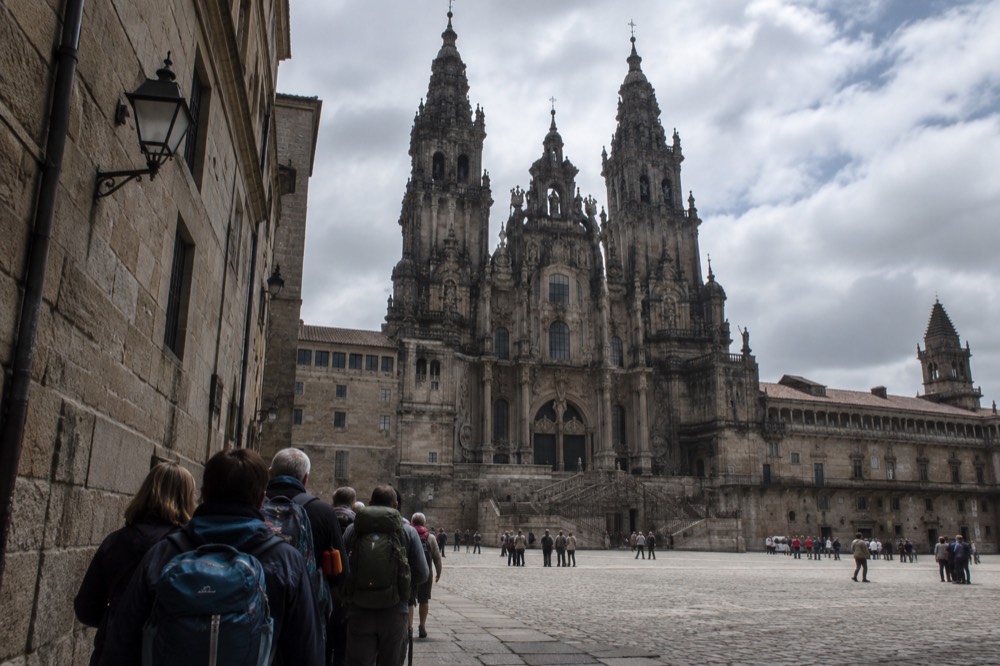
If you are finishing, the arrival rituals are different. The arriving in Santiago on the Camino guide covers the walk into the old town, and the pilgrim mass guide covers the services that mark the end of the walk. One dated note belongs here: pilgrim masses at the Cathedral's High Altar continue until 15 October 2026, but from 16 October 2026 the 9:30am, noon and 7:30pm masses relocate to the nearby Church of San Agustin while main-chapel remodelling continues ahead of the 2027 Holy Year. Only the 7:30am mass stays in the Cathedral's own Communion chapel. The Cathedral's own liturgy page is the source for any mass-time decision.
| Pilgrim Task | Where | Key Detail |
|---|---|---|
| Collect a credencial | Camino starting points, including Santiago | Two stamps per day minimum from official points |
| Claim a Compostela | Pilgrim's Office, Rua das Carretas 33 | In person only, last 100km walked or 200km cycled |
| Attend pilgrim mass | Cathedral until 15 Oct 2026, then Church of San Agustin | 7:30am mass stays in the Cathedral's Communion chapel |
| Visit the Apostle's tomb | Cathedral, free entry, about 7:00am-9:00pm | Via the Praterias door |
The Cathedral interior is free to enter and does not require a ticket, generally about 7:00am to 9:00pm via the Praterias door, with Saturday summer exceptions for the pilgrim vigil. Full ticketing detail for the museum, rooftops and Portico is in the Cathedral tickets and opening hours guide.
Can You Start Walking The Camino The Same Day You Land?
Yes, pilgrims regularly start walking the same day they land at Santiago de Compostela Airport, most often by taking a bus or train onwards to a starting point such as Sarria, Tui, O Cebreiro or Ferrol, but the honest planning answer is that a same-day start only works if your flight lands before midday and you have already decided your route. The airport is a hub for finishing walks, but it also serves as the entry point for starting them.
The classic case is Sarria. It sits on the Camino Frances at almost exactly 100km from Santiago, which is why the Camino Frances guide and the Sarria guide treat it as the single most popular starting town in the entire Camino system. Land at SCQ in the morning, transfer to the Estacion Intermodal, and a same-day arrival in Sarria is realistic. The Camino accommodation and albergues guide covers where you sleep when you get there.
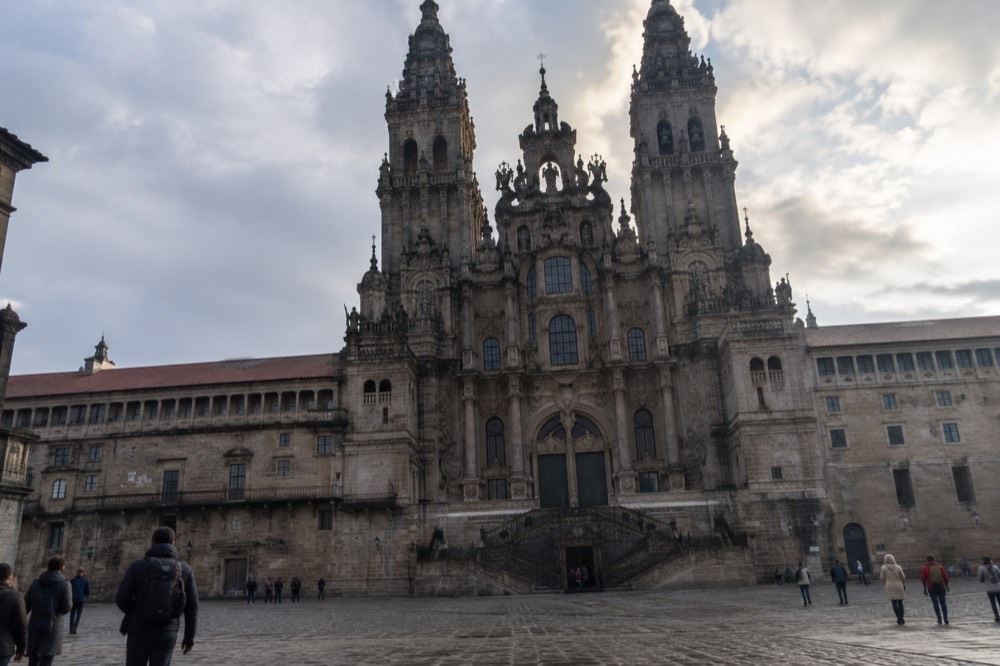
The same logic applies in other directions. The Portuguese Camino starts across the border, reached via the Vigo leg described in the Porto guide. The Ingles route starts in Ferrol or A Coruna, a short hop north by train. What does not work well is landing in the late afternoon and expecting to reach a distant starting point, collect a credencial and check into an albergue before they close. Build a buffer night in Santiago if your flight lands after mid-afternoon.
| Starting Point | Route | Why Fly Into SCQ For It |
|---|---|---|
| Sarria | Camino Frances | Almost exactly 100km out, the classic certificate-qualifying start |
| Tui / Porto side | Camino Portugues | Reached via Vigo, roughly 1 hour by train |
| Ferrol or A Coruna | Camino Ingles | A short direct hop north by train |
| O Cebreiro side | Camino Frances (eastbound start) | Reached via the Madrid line towards Lugo province |
| Santiago itself | Camino Finisterre | The only route that starts in Santiago, walking west to the coast |
The general Camino de Santiago guide pulls all of these options together if you have not yet committed to a route.
What Tours Are Worth Booking Once You Have Landed?
Once you have landed and settled in Santiago de Compostela, the tours that consistently earn their place are a small-group historic walking tour of the old town, a full-day Finisterre, Muxia and Costa da Morte excursion, and a Rias Baixas trip with a mussel boat and winery, because between them they cover the city, the coast west and the estuary country south. The airport puts you 20-30 minutes from the start of all three.
The city walk first. The Private Historic Walk, Small Group runs from $29 per person and is rated 4.9 from 16 reviews, a small-group format with an official guide that suits a first afternoon when your legs are fresh from a plane rather than a Camino. Check availability on the operator's live listing.
Then the coast. The Finisterre, Muxia & Costa da Morte day trip runs from $59 per person, rated 4.7 from 2,312 reviews, and reaches the lighthouse at what the Roman world called the end of the earth. The Finisterre guide and the Costa da Morte guide on this site give the full context for what you will see.
And the estuary. The Boat Trip, Winery, Full Day Rias Baixas excursion runs from $53 per person, rated 4.7 from 482 reviews, combining a mussel-boat outing with an Albarino winery stop in the Rias Baixas wine country. Seasonal sailing schedules shape this one, so confirm your dates on the operator's live listing.
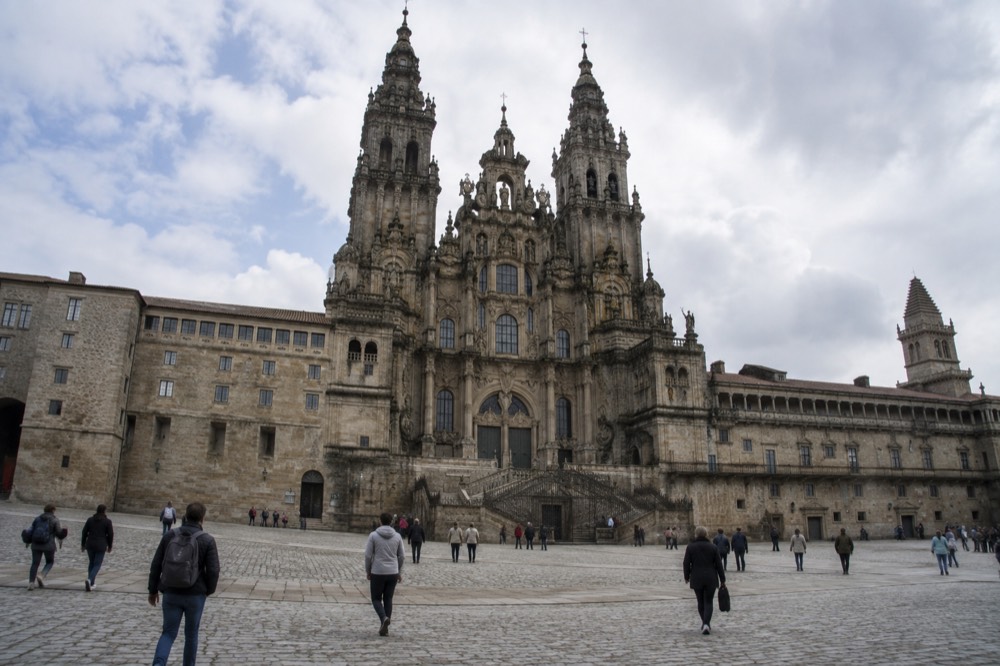
If your time is short, the trio above covers the three geographies that define Galicia: granite city, death coast and wine estuary. The is Santiago worth visiting question has a longer answer for anyone still deciding how much time to give the city.
When Is The Best Time To Fly Into Santiago de Compostela?
The best time to fly into Santiago de Compostela depends on what you are coming for: for the Camino, the shoulder months of May, June and September balance weather and crowds, while for the city itself the driest window is July and August, and AEMET's climate data for the city shows a wet, temperate oceanic climate that is wetter from October to March and driest in July and August. The airport does not close for winter, but the weather you land into changes radically across the year.
AEMET's own station data for Santiago de Compostela, station 1475X at Labacolla, the same area the airport sits in, shows annual precipitation on the order of 1,690-1,890mm depending on the station and year measured. That is wet by any Spanish standard, and it explains two things visitors notice immediately: the green of the landscape and the frequency of rain on the arrivals forecourt. No verified month-by-month table is available, so no specific monthly rainfall or temperature figure belongs on this page, but the seasonal shape is solid: wet and cool from October to March, driest in July and August.
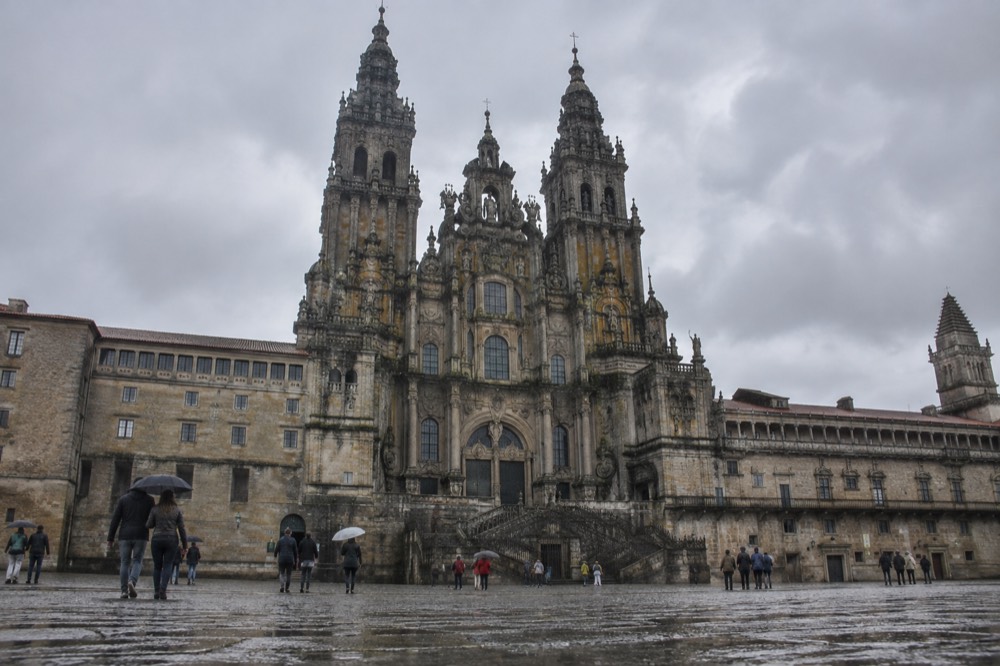
Two calendar anchors shape demand. The Feast of St. James on 25 July brings a Pontifical Mass, the national offering to the Apostle, fireworks and concerts, covered in the Feast of St. James guide, and flights around that date fill early. And 2027 is the next Holy Year, the Xacobeo, with the Holy Door opening on the evening of 31 December 2026 and the Holy Year running through 31 December 2027, a sequence the Holy Year 2027 guide explains. Anyone flying in for the Holy Year should expect airport and accommodation pressure on a scale the city has not seen since the last Xacobeo.
| Period | Weather Pattern | Airport And City Notes |
|---|---|---|
| October to March | Wet and cool, the wetter half of the year | Quieter flights, pack real rain gear |
| April to June | Warming, showers still common | Shoulder season, good Camino conditions |
| July and August | Driest months of the year | Peak season, busiest around 25 July |
| September | Cooling, showers returning | Popular Camino month, book early |
| 31 Dec 2026 through 2027 | Holy Year window | Major demand surge expected citywide |
The full seasonal breakdown, including what it means for walking rather than flying, is in the best time to visit guide and the weather guide.
Where Should You Stay And Eat On Your First Night After Landing?
On your first night after landing at Santiago de Compostela Airport, most visitors stay inside or just outside the UNESCO-listed old town, which was inscribed in 1985, because it puts you within walking distance of the Cathedral, the Praza do Obradoiro and the tapas streets, while pilgrims starting a route often sleep near the Estacion Intermodal to catch an early bus or train onwards. The choice is between atmosphere and logistics, and both work.
The old town's inscribed status, listed by UNESCO since 1985, is why the hotel stock leans historic and compact. The where to stay guide breaks the city into the areas that matter, from the monumental core out to the Alameda side. Food needs less deliberation: the where to eat guide covers Rua do Franco and the streets around it, where a first-evening pilgrim menu and a slice of tarta de Santiago close the day properly.
Budget planning is easier here than in much of Spain. Santiago de Compostela has charged a municipal tourist tax since 1 October 2025, a surcharge on Galicia's tourist-stay tax, ranging from 1 EUR to 2.50 EUR per person per night for up to 5 nights, with under-18s and Xunta-run public albergues exempt. The broader cost picture, including what a budget trip looks like, is in the Santiago on a budget guide.
Common Questions About Santiago de Compostela Airport
How Far Is Santiago de Compostela Airport From The City Centre?
About 12km, a 20-30 minute drive, though sources disagree between roughly 11 and 15km depending on the measured point, so treat the distance as approximate rather than exact.
How Much Is The Bus From Santiago de Compostela Airport To The City?
As of late September 2026, line 6A costs 1 EUR paid to the driver, or 0.36 EUR per trip on a rechargeable card. A new Monbus contract with a fare near 6 EUR is expected in autumn 2026, possibly by December, so check the operator or city site for the live fare.
How Often Does The Airport Bus Run?
Roughly every 30 minutes during operating hours, from around 06:30-07:00 until about 00:30, with the journey taking roughly 25-45 minutes to the city centre and Estacion Intermodal.
Can You Walk The Camino Starting From Santiago de Compostela Airport?
You cannot collect a Compostela by walking from the airport itself, because the certificate requires the last 100km of a recognised Camino route. Pilgrims typically transfer from the airport to a starting point such as Sarria, Tui or Ferrol the same day or the next morning.
Is There A Direct Train From Santiago de Compostela To Porto?
No. There is no direct rail line to Porto. Travellers change via Vigo, which is roughly 1 hour from Santiago by regional train, then continue onwards into Portugal.
Do You Need A Tourist Tax When Staying In Santiago de Compostela?
Yes, Santiago de Compostela has charged a municipal tourist tax since 1 October 2025, a surcharge on Galicia's tourist-stay tax, ranging from 1 EUR to 2.50 EUR per person per night for a maximum of 5 nights, with under-18s and stays in Xunta-run public albergues exempt.
Landing at SCQ is the easy part: a small terminal, a 20-30 minute transfer, and a city whose entire pilgrim apparatus, from the Pilgrim's Office at Rua das Carretas 33 to the Cathedral's free entry through the Praterias door, sits within walking distance of the old town. Plan around the changing bus fare, give yourself a buffer night if you land late, and the airport does its job quietly while the city takes over the moment you step off the bus.