What Is The Best Airport To Fly Into To Walk The Camino de Santiago?
Santiago de Compostela's own airport (SCQ) is the best gateway for most pilgrims, with Madrid Barajas and Porto as the main alternatives depending on your Camino route. Here is how to choose.
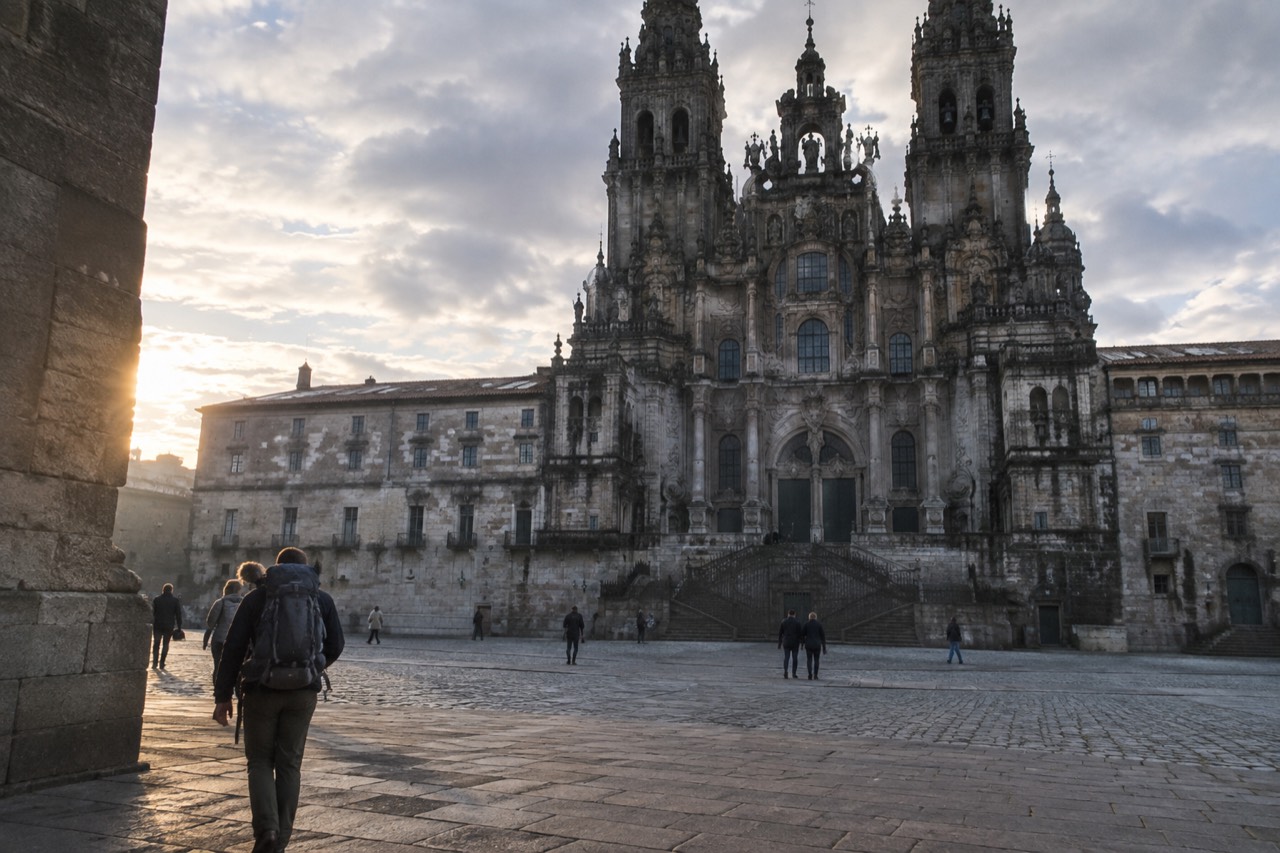
Santiago de Compostela issued a record 530,987 Compostela certificates in 2025, according to figures reported from the Oficina del Peregrino, and every one of those pilgrims had to land somewhere before they started walking. The honest answer is that the best airport is Santiago de Compostela's own field, SCQ, for most itineraries, but the right choice genuinely changes with your route. A pilgrim starting the last 100km of the Camino Frances from Sarria, a Portuguese-route walker landing in Porto and a coastal-route walker landing in Bilbao all answer this question differently.
What Is The Best Airport To Fly Into To Walk The Camino de Santiago?
Santiago de Compostela Airport (SCQ, Santiago-Rosalia de Castro) is the best airport to fly into for the majority of pilgrims: it sits about 12km from the old town, the public bus reaches the centre for 1 EUR paid to the driver, and it puts you at the finish of the walk.
Madrid Barajas is the stronger choice if your Camino starts at Sarria or elsewhere in Spain and you need a wide choice of intercontinental flights, since direct high-speed trains cover Madrid to Santiago in roughly 3 to 4 hours.
The deciding factor is not the airport itself, it is the point where your boots first hit the trail. If your walk begins in Santiago's immediate region, or you simply want the smoothest arrival at the end of a French-route walk that finishes elsewhere, SCQ wins on convenience every time. If your walk begins a train ride away from the finish, a bigger hub with better connections usually wins instead.
One nuance matters for 2026 and 2027 planners. The next Holy Year, Xacobeo 2027, opens when the Holy Door is unsealed on 31 December 2026, so demand into every Galician airport will climb through late 2026 and peak across 2027. Booking flights early for that window is not superstition, it is arithmetic. The site's Camino de Santiago guide covers the routes in detail if you have not fixed your start point yet.
Why Santiago de Compostela Airport (SCQ) Works For Most Pilgrims
SCQ is a small, single-terminal airport about 12km from the old town, a 20 to 30 minute drive, and the public bus into the centre costs 1 EUR paid to the driver on line 6A, run by Tussa as of late September 2026. The same ride costs 0.36 EUR per trip on a rechargeable card. A fare change is coming, though: a new Monbus contract with a dedicated airport line at roughly 6 EUR is expected in autumn 2026, possibly by December.
That fare situation deserves a flag rather than a promise. The city's own transport page, santiago.es, listed the Tussa line 6A at 1 EUR as of its 23 September 2026 update, while noting that the reorganised Monbus service is due to start within months. Anyone flying after October 2026 should treat the bus fare as subject to change and check the operator or city site before relying on either number. The distance is stable, at least: about 12km, though sources disagree between roughly 11 and 15km depending on the measured point.
| Line | Operator | Fare | Frequency And Hours |
|---|---|---|---|
| Line 6A airport bus | Tussa (as of 23 Sep 2026) | 1 EUR to the driver, 0.36 EUR on a card | Roughly every 30 minutes, about 06:30 to about 00:30 |
| Planned replacement | Monbus ("Estela" network) | Expected around 6 EUR, unsubsidised | Expected to start autumn 2026, possibly by December |
The airport is small enough that walking from gate to bus stop takes minutes, not the half-day shuffle of a major hub. For pilgrims finishing in the city, that matters after a month of walking. The Santiago de Compostela airport guide on this site covers the terminal in full.
Once you have landed and dropped your bag, the city rewards a first gentle afternoon. Arriving in Santiago on the Camino has its own rhythm, and a short guided orientation walk is one way to learn the old town before the crowds build around the cathedral. This Santiago de Compostela Travel Guide exists for exactly that first day, from the cathedral's liturgy schedule to the old town's tapas streets.
Is Madrid Barajas The Better Gateway For The Camino Frances?
Madrid Barajas is the better gateway when your Camino starts in Spain but away from Santiago, above all for the Sarria start on the Camino Frances. Direct high-speed trains run Madrid to Santiago de Compostela in roughly 3 to 4 hours, and Sarria, the classic last-100km starting point, sits on the rail line into Galicia. Barajas also has the intercontinental connections SCQ lacks, which matters for pilgrims flying from outside Europe.
Sarria is the single most popular starting point in the entire Camino system because 100km is the minimum walked distance the Oficina del Peregrino's FAQs set for the Compostela certificate. The walk from Sarria to Santiago is five stages of roughly a week, and each of the recognised Camino routes has its own character and its own natural gateway airport.
The Madrid route into Galicia is simple on paper: land at Barajas, transfer to Chamartin station, take a direct AVE or Avlo service to Santiago de Compostela in roughly 3 to 4 hours. The site's detailed answer on getting to the Camino from Madrid walks through that connection step by step. Train tickets for summer and Holy Year windows sell out well ahead, so the flight is not the only thing to book early.
For pilgrims who want the whole French route from the Pyrenees, Madrid or Bilbao in northern Spain usually makes more sense than flying into Galicia and backtracking. The trade-off is honest: SCQ wins for convenience, Barajas wins for reach and flexibility.
Which Airport Suits Each Camino Route?
Match the airport to your start point, not to the finish. The Camino Frances from Sarria pairs with Madrid Barajas, roughly 3 to 4 hours by train. The Camino Portugues pairs with Porto, with no direct train to Santiago, you change at Vigo for the final roughly 1 hour leg. The Camino del Norte and Camino Primitivo pair with northern airports like Bilbao or Asturias. SCQ suits short routes around Galicia and any walk finishing in the city.
That mapping is the entire answer in one glance. The route table below pairs each major route with its natural gateway and what the connection involves.
| Camino Route | Typical Start | Natural Airport | The Connection |
|---|---|---|---|
| Camino Frances, last 100km | Sarria | Madrid Barajas | Direct train Madrid to Santiago, roughly 3 to 4 hours |
| Camino Portugues, coastal or central | Porto or Tui | Porto | No direct Porto to Santiago train; change via Vigo, roughly 1 hour onward |
| Camino del Norte | Basque coast westward | Bilbao | Walk west along the coast into Galicia |
| Camino Primitivo | Oviedo | Asturias | Walk southwest across the Galician interior to Santiago |
| Camino Ingles | Ferrol or A Coruna | SCQ, Santiago | Shortest qualifying route, 100km from Ferrol |
Two caveats on that table. First, the Portuguese route is the one case where flying into Santiago makes little sense even for a short walk, because the walk runs north to south and Porto puts you at the true start. Second, route choice is its own decision with its own considerations, from how long the full walk takes to whether a first-timer should choose the Frances or a quieter route.
What About Porto, Bilbao Or Biarritz For The Camino?
Porto is the best airport for the Camino Portugues, since the route starts there and runs north to south into Santiago de Compostela, though there is no direct train from Porto, pilgrims change at Vigo for a final leg of roughly 1 hour. Bilbao serves the Camino del Norte's Basque start. Biarritz serves the full Camino Frances from Saint-Jean-Pied-de-Port. Neither northern option beats SCQ for convenience, only for route logic.
The Porto case deserves the clearest statement because it trips people up. A pilgrim walking the Portuguese route finishes in Santiago de Compostela, so the instinct is to fly home from SCQ and fly in somewhere on the route. Flying into Porto and walking north is the standard pattern, and the two cities are often compared side by side by pilgrims weighing a Galician versus a northern Portuguese base. What the rail network does not offer is a direct Porto to Santiago line: the route runs via Vigo, with the Vigo to Santiago leg taking roughly 1 hour. Buses and walking cover the rest.
Biarritz and Bilbao answer a different question. The full Camino Frances traditionally starts at Saint-Jean-Pied-de-Port on the French side of the Pyrenees, and Biarritz is the nearest airport with useful connections. Bilbao anchors the Camino del Norte's coastal start. These are route-first choices: nobody picks Biarritz for convenience, they pick it because the walk begins there and they intend to walk every kilometre that qualifies.
How Do You Get From SCQ To The City Centre After Landing?
Line 6A, the Tussa public bus, runs from Santiago de Compostela Airport to the city centre and the Estacion Intermodal for 1 EUR paid to the driver, 0.36 EUR per trip on a rechargeable card, as of late September 2026. It runs roughly every 30 minutes from about 06:30 to about 00:30, with journeys of roughly 25 to 45 minutes. The Monbus replacement at around 6 EUR is expected in autumn 2026.
For a pilgrim with a pack, that 1 EUR ride is one of the cheapest airport transfers in Spain, and the schedule spans nearly every realistic arrival time. The fare caveat bears repeating in plain words: the bus you ride in November 2026 may not cost what the September page said, because the contract change is live and dated. Check the city transport page or the operator's own timetable before you fly, and treat any figure you read online, including the ones here, as a snapshot of late September 2026 rather than a permanent tariff.
The walk-in alternative is none: about 12km on the airport road is not a scenic pilgrim path, so take the bus or a taxi. Once in the centre, the old town is compact enough that everything from the cathedral to the pilgrim office at Rua das Carretas 33 sits within a short walk.
What Should You Sort Before Booking The Flight?
Fix your route and start point first, then book the airport that serves them. Confirm you can meet the Compostela's distance rules, the last 100km on foot or 200km by bike on a recognised route, before you commit to a gateway airport. Then book early for the 2027 Holy Year window, and make sure your pilgrim passport and first night's bed are arranged before you pay for flights.
The order of operations trips more pilgrims than the airport choice itself. Choose the route, choose the start, and only then choose the airport, because the flight is the one component that gets more expensive and less available the longer you wait. For the Holy Year that opens 31 December 2026, that pressure starts months earlier than a normal season.
Budget planning belongs in the same breath. The site's answer on the average cost of walking the Camino covers the money side, and a lean packing list keeps the bag under the airline's limit.
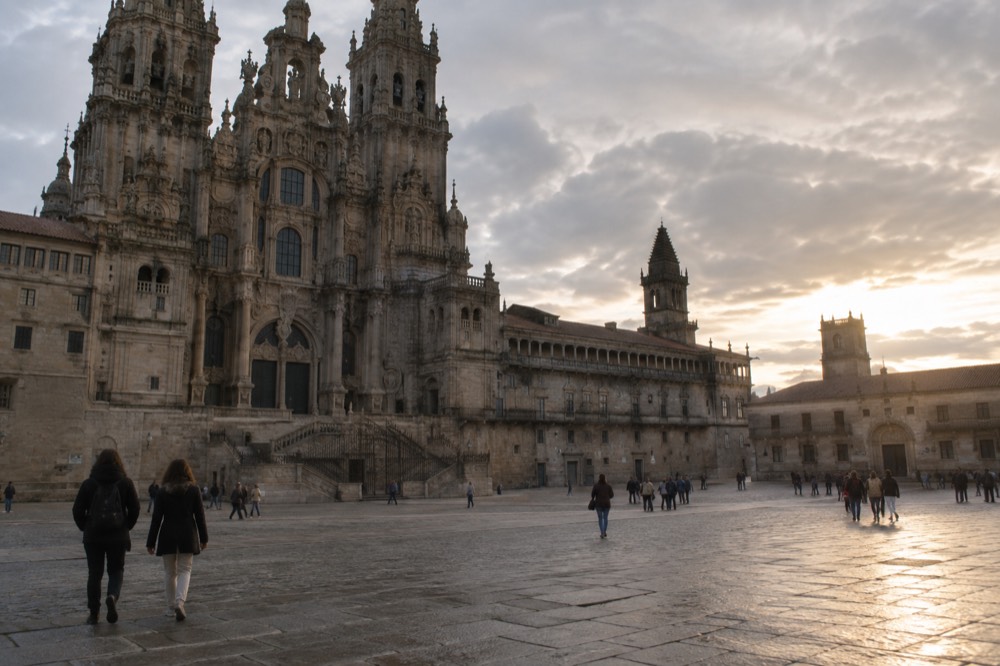
Whichever airport you choose, the walk ends in the same place: Praza do Obradoiro, in front of a cathedral that has been receiving pilgrims for over a thousand years. The flight is the least memorable part of the Camino de Santiago, and choosing it well simply means you never have to think about it again.
Common Questions About Camino de Santiago Airports
What is the best airport to fly into to walk the Camino de Santiago?
Santiago de Compostela Airport (SCQ) is the best gateway for most pilgrims, sitting about 12km from the old town with a 1 EUR bus connection. Madrid Barajas is better if your walk starts at Sarria or you need intercontinental flights, and Porto is best for the Camino Portugues.
How far is Santiago de Compostela Airport from the old town?
About 12km, a 20 to 30 minute drive. Sources measure it anywhere from roughly 11 to 15km depending on the exact point, so treat 12km as the working figure rather than a precise number.
How much does the bus from Santiago de Compostela Airport cost?
As of late September 2026, line 6A run by Tussa charges 1 EUR paid to the driver, or 0.36 EUR per trip on a rechargeable card. A new Monbus airport service at roughly 6 EUR is expected in autumn 2026, so check the city transport page before you fly.
Should I fly into Madrid to start the Camino Frances at Sarria?
Yes, Madrid Barajas is the natural gateway for the Sarria start. Direct high-speed trains run Madrid to Santiago de Compostela in roughly 3 to 4 hours, and Sarria is on the rail line into Galicia.
Can I fly into Porto and walk to Santiago de Compostela?
Yes, and that is the standard pattern for the Camino Portugues, which runs north to south from Porto. There is no direct train from Porto to Santiago: the rail route changes at Vigo, with the final Vigo to Santiago leg taking roughly 1 hour.
Is 2027 a Holy Year that will affect flight availability?
Yes. The Holy Door opens on 31 December 2026 and the Xacobeo 2027 Holy Year runs through 31 December 2027, so demand into SCQ, Porto, Madrid and the northern airports will peak through 2027. Book flights well ahead for that window.