Camino del Norte: The Complete Guide To Walking The Northern Route Into Santiago de Compostela
The Camino del Norte is the coastal way into Santiago de Compostela, following the Bay of Biscay through the Basque Country, Cantabria, Asturias and Galicia. This guide sets out what the verified record says about the route, its demands, its arrival in Santiago de Compostela, and the certificate rules at the end.
Short answer
The Camino del Norte is the Northern Way, a coastal pilgrim route into Santiago de Compostela recognized under the UNESCO inscription for the Routes of Northern Spain (1993). It rewards walkers with sea views and quieter paths, and it ends like every other route at the Cathedral and the Pilgrim's Office at Rua das Carretas 33, where the Compostela requires the last 100km on foot or 200km by bike.
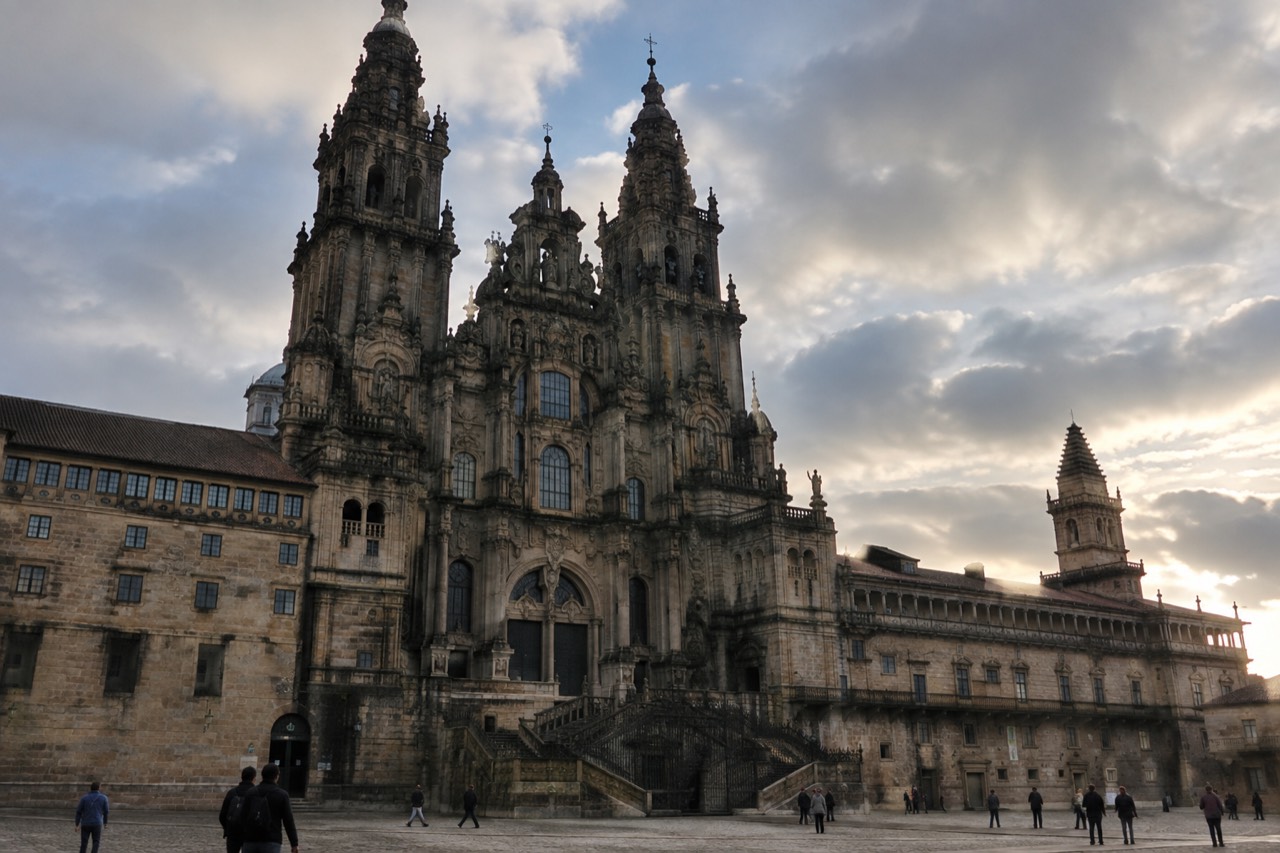
The Routes of Santiago de Compostela: Camino Frances and the Routes of Northern Spain entered the UNESCO World Heritage list in 1993, and the Camino del Norte is the coastal arm of that second inscription. It is the way into Santiago de Compostela that keeps the sea in sight for weeks, threading the Bay of Biscay coastline through the Basque Country, Cantabria and Asturias before turning inland across Galicia to the Apostle's tomb. Where the Camino Frances concentrates crowds, the Northern Way spreads them along cliffs, estuary mouths and small fishing ports. This guide, from the editors at Santiago de Compostela Travel Guide, walks through the route's shape, its demands, where to sleep, what it costs to plan for, and exactly what happens when the trail ends at Praza do Obradoiro.
What Is The Camino del Norte?
The Camino del Norte, or Northern Way, is the coastal pilgrim route into Santiago de Compostela, running west along the Bay of Biscay from the Basque Country through Cantabria and Asturias into Galicia, and it forms part of the UNESCO-inscribed Routes of Northern Spain recognized in 1993. It is one of several historic Jacobean ways, quieter and less frequented than its inland rival, and it finishes at the same tomb of St. James beneath the Cathedral of Santiago de Compostela.
Pilgrimage traffic reached Santiago de Compostela along the northern seaboard early in the city's history, and as the Camino Frances grew richer and more popular further south, the coastal corridor kept a lower profile. That character survives: the Camino del Norte remains quieter and wilder than the great inland routes, with long stretches where the day's company is the ocean rather than other walkers.
The route's cultural weight is officially recognized. UNESCO's World Heritage list carries two separate inscriptions for this destination, and they are often confused with each other. The Old Town of Santiago de Compostela was inscribed in 1985, and the Routes of Santiago de Compostela: Camino Frances and the Routes of Northern Spain followed in 1993 as a distinct listing. The Camino del Norte belongs to the 1993 inscription, which is the fact worth getting right, because a surprising amount of published copy merges the two dates into one.
How Long Does The Camino del Norte Take To Walk?
The Camino del Norte takes most walkers several weeks to complete end to end, being the longest and most demanding of the principal routes into Santiago de Compostela, and no single stage-count or kilometre figure is deliberately published for it here, so any exact number quoted elsewhere should be checked against a current guidebook or the official Camino resources before you plan around it.
What can be stated with confidence is the relationship between route choice and time. The full Northern Way from the Basque Country is a multi-week commitment, longer than the Camino Frances, longer than the Camino Primitivo, and far longer than the Camino Ingles, which was built precisely for pilgrims arriving by sea who needed the minimum qualifying distance. Walkers with limited time routinely start the Norte late in its course, in Asturias or Galicia, for the same reason.
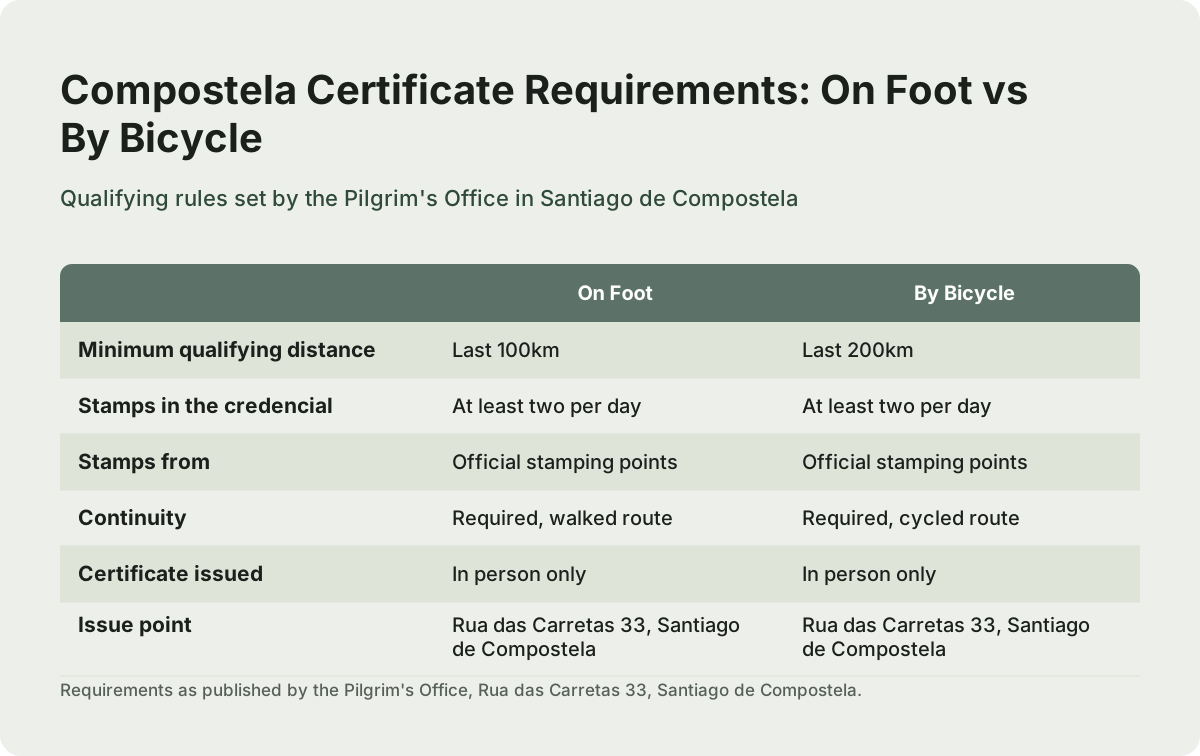
The one distance that matters legally is fixed and verified. The Pilgrim's Office issues the Compostela certificate to pilgrims who complete at least the last 100km on foot, or the last 200km by bicycle, on a recognized route, with credencial stamps collected along the way. That 100km threshold is why Sarria, on the Camino Frances, has become the classic late start point, and why Galician sections of the Norte serve the same function for coastal walkers. The full requirements sit in the table below, drawn from the Oficina del Peregrino's own published rules.
| Requirement | On Foot | By Bicycle |
|---|---|---|
| Minimum qualifying distance | Last 100km | Last 200km |
| Stamps in the credencial | At least two per day | At least two per day |
| Stamps from | Official stamping points | Official stamping points |
| Continuity | Required, walked route | Required, cycled route |
| Certificate issued | In person only | In person only |
| Issue point | Rua das Carretas 33, Santiago de Compostela | Rua das Carretas 33, Santiago de Compostela |
The office closed only 25 December and 1 January in the most recently published schedule, with seasonal hours otherwise, so late-stage walkers arriving on a holiday should plan the certificate collection for the next morning. Our Camino de Santiago overview carries the wider context, and the walking-time question in detail lives in this site's dedicated answer page on how long the Camino takes to walk.
Where Does The Camino del Norte Start And End?
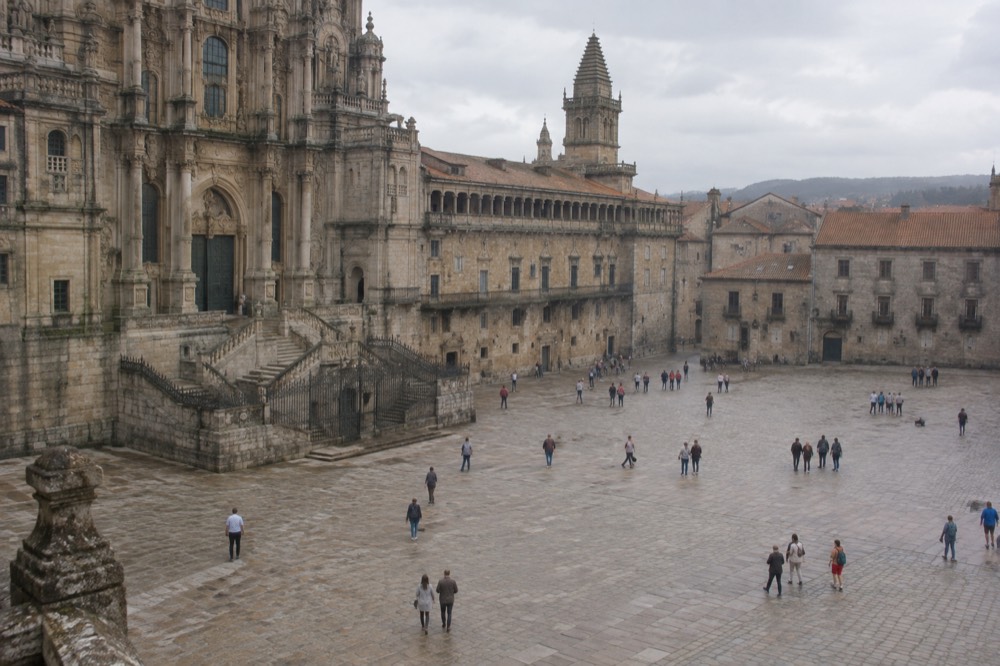
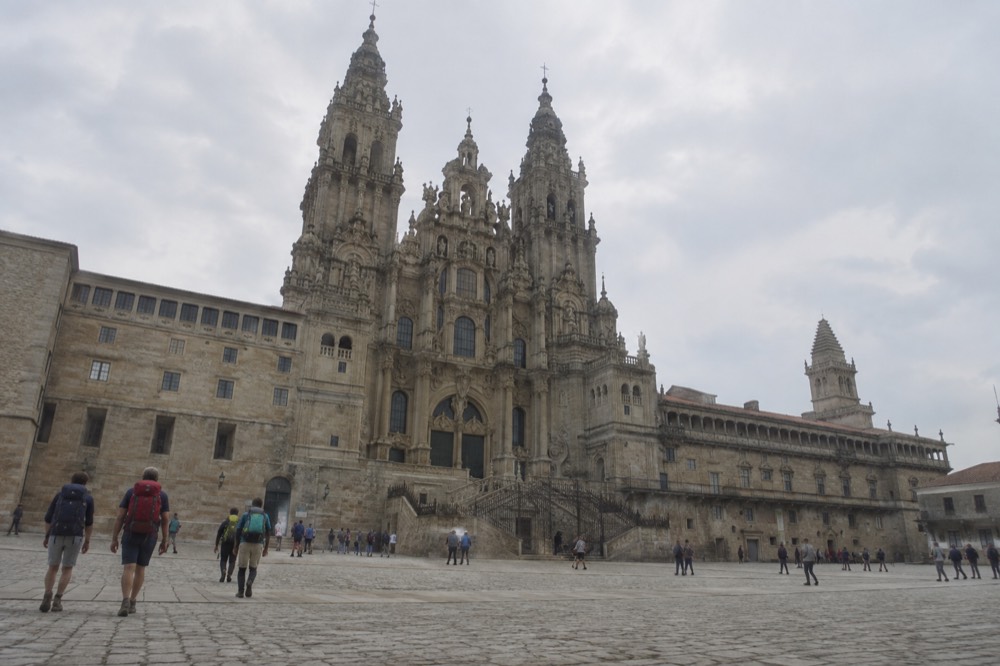
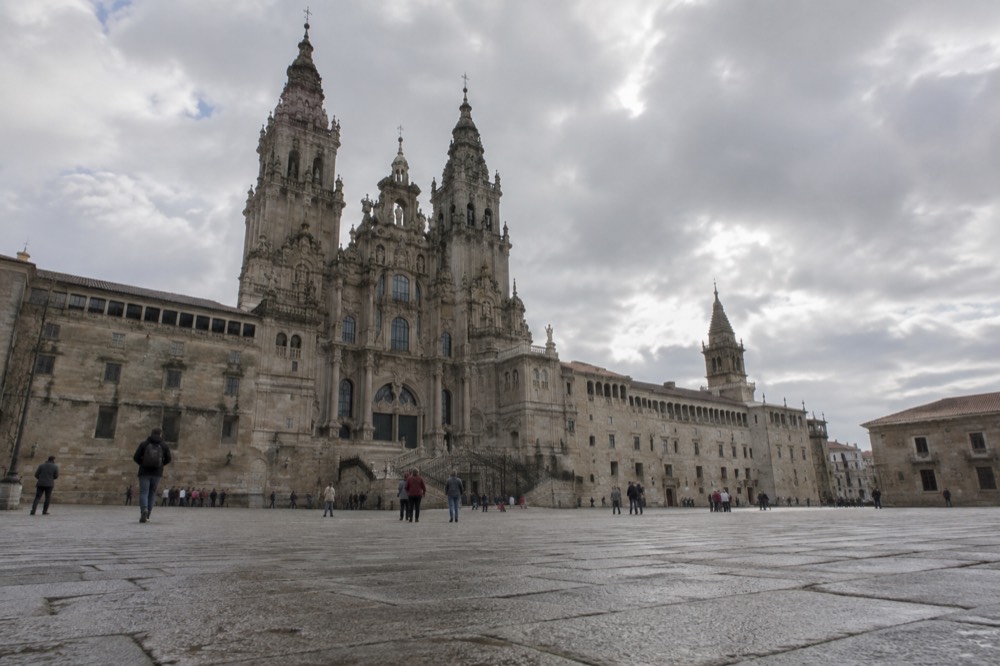
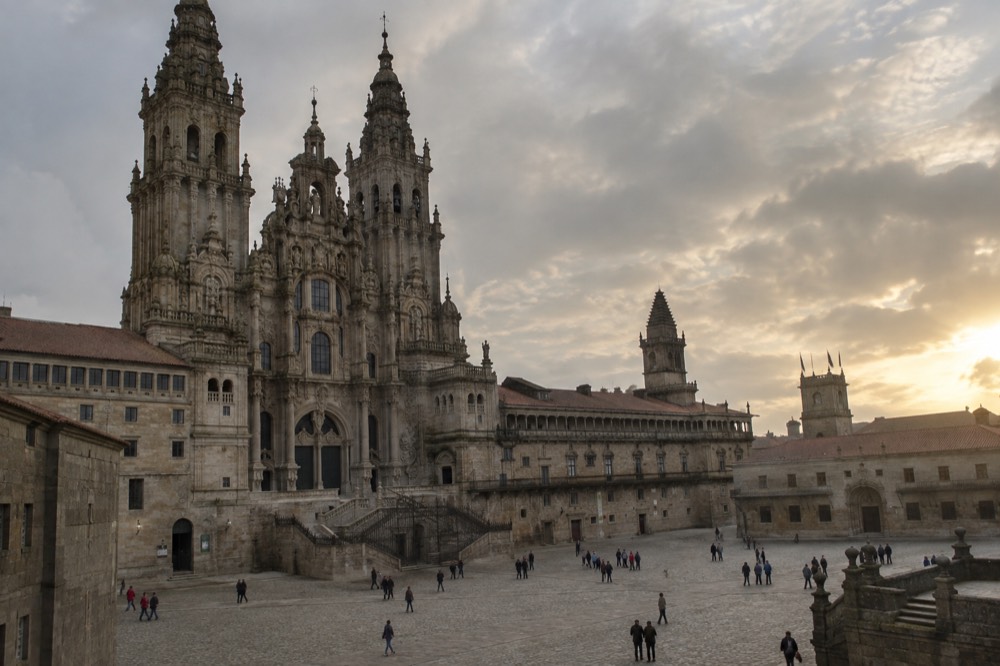
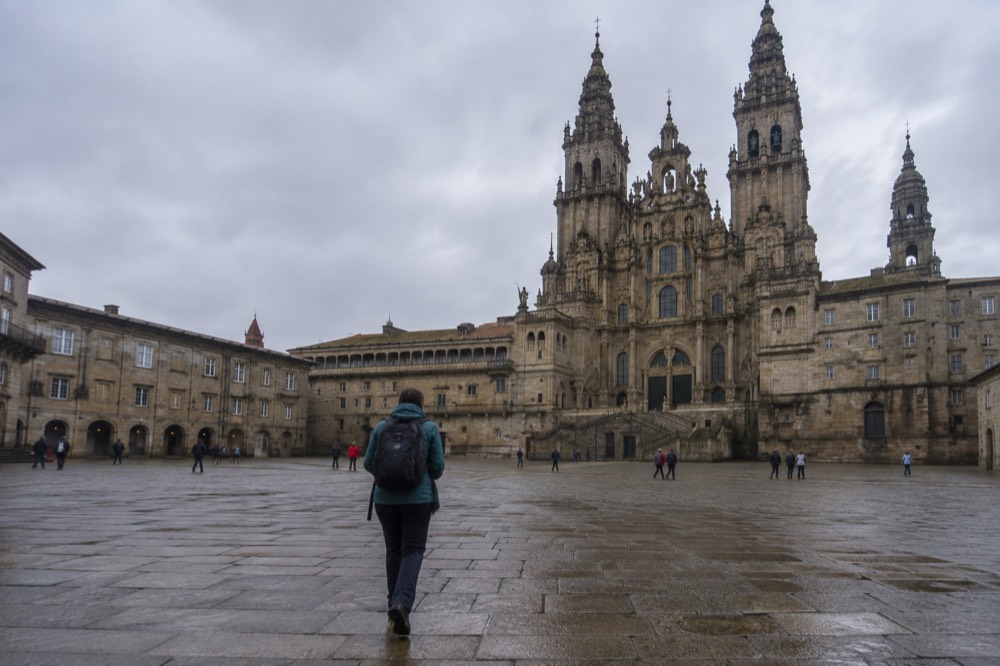
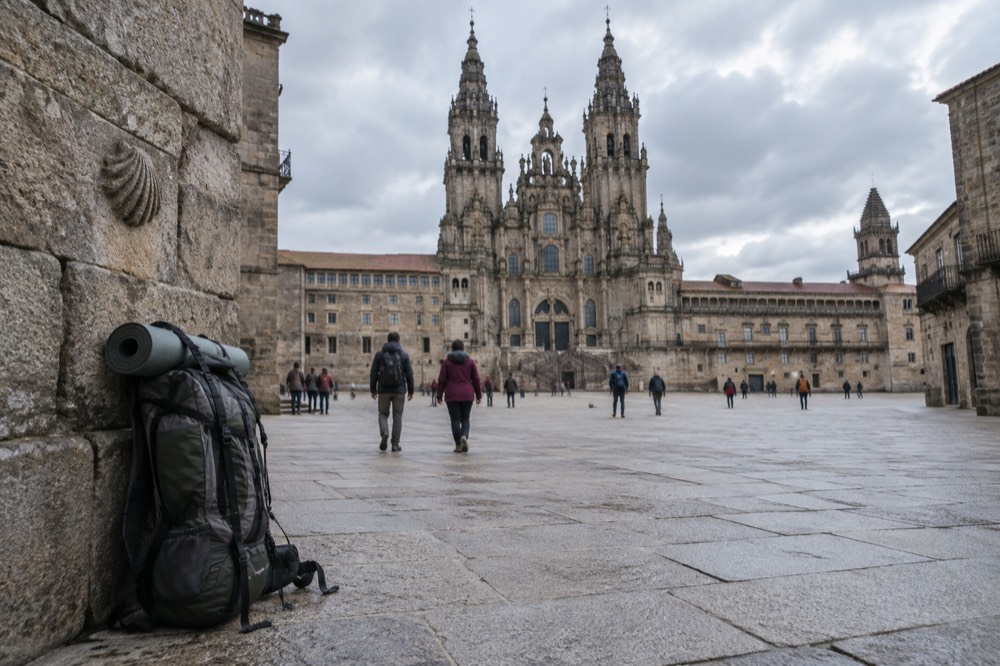
The Camino del Norte starts in the Basque Country on the Spanish Atlantic coast and ends, like every recognized Jacobean route, at the Cathedral of Santiago de Compostela in Galicia, with the final approach arriving through the city's eastern streets into Praza do Obradoiro, the grand square where the Cathedral's baroque facade faces the town hall and the Hostal dos Reis Catolicos.
Between those two points the route keeps broadly to the coast. It crosses Basque estuaries, runs the Cantabrian shoreline past small ports and green headlands, follows the Asturian coast with its industrial towns and empty beaches, then turns into Galicia, where the landscape softens and the final days run through inland Galician countryside before the city appears. Several junctions along the way matter to planners: the Norte links with the Camino Primitivo at Ribadeo, and the Camino Ingles historically branched from coastal ports, so route decisions on the Norte genuinely shape the last week of walking.
The end point deserves precision because it is a legal threshold as well as a spiritual one. The final 100km on the Norte, wherever a walker chooses to enter it, must be walked continuously and stamped twice daily to qualify for the Compostela, and the certificate itself is issued only in person at the Pilgrim's Office on Rua das Carretas 33, a short walk from the Cathedral. Our guide to arriving in Santiago on the Camino covers the last-day sequence in full, from the Monte do Gozo descent to the tomb visit.
How Difficult Is The Camino del Norte?
The Camino del Norte is widely regarded as the most physically demanding of the main routes into Santiago de Compostela, because its coastal profile repeatedly climbs and descends between clifftop paths and estuary towns, crossing green northern terrain that stays wet for much of the year, so it suits walkers with genuine hill fitness and honest footwear rather than first-timers seeking the gentlest introduction.
The difficulty is vertical rather than technical. Days on the Norte are rarely exposed or dangerous, but the accumulated ascent is real, and the surface varies from paved seaside promenades to muddy woodland track, which punishes thin-soled shoes. Rain is the other factor. AEMET's climate data for the Santiago station, inland at Labacolla, shows a temperate oceanic regime with precipitation on the order of 1,690 to 1,890mm annually, wettest October to March and driest July and August, and the coastal sections the Norte follows sit broadly inside the same wet northern regime. A walker planning spring or autumn should expect rain days as a norm, not an exception.
For beginners, the comparison matters: the Camino Frances and Camino Portugues offer flatter final sections and denser infrastructure, while the Norte trades comfort for scenery and solitude. Fit walkers who want the coast should not be deterred, they should simply train on hills beforehand and pack for weather, and the gear side of that equation is covered further down this page.
Where Do You Sleep On The Camino del Norte?
Sleeping on the Camino del Norte follows the standard Camino system of public albergues, private albergues, small guesthouses and occasional hotels, with the public network thinner along the Northern Way than on the Camino Frances, so the practical rule is to carry the pilgrim credencial for access to the public refugios and to start looking for a bed earlier in the afternoon than a Frances walker would.
The credencial is the key that unlocks the system. Public albergues, run by associations and municipal bodies, prioritize pilgrims walking with a credencial, and the same document accumulates the two daily stamps that the Compostela requires over the final 100km. Our albergue and accommodation guide and our pilgrim passport explainer cover the mechanics in depth, including where the credencial is obtained before the walk and how stamps should be spaced.
The Norte's infrastructure gap is real but manageable with planning. In the Basque Country and eastern Cantabria, stages between beds are longer and private rooms need earlier booking, while the Galician final stretch, carrying the qualifying 100km, has denser provision. Solo walkers and women walking alone frequently ask about safety on the whole network, and the honest answer for the Norte is that its quieter paths mean fewer evening crowds but also fewer eyes, which cuts both ways, and the same standard precautions that apply to any long rural walk apply here: keep the day's plan known to someone, book beds in advance where stages are long, and trust the network of fellow pilgrims where it exists.
What Does The Camino del Norte Cost?
This site does not publish a costed budget line for the Camino del Norte, and no honest euro figure per day can be printed here, so the planning answer is that costs track the general Camino pattern: near-nothing for pilgrims sleeping in donation-based public albergues and cooking, materially more for private rooms and restaurant meals, with the two fixed reference points being the free Cathedral interior and the free Compostela certificate at the end.
What can be stated is the structure of the spend. The main variables are beds, food and feet: albergue prices versus private rooms, supermarket picnics versus pilgrim menus, and the real cost of replacing boots or physio if the body objects. Readers wanting the worked numbers should look at this site's dedicated answer on the average cost of walking the Camino, which frames the budget question across routes, and the same frugality tactics that make Santiago de Compostela affordable on a daily budget apply to the arrival city too.
Two things at the end of the Norte are free and verified. Entry to the Cathedral's nave, the high altar and the Apostle's tomb costs nothing, with the interior open daily roughly 7:00am to 9:00pm per the Cathedral's own published hours, and the Compostela certificate itself carries no charge. The paid layers start beyond that: the Cathedral Museum and its combined tickets run EUR9-23 depending on type per the Cathedral's ticketing, and the official rooftop tour, Cubiertas plus Torre de la Carraca, is EUR15 general and EUR12 reduced, bookable online at the Cathedral's own ticket site. A certificate and a view from 72 metres up are, in that order, the standard finishers' extras.
When Is The Best Time To Walk The Camino del Norte?
The best window for the Camino del Norte is the dry half of the northern Spanish year, with July and August the driest months in AEMET's station data for Santiago de Compostela and the wet season running October to March, so the honest answer is late spring through early autumn for weather, with shoulder months trading some rain for thinner crowds and cooler walking.
The climate framing comes with a caveat this site takes seriously. AEMET's verified data for station 1475X, Santiago de Compostela at Labacolla, confirms the annual precipitation range and the seasonal pattern, but a full month-by-month normals table has not been officially published, and no invented monthly millimetre or degree figure appears on this site. What that means for a planner is the shape of the year without false precision: a wet, cool October-to-March regime and a drier July-August peak, with the coastal Norte marginally maritime throughout.
The seasonal trade-offs across the whole network deserve their own reading, and two route-specific notes matter for the Norte. First, the summer dry season is also the northern Spanish holiday season, and coastal accommodation in the Basque Country and Cantabria fills with beach tourism as well as pilgrims, so midsummer walkers should book beds ahead. Second, one date reshapes every summer: 25 July, the Feast of St. James, falls every year and turns Santiago de Compostela into a festival city, with the Pontifical Mass, the national offering to the Apostle and fireworks. Arriving on or just before it is memorable, and booking-critical.
The calendar also decides whether a walk ends in a Holy Year, and the schedule is verified and near. The next Xacobeo after 2026 is 2027, because 25 July 2027 falls on a Sunday: the Holy Door opens solemnly on the evening of 31 December 2026 at the Praza da Quintana ceremony and the Holy Year runs through 31 December 2027. A Norte walker finishing in 2026 does not earn a Holy Year arrival, and one finishing in 2027 does. The confirmed sequence of Holy Years follows.
| Holy Year (Xacobeo) | Why It Is A Holy Year | Door Date Verified Here |
|---|---|---|
| 2027 | 25 July 2027 falls on a Sunday | Opens 31 December 2026, runs to 31 December 2027 |
| 2032 | Listed by the official Santiago site | Not published in this site's sources |
| 2038 | Listed by the official Santiago site | Not published in this site's sources |
| 2049 | Listed by the official Santiago site | Not published in this site's sources |
Our Holy Year 2027 guide carries the full detail on what changes in the city when the door is open, and the Camino's own history explains why the Sunday rule produces the irregular 6-5-6-11 rhythm between Holy Years.
Camino del Norte Or Camino Frances: Which Should You Choose?
The Camino Frances offers the densest infrastructure, the flattest final section and the deepest community of walkers, while the Camino del Norte offers the coast, fewer people and a harder physical profile with climbing throughout, so the choice reduces to whether a walker prioritizes support and shared experience or scenery and solitude, with fitness the honest deciding factor for the Norte.
The Frances is the route most of the world pictures when it hears the words Camino de Santiago: the classic pipeline through Pamplona, Burgos and Leon, described in our Camino Frances guide, with beds every few kilometres and a permanent moving village of pilgrims. The Norte is a different product. It suits walkers who have already done a long route, or who train properly before starting, and who would rather eat lunch alone on a headland than queue at a midday pilgrim menu. The two routes converge in spirit only at the end, at the same tomb in the same crypt under the same Crossing.
For a like-for-like decision aid, put the main ways side by side on the map before committing. One structural fact helps planners weighing the Norte against its siblings: the Primitivo, the oldest way, branches south from the northern corridor at Ribadeo in Galicia, so a Norte walker can sample inland Galicia for the final stretch without committing to it from the coast. The Portugues, covered in our Camino Portugues guide, is the other common first-timer's choice, flatter and shorter from southern Galicia.
What Should You Pack For The Camino del Norte?
Packing for the Camino del Norte means packing for rain and hills above all: broken-in boots with genuine grip, layered clothing that dries fast, working rain protection for body and pack, and the credencial kept dry, because the verified climate pattern of 1,690-1,890mm of annual precipitation and repeated vertical stages makes waterproofing and footwear the two decisions that most affect whether the walk succeeds.
The full item-by-item reasoning lives in our Camino packing list, and its priorities apply doubled on the Norte. The coastal profile means a walker can descend to sea level and climb back to clifftop within a single morning, repeatedly, so weight discipline matters more here than on flatter ways: every kilogram in the pack is re-lifted dozens of times per day. Boots should be broken in months before, not kilometres in, because the Norte's mixed surfaces, tarmac, mud, rock and sand, expose new footwear faster than the Frances' farm tracks.
Two administrative items belong on any Norte checklist. First, the credencial, obtained before departure or in the early stages, because it unlocks public albergues and records the two-daily stamps the Compostela needs. Second, luggage transfer arrangements if the walk is being done with a heavier bag than the body should carry: our Camino luggage transfer guide explains how the daily-forwarding services work, which many Norte walkers use given the route's longer, lonelier stages where a wrong packing decision cannot be fixed at the next village shop.
What Happens When You Arrive In Santiago de Compostela?
Arrival on the Camino del Norte ends at the Pilgrim's Office at Rua das Carretas 33, which issued a record 530,987 Compostelas in 2025 and issues the certificate in person only, before the Cathedral visit itself, where the free nave holds the Apostle's tomb and, under current works, the Botafumeiro is grounded and the pilgrim masses move from the High Altar to the Church of San Agustin on 16 October 2026.
The sequence matters on a busy day. The last stage of the Norte descends into the city from the east, and walkers queue at the Pilgrim's Office for the credential check and the Compostela, with the office closed 25 December and 1 January and seasonal hours otherwise. The record 2025 figure of 530,987 Compostelas, reported by the Oficina del Peregrino's own statistics through press citation, tells the arrival story plainly: the finishing city processes over half a million certificates a year, and July is its heaviest month. Once the certificate is in hand, the tomb in the crypt, reached by a short staircase behind the high altar, is the traditional finisher's embrace, free to enter within the Cathedral's general visiting hours.
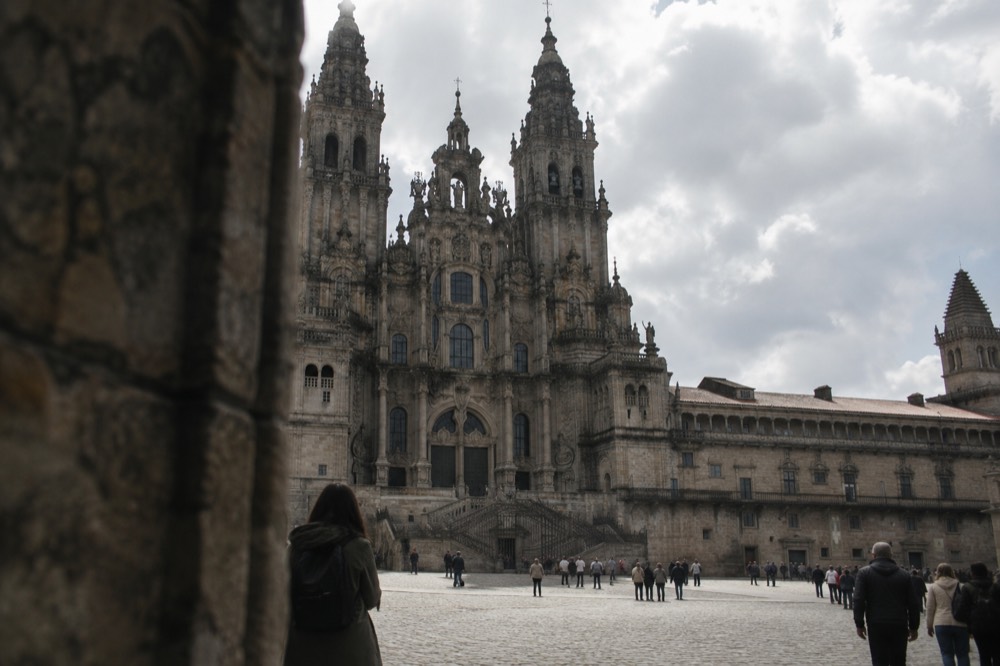
Inside the Cathedral, three verified conditions apply right now, and a 2026 or 2027 arriver should know all three before promising anything to travel companions. The naves, tomb and embrace area remain fully open under normal free-entry hours, while restoration works on the cimborrio, the Berenguela clock tower and chapel roofs proceed around the open interior. The Botafumeiro, the great swinging censer, is temporarily out of action because dome-restoration scaffolding covers its hanging mechanism, confirmed in writing by the Cathedral on 5 September 2026, with no published return date. And the pilgrim masses relocate: the 9:30am, noon and 7:30pm masses move from the Cathedral's High Altar to the nearby Church of San Agustin from 16 October 2026, with only the 7:30am mass remaining in the Cathedral's own Communion chapel.
| Pilgrim Mass | Before 16 October 2026 | From 16 October 2026 |
|---|---|---|
| 7:30am | Cathedral, High Altar | Cathedral, Communion chapel |
| 9:30am | Cathedral, High Altar | Church of San Agustin |
| 12:00 noon | Cathedral, High Altar | Church of San Agustin |
| 7:30pm | Cathedral, High Altar | Church of San Agustin |
The Botafumeiro's normal life, clearly flagged as currently suspended, is a fixed annual calendar of twelve solemnities rather than a daily performance, and the schedule below is how it works when the mechanism hangs free again. No date on this list should be promised to a 2026 traveller, and the Cathedral publishes no return date.
| Solemnity | Date The Botafumeiro Normally Swings |
|---|---|
| Epiphany | 6 January |
| Easter Sunday | March or April, movable |
| Ascension of the Lord | Movable, spring |
| Apparition of the Apostle at Clavijo | 23 May, or transferred |
| Pentecost | Movable, spring |
| Feast of St. James the Apostle | 25 July |
| Assumption of the Virgin | 15 August |
| All Saints | 1 November |
| Christ the King | Last Sunday before Advent |
| Immaculate Conception | 8 December |
| Christmas | 25 December |
| Transfer of the Apostle | 30 December |
Beyond the tomb, most finishing pilgrims add one paid layer: the museum and rooftops. The Cathedral Museum runs from EUR9 to EUR23 by ticket type, and the official Cubiertas rooftop tour with the Torre de la Carraca costs EUR15 general, EUR12 reduced, roughly 60 minutes, 140 steps and views from about 72 metres, bookable online at the Cathedral's own ticket site. Guided options through the operator listings below bundle the queueing away, and a small-group historic walking tour of the old town is the other common first-evening purchase, alongside an evening legends tour of Compostela for those with energy left.
| Tour In Santiago de Compostela | From (Per Person) | Rating | Reviews |
|---|---|---|---|
| Cathedral, Portico and Cathedral Tickets, City Complete | $47 | 4.8 | 194 |
| Cathedral and Museum Tour, Skip The Line | $26 | 4.8 | 2,425 |
| Cathedral Visit, Skip The Line | $31 | 4.7 | 582 |
| Historic Town Walk With Official Guide | $14 | 4.8 | 144 |
| Old Town Walk With An Official Guide | $12 | 4.8 | 338 |
| Secrets of Compostela Night Tour | $17 | 4.9 | 74 |
Some Norte finishers do not stop at Santiago at all. The Camino continues west to Fisterra and Muxia on the Costa da Morte, the medieval "end of the world" extension described in our Camino Finisterre guide, and those with no walking days left can reach the same headlands on a full-day coach tour.
For those heading onward by rail rather than on foot, the verified connections from Santiago de Compostela set the distances in ranges, and no timetabled minutes are published on this site beyond these.
| Rail Connection From Santiago de Compostela | Typical Journey | Notes |
|---|---|---|
| To Madrid | Roughly 3-4 hours | Direct high-speed services |
| To A Coruna | A short hop | Direct regional and high-speed services |
| To Vigo | Roughly 1 hour | Direct regional services |
| To Porto | No direct line | Change at Vigo for the onward service |
Common Questions About The Camino del Norte
Does the Camino del Norte count for the Compostela certificate?
Yes. The Camino del Norte is a recognized route, and the Oficina del Peregrino's rules apply to it exactly as to the others: at least the last 100km on foot or 200km by bike, at least two credencial stamps per day from official points, and in-person collection at Rua das Carretas 33 in Santiago de Compostela.
Is the Camino del Norte harder than the Camino Frances?
Yes, in the specific sense of vertical effort. The Norte's coastal profile climbs and descends repeatedly, and its infrastructure is thinner, so beds need earlier planning. The Frances concentrates its difficulty into a few stages and offers far denser services.
Can you see the Botafumeiro swing when you finish in Santiago de Compostela?
Not currently. The Cathedral confirmed in writing on 5 September 2026 that the Botafumeiro is temporarily out of action because cimborrio restoration scaffolding covers its hanging mechanism, and no return date has been published. Normally it swings on twelve fixed solemnities a year, not daily.
Is 2026 a Holy Year in Santiago de Compostela?
No. The next Holy Year is 2027, because 25 July 2027 falls on a Sunday. The Holy Door opens on 31 December 2026 and the Holy Year runs through 31 December 2027.
Where do you get the Compostela at the end of the Camino del Norte?
In person only, at the Pilgrim's Office at Rua das Carretas 33 in Santiago de Compostela, on presenting the stamped credencial. The office closes 25 December and 1 January, with seasonal hours otherwise.
Can you continue walking past Santiago de Compostela on the Camino del Norte?
Yes. The Camino Finisterre continues west from Santiago de Compostela toward Fisterra on the Costa da Morte, with a branch to Muxia, and many coastal-route finishers treat it as the natural final chapter of the northern pilgrimage.
The Camino del Norte earns its reputation as the connoisseur's route into Santiago de Compostela: the longest coastline, the quietest paths and the hardest hills on the Jacobean network, ending at the same free tomb and the same 100km certificate rule that govern every other way. Walk it with rain gear, honest boots and a stamped credencial, and the Northern Way delivers the sea for weeks and the spires of Praza do Obradoiro at the end.