Camino Portugues: The Complete Walking Guide From Portugal To Santiago de Compostela
The Camino Portugues runs north from Portugal into Galicia and finishes at the Cathedral of Santiago de Compostela. This guide covers the variants, the Compostela rules, where to sleep, and what has changed in the city in 2026.
Short answer
The Camino Portugues is the pilgrim route to Santiago de Compostela that starts in Portugal, most commonly in Porto. Walkers choose between the Central route through Tui and Pontevedra or the Coastal route along the Atlantic, and both finish at the Cathedral. The last 100km on foot, stamped twice a day, earns the Compostela certificate.
The Camino Portugues is the pilgrim route that walks north out of Portugal and across the Galician border to the tomb of St. James in Santiago de Compostela. It is the second most walked Camino after the Camino Frances, and its character is different almost everywhere: granite quays in Porto, Atlantic sand and eucalyptus on the Coastal variant, vineyards and river valleys inland, and a final Galician week through Tui, Pontevedra and the hills that drop into Santiago. This guide from the Santiago de Compostela Travel Guide editors covers the variants, the practical rules that decide whether you earn the Compostela certificate, and what has changed in the city at the end of the walk in 2026.
What Is The Camino Portugues To Santiago de Compostela?
The Camino Portugues is the network of pilgrim routes that approach Santiago de Compostela from Portugal rather than from France, historically fed by pilgrims arriving in Porto and Lisbon by sea and walking north into Galicia. Today most walkers start in Porto, choose between the inland Central variant through Tui and Pontevedra or the Coastal variant along the Atlantic, and finish at the Cathedral of Santiago de Compostela. Its Galician sections pass through some of the greenest walking country on any Camino.
The historical thread matters for context. Medieval pilgrims from Portugal and from Atlantic Europe landed at Portuguese ports and walked north, and the route's heritage is formally recognized: UNESCO inscribed the Routes of Santiago de Compostela in 1993 as a listing separate from the Old Town of Santiago de Compostela itself, which was inscribed in 1985. Two inscriptions, two dates, one destination. The Portuguese routes belong to that wider network.
For a modern walker the route divides into two broad halves. South of the Minho river you are in Portugal, walking through Porto's outskirts, rural Minho, and towns like Barcelos and Ponte de Lima on the Central variant, or through Vila do Conde, Viana do Castelo and A Guarda on the Coastal. Crossing the international bridge at Tui, or the river ferry near A Guarda, brings you into Spain for the final Galician stretch, which shares its last days toward Santiago de Compostela with other traffic on the Camino de Santiago network. If you are still deciding between this route and the French one, our Portuguese Camino or French Camino comparison breaks the trade-offs down question by question.
Which Camino Portugues Variant Should You Walk?
Most walkers choose the Central variant through Tui and Pontevedra, which is the shortest, best-waymarked line to Santiago de Compostela and carries the classic pilgrim atmosphere of albergue towns. The Coastal variant trades some of that for Atlantic scenery, fishing ports and quieter paths through Viana do Castelo, A Guarda and Oia. A third option, the Spiritual Variant, splits from the Central near Pontevedra and includes a boat crossing tied to the St. James legend before rejoining the main route.
The variants share only their direction. The Central route is the one pilgrims have used for centuries: river valleys, granite towns, and a steady rhythm of bars, albergues and yellow arrows. The Coastal variant runs closer to the ocean, with long stretches of boardwalk and dune in Portugal and a cliff-and-monastery stretch at Oia in Galicia. Walkers who want both can mix them, crossing between the lines by regional bus or train where the two come near each other in Portugal.
The Spiritual Variant is the least obvious choice and the one worth understanding before you commit. It leaves the Central route south of Pontevedra and follows the river Arousa estuary toward Padron, the town where legend says the boat carrying the body of St. James first made landfall in Galicia. The listing details for the variant describe a short boat crossing included as part of the experience, and it rejoins the standard final approach into Santiago de Compostela. That final approach is shared, so whichever variant you choose, your last days converge with everyone else's.
| Variant | Character | Where it splits or rejoins | Best suited to |
|---|---|---|---|
| Central | Inland, classic albergue towns, strongest waymarking | Main line through Tui and Pontevedra into Santiago de Compostela | First-time walkers wanting the full pilgrim infrastructure |
| Coastal | Atlantic ports, boardwalk, quieter and greener | Runs north of the Central in Portugal, rejoins before Santiago de Compostela | Walkers who want sea over towns |
| Spiritual Variant | River estuary and boat crossing, tied to the St. James legend | Splits from the Central near Pontevedra, rejoins before Santiago de Compostela | Walkers who want the legend's geography |
How Does The Camino Portugues Compare With The Camino Frances?
The Camino Portugues is generally flatter and greener than the Camino Frances, with fewer high passes and a wetter Atlantic climate, and it is typically quieter on the path while still having enough pilgrims for companionship. The Camino Frances is the busier, longer-established route with the densest albergue network in Spain, running across the Pyrenees, the Meseta and the Leon mountains. The Portugues suits walkers who want coastal and river scenery, the Frances suits walkers who want the classic crowd.
The honest comparison point is atmosphere. The Frances in high summer can feel like a moving village: long lines for albergue beds, full dinner tables, and a party by the time the last week arrives in Santiago de Compostela. The Portugues has the same rhythm in miniature, especially from Tui onward in Galicia, but with more room to walk alone if you want to. Our full Camino Frances guide covers that route's stages and the trade-offs of its popularity.
Weather is the other axis. Both routes sit on the Atlantic side of Spain, but the Portugues spends most of its length even closer to the ocean, in the wetter corner of the Iberian peninsula. AEMET's climate data for the Santiago de Compostela station shows a temperate oceanic regime with rain year-round, wetter from October to March and driest in July and August, and annual precipitation on the order of 1,690 to 1,890mm. The Portugues walker should plan for rain in any month, and pack accordingly from our Camino packing list.
| Aspect | Camino Portugues | Camino Frances |
|---|---|---|
| Terrain | Mostly low, river valleys, some Galician hills | High passes, the Meseta plateau, mountain descents |
| Scenery | Green Atlantic countryside, ports, eucalyptus, vineyards | Mountains, wheat plains, Castilian towns |
| Path traffic | Moderate, busiest from Tui in Galicia | Heaviest of any route, especially in summer |
| Climate exposure | Wet Atlantic conditions year-round | Drier in the interior, cold in the mountains |
| Finish | Cathedral of Santiago de Compostela | Cathedral of Santiago de Compostela |
Beginners sometimes ask whether either route is a realistic first walk. Both are, but the Portugues has an edge for a first multi-day walk because of its shorter overall scale from Porto and its gentler profile, and our beginners' Camino guide goes through the choice in detail.
Where Does The Camino Portugues Start, And How Do You Get There?
The two classic starting points are Porto, which is where almost all modern walkers begin, and Lisbon, the historic capital start that adds roughly a week to a week and a half of walking before Porto. Flying into Porto suits most people directly, while flying into Lisbon suits walkers with more time who want the full Portuguese length. There is no direct train from Porto to Santiago de Compostela, so arrival logistics work backwards from the start you choose.
Porto is the practical answer for most itineraries. The city's historic centre is itself a UNESCO-listed riverside landscape, and the cathedral square above it is the traditional zero point where pilgrims collect their first stamp. From there the Central route walks north out of the city through suburban streets before the countryside opens up. Lisbon is the longer, quieter choice: pilgrims who start there walk the length of central Portugal through Santarem, Coimbra and Porto before ever reaching the section most guidebooks describe.
Getting to your start is a separate planning problem. Porto and Lisbon both have major airports with connections across Europe, and our guide to the best airport to fly into for the Camino compares the options. What the details below are clear on is the return leg: there is no direct rail line between Santiago de Compostela and Porto. Travellers heading back to Portugal after the walk change at Vigo, with the Santiago to Vigo leg a regional ride of roughly an hour. Direct trains run from Santiago de Compostela to Madrid in roughly three to four hours, and to A Coruna as a short hop.
| Journey | Best option | Time or fare | Note |
|---|---|---|---|
| Porto to Santiago de Compostela by rail | No direct train, change via Vigo | Santiago to Vigo roughly 1h | Regional service onward into Portugal |
| Santiago de Compostela to Madrid | Direct high-speed rail | Roughly 3-4h | AVE and Avlo services |
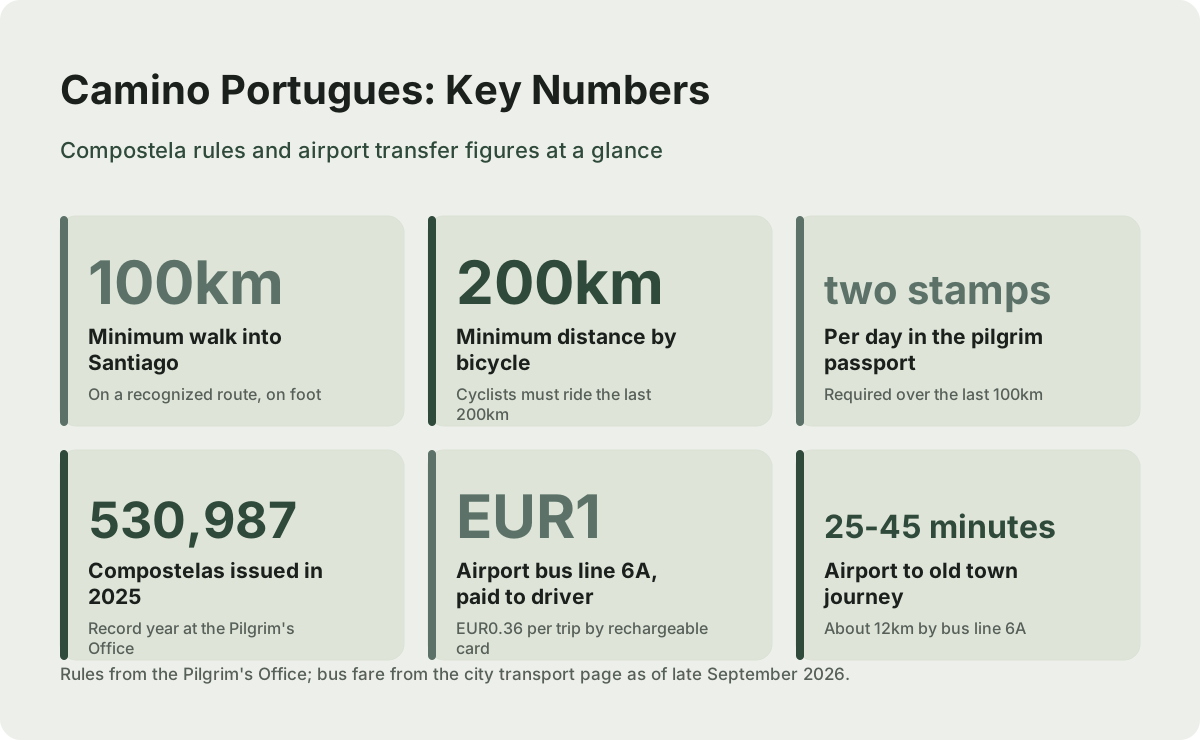
| Airport to Santiago de Compostela old town | Bus line 6A | EUR1 to the driver, EUR0.36 by card | About 12km, journey roughly 25-45 minutes |
| Airport bus change pending | New Monbus contract | Proposed around EUR6 fare | Expected in autumn 2026, possibly by December |
The airport row deserves a dated note. As of late September 2026 the city's transport page lists Tussa line 6A at EUR1 paid to the driver and EUR0.36 per trip on a rechargeable card, but a new Monbus contract with a higher proposed fare, around EUR6, is expected to take effect in autumn 2026, possibly by December. Any walker planning arrival in that window should treat the fare as subject to change and check the operator's live page rather than budget a fixed figure.
How Do You Qualify For The Compostela On The Camino Portugues?
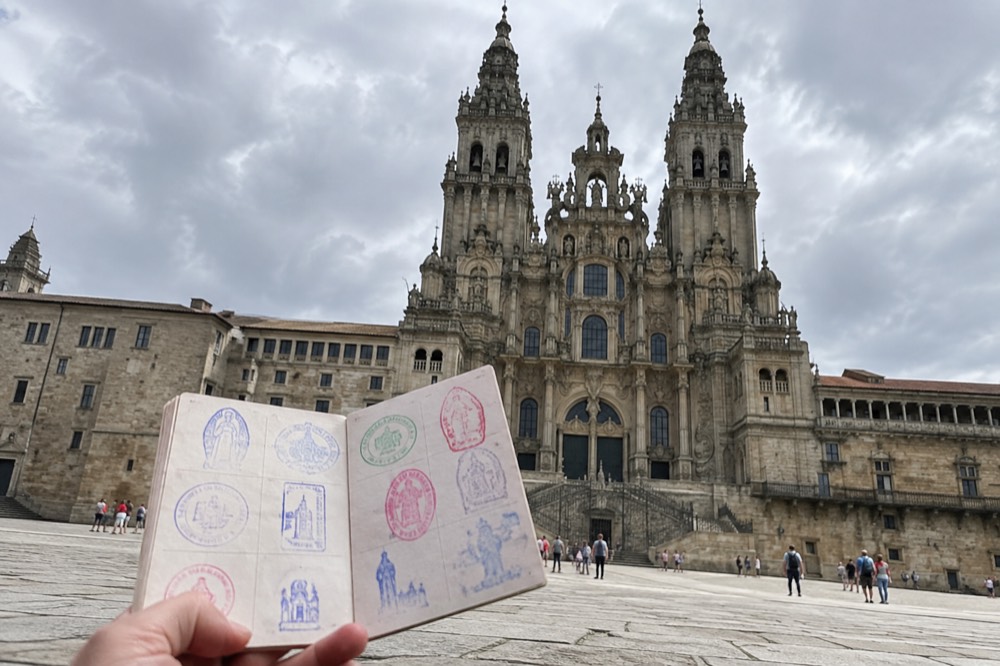
To earn the Compostela certificate you must walk at least the last 100km into Santiago de Compostela on a recognized route, collecting at least two stamps per day in your pilgrim passport from official stamping points, and you must present the passport in person at the Pilgrim's Office at Rua das Carretas 33. Cyclists need the last 200km. On the Camino Portugues that 100km threshold is why so many walkers stage their start from Tui.
The rules come from the Oficina del Peregrino, the Pilgrim's Office that issues the certificate, and they are mechanical rather than judgmental. The two-stamps-per-day requirement is about proof of a continuous walk, not about visiting any particular place: stamps from albergues, churches, bars and town halls along the route all count, as long as the last 100km shows two per day. The pilgrim passport guide explains how the credencial works and where to collect it before you start walking.
The scale of the thing is worth knowing. The Pilgrim's Office issued 530,987 Compostelas in 2025, a record year, and the Portugues is the second-largest contributor to that total after the Frances. Queues at Rua das Carretas 33 reflect it: arriving early in the day, and not on the 25th of July if you can avoid it, keeps the wait short. The office's FAQs state the in-person requirement plainly, so plan your first afternoon in the city around the visit.
| Requirement | Rule | Where it is checked |
|---|---|---|
| Minimum distance on foot | Last 100km on a recognized route | Pilgrim's Office, Rua das Carretas 33 |
| Minimum distance by bicycle | Last 200km on a recognized route | Pilgrim's Office, Rua das Carretas 33 |
| Proof of passage | At least two stamps per day in the credencial | Passport inspection at issue |
| Issue | In person only, no postal option | Pilgrim's Office counter |
Where Do You Sleep On The Camino Portugues?
Sleeping on the Camino Portugues runs the full range from municipal and parish albergues costing a few euros a night, through private albergues with smaller dorms and better showers, to small hotels and guesthouses in every town of any size. Portugal's stretch has a strong guesthouse culture with fewer classic pilgrim dorms, while Galicia from Tui onward has the full Spanish albergue network, and the busiest beds are always in the last 100km.
The contrast between the two countries is the detail most first-time Portugues walkers miss. South of the border you are mostly in pilgrim-friendly guesthouses and a scattering of albergues, and booking a day ahead is normal in the Portuguese summer. Once you cross at Tui the Spanish network takes over: municipal albergues, donation-based or fixed low price, private albergues with more comfort, and casas rurales in the smaller villages. The full picture, including what to expect from parochial versus private beds, is in our Camino accommodation and albergues guide.
The pressure point is the Compostela threshold again. Because the last 100km qualifies, the stretch from Tui onward absorbs a wave of walkers who start there for a week-long walk, and beds in the classic stopover towns fill earliest. Walking a little further than the standard stage, or carrying the section where beds are thin, is the usual fix. Some walkers also use a luggage transfer service so the daily decision is about distance rather than weight, and our Camino luggage transfer guide covers how that works on the Portuguese routes.
When Is The Best Time To Walk The Camino Portugues?
The best months for the Camino Portugues are late spring, May and June, and early autumn, September and October, when the Atlantic weather is settled enough for walking and the trail and albergues are not at peak pressure. July and August are the driest months but the busiest and hottest in the open sections, and October to March is wet and cool, with the deepest quiet but the highest chance of walking in rain.
The climate framing comes straight from the official data. AEMET's station for Santiago de Compostela records a temperate oceanic climate: rain somewhere in every month of the year, a wet and cool season from October to March, and the driest period in July and August, with annual precipitation on the order of 1,690 to 1,890mm. That is a wet climate by any European standard, and the Portugues spends its whole length inside it. Rain kit is a year-round item, not a seasonal one, on this route.
| Season | Conditions on the Portugues | What it means for planning |
|---|---|---|
| May to June | Settled, green, warming | The most popular balance of weather and crowds |
| July to August | Driest and warmest, peak pilgrim season | Book beds ahead, expect company |
| September to October | Cooling, still busy, autumn colour | Good walking, rain risk rising from October |
| November to March | Wet and cool, very quiet | Full rain kit, many albergues reduce hours |
One seasonal fact belongs on any Camino calendar. 2027 is the next Holy Year, the Xacobeo, not 2026: the Holy Door opens on 31 December 2026 and the Holy Year runs through 31 December 2027, because 25 July 2027 falls on a Sunday. Walking into Santiago de Compostela during a Holy Year is a different experience, busier and more ceremonial, and our Holy Year 2027 guide lays out what changes and when. For a quieter walk, avoid 2027; for the full pilgrimage theatre, plan around it.
What Awaits You In Santiago de Compostela At The End?
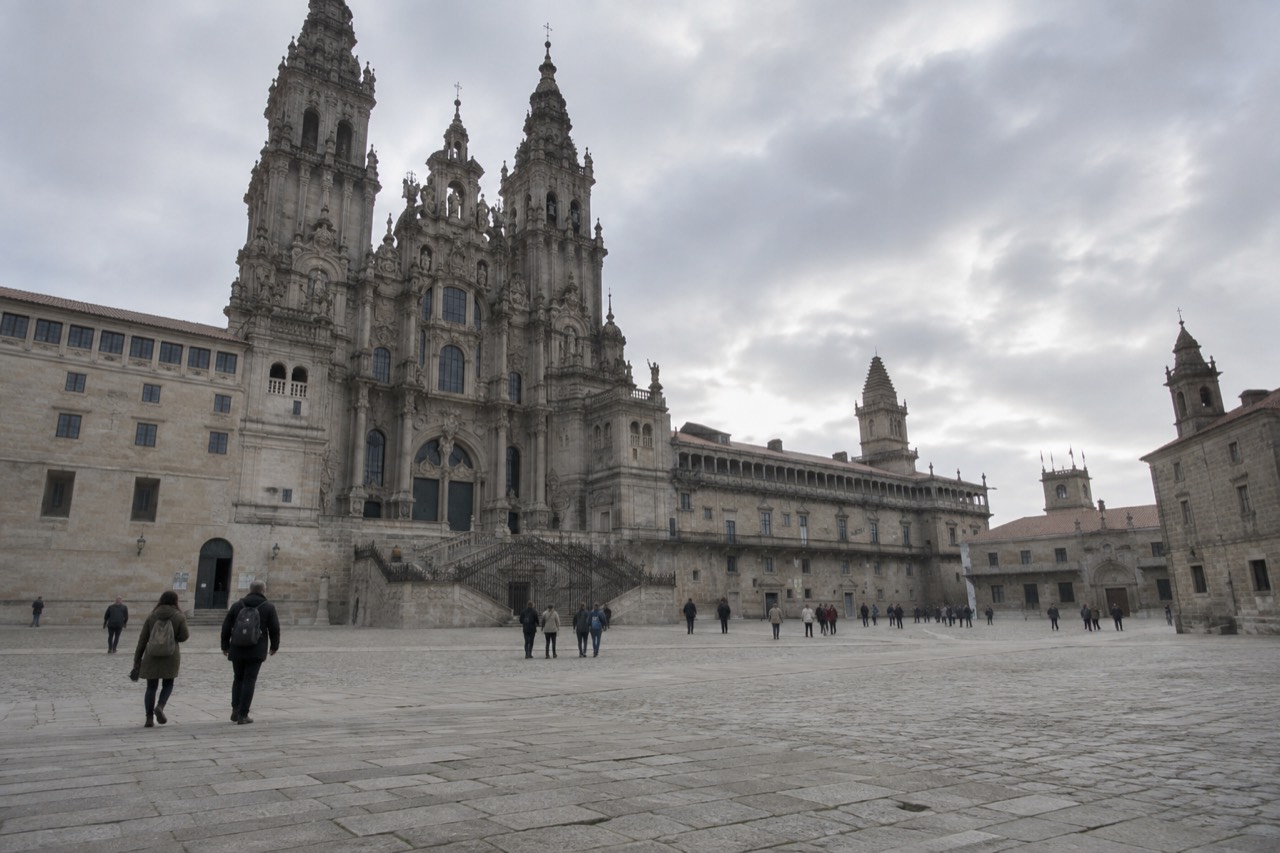
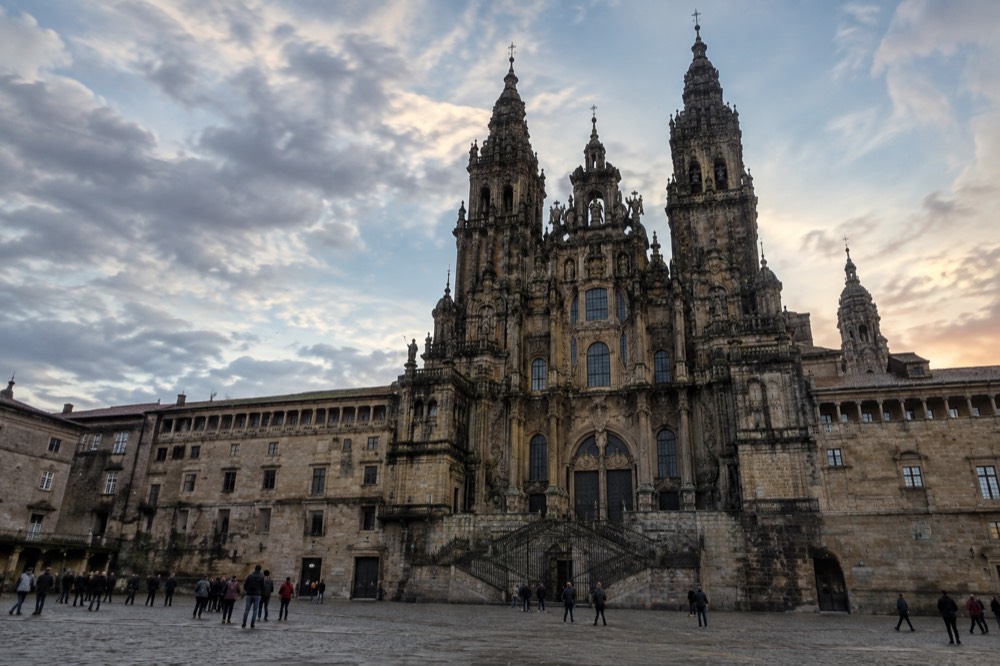
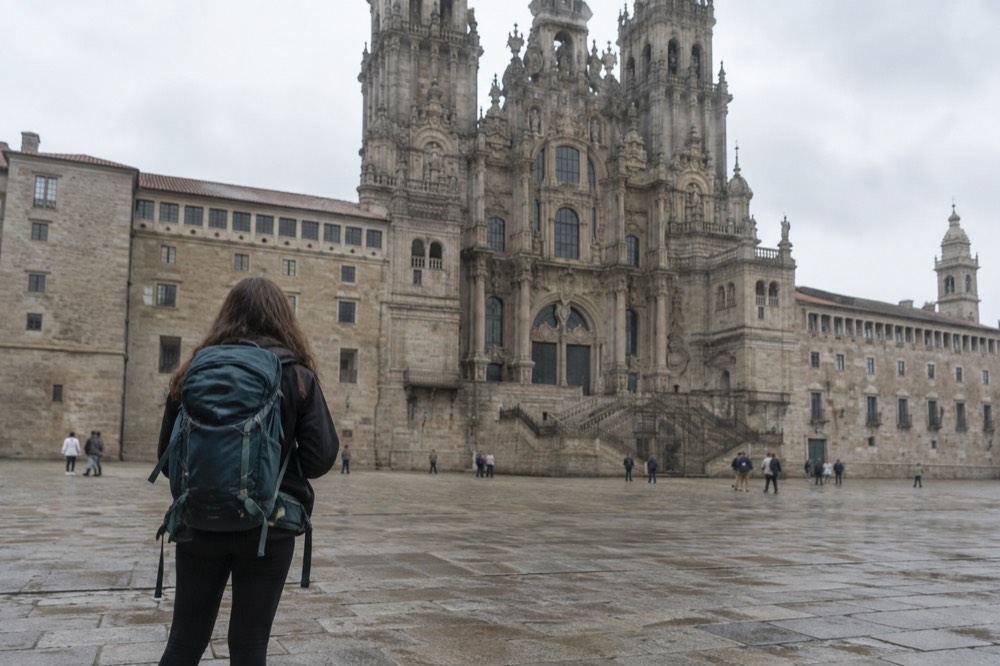
Arriving in Santiago de Compostela, walkers reach the Cathedral, the tomb of St. James beneath the high altar, and the Pilgrim's Office for the Compostela. Two things are different in 2026: the Botafumeiro is currently out of action because dome-restoration scaffolding covers its mechanism, with no return date published, and from 16 October 2026 the 9:30am, noon and 7:30pm pilgrim masses move from the Cathedral's high altar to the nearby Church of San Agustin, leaving only the 7:30am mass in the Cathedral itself.
The arrival is the emotional payoff of the whole route, so it is worth knowing what state the Cathedral is in before you plan your final day. The good news first: the Cathedral's naves, the Apostle's tomb and the embrace area remain fully open, with free entry generally from about 7:00am to 9:00pm. The interior works are confined to the crossing dome, which is what has grounded the Botafumeiro, the giant incense burner that normally swings on twelve fixed solemnities a year. The Cathedral confirmed in writing on 5 September 2026 that the suspension is due to the scaffolding, not a breakage, and no return date has been published. Do not build your last day around seeing it fly.
The mass relocation is the other dated change. Until 15 October 2026 the pilgrim masses are at the main altar at 7:30am, 9:30am, noon and 7:30pm. From 16 October 2026, until further notice, the 9:30am, noon and 7:30pm masses relocate to the Church of San Agustin, a short walk away, while the 7:30am mass stays in the Cathedral's Communion chapel. Walkers arriving after mid-October should check the Cathedral's own liturgy page for the current arrangement rather than assume the altar they have seen in photos.
| Pilgrim mass | Until 15 October 2026 | From 16 October 2026 |
|---|---|---|
| 7:30am | Cathedral, main altar | Cathedral, Communion chapel |
| 9:30am | Cathedral, main altar | Church of San Agustin |
| 12:00 noon | Cathedral, main altar | Church of San Agustin |
| 7:30pm | Cathedral, main altar | Church of San Agustin |
The classic day-after-arrival move is to see the city you just walked into, and the Cathedral's own rooftops tour is the strongest version of that. The Cathedral itself operates the Cubiertas and Torre de la Carraca guided visit: about 60 minutes, about 140 steps, and views from roughly 72 metres above the rooftops of the old town, at EUR15 general or EUR12 reduced, with pilgrims among those eligible for the reduced rate. It is bookable online with timed slots on the Cathedral's own ticket site, and slots in high season sell out. A licensed operator also runs a Cathedral and Carraca Tower Roofs tour, and Check availability on the operator's live listing if you prefer a guided option in English. Our Cathedral rooftops tour guide covers what the climb actually involves.
For the city itself, a guided walk with an official guide is the efficient way to decode the old town's stones after a week of walking past them at pilgrim pace. The Hidden City Walking Tour runs from $17 per person and is rated 5 from 13 reviews, a small-review-count product but a strong one, and its dates can be checked on the operator's live listing. The free GuruWalk layer is worth knowing too: the Essential Free Tour Santiago includes an individual radio guide and is rated 4.96 from 1,099 reviews, tip-based, with the guide named on the listing, and it costs nothing to join beyond what you choose to tip.
What Should You Do In Galicia After The Walk?
The strongest post-walk options from Santiago de Compostela are the Atlantic day trips west and north: the Costa da Morte and Fisterra, where many pilgrims traditionally walked on to the sea, the Cies Islands, and the Rias Baixas wine country. A day trip to the Catedrais beach and Lugo combines a spectacular rock-arch shoreline with a complete Roman wall, and a guided excursion runs from $68 per person, rated 4.9 from 181 reviews.
The Fisterra extension is the one with real Camino meaning. A medieval tradition held that Santiago de Compostela was not the true end, that the road continued to the ocean at Fisterra, the "end of the world" on the Costa da Morte, and a modern version of that extension exists as its own short walk from Santiago de Compostela, covered in our Camino Finisterre guide. Walkers short on days can reach the same coast by bus or by an organized excursion, and the Costa da Morte tours are among the most-reviewed products in the region: the From Santiago Finisterre, Muxia and Costa da Morte tour runs from $59 per person and is rated 4.7 from 2,312 reviews, a full day.
For a rest-day excursion in a different direction, the Catedrais beach and Lugo trip covers two of Galicia's headline sights in one day. The beach's natural arches are only walkable at low tide, and Lugo's Roman wall is the only complete one of its kind in Spain, fully circuitable on foot. The excursion runs from $68 per person, rated 4.9 from 181 reviews, and its availability can be checked on the operator's live listing for your dates. Wine walkers tend to prefer the Rias Baixas instead, Albarino country, described in our guide to the Rias Baixas wine region and Cambados.
| Post-walk excursion | From | Rating | Reviews | Style |
|---|---|---|---|---|
| Finisterre, Muxia and Costa da Morte | $59 | 4.7 | 2,312 | Full day |
| Catedrais beach, Lugo and Asturias | $68 | 4.9 | 181 | Full day, guided |
| Rias Baixas with winery and mussel boat | $54 | 4.8 | 322 | Full day, optional boat |
| Fisterra and Muxia Express | $45 | 4.4 | 50 | Half day, express |
How Should You Plan Your Camino Portugues Day By Day?
Plan the Camino Portugues around the Compostela threshold rather than the full distance: decide your start point from whether you want the whole route from Porto or the qualifying last 100km from Tui, then break the walk into daily stages of a distance you have actually tested, with rest days built into the Galician half where the hills and the bed pressure both rise. Book the first night and the last two nights in advance, and leave the middle looser.
Stage planning on this route is really two decisions. The first is the start, covered earlier: Porto for most walkers, Lisbon for the long version, Tui for the qualifying week. The second is daily distance, and the honest advice is to test your planned stage length on consecutive days at home before committing to it for a fortnight. A distance that feels fine on day one feels different on day five in rain, which on this route is a real planning input, not a hypothetical. The time budgets for each route length are worked through in our answer on how long the Camino takes to walk.
The Galician half deserves the extra planning attention. It is hillier than Portugal's stretch, bed pressure is at its highest within the qualifying 100km, and the final approach into Santiago de Compostela mixes forest tracks with suburban streets that reward knowing where the quiet entries are. Our arriving in Santiago on the Camino guide covers the last day in detail, and the wider Camino de Santiago routes page shows how all the routes, Portugues included, converge on the city.
Common Questions About The Camino Portugues
How long does the Camino Portugues take to walk?
The length depends entirely on your start point. From Tui, the qualifying last 100km, most walkers take about a week. From Porto, the most common full start, the walk typically runs about two weeks depending on daily distance, and from Lisbon it is roughly a week to a week and a half longer again before you even reach Porto.
Is the Camino Portugues good for beginners?
Yes. Its profile is gentler than the mountain routes, waymarking on the Central variant is reliable, and the albergue network from Tui onward is dense enough that a mistake in stage planning rarely leaves you stranded. The main beginner caution is the Atlantic rain, which can appear in any month.
Where does the Camino Portugues cross into Spain?
The Central variant crosses the Minho river at the international bridge into Tui. Coastal walkers can also cross the river by ferry near A Guarda and join the Galician network from Oia onward. Both crossings put you inside the last 100km that qualifies for the Compostela.
Do I need to book accommodation in advance?
It depends on the season and the country. In Portugal, guesthouse culture makes booking a day or two ahead normal in summer. In Galicia, the municipal and private albergues fill earliest in the last 100km in July, August and Holy Year periods, so booking the busiest stopover towns ahead is sensible at peak times.
Can I see the Botafumeiro when I arrive in Santiago de Compostela?
Not currently. The Botafumeiro is out of action because scaffolding for dome restoration covers its mechanism, confirmed in writing by the Cathedral on 5 September 2026, with no return date published. It normally swings on twelve fixed solemnities a year, but no visitor should plan around seeing it until the Cathedral announces its return.
What if I want to keep walking after Santiago de Compostela?
The traditional continuation is the walk out to Fisterra on the Costa da Morte, the medieval "end of the world" extension, which exists today as its own marked route from Santiago de Compostela. Shorter on time, the same coast is reachable by full-day excursions from the city.
The Camino Portugues is the route for walkers who want the pilgrimage's classic ending without its busiest approach: a border, two languages, the greenest walking in the network, and the same Praza do Obradoiro finish every pilgrim since the Middle Ages has aimed for. Choose your variant with the sea in mind, stamp the passport twice a day from Tui, and arrive knowing exactly what has moved and what has not inside the Cathedral this year.