Camino Primitivo: Walking The Original Route To Santiago de Compostela
The Camino Primitivo is the original pilgrim route to Santiago de Compostela, running from Asturias through the mountains of Galicia to the Cathedral of St. James. This guide covers its character, difficulty, the Compostela certificate rules, where pilgrims sleep, and what has changed in Santiago de Compostela in 2026 and 2027.
Short answer
The Camino Primitivo is the oldest of the pilgrim routes into Santiago de Compostela, beginning in Asturias and crossing mountain terrain before joining the network that ends at the Cathedral. Pilgrims who walk the final 100km, or cycle the final 200km, with two stamps per day in a credencial, qualify for the Compostela certificate, issued in person at the Pilgrim's Office in Santiago de Compostela.
The Camino Primitivo is the route that made Santiago de Compostela a destination in the first place: the pilgrim road from Asturias, the oldest recorded way to the tomb of St. James, walked by kings centuries before the Camino Frances became the busy spine of the network. This site's editorial desk covers it as a route to Santiago de Compostela in Galicia, Spain, the cathedral city where every Camino ends, not the Chilean capital or any of the other Santiagos a bare search of that word can produce. The Primitivo is quieter, wetter and harder than the Frances, and it suits pilgrims who want mountains, solitude and a genuine physical challenge before the final walk into the Old Town, which UNESCO inscribed as a World Heritage Site in 1985, separate from the 1993 inscription of the Routes of Santiago de Compostela themselves.
What Is The Camino Primitivo To Santiago de Compostela?
The Camino Primitivo is the original pilgrim route to Santiago de Compostela, beginning in Asturias and walking southwest through the mountains into rural Galicia before joining the older, busier route network at a shared final stretch into the city. It is called Primitivo, meaning original or primitive, because it traces the earliest recorded pilgrimage from the Asturian kingdom to the tomb of St. James, centuries before the Camino Frances existed.
The name is not marketing. The first pilgrims who travelled to the newly discovered tomb of the Apostle came from Oviedo, the seat of the Asturian court, and their path through the interior mountains became the template for everything that followed. The route's full story, from that first royal pilgrimage through the medieval boom, is covered in the site's history of the Camino de Santiago, which treats the Primitivo as the founding thread of the whole tradition.
What distinguishes the Primitivo from the other routes compared in the site's overview of Camino de Santiago routes is terrain and traffic. It crosses some of the most demanding mountain country of any recognized route, and it carries a fraction of the walkers of the Frances. Pilgrims who choose it tend to be returning Camino walkers, or first-timers who specifically want quiet. The trade is simple: fewer beds, fewer crowds, more climbing, more mud.
How Hard Is The Camino Primitivo Compared With Other Camino de Santiago Routes?
The Camino Primitivo is widely regarded as the most physically demanding of the main recognized routes into Santiago de Compostela, because it crosses high mountain terrain with sustained ascents and descents, and its weather is the wet Atlantic climate of Asturias and Galicia rather than the drier plateau the Camino Frances crosses. It is not a route for a first walk unless that walker is fit, and it is not the route most beginners should choose.
For beginners, the site's dedicated comparison, which Camino is best for beginners, walks through the choice in detail, and the Primitivo is not its recommendation. The difficulty is not technical, there is no scrambling or exposure, it is cumulative: long climbs on consecutive days, steep descents that punish knees, and sections where rain turns the track to mud. Weather is the multiplier. AEMET's climate data for the Santiago de Compostela station shows a temperate oceanic pattern, wet year-round, wetter from October to March, drier in July and August, with annual precipitation on the order of 1,690-1,890mm. The Primitivo's mountain sections sit in the same wet Atlantic system.
The honest comparison, in the site's voice:
| Route | Start Point | Character | Who It Suits |
|---|---|---|---|
| Camino Primitivo | Oviedo, Asturias | Original, mountainous, quiet | Fit walkers, returning pilgrims |
| Camino Frances | Saint-Jean-Pied-de-Port / Roncesvalles | Busiest, best-served, classic | First-time pilgrims |
| Camino Portugues | Lisbon or Porto | Flat to rolling, city and coast | Walkers wanting gentler terrain |
| Camino del Norte | Irun along the northern coast | Long, coastal, hilly | Walkers wanting sea and solitude |
| Camino Ingles | Ferrol or A Coruna | Short, qualifies for the certificate | Pilgrims with limited days |
A comparison of the Primitivo with the Portuguese route, the other main mountain-versus-gentle choice, is covered in the site's answers on how difficult the Portuguese Camino is and on which is better, the Portuguese Camino or the French Camino. The site also answers the age question directly, and the Primitivo is the route where that answer matters most.
What Do You Need To Qualify For The Compostela Certificate?
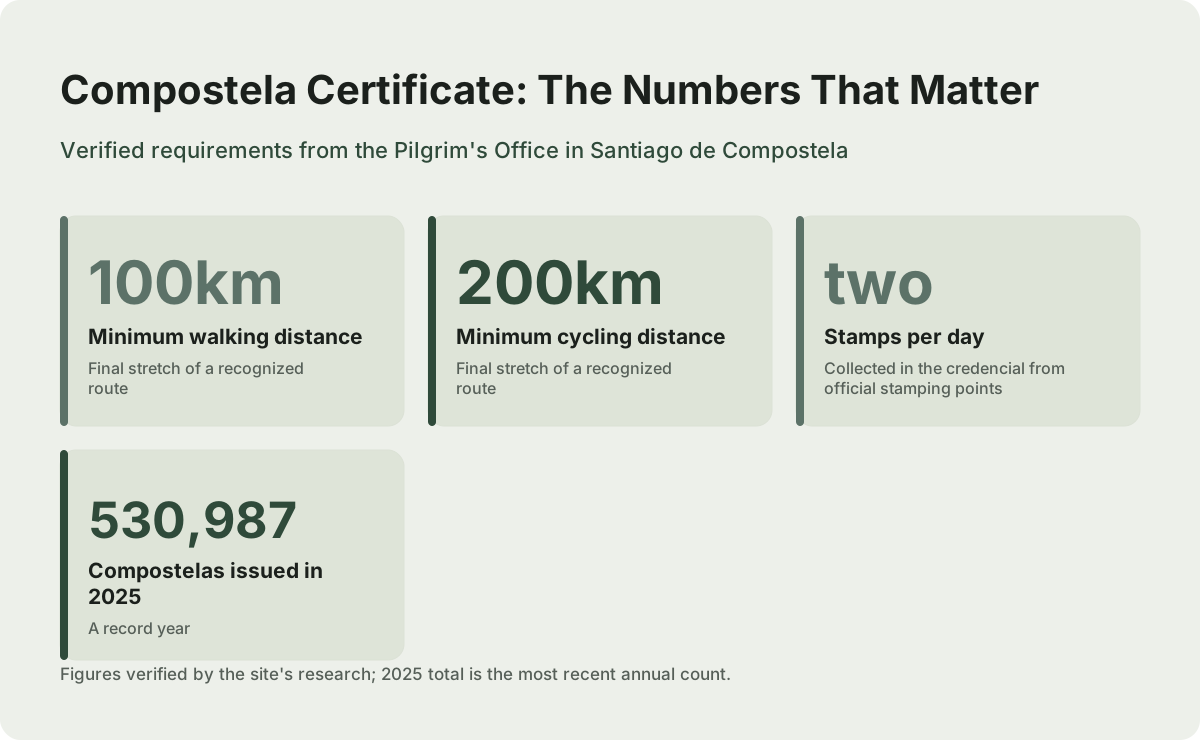
To earn the Compostela certificate, the Pilgrim's Office requires a pilgrim to have walked at least the final 100km of a recognized route into Santiago de Compostela, or cycled the final 200km, with at least two stamps per day collected in the credencial, the pilgrim passport, from official stamping points along the way. The certificate is issued in person only, and no walker receives it by post or email.
Those rules come from the Oficina del Peregrino's own published requirements, and they apply to the Primitivo exactly as they apply to every other route. The two-stamps-per-day rule is the one that catches walkers on quiet routes: on the Primitivo's remote stretches, stamping points are thinner on the ground than on the Frances, so collecting a second stamp each day takes planning. The credencial itself, where to get one and how the stamping system works, is covered in the site's guide to the pilgrim passport and credencial, and the certificate itself in the site's guide to the Compostela certificate.
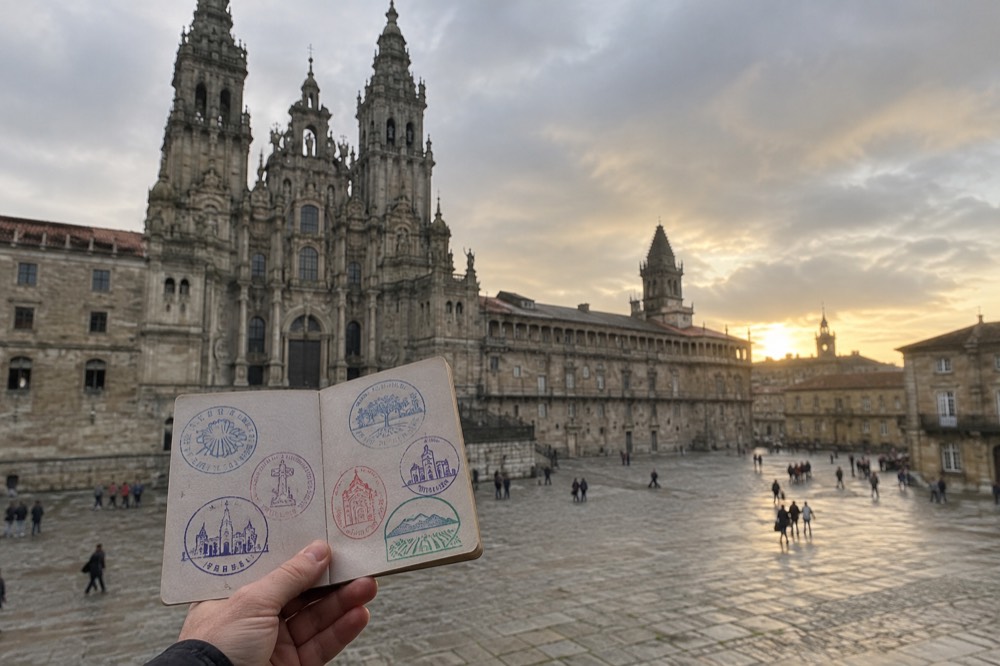
The office that issues the certificate sits at Rua das Carretas 33 in Santiago de Compostela, with hours that vary seasonally, roughly from morning to evening, and closed on 25 December and 1 January. The most recent annual figure the site's research verified is 530,987 Compostelas issued in 2025, a record year, which puts the size of the modern pilgrimage in perspective against a route like the Primitivo that carries only a small share of those walkers.
| Certificate Requirement | Walking | Cycling |
|---|---|---|
| Minimum qualifying distance | Final 100km | Final 200km |
| Stamps in the credencial | Minimum two per day | Minimum two per day |
| Where it is issued | Rua das Carretas 33, in person only | Rua das Carretas 33, in person only |
| Routes that qualify | Any recognized Camino route, including the Primitivo | Any recognized Camino route, including the Primitivo |
When Is The Best Time Of Year To Walk The Camino Primitivo?
The best window for the Camino Primitivo is late spring through early autumn, with the driest and warmest conditions in July and August according to AEMET's climate data for the region, while October to March is wet, cool and materially harder on the mountain sections. Spring offers longer days and greener country, and shoulder months trade thinner crowds against a higher chance of rain.
The climate of the Santiago end of the route is verified from AEMET station 1475X, Santiago de Compostela / Labacolla: temperate oceanic, wet year-round, wetter from October to March, driest in July and August. The site refuses to publish a month-by-month rainfall table for now because that granular table has not been extracted from AEMET's own data, and this site does not print a figure it has not verified. What can be said with certainty is directional: the wet season is long, and the Primitivo's mountain stages suffer most from it.
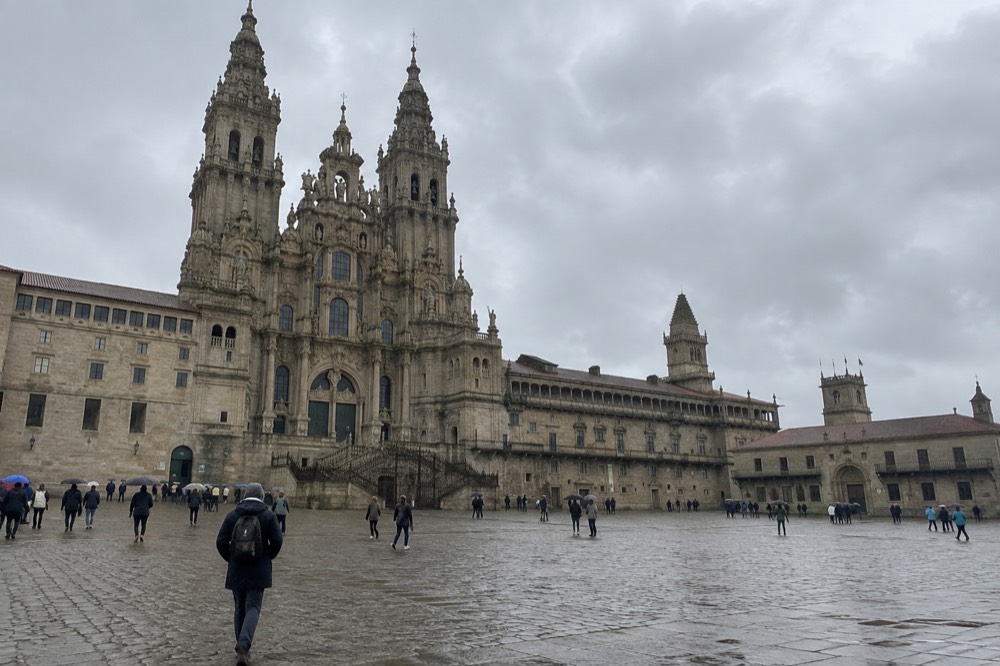
Two seasonal factors matter more on the Primitivo than on the Frances. First, daylight: the route sits at Galicia's latitude, and winter walking days are short, which compresses what can be walked safely in mud. Second, the best month to walk the Camino de Santiago is a decision that has to weigh the Primitivo's thinner accommodation network, since seasonal closures are more common on quiet routes than on routes with year-round demand. The site's guide to the best time to visit Santiago de Compostela covers the city end of that decision.
| Season | Weather Pattern (AEMET Station 1475X) | What It Means On The Primitivo |
|---|---|---|
| October to March | Wettest and coolest period of the year | Muddy tracks, short days, more seasonal closures |
| April to June | Wetter than summer, greener country | Long days, cold mountain mornings, thinner crowds |
| July and August | Driest months of the year | Firm tracks and long days, busiest small-town beds |
| September | Transition month, mixed conditions | A practical compromise of light, weather and space |
Where Do You Sleep On The Camino Primitivo?
Accommodation on the Camino Primitivo follows the standard Camino pattern of public albergues, private albergues, small guesthouses and hotels, but the network is thinner than the Camino Frances, with fewer beds in smaller villages and a real need to stop walking where the beds are rather than where the body would prefer. Booking ahead is normal practice on this route in the busier months.
The site's guide to Camino accommodation and albergues covers the system in full: the public network, the private network, what an albergue stay involves, and the etiquette of dormitory sleeping. On the Primitivo specifically, the practical difference is density. Where the Frances offers a bed every few kilometres through high season, the Primitivo's mountain stages concentrate walkers into a small number of overnight villages, and a full house at the last open albergue is a genuine possibility in July and August.
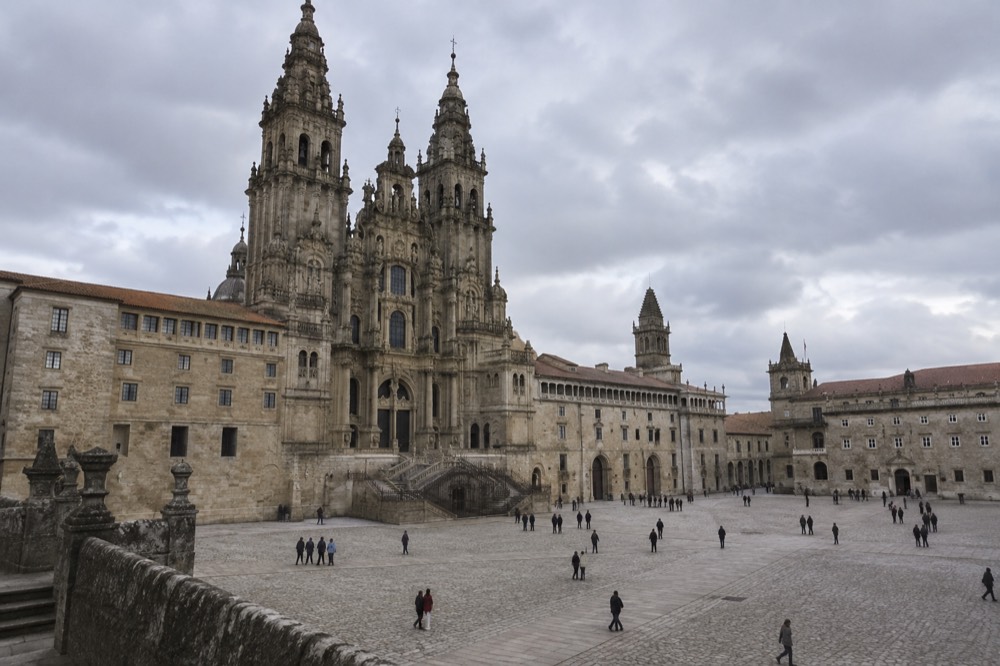
Pilgrims who would rather not carry everything have options covered in the site's guide to Camino luggage transfer, which is worth reading for the Primitivo's long climbs even if it feels like cheating on gentler routes. The cost question is answered in the site's average cost to walk the Camino de Santiago breakdown, and the honest framing is the same there as here: prices move with the season and the room, so treat any figure as a planning range and check the listing or the albergue directly.
What Should You Pack For The Camino Primitivo?
Pack for a wet mountain walk, not a warm-weather stroll: broken-in walking boots with real ankle support, genuine rain protection for body and pack, layers for cold mornings at height, a sleeping bag liner or light bag for albergues, and the credencial carried somewhere it cannot be soaked or lost. The Primitivo's terrain and weather punish over-packing more than any other main route.
The full checklist lives in the site's Camino packing list, which was written with routes like this in mind. Two items earn their place on the Primitivo specifically. Boots over trail shoes: the descents are steep and long, and wet rock and mud make a rolled ankle the classic Primitivo injury. A pack cover plus dry bags inside, not instead: sustained Atlantic rain finds a single layer of defence eventually.
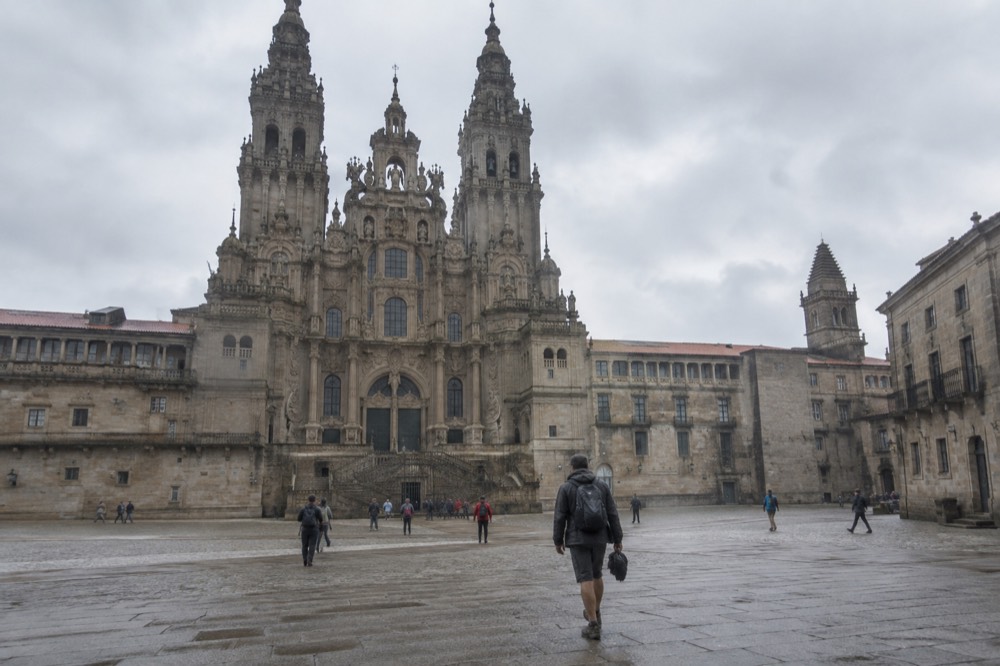
What to leave behind matters as much. The site's Camino de Santiago master guide makes the point that almost every first-time pilgrim carries too much in the first week and posts things home from the second. On this route, the mountain stages make that lesson arrive faster.
What Do You See Along The Camino Primitivo?
The Camino Primitivo delivers the interior of Asturias and Galicia: high mountain passes between green valleys, medieval hospitals and bridges built to serve pilgrims centuries ago, the Roman walls and old city of Lugo as the route crosses that provincial capital, and finally the shared approach into Santiago de Compostela past Monte do Gozo, where the first sight of the city opens up.
It is a landscape route more than a monuments route. The early stages from Asturias are the highest walking of any main Camino, and the middle stages run through some of the least-visited country in Galicia, deep forest, small farm villages, stone crosses at track junctions. Lugo, one of the site's verified day-trip destinations, is the largest city on the Primitivo after the start, and its intact Roman walls ring the old centre. Many Primitivo walkers stop there a full afternoon just to walk the walls.
| Section Of The Primitivo | Landscape And Character | Highlight |
|---|---|---|
| Asturian start | High passes, short stages, steep climbing | The first mountain crossings above green valleys |
| Border country | Remote forest tracks, few services | The most solitary walking of any main route |
| Lugo approach | Rolling farmland and river valleys | The Roman walls of Lugo's old city |
| Final stretch | Shared corridor with the Frances network | The arrival at Monte do Gozo and the city |
The end of the walk is covered in the site's guide to arriving in Santiago on the Camino, including Monte do Gozo, the hill viewpoint whose name means hill of joy. The final stages of the shared corridor bring the Primitivo's quiet to an abrupt end, because the last walk into the city is the busiest part of the entire network, and the contrast is part of the experience.
Arriving In Santiago de Compostela: What Changes In 2026 And 2027?
Walkers arriving in Santiago de Compostela from October 2026 onwards should know three verified things: the Botafumeiro is currently out of action because dome-restoration scaffolding covers its mechanism, confirmed in writing by the Cathedral on 5 September 2026 with no return date published; the 9:30am, noon and 7:30pm pilgrim masses move to the Church of San Agustin from 16 October 2026; and 2027 is the next Holy Year, with the Holy Door opening 31 December 2026 and the Holy Year running through 31 December 2027.
Each of those is time-sensitive and verified, and each changes plans. The Botafumeiro, the great censer that normally swings on twelve fixed liturgical solemnities a year, cannot be promised to any visitor right now, and the site's Botafumeiro guide tracks the position. The mass relocation is temporary but open-ended, tied to main-chapel remodelling works preparing for the Holy Year: until 15 October 2026 the 7:30am, 9:30am, noon and 7:30pm masses are at the Cathedral's High Altar, and from 16 October 2026 the 7:30am mass remains in the Cathedral's own Communion chapel while the other three move to San Agustin nearby. The site's pilgrim mass guide carries the full detail.
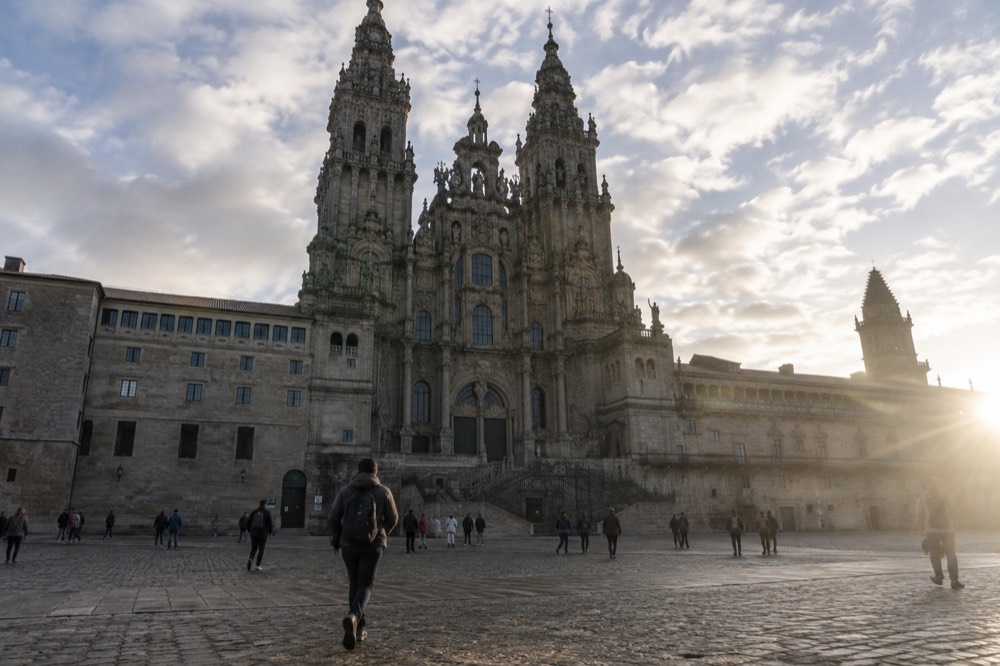
The Holy Year is the bigger picture. Because 25 July 2027 falls on a Sunday, 2027 is a Xacobeo, declared whenever the Apostle's feast day lands on a Sunday, and the Holy Door opens on the evening of 31 December 2026 at the Praza da Quintana ceremony, staying open through 31 December 2027. The site's guide to the Holy Year 2027 covers what that means for crowds: a Primitivo walker arriving in 2027 should expect the quietest route in the network to feel noticeably less quiet, and should book early.
| Arrival Fact | Before 16 October 2026 | From 16 October 2026 |
|---|---|---|
| 7:30am pilgrim mass | Cathedral, High Altar | Cathedral, Communion chapel |
| 9:30am pilgrim mass | Cathedral, High Altar | Church of San Agustin |
| Noon pilgrim mass | Cathedral, High Altar | Church of San Agustin |
| 7:30pm pilgrim mass | Cathedral, High Altar | Church of San Agustin |
| Botafumeiro | Suspended, scaffolding over the mechanism | Suspended, no return date published |
For the Cathedral visit itself, the interior remains open daily, roughly 7:00am to 9:00pm, with free general entry, and the museum runs from about 10:00am to 8:00pm with tickets in a EUR9-23 range depending on type. The site's Cathedral tickets and opening hours guide holds the full breakdown, and the rooftop and tower visit is the one arrival experience most worth reserving ahead.
The Cathedral's own ticketing lists the Cubiertas and Torre de la Carraca guided rooftop visit, about 60 minutes with 140 steps and views from roughly 72 metres, at EUR15 general or EUR12 reduced, bookable online with timed slots, and English-language visits at a flat EUR15. Reduced rates apply to accredited pilgrims, which every Primitivo finisher with a Compostela in hand qualifies for. That ticket also grants seven-day access to the museum's permanent collection and other cathedral spaces, one use per space.
Between the certificate and the city, a rest day is the standard advice, and the site has a dedicated guide to the rest day after the Camino. Many Primitivo walkers extend the pilgrimage itself one final step further: the route onward to the sea at Fisterra, covered in the site's Camino Finisterre guide, and the question of whether the walk from Santiago to Finisterre is worth it. For those who stop in the city instead, the coast is reachable as a day trip, including the full-day Finisterre and Costa da Morte excursions in the picks above.
Whatever the ending, the walk itself is the reason to choose this route, and the Santiago de Compostela Travel Guide editorial desk keeps every Camino page on this site anchored to verified primary sources: the Cathedral's own liturgy and ticketing pages, the Oficina del Peregrino's published rules, and AEMET's station data for the Santiago de Compostela climate.
Common Questions About The Camino Primitivo
What Is The Camino Primitivo?
The Camino Primitivo is the original pilgrim route to Santiago de Compostela, starting in Asturias and crossing mountain country into Galicia before joining the shared final corridor into the city. It is the oldest recorded way to the tomb of St. James and the most physically demanding of the main recognized routes.
Is The Camino Primitivo Harder Than The Camino Frances?
Yes. The Primitivo crosses sustained mountain terrain with long climbs and steep descents, in the wet Atlantic climate of Asturias and Galicia, while the Frances runs through gentler country with far denser services. AEMET's climate data for the region shows wet weather year-round, wetter October to March, and the Primitivo's stages feel that fully.
How Many Days Does The Camino Primitivo Take?
The site does not publish a day count for the Primitivo because the details below are not confirmed by a stage-by-stage breakdown for this route. The honest planning method is to start from the days available, the minimum 100km qualifying distance for the Compostela, and the route's thin accommodation network, which fixes the overnight villages and therefore the daily distances. The general question is answered in how long it takes to walk the Camino de Santiago.
Can A Beginner Walk The Camino Primitivo?
A fit beginner can, but it is not the recommended first Camino. The mountain stages and the two-stamps-per-day credencial discipline on a quiet route both raise the difficulty. A first-time pilgrim who still wants the Primitivo should train on consecutive hilly days with a loaded pack beforehand, and read the site's beginner comparison before committing.
Does The Camino Primitivo Qualify For The Compostela Certificate?
Yes. It is a recognized route, so the standard rules apply: walk at least the final 100km with a minimum of two credencial stamps per day, collect stamps at official points, and present the completed credencial in person at the Pilgrim's Office, Rua das Carretas 33, Santiago de Compostela. Cyclists need the final 200km.
When Is The Best Month To Walk The Camino Primitivo?
July and August are the driest months per AEMET's regional data, with late spring a good trade of lighter crowds against a higher rain chance. October to March is the wet, cool season and the hardest time for the route's mountain stages. Full reasoning is in the site's best month to walk the Camino de Santiago answer.