Botafumeiro In Santiago de Compostela: Dates, Suspension, And What To See Instead
The Botafumeiro, the giant swinging censer of Santiago de Compostela Cathedral, is the city's single most requested spectacle, and right now it is not operating. This guide sets out what it is, the 12 solemnities on which it normally swings, the restoration scaffolding that has grounded it, and what the Cathedral still offers visitors while it rests.
Short answer
The Botafumeiro normally swings at the end of Mass on 12 fixed liturgical solemnities a year, or by private request. As of late September 2026 it is out of action: scaffolding for the cimborrio restoration covers its hanging mechanism, the Cathedral confirmed the stoppage in writing on 5 September 2026, and no return date has been published.
The Botafumeiro of Santiago de Compostela is a thurible the size of a small person, swung on ropes across the Cathedral's transept, and it is the most famous single object in Galicia after the bones of the Apostle himself. Pilgrims who have walked weeks across Spain ask about it before they ask where to sleep. And yet the honest answer to the question every visitor asks, will it swing while I am here, is currently no: the Cathedral confirmed in writing on 5 September 2026 that the Botafumeiro is temporarily out of action, because scaffolding for the restoration of the cimborrio, the dome over the crossing, covers its hanging mechanism, and no return date has been published.
This page, from the Santiago de Compostela Travel Guide editorial desk, sets out exactly what the primary sources say: the 12 solemnities on which the censer normally flies, the times of day it historically appears, how the private request system works when it is running, why it is grounded now, and how the Cathedral's worship and visiting schedule changes around it, including the relocation of three of the four daily pilgrim Masses to the Church of San Agustin from 16 October 2026.
What Is The Botafumeiro Of Santiago de Compostela?
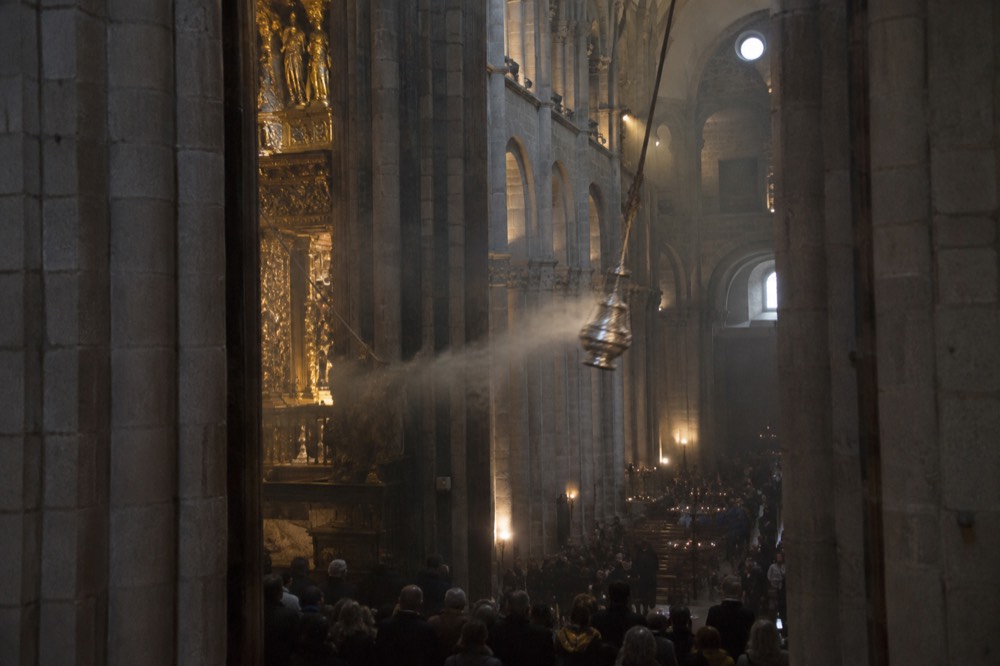
The Botafumeiro is a giant thurible, a censer for burning incense, that hangs from ropes in the crossing of Santiago de Compostela Cathedral and is swung at high speed across the transept by a team of tiraboleiros pulling the rope. The Cathedral Chapter guarantees its use during the main solemn Mass on 12 fixed liturgical dates each year, and outside those dates it can be requested privately. It does not operate daily, and it does not appear at every pilgrim Mass.
The name needs no translation help once you hear it spoken: botafumeiro is Galician for "smoke thrower." The object exists for the oldest and most practical of reasons. Santiago de Compostela was the destination of medieval pilgrims who arrived after weeks of walking, and a swinging censer perfuming the church has always been the liturgical answer to a crowded nave. The device is attached to the crossing directly beneath the cimborrio, the lantern tower over the intersection of nave and transept, which is precisely why the current dome restoration has grounded it.
What surprises many visitors is that the spectacle is not a tourist performance at all. The Cathedral's own liturgy page treats the Botafumeiro as part of the Eucharist: it flies at the end of the Mass, typically around 45 minutes after the Mass begins, as the liturgy reaches its close. The tiraboleiros, the men who work the rope, are functionaries of the Chapter, and the whole operation belongs to the order of worship rather than to any visitor program.
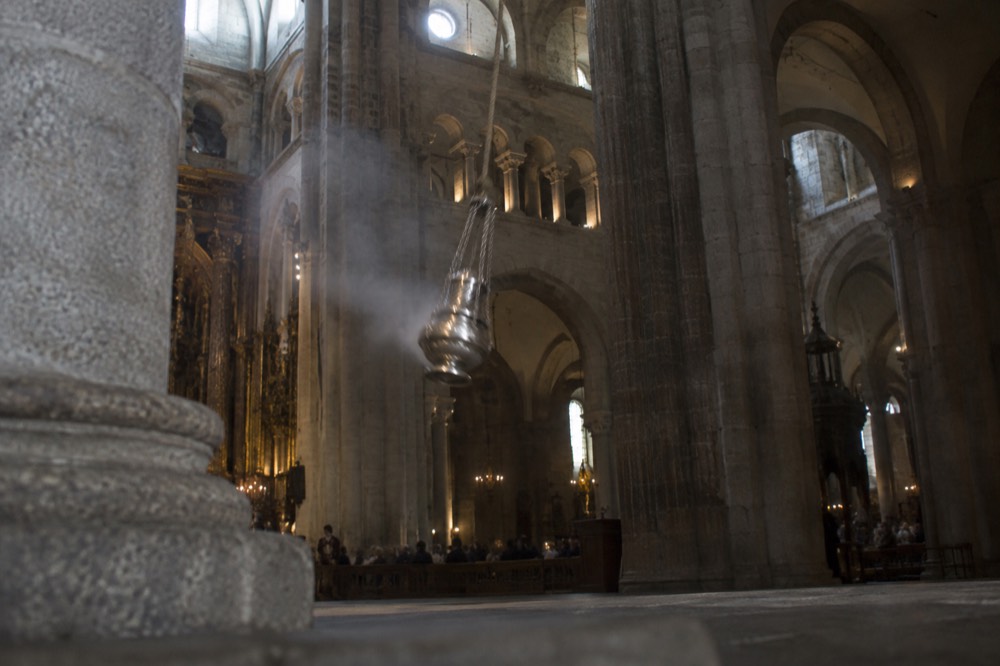
The full setting matters too. The censer operates inside the Cathedral of Santiago de Compostela, the endpoint of the Camino de Santiago and a building whose tomb of St. James is the reason the city exists. The Cathedral's interior, including the naves, the High Altar and the crypt, remains fully open daily roughly 7:00am to 9:00pm, with general entry free via the Praterias door, even while the dome works continue above. The suspension affects the censer alone, not the visit.
On Which Dates Does The Botafumeiro Normally Swing?
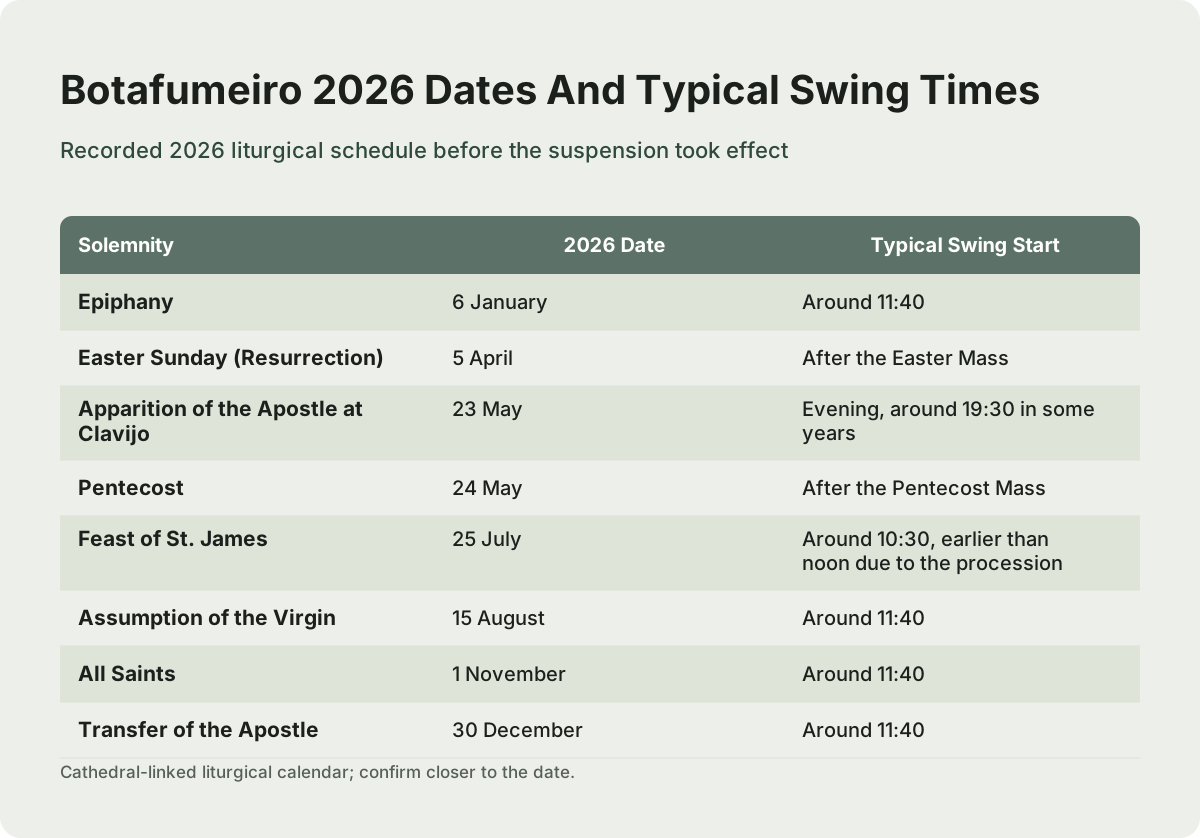
On a normal year the Botafumeiro swings during the main solemn Mass on 12 dates: Epiphany on 6 January, Easter Sunday, the Ascension, the Apparition of the Apostle at Clavijo on 23 May, Pentecost, the Feast of St. James on 25 July, the Assumption on 15 August, All Saints on 1 November, Christ the King, the Immaculate Conception on 8 December, Christmas Day, and the Transfer of the Apostle on 30 December. It flies at the end of the Eucharist, typically around 45 minutes after Mass begins.
That list comes from the Cathedral Chapter's own liturgical calendar, and it is the list every local source repeats. Several of the dates are fixed to the calendar and land on the same day every year: Epiphany, St. James, the Assumption, All Saints, the Immaculate Conception, Christmas and the Transfer of the Apostle. Others move with the Easter cycle, so the Ascension, Pentecost and Christ the King shift annually. In a year when 25 July falls on a Sunday, the whole city becomes a Holy Year, and the Feast of St. James Mass carries the national offering to the Apostle.
The recorded 2026 schedule, published by the Cathedral-linked calendar before the suspension took effect, gives a useful picture of the typical pattern, including the fact that solemnity Masses often start earlier than the usual noon slot because of processions:
| Solemnity | 2026 Date | Typical Start Of The Swing |
|---|---|---|
| Epiphany | 6 January | Around 11:40 |
| Easter Sunday (Resurrection) | 5 April | After the Easter Mass |
| Apparition of the Apostle at Clavijo | 23 May | Evening, around 19:30 in some years |
| Pentecost | 24 May | After the Pentecost Mass |
| Feast of St. James | 25 July | Around 10:30, earlier than noon due to the procession |
| Assumption of the Virgin | 15 August | Around 11:40 |
| All Saints | 1 November | Around 11:40 |
| Christ the King | 22 November | Around 11:40 |
| Immaculate Conception | 8 December | Around 11:40 |
| Christmas Day | 25 December | Around 11:40 |
| Transfer of the Apostle | 30 December | Around 11:40 |
Times marked in that table are indicative, drawn from the 2026 liturgical program, and the sources themselves advise confirming closer to the date on the Cathedral's liturgy calendar because solemnity Masses shift for processions. The lesson for a planner is structural rather than precise: on the fixed dates the censer historically appears late morning, roughly 40 to 50 minutes into the main solemn Mass, and on the Feast of St. James the whole timetable moves earlier because the national offering and the procession come first.
Anyone hoping to see the censer in a future year should plan around the fixed summer dates, 25 July and 15 August, when the city is at its fullest and the solemn Mass is the largest of the year. The Feast of St. James brings fireworks, concerts and folk events across the city alongside the Mass, so the day rewards a full visit even without the censer. The answer to the narrower question, does it swing daily, is covered on our does the Botafumeiro swing every day page.
For travelers whose trip is about the Cathedral itself rather than one specific spectacle, guided visits with skip-the-line entry are the most reliable way into the building in peak season:
Those three options cover the building from different angles: the skip-the-line visit focuses on the Cathedral, the historic town walk puts the building in its urban setting, and the combined cathedral, museum and old town product is the fullest single booking. Whichever shape the visit takes, the table of solemnity dates above remains the calendar to plan around for a future flight of the censer.
Why Is The Botafumeiro Not Operating Right Now?
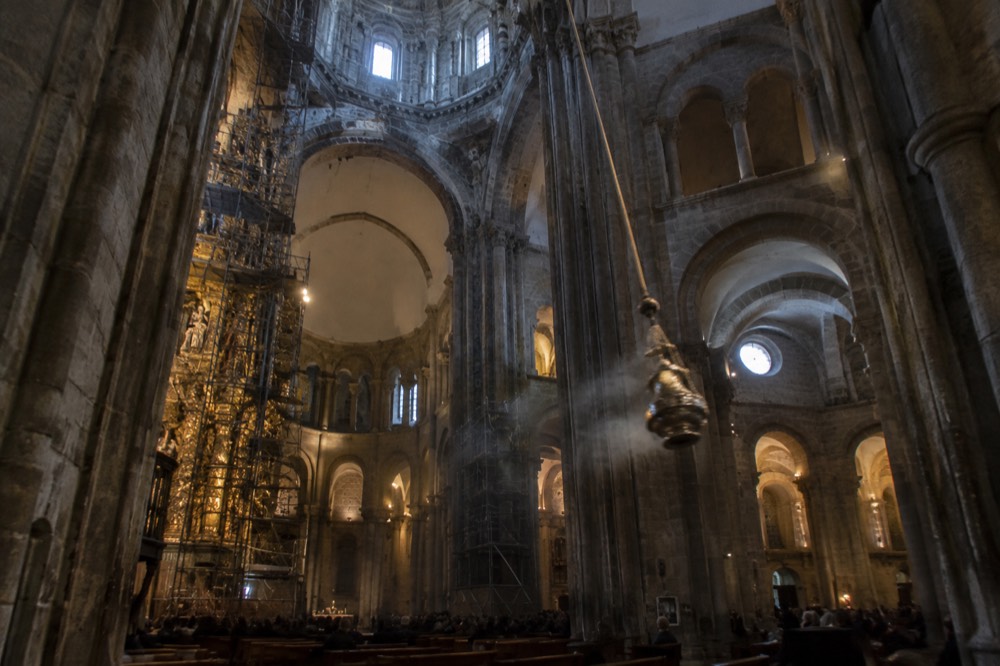
The Botafumeiro is temporarily out of action because interior scaffolding erected for the restoration of the cimborrio, the dome over the Cathedral's crossing, covers the mechanism from which the censer hangs. The Cathedral confirmed the stoppage in writing on 5 September 2026 and has published no date for its return. The suspension is not a breakage or a malfunction, and it does not close the Cathedral: the naves, the tomb of the Apostle and the embrace of St. James all remain open.
This is the single most important fact on the page, and it is the one most competing guides get wrong. The cimborrio restoration is active work inside the Cathedral, with scaffolding standing over the crossing. The Botafumeiro's rigging depends on that exact volume of space, so while the scaffold is up, the censer cannot fly, neither on its solemnity dates nor by private request. The Cathedral's written confirmation of 5 September 2026, reported by the city's own what-to-see page as of late September, is the primary statement of record, and it includes no reopening date.
The same works program touches other parts of the building without closing anything visitors use. The Berenguela clock tower is under an exterior restoration spanning 2026 and 2027, covering stonework, the clock machinery, the wooden structures and the Berenguela bell, and a second phase of chapel roof restoration was authorized in May 2026 to address leaks. All of that is exterior-focused. The museum, the rooftops and the Portico da Gloria are reported with no closures or restrictions beyond normal timed ticketing and conservation limits.
| Item | Status |
|---|---|
| Cathedral naves, tomb, embrace | Fully open, normal hours, free entry via Praterias door |
| Botafumeiro | Suspended, scaffolding over the hanging mechanism, no return date |
| Cimborrio dome restoration | Active, interior scaffolding over the crossing |
| Berenguela clock tower | Exterior restoration works, 2026 to 2027, no visit impact |
| Museum and Portico da Gloria | Open, timed ticketing as normal |
| Pilgrim Masses at the High Altar | Continue until 15 October 2026 |
A planner reading that table should draw one conclusion: do not build a Santiago itinerary around seeing the censer fly. Nothing in the current works program suggests the stoppage is short, and no date exists to plan against. What the sources do promise is a fully open Cathedral, and the sections below cover what that still includes, from the cathedral rooftops tour to the Portico da Gloria.
Can You Request The Botafumeiro Privately?
Outside its 12 guaranteed solemnities, the Botafumeiro can normally be requested privately for a group, by email to the Cathedral, and the request system is the route the Cathedral Chapter itself publishes. As of this writing the private request channel is unavailable along with the scheduled swings, because the same scaffolding that grounds the annual dates grounds every flight. No private booking can currently be made, so treat any offer that promises you the censer as a sign to walk away.
When the system is running, requests go to the Cathedral by email, and the arrangement is made directly with the Chapter rather than through any tour operator or platform. That matters for honesty: the censer is a liturgical act inside a Mass, not a bookable performance, and the Cathedral treats it that way. Our reporting policy on this site is to decline to publish the indicative private request cost as a currently bookable figure, because at present it is not bookable at any figure, and prices quoted for suspended services mislead readers.
The warning in that last sentence deserves its own paragraph. The suspension is public, confirmed in writing, and dated, yet a traveler searching today will still find pages implying the censer can be arranged for a group as if nothing had changed. The Oficina del Peregrino's FAQs and the Cathedral's own liturgy page are the sources that carry the current status, and this site flags live conditions rather than freezing them. Before any trip built around the censer, check the status again; the situation is a live one, and the restoration that caused it is a multi-year project tied to preparations for the 2027 Holy Year.
There is also a timing question hiding inside the private request topic. The Holy Door opens on the evening of 31 December 2026 at Praza da Quintana, and the Holy Year runs through 31 December 2027. A dome restoration scheduled around Holy Year preparations makes the censer's return plausibly, though this is inference and not a published date, a matter for the Xacobeo itself. The Holy Year 2027 page covers what the city has confirmed for that year.
If the censer is the reason you are considering a guide at all, redirect the intent rather than cancelling it: the building that houses the censer is the deeper sight, and a guided visit covers the tomb, the Portico da Gloria, the architecture and the history that made a smoke throwing machine necessary in the first place. The guided products below are the ones this site rates for that redirected visit, and they can all be reserved with cancellation protection.
Where In The Cathedral Does The Botafumeiro Fly?
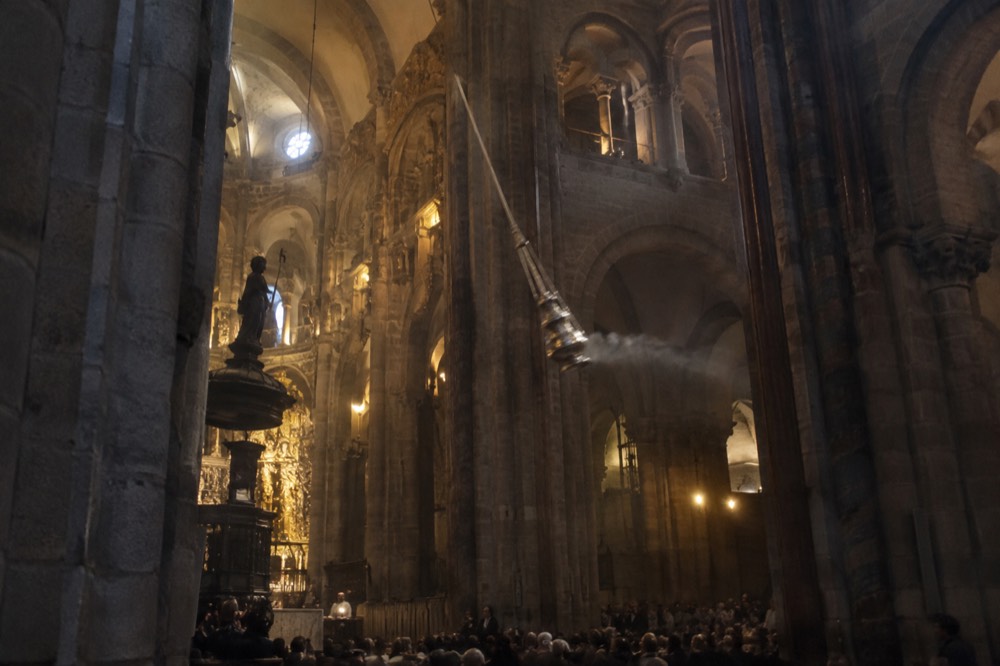
The Botafumeiro flies across the Cathedral's transept, directly beneath the cimborrio at the crossing where the nave and the transepts meet, roughly 40 to 50 minutes after the solemn Mass begins, at the end of the Eucharist. Spectators historically gather in the nave and the transept aisles with clear sightlines up into the crossing, which is the same volume now occupied by the restoration scaffolding.
The geometry explains both the spectacle and the suspension. The rigging hangs from the lantern of the dome, high above the crossing floor, and the censer sweeps in a great arc along the transept, passing over the heads of the congregation at height. The ropes are worked from the crossing, the tiraboleiros haul in rhythm, and the censer accelerates with each pass. Any structure standing in that volume, such as the current scaffold, makes the flight impossible, which is the whole story of the current stoppage in one sentence.
For a future visit, the practical seating and standing advice follows from the liturgy rather than from a viewing gallery. The swing belongs to the main solemn Mass of the day, historically the noon or late-morning celebration on the fixed dates in the table above, and arriving before the Mass begins, rather than at its end, is the pattern regulars follow. The pilgrim Mass page covers the Mass schedule in full, including the current relocation of three of the four daily Masses to the Church of San Agustin from 16 October 2026, which changes where a solemnity is actually celebrated while the High Altar works continue.
That relocation deserves its own careful statement, because it is dated and it affects exactly the kind of traveler who plans around a solemnity:
How Do Pilgrim Masses Change From 16 October 2026?
From 16 October 2026, the 9:30am, noon and 7:30pm pilgrim Masses relocate from the Cathedral's High Altar to the nearby Church of San Agustin, while the 7:30am Mass stays in the Cathedral, celebrated in its own Communion chapel. Until 15 October 2026 all four Masses continue at the Cathedral's High Altar. The Cathedral itself remains open to visitors throughout, and the move is tied to main chapel remodelling ahead of the 2027 Holy Year.
The two arrangements side by side:
| Pilgrim Mass | Until 15 October 2026 | From 16 October 2026 |
|---|---|---|
| 7:30am | Cathedral, High Altar | Cathedral, Communion chapel |
| 9:30am | Cathedral, High Altar | Church of San Agustin |
| 12:00 noon | Cathedral, High Altar | Church of San Agustin |
| 7:30pm | Cathedral, High Altar | Church of San Agustin |
For a pilgrim arriving in the city, the change is smaller than it first looks. San Agustin is a nearby church, not a distant one, and the Oficina del Peregrino's FAQs along with the Cathedral's liturgy page carry the arrangement. What it does change is the ritual of standing in the nave for the noon Mass, which for generations has been the moment arriving pilgrims queue for their Compostela certificate and then attend. The certificate itself is still issued in person only at Rua das Carretas 33, unchanged.
There is also a note of caution worth adding about any Mass plan: the times above are the published daily pilgrim schedule, and solemnities move their own Masses, sometimes earlier, sometimes with processions attached. The Feast of St. James in 2026, for instance, carried an earlier start because of the national offering. Anyone planning a visit around a specific solemnity should treat the Cathedral's liturgy calendar as the live authority and re-check it close to the date, exactly as the Cathedral's own materials advise.
What Can You See In The Cathedral While The Botafumeiro Rests?
The Cathedral remains one of the most visitable churches in Spain even with the censer grounded: the basilica interior is free to enter daily roughly 7:00am to 9:00pm, the Cathedral Museum is open daily around 10:00am to 8:00pm with tickets in a range of roughly EUR9 to EUR23 depending on type, and the official Cubiertas rooftop and Torre de la Carraca guided tour costs EUR15 general or EUR12 reduced, bookable online with timed slots.
The rooftop figure is the one travelers most often miss, because the tour is run by the Cathedral itself through its own ticketing site, separately from the guided visit products sold through operators. The official listing describes a guided visit of around 60 minutes including about 140 steps and views from a height of around 72 meters, and the ticket includes free access to the museum's permanent collection, the Palacio de Gelmirez, the crypt of the Portico da Gloria, MuSar and the Diocesan Museum, valid for seven days with one use per space. Reduced rates apply to accredited pilgrims, students, unemployed visitors, large families, disabled visitors, over-65s and under-12s with proof at entry.
| Cathedral Visit Option | Price | What It Includes |
|---|---|---|
| Basilica interior | Free entry | Naves, High Altar, crypt, no ticket needed |
| Cathedral Museum | Roughly EUR9-23 by ticket type | Permanent collection, Gelmirez Palace |
| Rooftops and Torre de la Carraca | EUR15 general, EUR12 reduced | 60-minute guided tour, about 140 steps, museum access valid 7 days |
| Portico da Gloria | Via museum ticket | Timed, audio-guided, conservation-limited access |
The Cathedral Museum and the cathedral of Santiago de Compostela pages on this site carry the full detail on each of those options. The Portico da Gloria, the sculpted portal by Master Mateo whose major restoration finished in 2018, is under no current restriction beyond its normal timed and time-limited access, so the grounding of the censer costs a visitor nothing there. The museum operates on timed ticketing and closes its ticket office 30 minutes before the doors.
For visitors who prefer a guide to a self-directed visit, several bookable products cover the Cathedral and the old city, and their current pricing and review figures, as carried on the operators' live listings, look like this:
| Guided Visit | Kind | From Price | Rating |
|---|---|---|---|
| Guided Cathedral Visit, Skip Line | Cathedral | From $31 | 4.7 from 582 reviews |
| Cathedral, Museum, Old City | Cathedral | From $34 | 4.9 from 115 reviews |
| Half Day, Cathedral Tickets Included | Cathedral | From $45 | 4.9 from 47 reviews |
| Cathedral Roofs, Carraca Tower | Cathedral | From $42 | 4.6 from 132 reviews |
| Historic Town Walk, Official Guide | Walking tour | From $14 | 4.8 from 144 reviews |
The last row is the budget pick among them: an official-guide walking tour of the historic town at from $14 per person. And for travelers who want the cheapest structured introduction of all, the GuruWalk free tours, tip-based walks led by named local guides, cover the historic center at no fixed price at all. Among the paid options, the skip-the-line Cathedral visit is the one this site most often recommends for a first visit, because it pairs the building's interior with a guide at a moderate price:
That product typically spends its time inside the basilica itself, so it pairs well with a separately booked rooftops slot on the same day, one visit below the scaffold and one above the whole city.
What Else Fills A Botafumeiro-shaped Gap In A Santiago Day?
If the censer was going to be the centerpiece of your day, replace it with the Portico da Gloria, the rooftops tour, the pilgrim Mass at whichever church is celebrating it, and the evening Praza do Obradoiro, and you will still spend the day inside the most complete medieval ensemble in Galicia. The Old Town of Santiago de Compostela has been UNESCO-listed since 1985, and the Camino routes themselves carry a second UNESCO inscription from 1993.
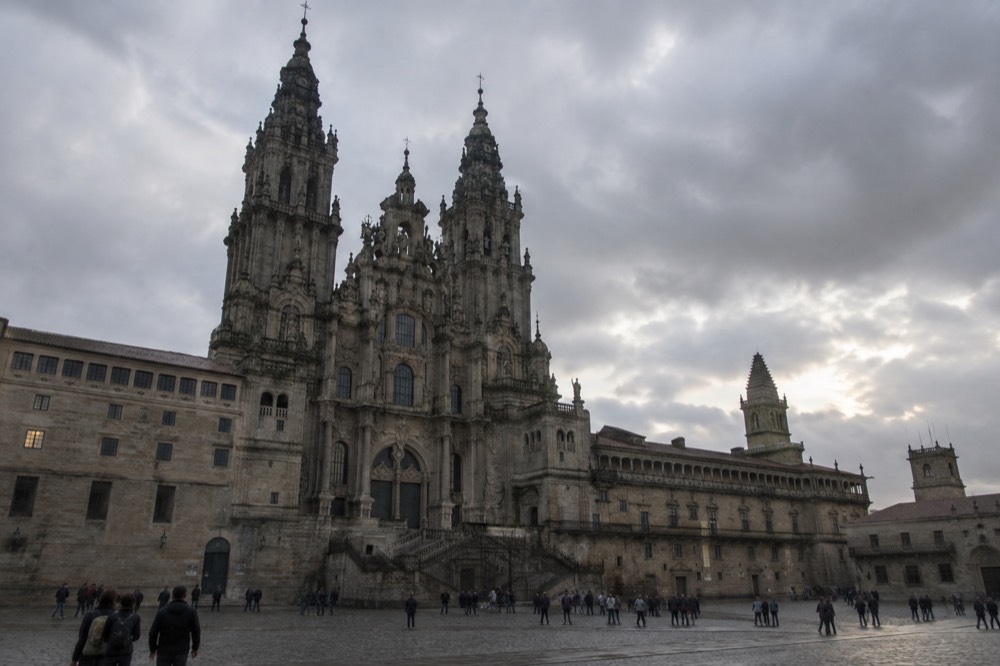
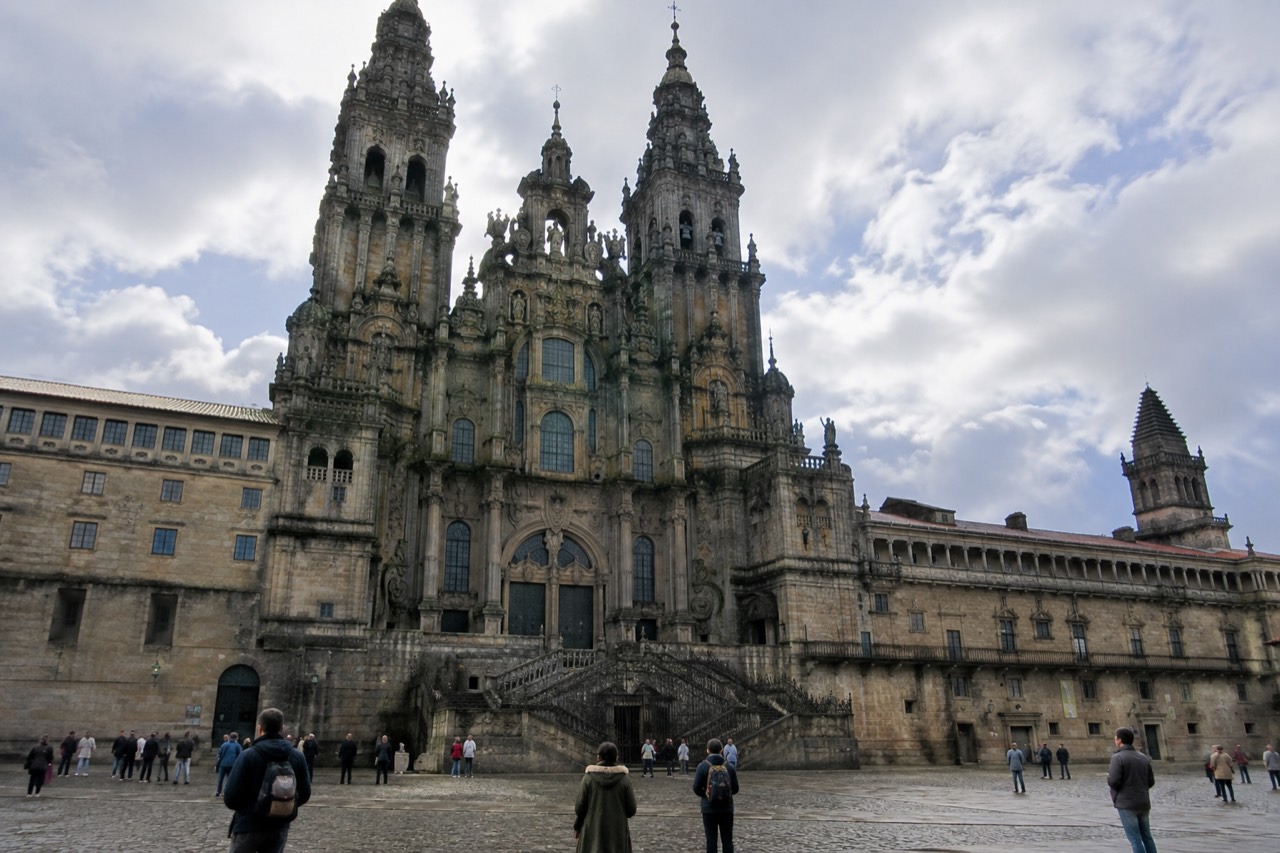
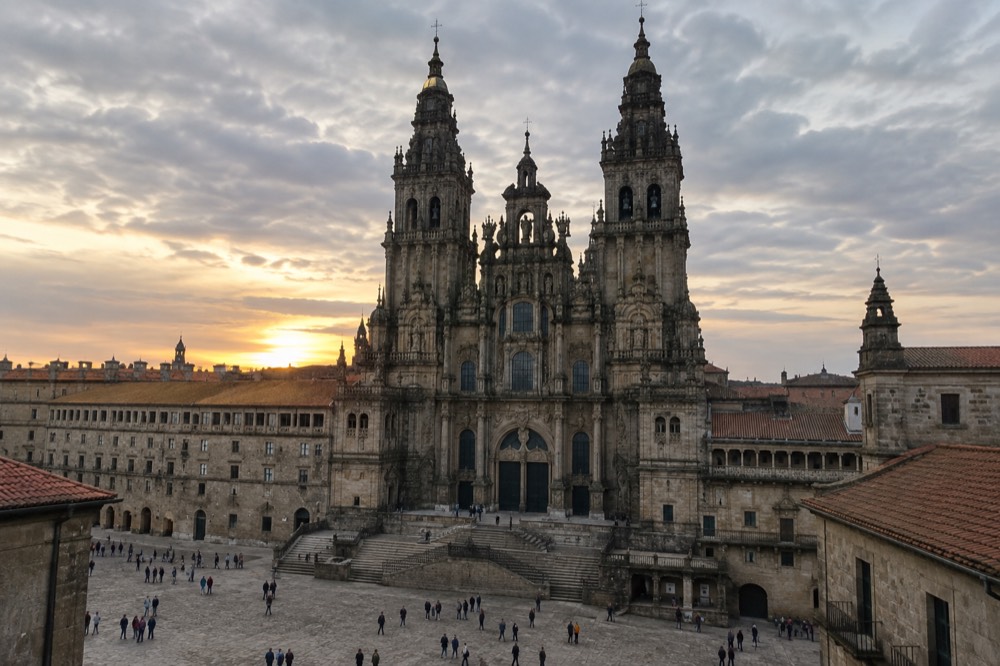
Begin in the morning at the Praza do Obradoiro, the grand square facing the Cathedral's baroque facade, where arriving pilgrims have always posed beneath the Hostal dos Reis Catolicos, now a Parador. Then enter the basilica free, visit the tomb and the embrace of the Apostle, and let the interior scaffolding over the crossing be a piece of living restoration rather than a disappointment: the works are the latest chapter in the history of a building that has been remodeled and restored many times over.
Afternoon belongs to the ticketed spaces. The museum's permanent collection and the Gelmirez Palace sit off the square, and the rooftops tour, if you book it in time, gives you the whole city laid out green to the horizon, because Santiago de Compostela is a low city in a high landscape of hills. The rooftops option is the one to reserve online in advance, timed slots sell out in peak season, and it is the Cathedral's own channel rather than a reseller's.
Evening is when the city performs for free. The Praza da Quintana, with the Holy Door facing it, is the spot where the Holy Year will visibly begin on 31 December 2026, and the Praza da Quintana and Holy Door page explains the door's mechanics and its plasterwork secret. Rua do Franco and the streets off it fill with pilgrims comparing final stamps, and the Mercado de Abastos closes its day in the late afternoon, hours should be checked on the market's own site before you build a plan around them.
Between the afternoon and the evening, a combined cathedral, museum and old town tour is the single booking that covers most of what this page describes in one guided sweep, and it is the product this site recommends for visitors who want the building and its setting explained together:
For a lighter, cheaper alternative that still puts an official guide in front of you, the historic town walk covers the squares, the streets and the stories at from $14, leaving the Cathedral's interior for a free self-guided visit afterwards:
Either way, the day reconstructs itself around what the Cathedral can still give, and neither walk requires you to book the ticketed interior options in advance.
How Should You Plan Around A Future Botafumeiro Return?
Plan around the fixed dates, book the Cathedral's timed offerings in advance, and re-verify the censer's status directly before you travel, because the return date does not exist in any published source as of this build. The next fixed solemnities are All Saints on 1 November, Christ the King, the Immaculate Conception on 8 December, Christmas Day and the Transfer of the Apostle on 30 December, and that festive cluster is the strongest candidate window for a first flight back.
That window is inference, stated as inference, not a promise. What is published is the works calendar: cimborrio scaffolding now, a Holy Door opening ceremony on the evening of 31 December 2026, and a Holy Year running through 31 December 2027. A city preparing its dome and its main chapel for a Holy Year has every architectural reason to finish the crossing before the pilgrim numbers arrive, but the Cathedral has not said so, and this site will not put words in the Chapter's mouth.
The planning mechanics are simple either way. Fix your visit on a solemnity date, arrive for the start of the main solemn Mass rather than its end, and hold a timed ticket for the museum or the rooftops for another part of the day, because the Mass and the ticketed visits are separate capacities. Check the Cathedral's liturgy calendar in the week before travel, and treat any third-party page that still lists the censer as running as out of date. The best time to visit Santiago de Compostela guide carries the climate background, wet and cool from October to March and driest in July and August, which is the other axis of a solemnity-date plan.
For travelers who want to combine the city with the coast, the Finisterre and Costa da Morte day trips are the classic post-Camino extension, and many pilgrims treat the lighthouse at Fisterra as the true end of their walk. The what is the best day trip from Santiago de Compostela answer compares them honestly.
And if the whole plan hinges on a solemnity date and a cathedral interior, these three products are the ones that cover the building and the city in one reservation each:
All three can be reserved with cancellation protection, which matters when a plan depends on a liturgical calendar that solemnities themselves can shift. Book the interior visit for the day before or after the solemnity if you can, so the Mass and the tour never compete for the same morning.
Common Questions About The Botafumeiro
Does The Botafumeiro Swing Every Day?
No. The Botafumeiro swings only on 12 fixed liturgical solemnities a year, or by private request, and it is currently suspended entirely due to cimborrio restoration scaffolding. It does not appear at the daily pilgrim Masses on ordinary days, so a random visit will not catch it even in a normal year.
The daily Masses at 7:30am, 9:30am, noon and 7:30pm are the pilgrim Masses, and the censer belongs only to the main solemn Mass on its 12 dates. The full answer on this site, does the Botafumeiro swing every day, covers the question in detail.
When Will The Botafumeiro Swing Again?
No return date has been published. The Cathedral confirmed the stoppage in writing on 5 September 2026, the scaffolding covering the censer's hanging mechanism is part of an active dome restoration, and any page naming a comeback date is guessing. Re-check the Cathedral's liturgy page before planning around it.
How Much Does It Cost To See The Botafumeiro?
Nothing, and there is currently nothing to buy. The censer's flights belong to Masses that are free to attend, and the private request channel is unavailable while the suspension lasts. This site does not publish the indicative private request figure as a bookable price, because at present it is not bookable at any price.
Where Is The Botafumeiro Kept When It Is Not Swinging?
The censer hangs at the crossing beneath the cimborrio, and it is worked from the crossing floor by the tiraboleiros who pull the rope. That exact position under the dome is why the current restoration scaffolding makes every flight, scheduled or private, impossible until the scaffold comes down.
Can You See The Botafumeiro From The Rooftops Tour?
The rooftops tour takes visitors up about 72 meters over the Cathedral's stone via around 140 steps, but it is a separate ticketed experience from the Masses, and with the censer suspended there is no flight to see from any angle. The tour costs EUR15 general or EUR12 reduced through the Cathedral's own ticketing site.
Is The Cathedral Open While The Botafumeiro Is Suspended?
Yes. The Cathedral's interior is open daily with free entry, roughly 7:00am to 9:00pm, the museum runs on timed tickets around 10:00am to 8:00pm, and the Portico da Gloria, the rooftops and the tomb of the Apostle are all reported open with no closures beyond normal ticketing limits.
The Honest Summary
The Botafumeiro is grounded, and no published date says otherwise: the Cathedral confirmed the stoppage in writing on 5 September 2026, and every plan built on seeing the censer fly should be treated as provisional until that changes. What Santiago de Compostela offers instead is a fully open cathedral with free entry, a museum across two palaces, an official rooftops tour at EUR15, and a Holy Year opening on 31 December 2026.
The smoke thrower is the most dramatic liturgical machine in Europe, and right now it is a grounded one. What the city offers instead is the building that made it necessary: a free-entry basilica over the tomb of St. James, a museum complex, a rooftops tour run by the Chapter itself, a restored portico by Master Mateo, and a city of granite squares where three of the four daily pilgrim Masses move next door to San Agustin from 16 October 2026 while the main chapel is made ready for the Holy Year. Plan for the solemnity dates if the censer is your dream, verify its status before you book anything around it, and let the Cathedral itself, suspension scaffolding and all, carry the day. The cathedral of Santiago de Compostela page on this site carries the building's full detail.
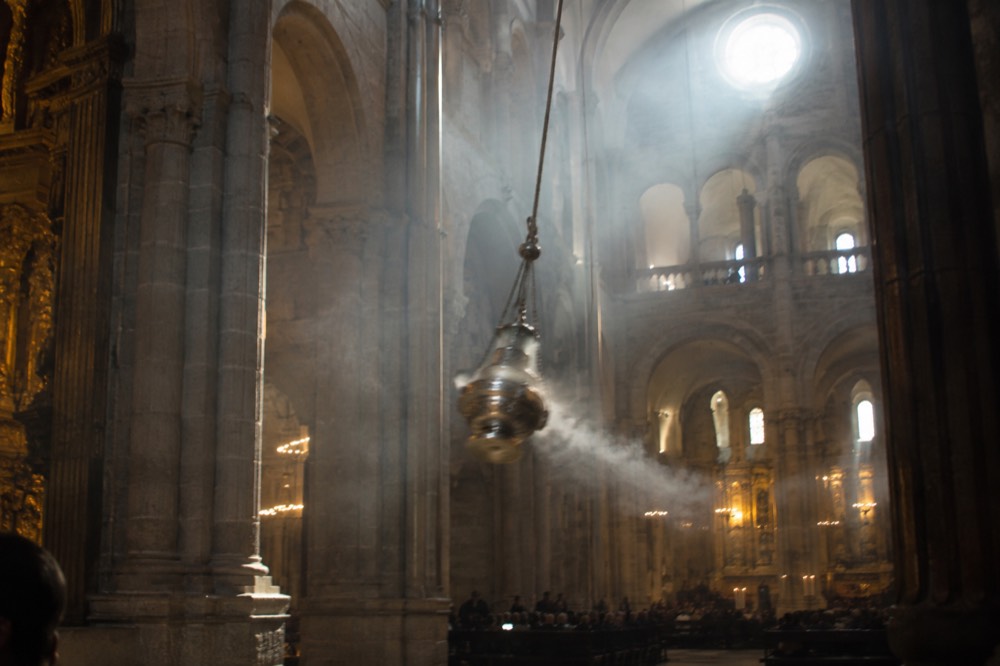
For the censer's own future, the honest sentence is the shortest one on this page: the Cathedral has said nothing, so this guide says nothing either, beyond the dates on which the smoke thrower has flown for centuries and will fly again when the dome is done.