Portico da Gloria
The Portico da Gloria is the carved Romanesque porch that medieval pilgrims saw when they finally reached Santiago de Compostela, and it still frames the west entrance of the Cathedral today.
Short answer
The Portico da Gloria is a Romanesque carved stone porch at the west entrance of the Cathedral of Santiago de Compostela. A major restoration was completed in 2018, and visits today are time-limited for preservation, accessed through Cathedral Museum tickets that run 9 to 23 EUR depending on ticket type.
The most famous carving in Santiago de Compostela is not inside a museum case or hanging in a gallery. It is the Portico da Gloria, the great Romanesque porch of stone figures that the Cathedral's medieval workshop carved for the west entrance of the Cathedral of Santiago de Compostela. For centuries, pilgrims arriving on the Camino de Santiago walked up to these three arches as the finale of their journey, and the porch still serves that role for every walker who enters Praza do Obradoiro today.
The Portico is a working piece of the Cathedral rather than a detached monument. Its arches sit behind the later baroque facade that faces the square, so most visitors meet the figures only once they are already inside the building. That placement surprises people, and it is one of the reasons a planned visit beats a casual one. This guide covers what the Portico da Gloria is, what its sculptures show, how timed visits and Cathedral Museum tickets work, and how to fit the porch into a day in Santiago de Compostela.
What Is The Portico da Gloria In Santiago de Compostela?
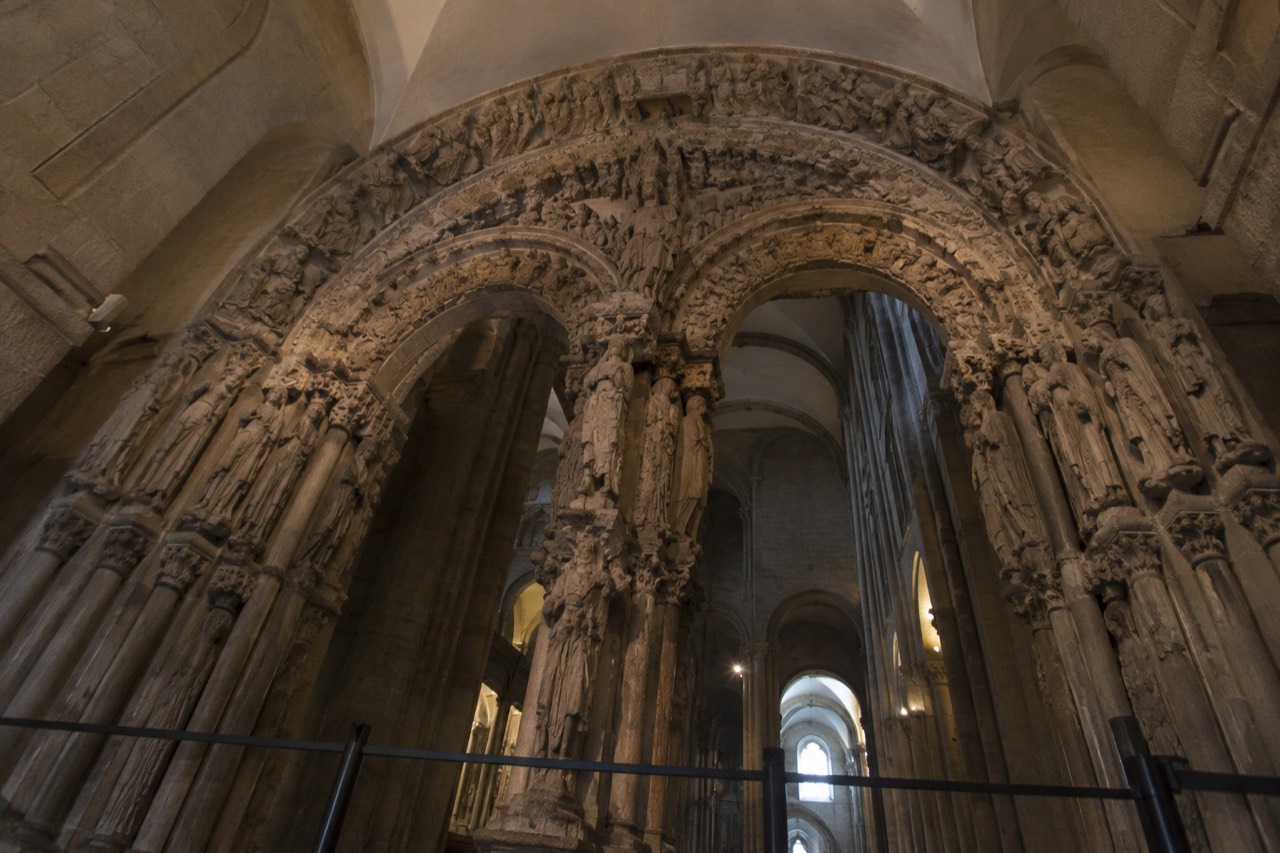
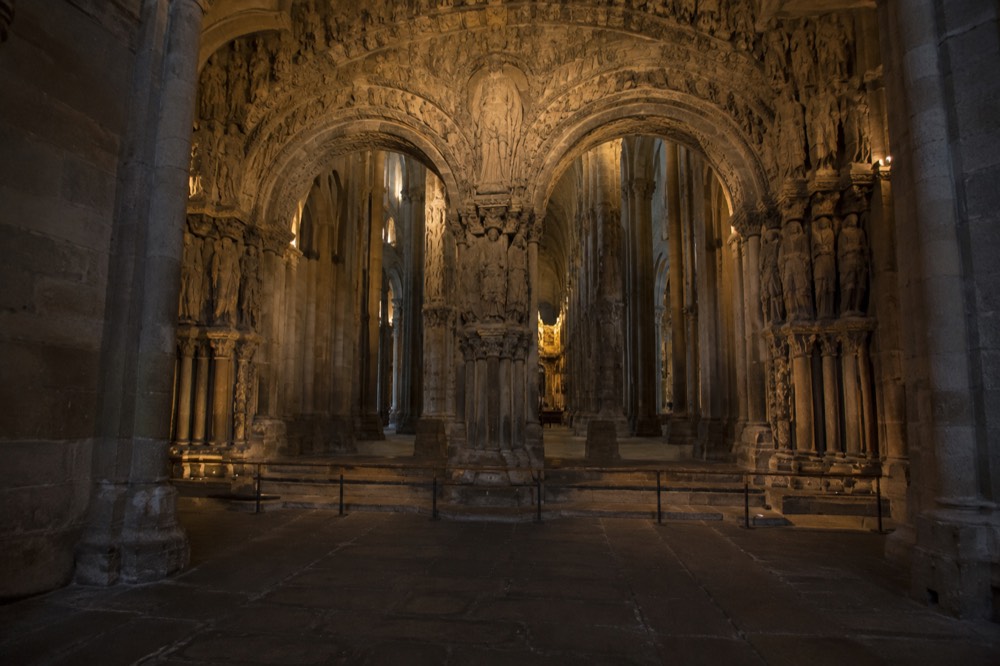
The Portico da Gloria is the carved Romanesque porch built into the west end of the Cathedral of Santiago de Compostela, a screen of apostles, prophets and angels arranged across three stone arches around a central image of Christ in glory. It is the artistic high point of the medieval Cathedral and one of the defining works of Romanesque sculpture anywhere in Europe, which is why it draws visitors who otherwise never set out to study medieval stonework.
The porch was designed as a gateway rather than a facade in the modern sense. Pilgrims who had walked for weeks crossed the threshold of the Cathedral through these carved arches, and the sculpture program was built to speak to them directly. Christ sits at the center in majesty, the apostles line up on either side of him, and angels and elders fill the spaces above. The message of the whole ensemble is welcoming and judgmental at once, exactly the mix an arriving pilgrim might have carried in their own head.
The Portico also anchors the identity of Santiago de Compostela as a pilgrimage city. UNESCO inscribed the Old Town of Santiago de Compostela on the World Heritage list in 1985, and the Cathedral and its porch are the fixed point around which the whole listed quarter grew. Praza do Obradoiro, the Hostal dos Reis Catolicos and the surrounding granite buildings all orient toward the same building whose west door the Portico decorates.
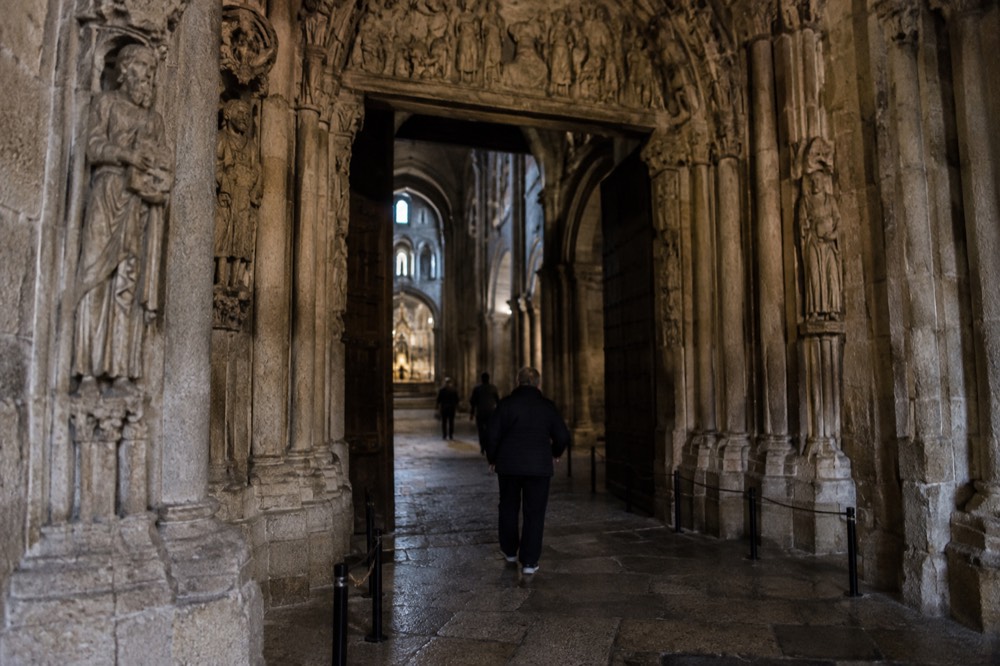
What often goes unmentioned is how physically close the carvings feel. The figures sit at eye level and within arm's reach at the entrance, not high on a wall. Visitors on a timed entry walk in among them, which is a very different experience from squinting up at relief carving from a nave floor.
Why Is The Portico da Gloria Considered A Masterpiece Of Romanesque Art?
It is considered a masterpiece because the porch compresses an entire theological program into naturalistic, deeply carved granite figures arranged with architectural precision, and because the sculptors achieved a level of expressive detail that few Romanesque workshops matched. The faces, drapery and gestures of the apostles read as individual people rather than repeated symbols, and the whole screen was designed to be read by pilgrims walking straight toward it.
Romanesque carving across Europe often repeats a small vocabulary of stylized forms. The Portico da Gloria instead gives each apostle distinct features, posture and clothing folds. Sculptors carved the granite deeply so that light and shadow animate the figures through the day, and the porch was polychromed in the medieval period, meaning the stone once carried paint whose traces survive. The expressive ambition of the work is what places it among the leading sculptural achievements of its period in any European context.
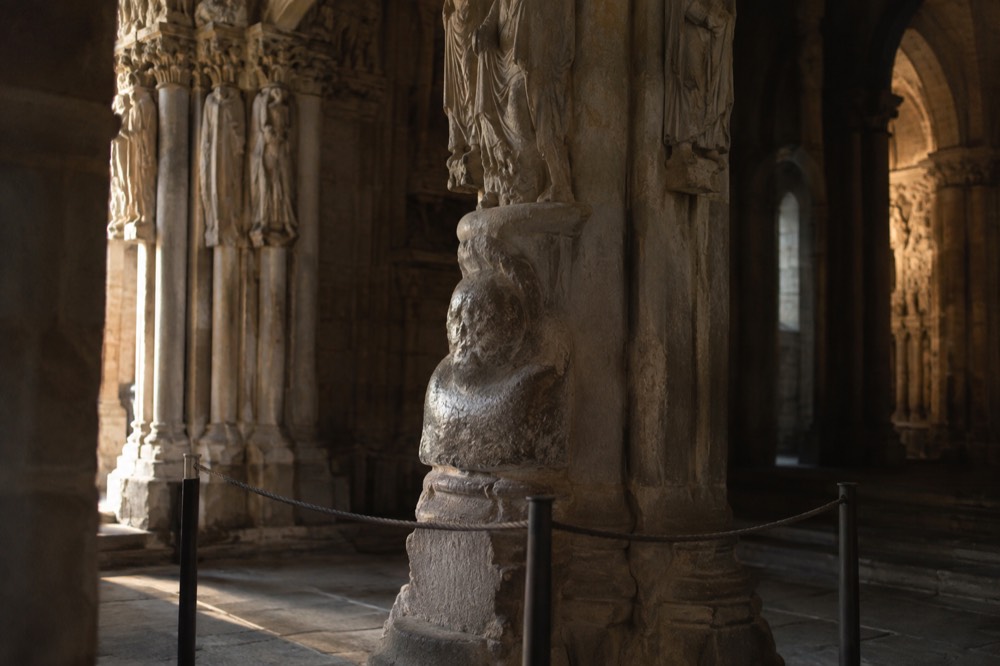
The porch also functioned structurally as part of the entrance sequence. Its central column rests on a carved base featuring figures and inscriptions, and one carved head on that base became one of the best loved pieces of folk tradition in Santiago de Compostela. Generations of students and pilgrims touched or bumped their heads against it, a custom known locally around the Santo dos Croques, and the polished patch of stone tells you exactly where. The practice is a living layer of tradition on top of the medieval carving, which the carving survived remarkably well.
The final reason for the masterpiece label is condition. The Portico underwent a major restoration that was completed in 2018, removing centuries of grime and returning the figures to something close to their original legibility. Because that work is finished, the porch is not a study in lost grandeur. It is a fully legible medieval program that you can read stone by stone, on a timed visit, an hour's walk from wherever you are staying in the old town.
For travelers who want the carved porch explained in context with the city around it, these guided visits cover the pairing well:
Each of these is a walking-scale visit in the city rather than a coach day trip, and the first bundles the Portico with Cathedral entry, which matters for anyone who wants the timed access handled for them.
How To Visit The Portico da Gloria: Tickets, Hours And Timed Entry?
The Portico da Gloria is visited through Cathedral Museum tickets, which run from 9 to 23 EUR depending on ticket type, with the Museum (permanent collection, Palacio de Gelmirez) open daily roughly 10:00am to 8:00pm and the ticket office closing 30 minutes earlier. Visits to the Portico are time-limited for preservation, so the porch is not something you can linger in indefinitely, and timed access is why advance planning matters more here than at the Cathedral's free nave entry.
The visit structure divides the Cathedral into two experiences. The basilica interior, including the tomb of the Apostle and the embrace of the statue of St. James, is free to enter and generally open daily from about 7:00am to 9:00pm through the Praterias door. The Portico da Gloria sits in the paid, timed zone of the visit offering, together with the museum collection in the Palacio de Gelmirez and the other ticketed spaces. If you only have time for the free interior you will see the Cathedral, but you will not stand among the carved figures of the porch.
Booking in advance is the single most useful step. Timed slots for the Portico are capped for preservation reasons, and the Cathedral's own ticketing operates timed entry for these visits. Peak periods in Santiago de Compostela, especially around the Feast of St. James on 25 July and the summer pilgrimage months, fill the timed slots first because so many visitors arrive at once.
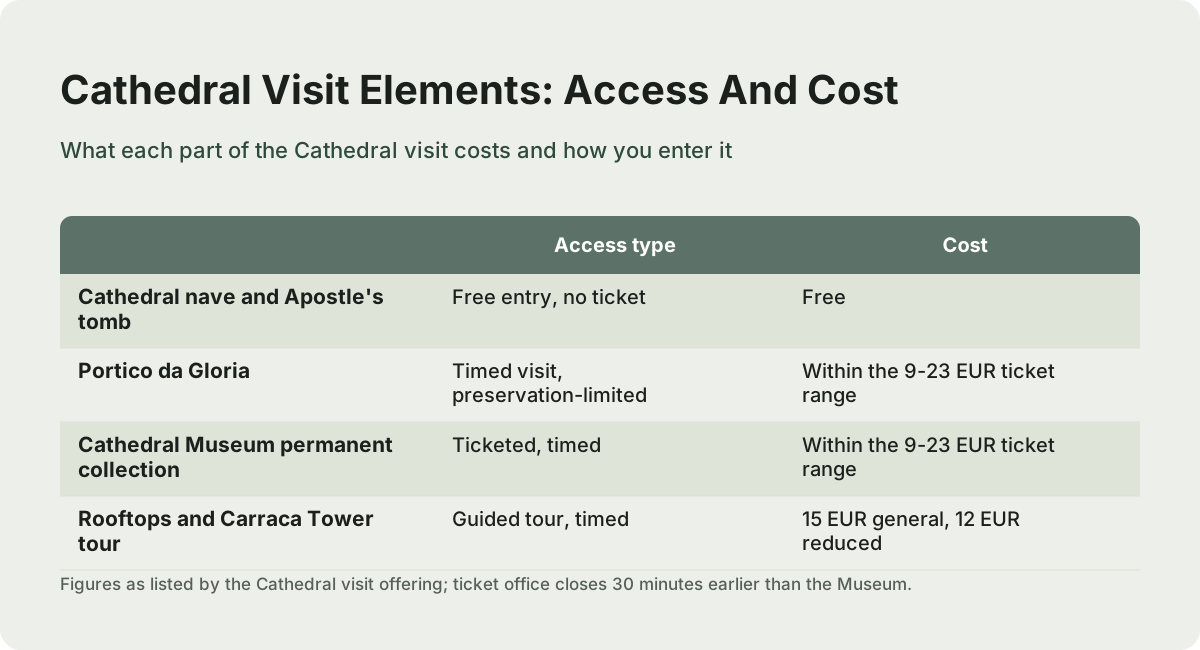
| Visit element | Where it sits | Access type | Cost |
|---|---|---|---|
| Cathedral nave and Apostle's tomb | Basilica interior | Free entry, no ticket | Free |
| Portico da Gloria | West end, behind the Obradoiro facade | Timed visit, preservation-limited | Within the 9-23 EUR ticket range |
| Cathedral Museum permanent collection | Palacio de Gelmirez | Ticketed, timed | Within the 9-23 EUR ticket range |
| Rooftops and Carraca Tower tour | Cathedral roofs | Guided tour, timed | 15 EUR general, 12 EUR reduced |
One timing note matters for anyone combining the Portico with a mass. The Cathedral's own liturgy page lists daily pilgrim masses at 7:30am, 9:30am, noon and 7:30pm at the main altar. From 16 October 2026, the 9:30am, noon and 7:30pm masses relocate to the nearby Church of San Agustin while main chapel works prepare for the 2027 Holy Year, and only the 7:30am mass remains in the Cathedral's own Communion chapel. Check which arrangement applies on your travel dates before you plan a mass around a timed Portico slot.
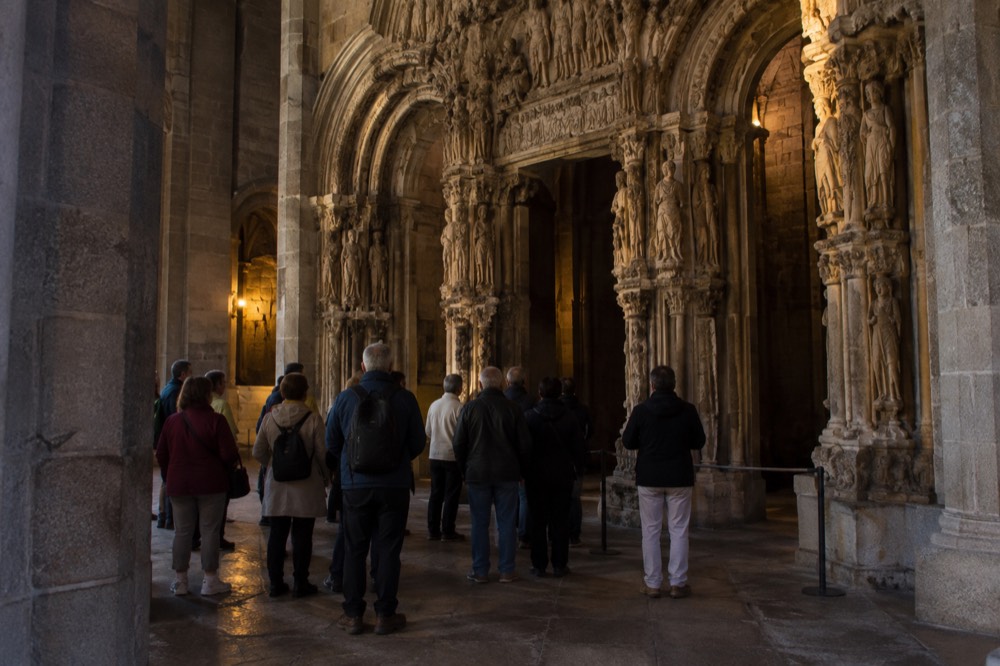
For many visitors, a guided visit that includes the Portico removes all of the timing decisions at once, with tickets handled in the booking:
That guided option covers the city, the Portico and the Cathedral with tickets included, which suits anyone who wants the timed access arranged rather than self-managed. If you would rather not commit to a fixed date before your travel plans settle, the same visit can be checked and reserved closer to the day, and free cancellation on the operator's live listing means an early booking carries little risk.
What Do The Sculptures Of The Portico da Gloria Depict?
The sculptures depict Christ in glory at the center of the middle arch, flanked by the apostles, prophets and evangelists arranged across three arches, with a Tree of Jesse filling the left-hand arch and apocalyptic elders and angels above. The program is a carved summary of the medieval Christian vision of judgment and salvation, addressed to pilgrims arriving at the tomb of St. James, and each figure is individually carved rather than repeated from a pattern.
The central arch carries the theological weight. Christ sits enthroned in majesty, showing the wounds of the crucifixion, flanked by the four evangelists with their symbols and surrounded by angels carrying the instruments of the passion. Below and around him, the apostles stand in a row across the two side columns of the porch, each with a book, a scroll or a personal attribute. Reading the row left to right is like walking a carved processional route. Other pages covering the same trip are gathered on Santiago de Compostela Travel Guide.
The left arch holds the Tree of Jesse, the genealogical tree linking the House of David to Christ, a subject medieval pilgrims knew well from church teaching. The right arch balances it with figures of the saved and the damned, and the sober carved faces of the damned are among the most studied pieces of the porch. Art historians point to them as evidence of how far the porch's sculptors pushed toward individual expression, well beyond the flat symbolic figures common in earlier Romanesque work.
| Arch or element | Principal figures | What it says to a pilgrim |
|---|---|---|
| Central arch | Christ in majesty, evangelists, angels with instruments of the passion | The journey ends in glory and judgment at once |
| Left arch | Tree of Jesse with the ancestors of Christ | The story of salvation has deep roots, walked for generations |
| Right arch | Saved and damned figures | Choices on the road carry consequences beyond it |
| Column figures | Apostles and prophets in a row across the porch | The pilgrim joins a procession of witnesses |
| Central column base | Carved figures including the head polished by the Santo dos Croques custom | Popular devotion layered onto the medieval carving |
The central column deserves a moment of its own. It carries the seated figure of St. James with a pilgrim inscription band, and beneath it the carved base that includes the famous worn head. The scholarly value of the column and its base is that it frames the whole porch: the pilgrim approaches Christ, and St. James stands as the host at his own city's threshold. The figure of the Apostle holds a staff and a scroll, the same attributes pilgrims still carry into Santiago de Compostela on the credencial routes.
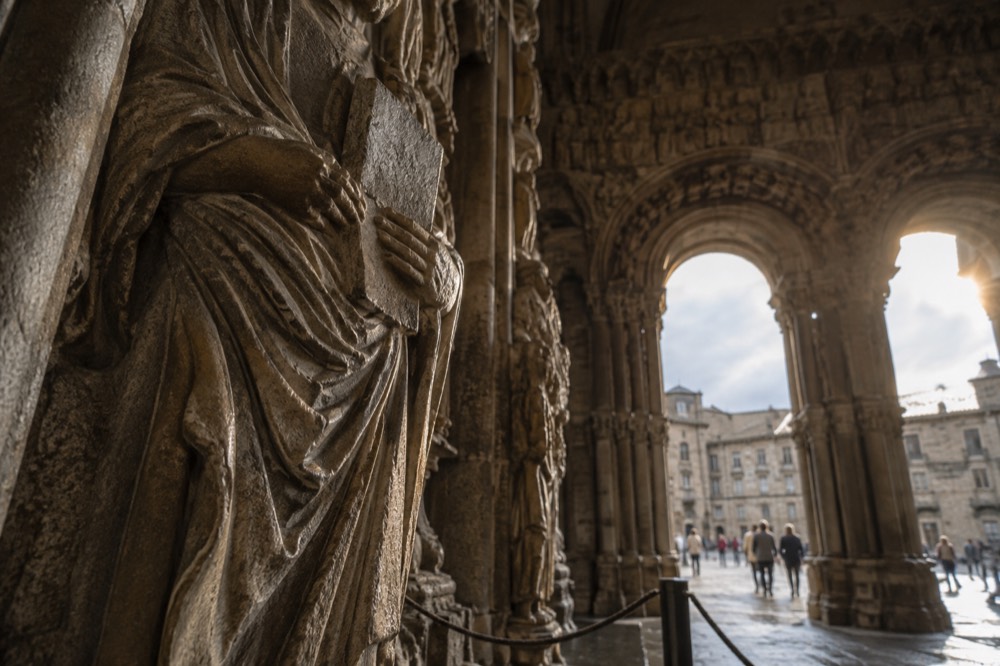
Where Does The Portico da Gloria Sit Within The Cathedral Of Santiago de Compostela?
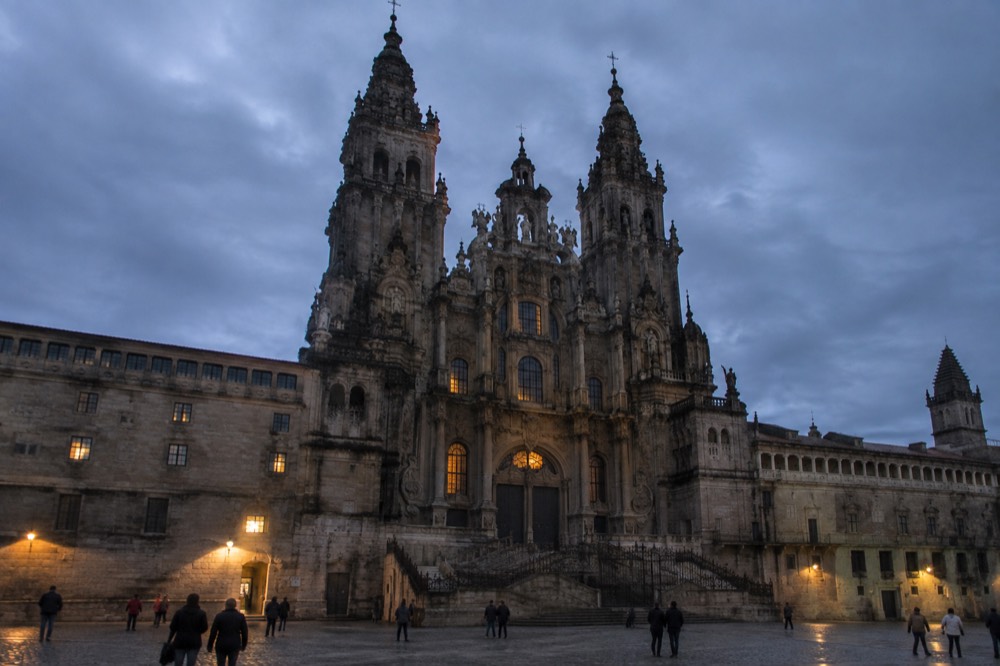
The Portico da Gloria sits at the west end of the Cathedral of Santiago de Compostela, directly behind the baroque Obradoiro facade that fronts Praza do Obradoiro, so the porch faces the square in the same direction pilgrims historically approached it. Visitors standing in the square see the later facade, not the Portico, and only once inside the Cathedral or on a timed visit do the Romanesque arches appear in their original threshold position.
This layered arrangement is the single most confusing thing about the Portico for first-time visitors. The Cathedral was built in stages, and the baroque facade was added generations after the porch, enclosing it rather than replacing it. The result is a building with two west faces: the ornate stone screen that tourists photograph from the square, and the medieval carved porch just behind it that most of the world never sees in photographs.
Around the porch, the rest of the visit route stacks up quickly. The tomb of the Apostle sits beneath the main altar, reachable from the interior, and the Cathedral Museum occupies the Palacio de Gelmirez next door, itself a Romanesque monument worth the timed ticket on its own. The Cathedral Rooftops tour adds the Cubiertas and the Carraca Tower, a guided 60-minute walk up about 140 steps to roughly 72 meters above the square, priced at 15 EUR general or 12 EUR reduced on the Cathedral's own ticketing. That tour also grants free access to the permanent museum collection and several other spaces, valid for seven days and one use per space, so it can cover the Portico's paid zone in the same trip for some visitors.
| Cathedral element | Where you see it from | Ticket or access |
|---|---|---|
| Portico da Gloria | Interior west end, timed visit | Within the 9-23 EUR range |
| Obradoiro facade | Praza do Obradoiro, from outside | Free, always visible |
| Apostle's tomb and embrace | Main altar area and crypt below | Free interior entry |
| Cathedral Museum, Palacio de Gelmirez | Adjacent to the Cathedral | Within the 9-23 EUR range |
| Rooftops and Carraca Tower | Cathedral roofs, guided | 15 EUR general, 12 EUR reduced, includes museum collection access |
The neighborhood around the west front rewards the walk too. Praza do Obradoiro opens out from the facade, the Hostal dos Reis Catolicos stands on one side of the square, and Rua do Franco runs down toward the tapas and bar streets behind. Anyone planning a day around a morning timed Portico slot can realistically finish the paid visits by early afternoon and still have the rest of the old town to wander.
How Does The Portico da Gloria Compare To Other Cathedral Highlights?
Compared with the rest of the Cathedral, the Portico da Gloria is the deepest historical and artistic experience, while the tomb of the Apostle is the religious core, the rooftops give the best views, and the Botafumeiro is the most theatrical element of the building. The Portico is the choice for visitors who care about art history and medieval carving, the tomb for pilgrims, and the rooftop tour for photographers and anyone who wants the city laid out from 72 meters up.
The Botafumeiro is worth a separate caution. The giant censer normally swings at the end of the main solemn Mass on twelve fixed liturgical solemnities each year, but it is currently out of action: the Cathedral confirmed in writing on 5 September 2026 that scaffolding for the cimborrio restoration covers its hanging mechanism, and no return date has been published. Outside those solemnities it historically required a private request at an indicative cost of 450 to 500 EUR, but that option is also unavailable while the suspension lasts. No visit to the Portico should be planned around seeing the censer fly.
The rooftop route suits a different mood. The guided Cubiertas and Carraca Tower walk takes about 60 minutes, covers roughly 140 steps, and ends at about 72 meters of height looking out across the granite rooftops of Santiago de Compostela. The Cathedral's own ticketing lists it at 15 EUR general, 12 EUR reduced, with English-language visits at a flat 15 EUR, and the ticket includes seven-day access to the permanent museum collection and several other Cathedral spaces, one use per space. For a visitor whose priority is the Portico, the rooftop ticket is one way to wrap the porch, the museum and the roofs into a single purchase.
| Cathedral highlight | Best for | Current status |
|---|---|---|
| Portico da Gloria | Art, history, Romanesque carving | Open, timed visits, restoration completed 2018 |
| Apostle's tomb and embrace | Pilgrims and religious visitors | Open with free interior entry |
| Cathedral Museum collection | Gelmirez Palace, portico context, cloister works | Open daily roughly 10:00am to 8:00pm, tickets 9-23 EUR |
| Rooftops and Carraca Tower | Views and photography | Guided, timed, 15 EUR general, 12 EUR reduced |
| Botafumeiro | Spectacle and solemnities | Currently suspended, no return date published |
If the plan is a day in the city rather than a pilgrimage, an official-guide walking tour of the old town is an efficient companion to the timed Portico visit, since it covers the squares and stories between the Cathedral stops:
That walk pairs naturally with a morning Portico slot: the guide covers the old town while your timed ticket handles the Cathedral's paid zone.
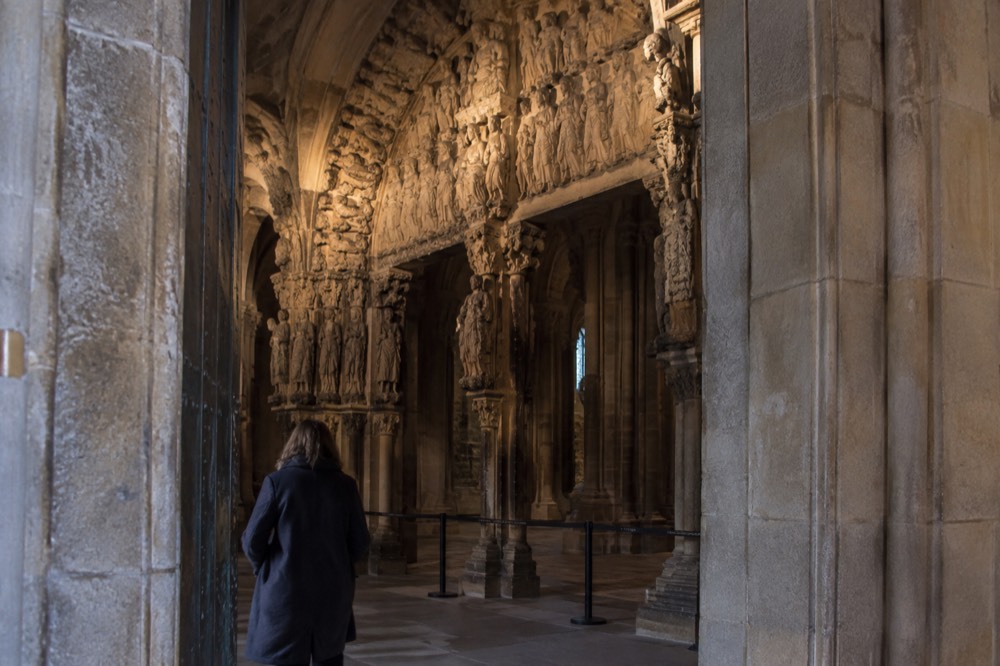
What Should You Know Before Your Portico da Gloria Visit?
Before visiting, you should know that the Portico requires a timed ticket rather than free entry, that the Cathedral Museum's ticket office closes 30 minutes before the roughly 10:00am to 8:00pm opening window ends, and that timed visits are deliberately short for preservation, so plan the rest of the Cathedral around your slot rather than the reverse. Visitors who book a guided visit with tickets included remove most of this friction at once.
A few practicalities are worth writing down before you travel. Santiago de Compostela has a temperate oceanic climate, wet year-round and wetter from October to March, with the driest weather in July and August, so the queue-free nature of a timed indoor visit is a genuine advantage in the wetter months. The city's rainy day planning is built around exactly this kind of covered, ticketed attraction. The airport bus from Santiago-Rosalia de Castro airport runs on line 6A at a fare of 1 EUR paid to the driver, but a new Monbus contract with a fare near 6 EUR is expected from autumn 2026, so treat the current fare as subject to change and check the operator's live page.
For visitors staying longer in the city, the Portico slot pairs well with a day trip. The question of what is the best day trip from Santiago de Compostela is usually answered by the coastal route west, and the Costa da Morte region around Finisterre and Muxia is the classic choice. The distinction matters for your planning because the Portico visit is a city activity in a compact old town, while the Finisterre trips are full-day coach journeys out along the Atlantic coast.
The third option in that band is exactly the coastal day trip: a full-day Finisterre, Muxia and Costa da Morte excursion with a stop at Cabo Vilan, rated 4.8 from 267 reviews and from 60 USD per person on the operator's live listing. If the Portico is your morning, that trip is a strong following day.
Finally, a quick planning summary for the paid and free zones:
| Plan | Time needed | Budget notes |
|---|---|---|
| Portico da Gloria timed visit | Booked slot, short for preservation | Within the 9-23 EUR Cathedral ticket range |
| Portico plus museum collection | Roughly half a morning | Same ticket range, timed slots |
| Portico plus rooftops and Carraca Tower | Add about 60 minutes and 140 steps | 15 EUR general, 12 EUR reduced, museum collection included |
| Full Cathedral day, Portico plus city walk | Most of one day | Ticket range plus a guided walk from 12 USD per person |
Common Questions About The Portico da Gloria
Is the Portico da Gloria open to the public?
Yes. The Portico is open to visitors through the Cathedral Museum's timed ticketing, with no closure or restriction currently reported beyond normal timed entry and conservation limits. The major restoration of the Portico was completed in 2018, and visits are time-limited for preservation, so book a timed slot rather than expecting open-ended access.
Can you see the Portico da Gloria for free?
No. The free part of the Cathedral is the basilica interior, including the Apostle's tomb, which is open daily roughly 7:00am to 9:00pm with free general entry. The Portico da Gloria sits in the paid, timed zone of the visit offering, accessed through tickets that run 9 to 23 EUR depending on ticket type.
Who carved the Portico da Gloria?
The Portico da Gloria was carved by the medieval workshop of the Cathedral of Santiago de Compostela for its west entrance. It is regarded as one of the defining achievements of Romanesque sculpture, with individually carved apostles, prophets and angels across three arches around a central Christ in glory.
Do you need to book Portico da Gloria tickets in advance?
Advance booking is strongly recommended. Visits are time-limited for preservation, so slots are capped, and demand peaks around the Feast of St. James on 25 July and through the summer pilgrimage season. Timed slots are sold through the Cathedral's own ticketing, and guided visits with tickets included are an alternative that handles the timing for you.
Is the Portico da Gloria the same as the Obradoiro facade?
No. The Obradoiro facade is the later baroque front of the Cathedral facing Praza do Obradoiro, and it encloses the earlier Romanesque porch. Visitors standing in the square see the baroque facade, while the Portico da Gloria's carved arches sit just behind it, inside the building.
Is the Botafumeiro running during Portico da Gloria visits?
No. The Botafumeiro is currently out of action because scaffolding for the cimborrio restoration covers its hanging mechanism, and the Cathedral confirmed this in writing on 5 September 2026 with no return date published. Do not plan a Portico or Cathedral visit around seeing the censer swing.
The Portico da Gloria is the one place in Santiago de Compostela where the medieval pilgrimage city and the modern visitor route meet face to face, stone to stone. Book the timed slot, take the extra minutes to read the columns, and let the apostles of the porch finish the journey the way they have finished it for centuries of arriving pilgrims.