Parador de Santiago de Compostela
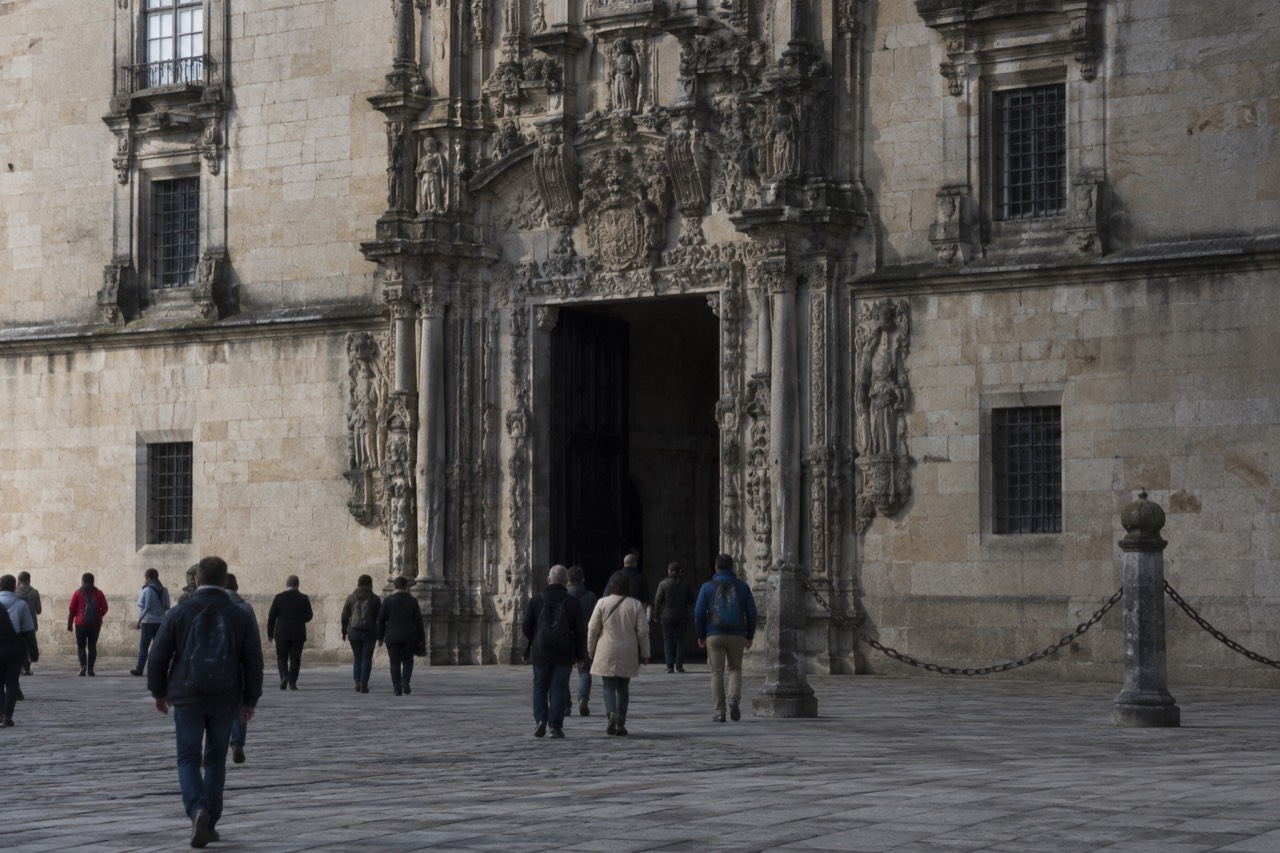
The Parador de Santiago de Compostela, the Hostal dos Reis Catolicos, stands directly on Praza do Obradoiro opposite the cathedral, and it is the most famous place to sleep in the city.
Short answer
The Parador de Santiago de Compostela is a historic hotel, the Hostal dos Reis Catolicos, occupying the former royal pilgrim hospital on Praza do Obradoiro. Book rates directly and in advance; entry to the surrounding sights such as the cathedral interior is free, with paid tickets for the museum and rooftop tour.
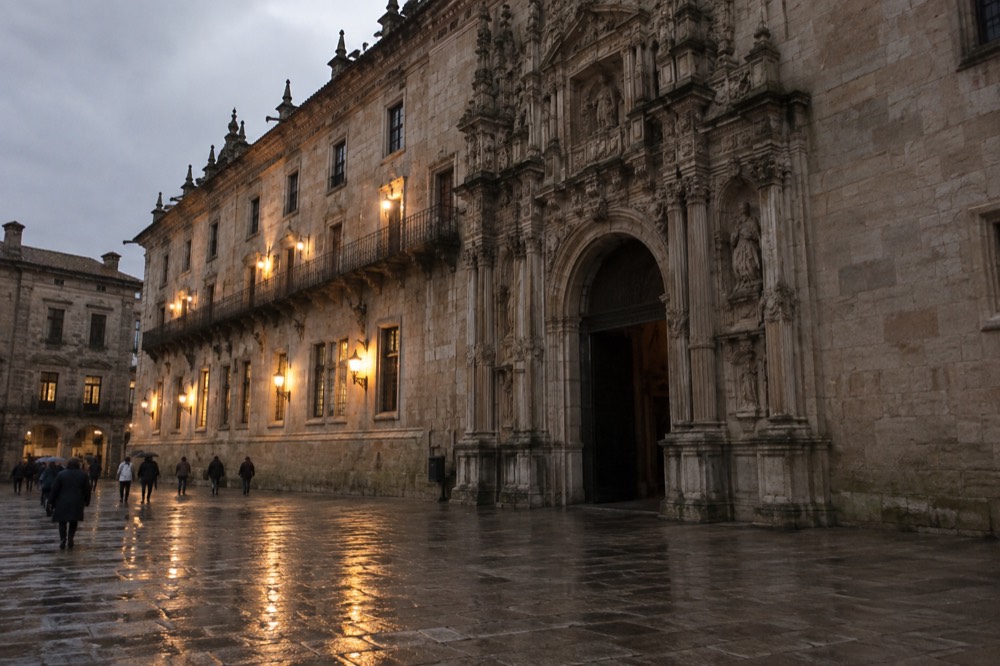
The Parador de Santiago de Compostela, better known as the Hostal dos Reis Catolicos, stands on the north side of Praza do Obradoiro, facing the west facade of the Cathedral of Santiago de Compostela across the square. Few hotels anywhere in Europe occupy a building with this pedigree: it was founded as a royal hospital for pilgrims arriving at the end of the Camino de Santiago, and it kept a care function for centuries before becoming the Parador it is today. A guest walking out of the front door is, within seconds, in the heart of the UNESCO-inscribed Old Town, which was added to the World Heritage list in 1985, a separate inscription from the 1993 listing of the Camino routes themselves.
This guide from Santiago de Compostela Travel Guide covers what the Parador is, exactly where it sits, what to see within a few minutes' walk, how the cathedral's paid tickets and tours are priced, and how the building still fits into the modern pilgrim experience of the city.
What Is The Parador de Santiago de Compostela?
The Parador de Santiago de Compostela is the hotel that occupies the Hostal dos Reis Catolicos, the former royal hospital built beside the cathedral to receive pilgrims finishing the Camino de Santiago. Today it operates as a Parador, Spain's state-run network of historic hotels, and it is routinely described as one of the oldest hotels in continuous hospitality use in the world. Its facade opens directly onto Praza do Obradoiro, the grand square at the symbolic finish of every Camino route.
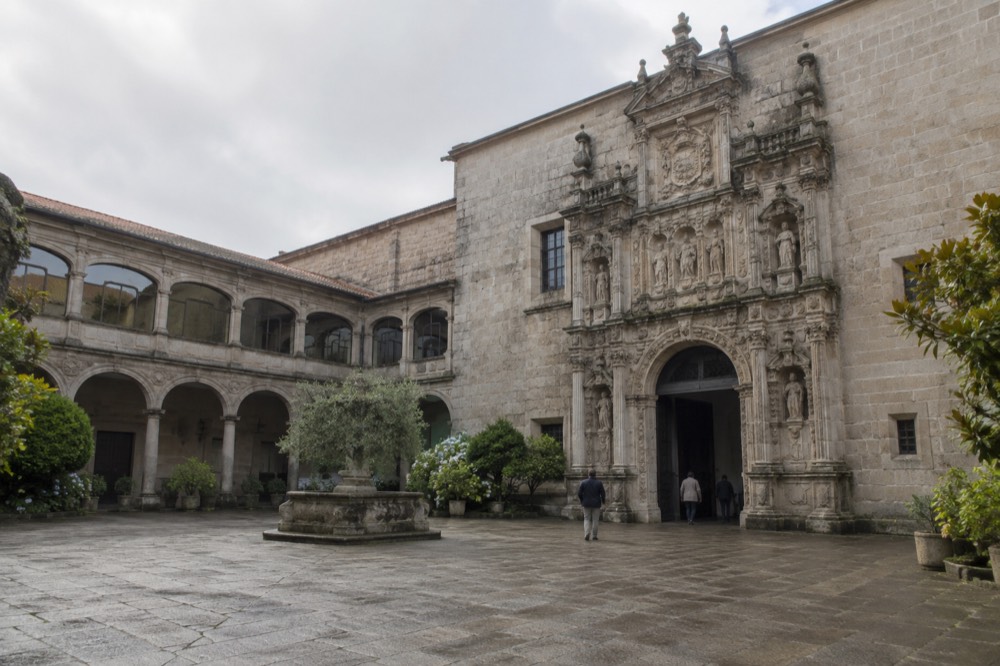
The building's identity is inseparable from pilgrimage. It was conceived as a hospital, and for most of its life it served exactly that purpose, treating and sheltering pilgrims who arrived in the city exhausted or sick after weeks on the road. The four courtyards, the long stone galleries and the chapel spaces that guests move through today are the surviving fabric of that hospital era, adapted rather than replaced. Walking from the entrance toward the inner patios, the scale of the original institution is still legible: this was not a guesthouse, it was a machine for receiving thousands of arrivals a year.
The transition to a Parador preserved the shell and repurposed the rooms. The dining service is the other reason many non-guests come through the doors: Galician dishes, from empanada to octopus and the region's wines, served inside a building most visitors only photograph from the outside. Booking a table, like booking a room, is done directly with the property, and demand is heavy in the summer months and around the Feast of St. James on 25 July, when the city holds its main civic and religious celebrations of the year.
The word "Parador" itself is worth understanding before you book. It is a brand, not a generic category: Paradores de Turismo de Espana is the state hotel company, and each property in the network occupies a building of historic or scenic importance. In Santiago de Compostela, the Parador is the Hostal dos Reis Catolicos, and reviews, guidebooks and booking pages use the two names interchangeably. That is why searches for "parador de santiago de compostela" and questions about the Hostal lead to the same front door.
Where Does The Parador Sit In Santiago de Compostela?
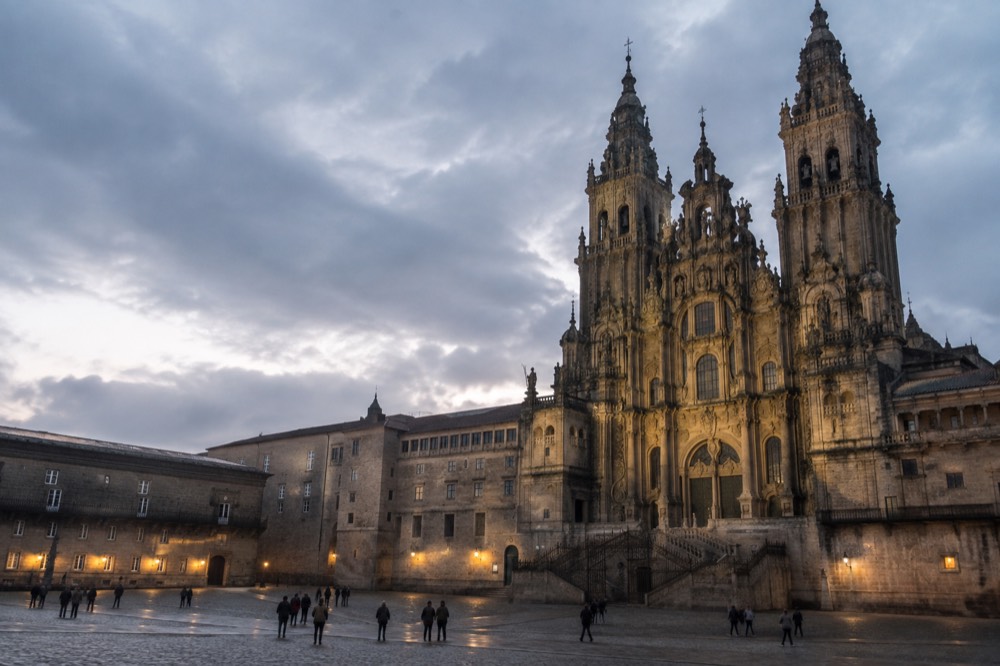
The Parador sits on the north side of Praza do Obradoiro, the main square of Santiago de Compostela, with the cathedral's baroque west facade directly opposite and the Town Hall closing the fourth side. Praza da Quintana, the Holy Door and the Obradoiro facade are all within a short walk of the entrance, and the old town's other squares fan out from this single point. It is the most central address in the city.
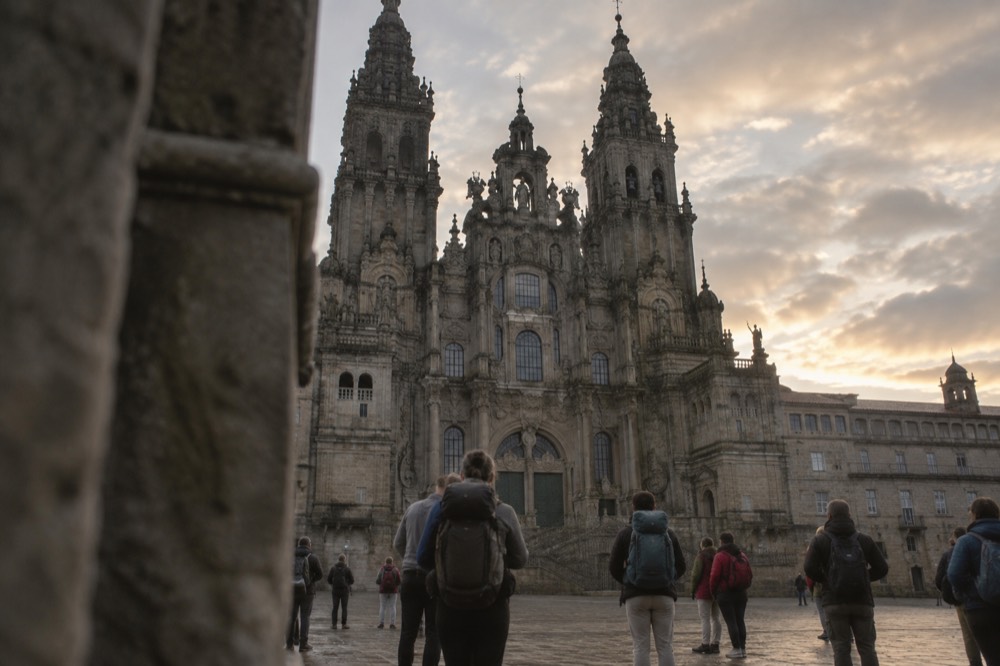
Praza do Obradoiro is not just a pretty square, it is the ceremonial finish line of the Camino de Santiago. Pilgrims arriving in the city make their way here to look up at the Obradoiro facade, and the Parador is the building they stand beside while they do it. Around the square stand the four historic powers of the city: the cathedral, the Town Hall (Pazo de Raxoi), the Colexio de San Xerome, now part of the university, and the Hostal dos Reis Catolicos itself, which represented royal charity toward pilgrims.
Walk east from the front door and you reach Praza da Quintana and the Holy Door within minutes. The Holy Door matters because of its calendar: it opens only in Holy Years, and the next Holy Year is 2027, not 2026. The door is scheduled to open solemnly on 31 December 2026, and the Holy Year then runs through 31 December 2027, because 25 July 2027 falls on a Sunday. Anyone planning a stay around that period should expect the square and the hotel to be dramatically busier than usual, and should read our page on praza da quintana and the Holy Door before fixing dates.
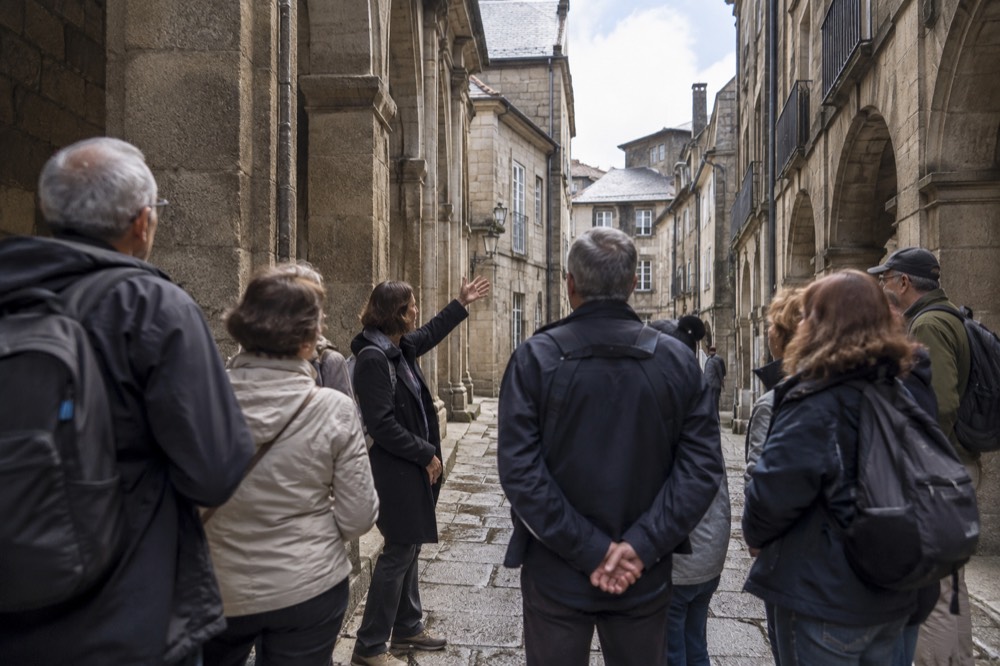
The practical geography is equally kind. The whole of the old town spreads south and east of the Parador's doorstep: Rua do Franco and the tapas streets, the market, the Alameda park viewpoint and the convent churches are all in a compact walkable radius. For orientation on arrival, a guided walk makes sense, and the two most relevant options are a cathedral sightseeing tour and a historic walking tour of the city's highlights.
A short walking circuit from the Parador door proves the point. Cross the square to the cathedral, drop down Rua das Carretas, where the Pilgrim's Office sits at number 33, come up through the back streets to the mercado, and return along the Alameda for the classic postcard view of the cathedral's towers with the Hostal on the left of the frame. That loop takes in the essential city without ever needing transport, and the cathedral of Santiago de Compostela page covers each stop in more depth.
What Is There To See Around The Parador de Santiago de Compostela?
The Parador's own building is the first sight: its Plateresque facade, its four courtyards and its historic chapel spaces can occupy an hour on their own. Beyond the door, the cathedral interior is free to enter, the Cathedral Museum charges EUR9-23 depending on ticket type, the rooftop tour costs EUR15 general or EUR12 reduced, and the pilgrim-themed Museo das Peregrinacions sits a few streets away. Everything is within walking distance.
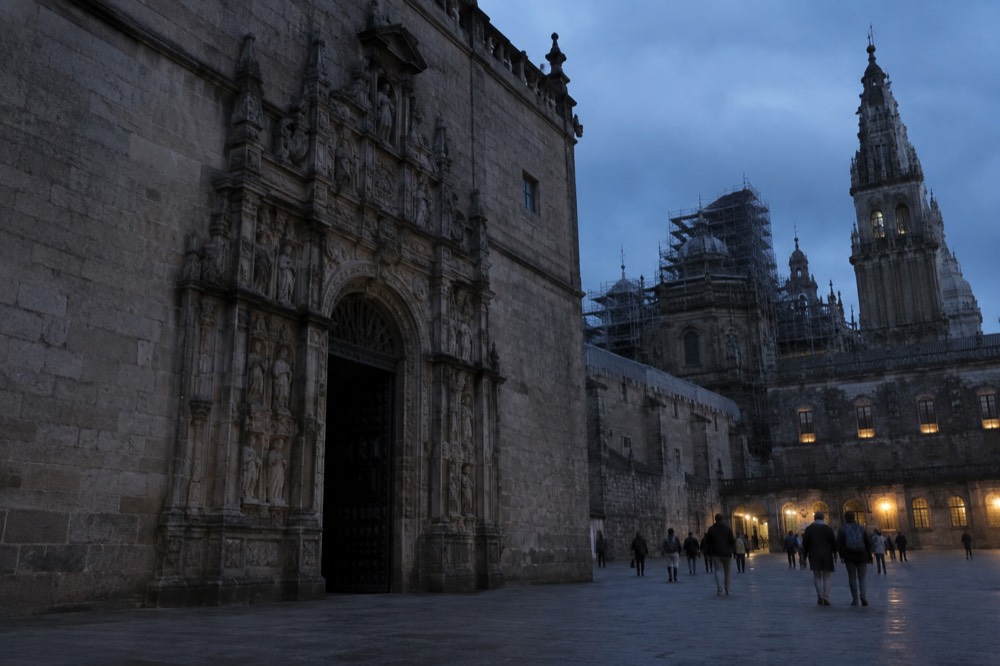
Start inside the cathedral, because entry to the interior is free and the hours are generous: the naves, high altar and crypt are open daily, roughly 7:00am to 9:00pm, with entry through the Praterias door. The tomb of the apostle beneath the main altar is the reason the city exists, and the embracing statue of St. James above it is where pilgrims traditionally queue to touch the saint's shoulder. The cathedral's own liturgy page publishes the details, and our cathedral tickets and opening hours coverage explains what each ticket type includes.
| Sight near the Parador | Entry cost | Verified detail |
|---|---|---|
| Cathedral interior (naves, altar, crypt) | Free | Open daily, roughly 7:00am to 9:00pm via the Praterias door |
| Cathedral Museum (collection, Gelmirez Palace) | EUR9-23 by ticket type | Open daily, about 10:00am to 8:00pm, ticket office closes 30 minutes earlier |
| Rooftop tour (Cubiertas + Torre de la Carraca) | EUR15 general, EUR12 reduced | Guided, about 60 minutes, about 140 steps, from about 72m height |
| Rooftop tour inclusions | Included in ticket price | Also grants free access to the museum's permanent collection and other cathedral sites, valid 7 days |
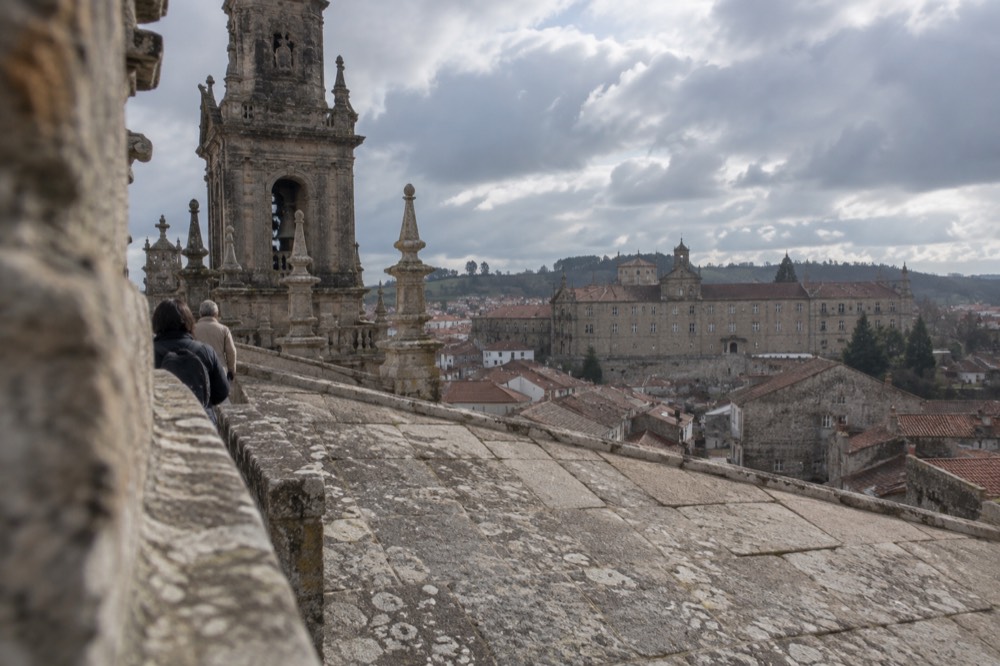
The cathedral rooftop tour deserves a special mention for Parador guests, because the view from the cubiertas looks straight down onto Praza do Obradoiro and the Hostal itself. Seeing your own hotel from the roof of a cathedral is not an experience many cities can offer. The reduced EUR12 rate applies to accredited pilgrims, students, over-65s and several other groups with proof at entry, and English-language rooftop visits are a flat EUR15. The cathedral's own ticketing site is the booking channel, with timed slots.
Two blocks away, the Museo das Peregrinacions tells the story of pilgrimage across the centuries, and its displays pair naturally with a stay in the old pilgrim hospital. The mercado de abastos is the city's working food market, and the Alameda park offers the elevated view of the cathedral complex that every guidebook photographs. Opening hours for the museums and the market should be checked on each venue's own site before you go, since they are not officially published to the hour.
For guests who want a guided experience rather than self-guiding, the roster of tours departing from the old town covers the cathedral, the rooftops and the historic streets. The pricing and ratings below come from the operators' live listings and are verified as of this guide's research date.
| Tour | Kind | From price | Rating |
|---|---|---|---|
| Cathedral Sightseeing Tour | cathedral-and-rooftops | from $28 per person | 4.6 from 542 reviews |
| Cathedral & Museum, Skip Line | cathedral-and-rooftops | from $26 per person | 4.8 from 2,425 reviews |
| Cathedral, Portico, Roofs, Museum | cathedral-and-rooftops | from $56 per person | 4.6 from 79 reviews |
| Cathedral Roofs, Carraca Tower | cathedral-and-rooftops | from $42 per person | 4.6 from 132 reviews |
The cheapest of these is not always the best fit. The skip-the-line cathedral and museum option carries the deepest review base, while the full roofs-and-portico tour covers the most ground in one ticket. Decisions like that are exactly why we suggest checking live availability before committing.
How Much Do Cathedral Tickets And Tours Cost From The Parador?
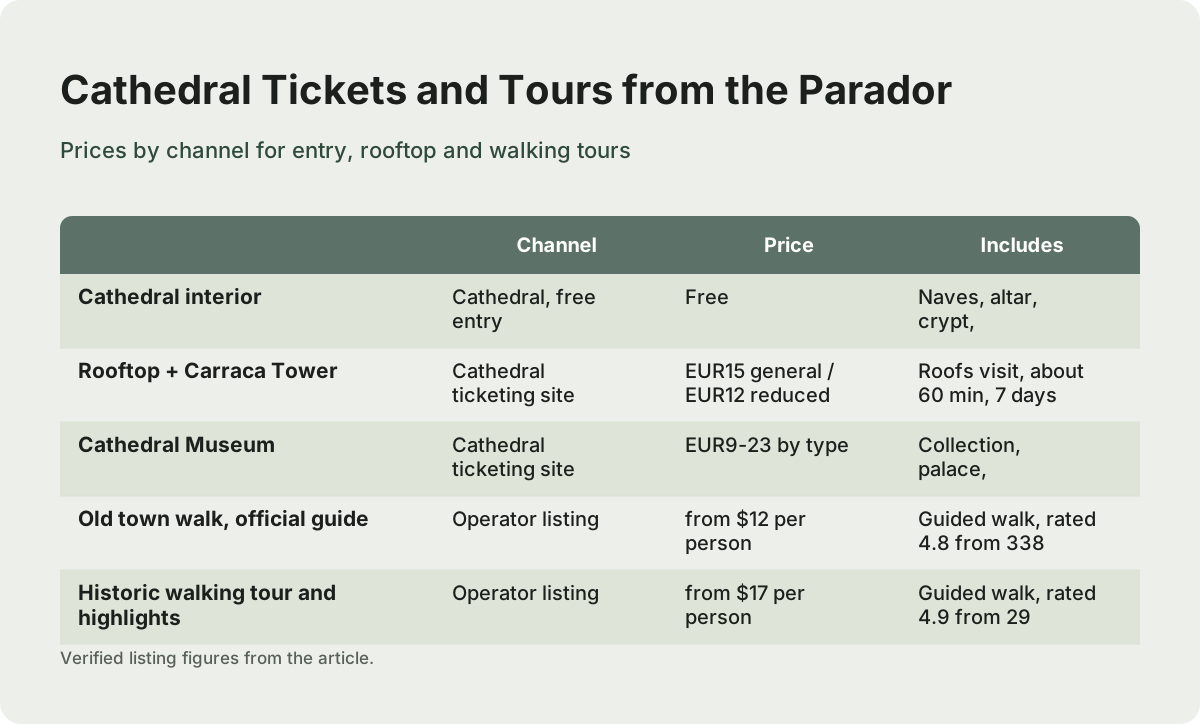
From the Parador's door, the free option is the cathedral interior, while the paid options start at EUR9 for museum tickets, EUR12-15 for the guided rooftop tour, and from $26-56 for guided tours booked through operators. Walking tours of the old town run from $12-17 per person at the budget end. Every price below is a verified listing figure, not an estimate, and the free cathedral entry is the single biggest saving available.
The pattern worth noticing is that the cathedral's own channel is cheaper than third-party guided products, but it does not include a guide. The official rooftop visit at EUR15 general or EUR12 reduced is bookable on the cathedral's own ticketing site with timed slots, and it includes seven days of access to the museum's permanent collection and the other cathedral sites, one visit per space. The operator products cost more but bundle a guide, queue handling and, in several cases, museum or rooftop entry.
| Ticket or tour | Channel | Price | What it includes |
|---|---|---|---|
| Cathedral interior | Cathedral, free entry | Free | Naves, high altar, crypt, about 7:00am-9:00pm |
| Rooftop + Carraca Tower | Cathedral ticketing site | EUR15 general / EUR12 reduced | Guided roofs visit, about 60 min, plus museum collection for 7 days |
| Cathedral Museum | Cathedral ticketing site | EUR9-23 by type | Permanent collection, Gelmirez Palace, about 10:00am-8:00pm |
| Old town walk, official guide | Operator listing | from $12 per person | Guided walking tour, rated 4.8 from 338 reviews |
| Historic walking tour and highlights | Operator listing | from $17 per person | Guided walk, rated 4.9 from 29 reviews |
For a Parador guest with only one full day, the arithmetic favors this sequence: free cathedral entry in the morning before the queues build, the official rooftop tour at a timed slot, and a guided old town walk in the late afternoon when the light comes across the square. That combination costs less than a single top-bundled tour product and covers the interior, the roofs and the streets.
When Are The Pilgrim Masses Held Near The Parador?
The pilgrim masses in the Cathedral of Santiago de Compostela are held daily at 7:30am, 9:30am, 12:00 noon and 7:30pm at the main altar, but this arrangement changes on 16 October 2026: the 9:30am, noon and 7:30pm masses then relocate to the nearby Church of San Agustin, and only the 7:30am mass remains in the Cathedral, in its Communion chapel. The Cathedral's own liturgy page publishes the current schedule.
For a Parador guest, this matters because the hotel sits closer to the cathedral than almost any accommodation in the city. Until 15 October 2026, all four masses are a one-minute walk away. From 16 October 2026, a guest wanting the noon or evening pilgrim mass walks a few minutes to San Agustin instead, while the early 7:30am mass stays inside the Cathedral. The relocation is tied to main-chapel remodelling works preparing the building for the 2027 Holy Year, so it is a dated, temporary arrangement, not a permanent schedule change.
| Mass time | Until 15 October 2026 | From 16 October 2026 |
|---|---|---|
| 7:30am | Cathedral, main altar | Cathedral, Communion chapel |
| 9:30am | Cathedral, main altar | Church of San Agustin |
| 12:00 noon | Cathedral, main altar | Church of San Agustin |
| 7:30pm | Cathedral, main altar | Church of San Agustin |
The Botafumeiro, the giant thurible that normally swings at the end of the main solemn mass on twelve fixed liturgical dates a year, is currently suspended. Scaffolding for the cimborrio, the dome over the crossing, covers its hanging mechanism, and the Cathedral confirmed the suspension in writing on 5 September 2026 with no published return date. No page should promise a visitor a scheduled swing right now, and the normal solemnity calendar, from Epiphany on 6 January through the Feast of St. James on 25 July to the Transfer of the Apostle on 30 December, describes how the mechanism works when it is back in service, not a bookable event today.
How Does The Parador Fit Into The Camino de Santiago?
The Parador occupies the building that once received pilgrims at the end of the Camino de Santiago, and its position still serves the same arrival: pilgrims finish their walk on Praza do Obradoiro, collect the Compostela certificate at the Pilgrim's Office on Rua das Carretas 33, and many mark the occasion with a night in the old hospital itself. The certificate requires the last 100km walked, or the last 200km cycled, with at least two stamps per day.
The Compostela rules are strict and worth knowing before you assume a stay here earns anything on its own. The Pilgrim's Office, at Rua das Carretas 33, a short walk from the Parador, issues the certificate in person only, on presentation of the pilgrim passport, the credencial, showing at least two stamps per day from official stamping points across the final continuous stretch. The compostela certificate requirements in full: 100km on foot or horseback, 200km by bicycle, continuous walking, and no shortcuts by car across the final distance.
| Compostela requirement | Rule |
|---|---|
| Minimum distance on foot or horseback | Last 100km of a recognized route |
| Minimum distance by bicycle | Last 200km of a recognized route |
| Stamps | At least two per day in the credencial from official stamping points |
| Continuity | The final stretch must be walked or cycled, not driven |
| Where it is issued | In person only, Pilgrim's Office, Rua das Carretas 33, Santiago de Compostela |
In 2025 the office issued a record 530,987 Compostelas, and demand keeps climbing toward the 2027 Holy Year. Guests staying at the Parador the night before they finish, or the night after, are following a pattern the building was built for, and the Camino de Santiago guide covers the planning in depth. If you are weighing walking distances, the answers on how long it takes to walk the Camino and the average cost of walking it break those decisions down by route and budget.
The old hospital's legacy also shapes how the city treats its arrivals. The modern pilgrim infrastructure, the credencial stamps, the office queues, the masses that greet walkers, all descends from the duty of care this building embodied. Staying here is, in a literal sense, sleeping in the institution the entire arrival ritual grew out of.
How Much Does A Night At The Parador Cost, And How Do You Book?
Nightly rates at the Parador de Santiago de Compostela are not published as fixed figures on this page, because the rates the booking channels show move with date and demand, and a printed "from" price goes stale within weeks. The honest answer is to check the live rate for your exact dates on the operator's own booking page, book well ahead for summer and for the 2027 Holy Year, and compare against the city's other central hotels before committing.
What can be said with confidence is the shape of the pricing. The Parador is the premium address in the old town, so expect the peak-season and feast-day rates to sit well above the city's hostels and mid-range hotels, and expect the shoulder seasons to offer real value by comparison. The Feast of St. James on 25 July, with its pontifical mass, fireworks and concerts, is the annual rate peak outside Holy Years. The opening of the Holy Door on 31 December 2026 and the whole of the 2027 Holy Year will stretch high demand across twelve months instead of one week.
| Booking factor | What to expect |
|---|---|
| Rate stability | No fixed published nightly rate; live rates change with date and demand |
| Peak demand windows | Feast of St. James, 25 July; Holy Year 2027 from 31 December 2026 |
| Booking lead time | Book as early as possible for summer and Holy Year dates |
| Cheapest comparable stays | Hostels and mid-range hotels in the old town, see our where-to-stay coverage |
| Direct booking | Rates and availability are shown on the Parador network's own pages |
For travelers weighing the spend, our answer page on how much it costs to stay one night in a Parador in Santiago de Compostela compares the value directly. One honest framing many visitors use: even if a night here is out of budget, the building is still worth visiting, and the restaurant, the courtyards and the facade can all be experienced without a room key.
What Is The Best Time Of Year To Stay At The Parador?
The best time to stay at the Parador de Santiago de Compostela is outside the wettest months and outside the peak crowds: late spring to early summer, and September into early October, offer the driest reliable weather alongside thinner queues. AEMET's climate data for the Santiago station shows a temperate oceanic pattern, wet year-round, wetter from October to March, and driest in July and August, so timing is a trade-off between rain and crowds.
The climate summary deserves care, because precise month-by-month figures are not officially published. What the AEMET data does establish is the pattern: this is one of the wettest cities in Spain, with annual precipitation on the order of 1,690-1,890mm depending on the station year measured, and the rain is spread across the calendar rather than concentrated in one season. July and August are the driest months and also the busiest, while October to March is wet and cool but dramatically quieter on Praza do Obradoiro.
| Period | Weather pattern | Crowd level at the Parador |
|---|---|---|
| July and August | Driest months of the year | Peak crowds, book far ahead |
| Late May and June | Warming, showers still common | Busy but manageable |
| September to early October | Cooling, showers returning | Thinning crowds, good value window |
| October to March | Wet and cool | Quietest, wettest streets |
Two calendar anchors override all of this. The Feast of St. James on 25 July brings the national offering, fireworks and concerts every year regardless of the weather, and it is the city's single biggest annual date. And the Holy Year calendar changes everything: the Holy Door opens on the evening of 31 December 2026, and the 2027 Xacobeo then runs through 31 December 2027, which makes 2026 the last ordinary year to enjoy the city without Holy Year pressure until the next one, listed as 2032.
Whatever dates you choose, the Parador's position means weather matters less than it does anywhere else in the city. Rain on Praza do Obradoiro is a two-minute dash to the cathedral door rather than a soaked cross-town walk, and the old town's granite arcades give most approaches cover. Bring a rain layer in every month, even August.
Common Questions About The Parador de Santiago de Compostela
Is the Parador de Santiago de Compostela the same building as the Hostal dos Reis Catolicos?
Yes. The Parador de Santiago de Compostela is the hotel operating inside the Hostal dos Reis Catolicos, the former royal pilgrim hospital on Praza do Obradoiro. The two names refer to the same front door, and the Parador network's own listing is the booking channel for both.
How much is it to stay one night in a Parador in Santiago de Compostela?
There is no fixed published nightly rate, because live rates change with date and demand. Check the rate for your exact dates on the Parador network's own booking page, and expect the highest prices around the Feast of St. James on 25 July and across the 2027 Holy Year, which begins when the Holy Door opens on 31 December 2026.
Can you visit the Parador without staying there?
Yes, the facade on Praza do Obradoiro is one of the city's signature sights, and the restaurant can be booked by non-guests. The historic courtyards and chapel spaces are part of the hotel's interior, so access inside the building is easiest as a guest or diner.
Is the cathedral opposite the Parador free to enter?
Yes, entry to the cathedral interior, the naves, the high altar and the crypt, is free, and the interior opens daily roughly 7:00am to 9:00pm via the Praterias door. The Cathedral Museum at EUR9-23 by ticket type and the rooftop tour at EUR15 general or EUR12 reduced are the paid options.
Will the Botafumeiro swing during my stay at the Parador?
No scheduled swings are currently possible: the Botafumeiro is temporarily out of action because cimborrio restoration scaffolding covers its hanging mechanism, and the Cathedral confirmed this in writing on 5 September 2026 with no published return date. Its normal pattern, twelve fixed liturgical solemnities a year, describes how it will work once the works finish, not a bookable event today.
Does staying at the Parador count toward the Compostela certificate?
No, accommodation plays no part in the certificate. The Compostela requires walking at least the last 100km of a recognized Camino route, or cycling the last 200km, collecting at least two credencial stamps per day, and presenting the credencial in person at the Pilgrim's Office on Rua das Carretas 33.
A night opposite the cathedral's west facade, in the building that received pilgrims for centuries, is the most complete way to finish a Camino or to anchor a short visit, and the square outside the Parador door is where both experiences begin.