Feast Of St James Santiago de Compostela
Every 25 July, the city of Santiago de Compostela stops for its patron: a Pontifical Mass, a national offering to the Apostle, fireworks, concerts, and a pilgrim crowd at its summer peak.
Short answer
The Feast of St James falls on 25 July every year in Santiago de Compostela, marked by a Pontifical and civic Mass at the Cathedral, the national offering to the Apostle, fireworks, concerts and folk events. In 2027 the feast coincides with the Holy Year, when the Holy Door is open, and visitor numbers will be far higher.
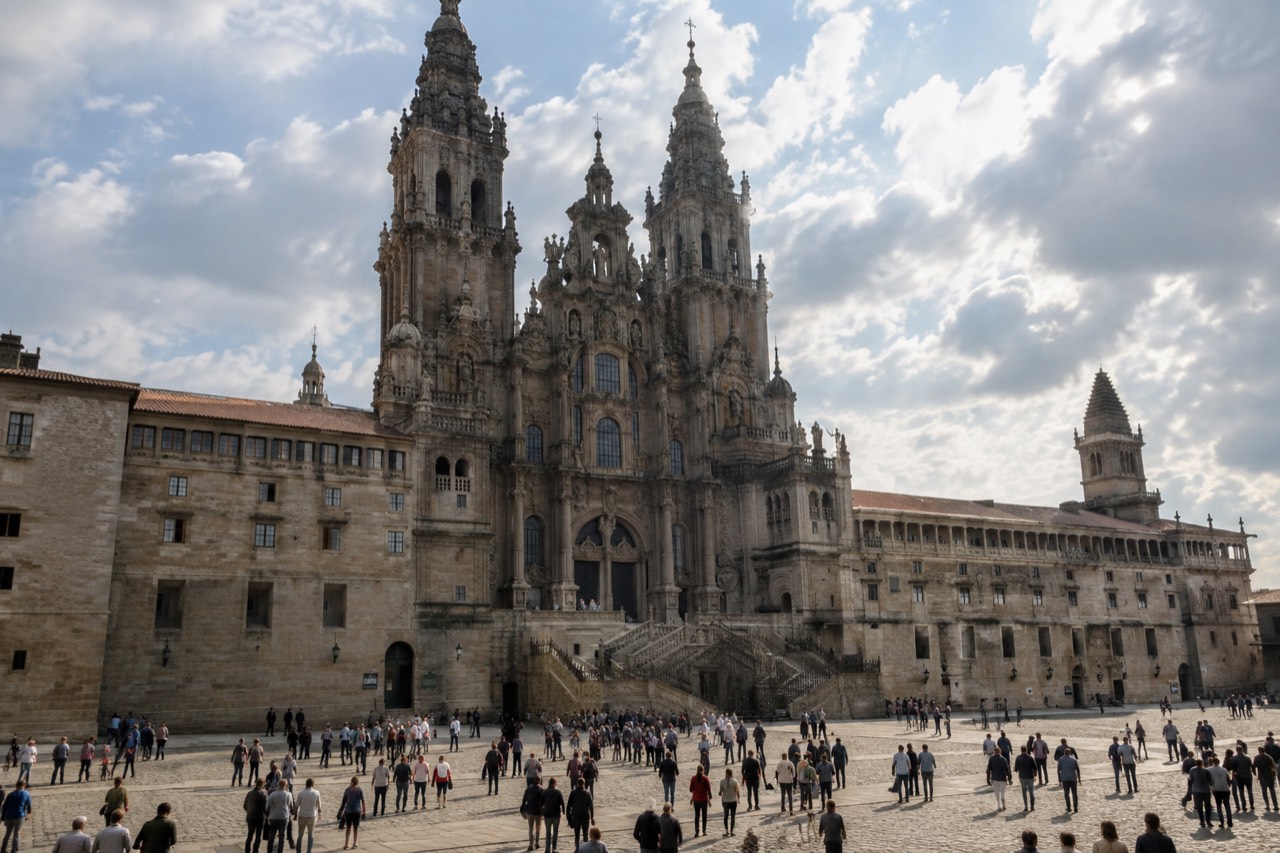
Every 25 July the pilgrim city of Santiago de Compostela turns itself over to its patron apostle. The Feast of St James is the one date on the Galician calendar when the Cathedral's liturgy, the city's civic program and the international pilgrim crowd all converge on the same stones of Praza do Obradoiro, and it has done so for centuries, long enough that the celebration carries both a solemn liturgical core and a summer street festival around it. The Oficina del Peregrino's own figures show why the day matters at scale: 530,987 Compostela certificates were issued in 2025, a record year, and late July is one of the heaviest arrival windows. This Santiago de Compostela Travel Guide lays out what the feast actually involves, what is confirmed for the years ahead, and what is currently suspended, because two things are different right now: the Botafumeiro is out of action, and pilgrim masses are moving from 16 October 2026.
What Is The Feast Of St James In Santiago de Compostela?
The Feast of St James, on 25 July every year, is the patronal feast of Santiago de Compostela, celebrated with a Pontifical and civic Mass at the Cathedral, a national offering to the Apostle, fireworks, concerts and folk events across the old town. It is a fixed date, so it never moves, and its character shifts with the calendar: when 25 July falls on a Sunday the year is declared a Holy Year, or Xacobeo, and the Holy Door stays open. The feast honours James the Greater, the apostle whose relics the Cathedral holds, and the city's identity is inseparable from him, as the story of St James and Santiago explains in full.
The day works on two levels at once. The liturgical level is the Cathedral's: the Pontifical Mass with the national offering, in which an offering is made to the Apostle on behalf of Spain, is the fixed centrepiece, and it often draws civil and state authorities into the pews alongside thousands of pilgrims. The civic level surrounds it: concerts, orchestras, cinema, folk performances and fireworks, the program contemporary city event coverage describes for each July. Contemporaneous reporting on the fiestas del Apóstol describes concerts, orchestras, cinema and fireworks woven through the days around the 25th.
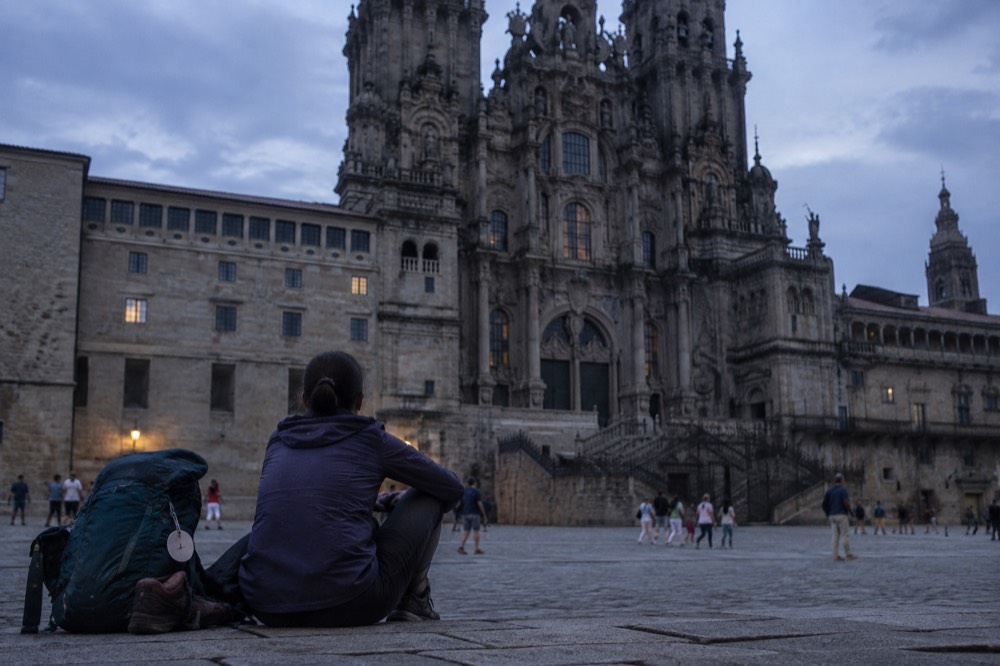
For pilgrims arriving on foot, the feast day is the climax of weeks of walking. The Camino de Santiago funnels walkers from all routes into the old town, and the arrival rituals, the Pilgrim's Office, the Compostela certificate, the embrace of the Apostle, all sit inside a city that is simultaneously throwing its biggest annual party. The question of whether St James is actually buried in Santiago is a separate, older debate, but the feast proceeds from the tradition regardless.
What Happens On 25 July In Santiago de Compostela?
On 25 July itself, the core sequence is the Pontifical and civic Mass at the Cathedral of Santiago de Compostela, frequently with the national offering to the Apostle, followed through the surrounding days by concerts, orchestras, cinema, folk events and fireworks. The exact program is published by the city each year, so treat the civic elements as the shape of the celebration rather than a fixed timetable. What is genuinely fixed is the date and the Mass, and the fact that late July is peak pilgrim season, with the feast drawing the year's largest concentration of arrivals into the old town.
A realistic feast-day shape looks like this, though every element should be confirmed against the city's own published program for the year you travel:
| Element | What It Involves | How Fixed It Is |
|---|---|---|
| Pontifical and civic Mass | The solemn Mass at the Cathedral, with the national offering to the Apostle | Fixed core of the feast, date always 25 July |
| Fireworks | A fireworks display over the city as part of the fiestas del Apóstol | Annual feature, exact night varies by year's program |
| Concerts and orchestras | Music performances in squares and venues across the old town | Program published by the city each July |
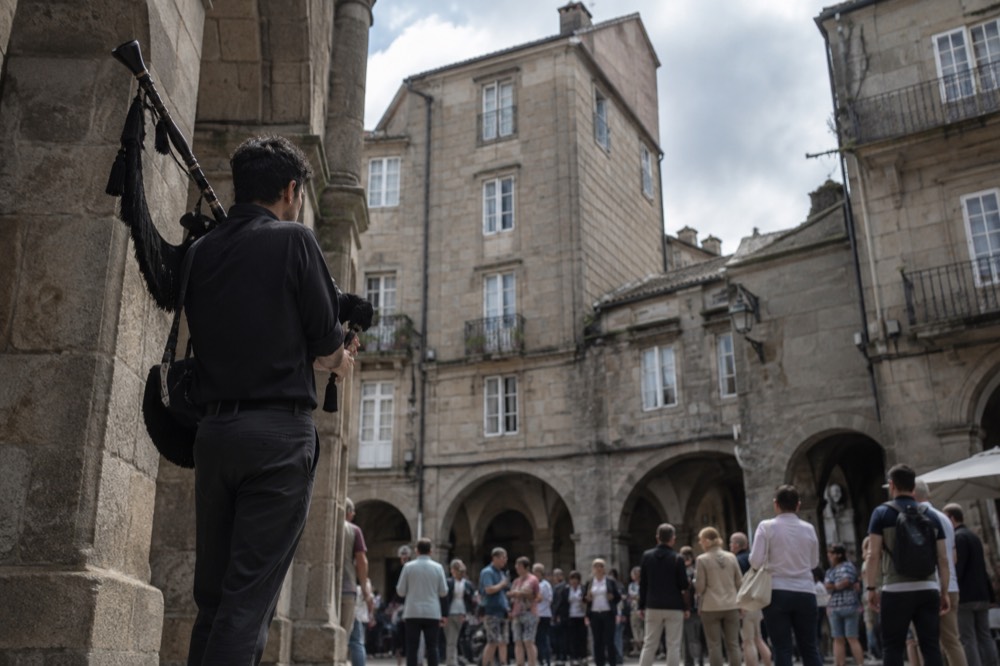
| Folk events | Galician music and dance, including bagpipe traditions, in public spaces | Program varies year to year |
| Pilgrim arrivals | Thousands of walkers finishing the Camino into the old town | Continuous through late July |
The crowds are the practical reality. Late July sits inside the driest stretch of the Galician year, AEMET's climate data for the Santiago station shows July and August as the driest months in an otherwise wet oceanic climate, and that, plus school holidays, plus the feast, makes the 25th one of the busiest days the old town sees outside a Holy Year. Anyone planning to attend the Mass should expect the Cathedral to be at capacity and the surrounding squares, Praza do Obradoiro, Praza da Quintana and Praza das Praterías, to be standing-room-only well before any scheduled event.
This is also when a guided walk earns its keep most. The Historic Walking Tour and Highlights, from $17 per person and rated 4.9 from 29 reviews, moves through the same crowded stones but with the context attached: which facade belongs to which century, why the Obradoiro front is baroque while the Praterías door is older, and how the feast-day geography of the old town was assembled. Check availability
For visitors who want to widen the day beyond the city, the feast period is also prime season for the coast. Galicia in late July is at its weather best, and the full-day trips west and south run at full frequency:
What Are The Pilgrim Mass Times During The Feast?
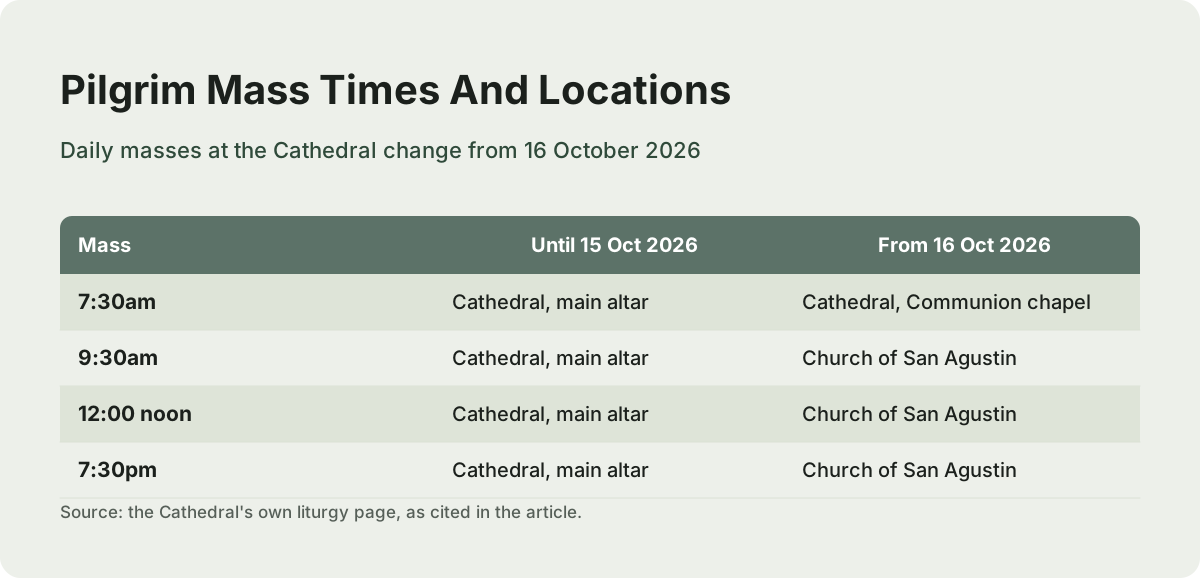
The Cathedral of Santiago de Compostela's daily pilgrim masses run at 7:30am, 9:30am, noon and 7:30pm at the main altar, but from 16 October 2026 the 9:30am, noon and 7:30pm masses relocate to the nearby Church of San Agustin while main chapel remodelling continues, with only the 7:30am mass staying in the Cathedral's Communion chapel. The Cathedral's own liturgy page is the source for these times, and any page discussing mass times must state both arrangements, dated, because the change is already scheduled and runs until further notice in preparation for the 2027 Holy Year.
For feast-day planning the distinction matters enormously. A 25 July before 16 October 2026 follows the current pattern; a 25 July from 2027 onward follows the relocated pattern unless the works finish, and the Cathedral will publish any return. The pilgrim mass guide covers the practical side of attending, and the cathedral tickets and opening hours guide covers entry logistics, which do not change: the basilica remains open to visitors and the relocation does not close the Cathedral.
| Mass | Until 15 October 2026 | From 16 October 2026 Until Further Notice |
|---|---|---|
| 7:30am | Cathedral, main altar | Cathedral, Communion chapel |
| 9:30am | Cathedral, main altar | Church of San Agustin |
| 12:00 noon | Cathedral, main altar | Church of San Agustin |
| 7:30pm | Cathedral, main altar | Church of San Agustin |
The feast-day Pontifical Mass is a separate, larger event from the daily pilgrim masses, and the city publishes its timing in the annual program. The Oficina del Peregrino's FAQs note the certificate process runs alongside all of this: the Compostela certificate requires the last 100km walked, or the last 200km cycled, with two stamps per day, issued in person only at Rua das Carretas 33, and the feast week is the office's busiest stretch. Queue time there on and around 25 July is a real planning factor, even though no published figure exists for it.
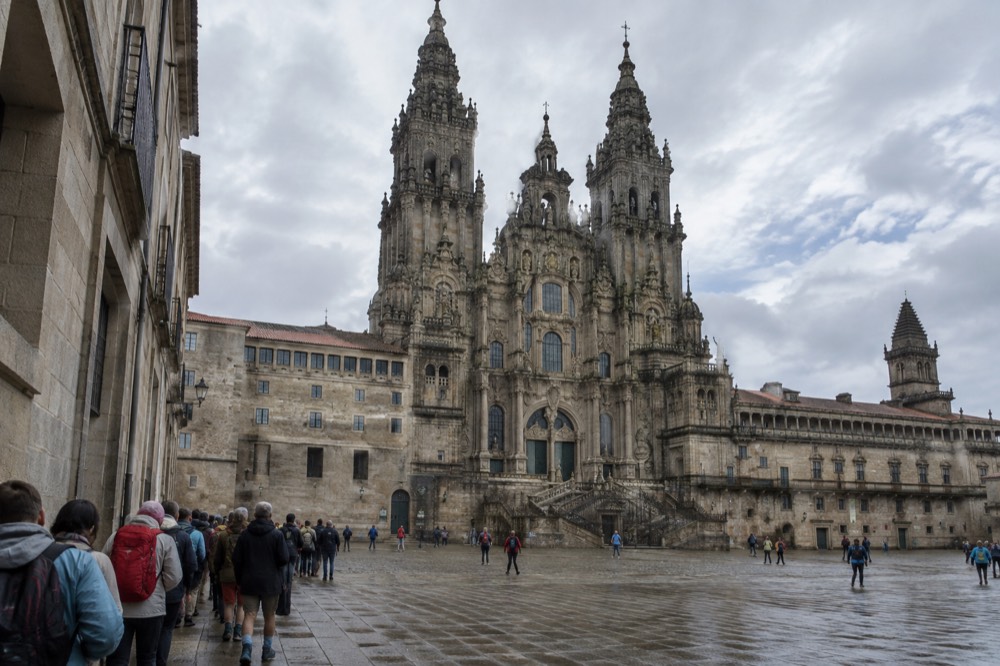
Planning a feast-day visit with a guide solves several of these frictions at once. A booking with free cancellation covers the very real possibility that a mass relocation or a crowd surge changes the plan mid-day.
Will The Botafumeiro Swing At The Feast Of St James?
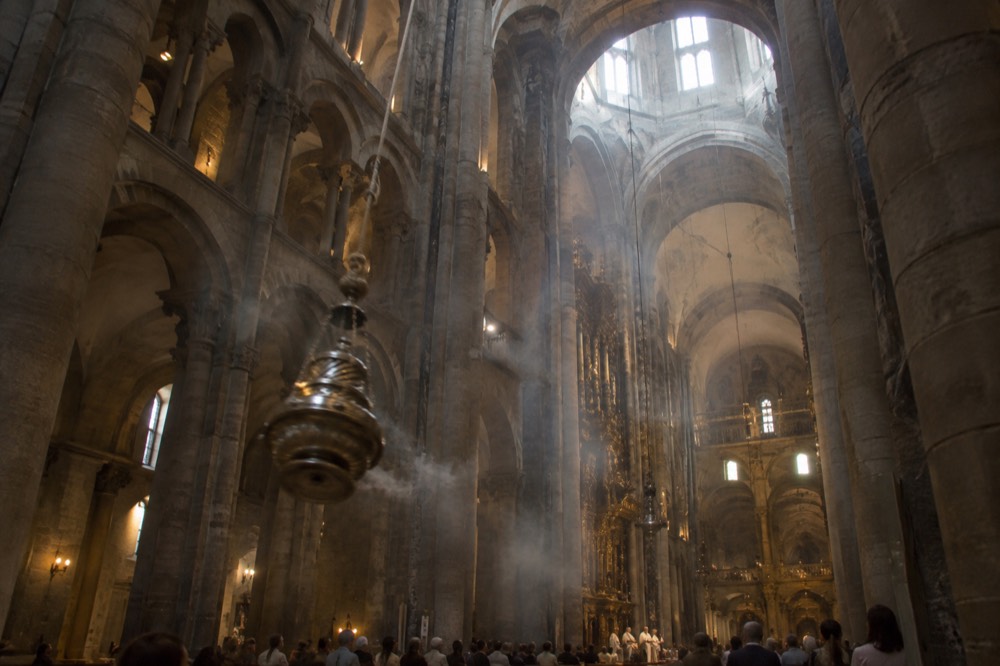
The Botafumeiro is currently out of action, and no visitor should plan around seeing it swing at the 2026 or 2027 feast: the Cathedral confirmed in writing on 5 September 2026 that scaffolding for the cimborrio restoration covers its hanging mechanism, and no return date has been published. The suspension affects the scheduled solemnity flights and private requests alike. The normal mechanism still deserves explaining, because the feast of St James, 25 July, is one of the twelve solemnities on which the giant censer traditionally flies at the end of the main Mass.
Normally, the Cathedral Chapter guarantees the Botafumeiro on twelve fixed liturgical dates each year, and it does not fly at ordinary pilgrim masses. The Cathedral's liturgy page lists the solemnities, and the santiago.es Botafumeiro page carries the current closure confirmation. The twelve dates, with their 2026 instances, are:
| Solemnity | Date | 2026 Instance |
|---|---|---|
| Epiphany | 6 January | 6 January, flight around midday |
| Easter Sunday | Moveable | 5 April |
| Ascension of the Lord | Moveable | Around 14 May, transfer varies |
| Apparition of the Apostle at Clavijo | 23 May, or transferred | 23 May |
| Pentecost | Moveable | 24 May |
| Feast of St James the Apostle | 25 July | 25 July, earlier start around the national offering |
| Assumption of the Virgin | 15 August | 15 August |
| All Saints | 1 November | 1 November |
| Christ the King | Last Sunday before Advent | 22 November |
| Immaculate Conception | 8 December | 8 December |
| Christmas | 25 December | 25 December |
| Transfer of the Apostle | 30 December | 30 December |
The flight times listed are indicative, drawn from the liturgical calendar references, and the Cathedral's own liturgy page is the place to confirm them, but under the current suspension none of them will run until the restoration scaffolding comes down. The Botafumeiro guide tracks the mechanism, the 140-step rooftop vantage points and the history; the short version for feast planning is simple: do not build a 25 July itinerary around the censer until the Cathedral announces its return, and treat any tour copy promising a sighting with suspicion.
What the feast still offers, unconditionally, is the fabric of the building itself. The Cathedral interior, the tomb, and the museum complex remain open through the works, and the rooftop tour, Cubiertas plus Torre de la Carraca, runs on the Cathedral's own ticketing at EUR15 general and EUR12 reduced, with timed slots bookable in advance on the official ticket site, and it includes museum access valid for seven days. Late July slots sell out, and the feast week sells out first.
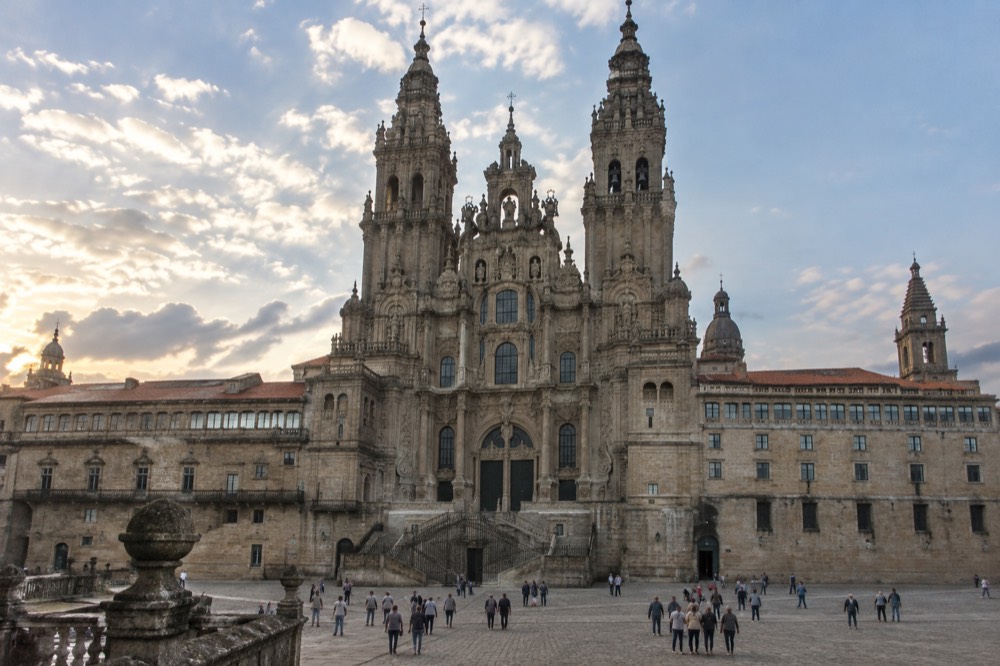
When Is The Next Holy Year And How Does It Change The Feast?
The next Holy Year, or Xacobeo, is 2027, not 2026: the Holy Door opens solemnly on the evening of 31 December 2026 and the Holy Year runs through 31 December 2027, so the Feast of St James on 25 July 2027 falls inside an open Holy Year and will be dramatically larger than a normal year's. A Holy Year is declared whenever 25 July falls on a Sunday, which it does in 2027, and subsequent regular Holy Years listed are 2032, 2038 and 2049. The santiago.es news pages and Cathedral pages carry the confirmation.
For feast planning, the difference is not marginal. In a Holy Year, pilgrim numbers run far above the already record levels of 2025, the Holy Door at Praza da Quintana becomes a destination in itself, and the 2027 feast will coincide with the main chapel remodelling works that are currently relocating masses to San Agustin. Anyone booking for 25 July 2027 should assume peak-of-peak conditions: the fullest hotels, the fullest masses, and the earliest-selling Cathedral tickets. The Holy Year 2027 guide collects the confirmed dates.
| Milestone | Date | Status |
|---|---|---|
| Holy Door opens | 31 December 2026, evening ceremony in Praza da Quintana | Confirmed, ceremony time may adjust |
| Holy Year runs | Through 31 December 2027 | Confirmed |
| Feast of St James 2027 | 25 July 2027, falls on a Sunday | Triggers the Holy Year |
| Masses relocate to San Agustin | From 16 October 2026, until further notice | Confirmed, tied to Holy Year preparation works |
| Botafumeiro suspension | Confirmed in writing 5 September 2026 | No return date published |
| Subsequent Holy Years | 2032, 2038, 2049 | Listed on official pages |
The feast in a non-Holy year is still a major event, and 25 July in 2026 will be a busy, celebratory day without the Holy Door dimension. Visitors deciding between years should weigh that a normal feast is crowded but workable, while the 2027 feast will be a once-eleven-years phenomenon with everything that implies for booking lead time.
Where To Watch The Fireworks And Celebrations In Santiago de Compostela?
The celebrations spread across the granite squares and parks of central Santiago de Compostela, with Praza do Obradoiro as the natural focal point in front of the Cathedral, and the practical strategy is to claim a spot early and expect every viewpoint to be densely crowded. The city publishes the full program each July, including which squares host which concerts and which night the fireworks fall on, so the exact schedule for a given year is a check-the-program exercise rather than something any guide can state in advance.
The geography rewards a little planning. The old town is compact and the main event spaces sit within a few minutes' walk of each other, so a walker can move between them, but on the feast itself the density in Praza do Obradoiro means movement slows to shuffling. The Alameda park, west of the old town, gives an elevated view across the rooftops toward the Cathedral towers, and it is the classic vantage for photographs of the lit facade. Praza da Quintana, behind the Cathedral at the Holy Door, carries a different atmosphere, quieter, and the Alameda park guide covers the viewpoint details.
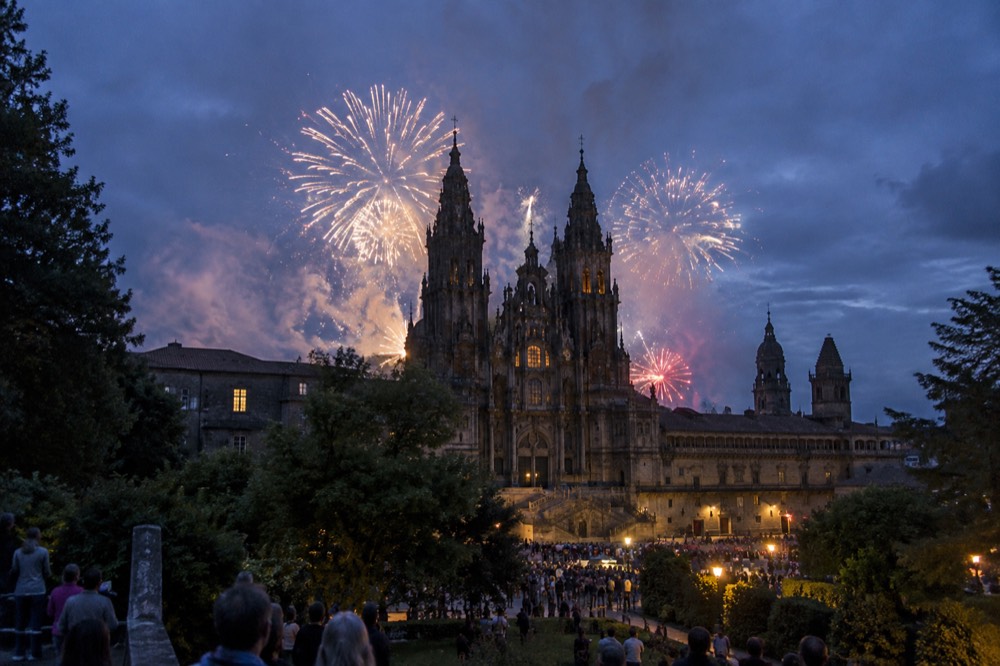
Evening is when the city shifts register. A night tour of the old town, the Secrets of Compostela walk at $17 per person, rated 4.9 from 74 reviews, runs through the squares when the lanterns are on and the folklore is at full volume, and it can be booked directly through its own listing page.
One caution that belongs in any honest feast-day section: pickpocket pressure rises with crowd density, and the feast creates the densest crowds the old town sees. The city is generally safe, but standard big-crowd habits, nothing valuable in back pockets, bags in front, matter more on 25 July than on any other day. Rain is the other variable: AEMET's station data shows the climate is wet year-round with only July and August reliably dry, so even a July feast can catch a shower, and the Santiago de Compostela weather guide frames the seasons properly.
What To Eat And Drink During The Feast Of St James?
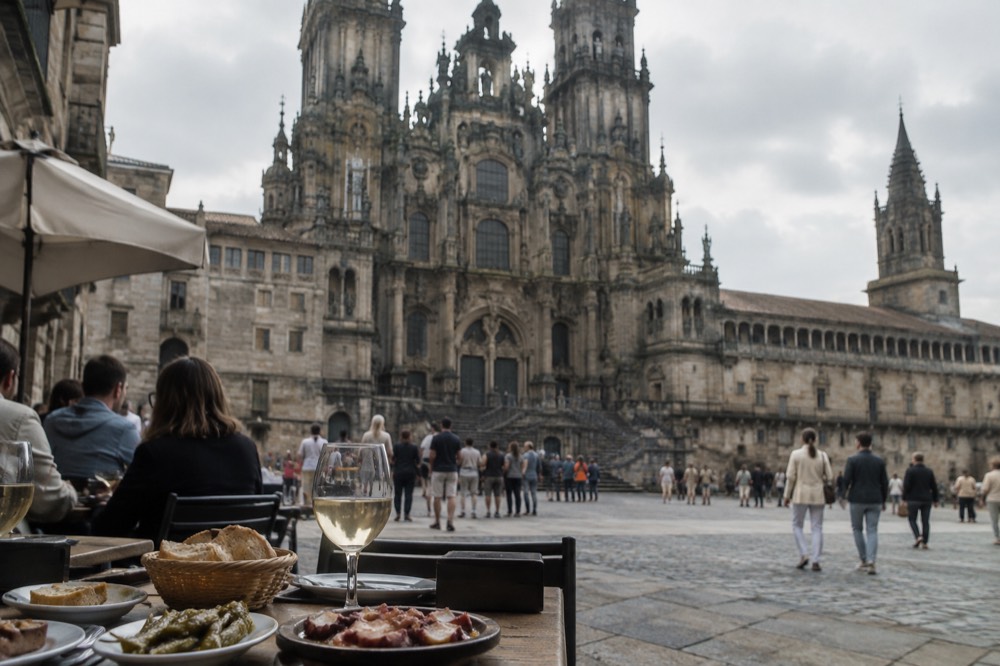
The feast table in Santiago de Compostela is Galician in full: pulpo a la gallega, Padrón peppers, empanada, local cheese, and the almond Tarta de Santiago named for the city itself, with Rías Baixas Albariño whites and queimada, the flamed spirit ritual, appearing in the celebrations. Late July also coincides with the pepper season's first harvests, and Padrón peppers, famously occasional in their heat, are a summer fixture on the tapas counters of Rua do Franco and the surrounding lanes.
The where to eat guide maps the eating geography, and the Galician food guide explains each dish; the feast-specific notes are simpler. Book ahead, or accept that the best-known tapas bars on feast weekend will have queues. Eat early or late by Spanish hours if the program matters. And treat the Tarta de Santiago, the almond tart stamped with the cross of Santiago, as the dessert of the day; the tarta guide covers its history and where it is best.
| Dish Or Drink | What It Is | Feast-Season Notes |
|---|---|---|
| Pulpo a la gallega | Boiled octopus with paprika, olive oil, coarse salt | A Galician centrepiece, on counters across the old town |
| Padrón peppers | Small green peppers, fried, salted, occasionally hot | Summer season peaks with late July |
| Tarta de Santiago | Almond tart stamped with the cross of Santiago | Named for the city, the feast-day dessert |
| Albariño | Crisp white wine from the Rías Baixas | The regional pairing for seafood |
| Queimada | Flamed spirit ritual with incantation, or conxuro | Performed at festivals, including a show-and-tasting experience |
Two food-anchored ways into the feast atmosphere are worth naming. The tapas tour of the city, from $52 per person and rated 4.7 from 243 reviews, moves through the bars that are hardest to read cold on a feast weekend.
And the queimada show and tasting, from $17 per person and rated 4.4 from 69 reviews, stages the conxuro, the Galician spell-chanting ritual around the flaming potion, which belongs squarely to festival season. Seafood is the other thread, and a full-day trip into the Rías Baixas combines winery visits with a mussel-boat run on the estuaries where that seafood comes from.
Where To Stay And How To Get To Santiago de Compostela For The Feast?
Feast-week accommodation in Santiago de Compostela books months ahead and prices climb steeply toward 25 July, so the practical answer is to book as early as the trip is decidable, expect the old town's hotel stock to fill first, and treat the airport bus, line 6A, as subject to a fare change with a new Monbus contract expected in autumn 2026. The current line 6A fare is 1 EUR paid to the driver, or 0.36 EUR per trip on a rechargeable card, per the city transport page as of late September 2026, but a reorganized service with a higher unsubsidized fare around 6 EUR one-way is expected to start by December 2026, so verify the fare after that date.
The where to stay guide sorts the neighbourhoods. The feast-day specific point is that staying inside the old town puts you inside the festival perimeter, which is wonderful at night and loud late, while staying near the train station or in the newer streets trades the atmosphere for sleep and lower prices. Pilgrim-budget options are covered in the albergues guide, though feast-week albergue pressure is intense.
| Arrival Route | What To Expect | Verified Detail |
|---|---|---|
| Flights into SCQ | Santiago-Rosalia de Castro airport, about 12km from the old town | Regional and domestic focus; the flights guide covers routes |
| Airport bus line 6A | Roughly every 30 minutes, journey around 25-45 minutes depending on stops | 1 EUR to the driver, 0.36 EUR by card, as of late September 2026; Monbus fare change expected autumn 2026 |
| Train from Madrid | Direct high-speed services, roughly 3-4 hours | The Madrid train guide has details |
| Train from Porto | No direct line; change via Vigo | The Porto to Santiago guide covers the routing |
| On foot via the Camino | The classic arrival, all routes converge on the old town | The arriving in Santiago guide covers the finish |
The airport distance is worth stating carefully: sources disagree between roughly 11 and 15km depending on the measured points, so "about 12km" and a 20-30 minute drive is the honest framing, never a single precise figure. Santiago de Compostela has charged a municipal tourist tax since 1 October 2025, a surcharge on Galicia's tourist-stay tax, from 1 EUR per person per night (maximum 5 nights) in private albergues, campsites and tourist apartments up to 2.50 EUR in five-star hotels, with under-18s and stays in Xunta-run public albergues exempt.
For the feast specifically, the arrival timing matters as much as the mode. Pilgrims walking the final stages, the most popular start being Sarria for the 100km qualifying distance described in the Sarria to Santiago guide, often aim to reach Praza do Obradoiro on or just before the 25th, and that concentrates arrivals on the narrow lanes of the old town in the days running up to the feast.
How Many Days Should You Plan Around The Feast Of St James?
Plan at least three days around 25 July in Santiago de Compostela: one for arrival and the Pilgrim's Office queue if certificates matter, one for the feast day itself with the Pontifical Mass and evening celebrations, and one recovery or exploration day after, when the city exhales but the summer program continues. The how many days guide treats this question at length for ordinary weeks, and the feast compresses the same logic into a busier container.
A feast-week frame that works: arrive on 24 July to settle and walk the old town in the evening while the program events begin around the feast; spend the feast day itself on the Pontifical Mass, the offering and the evening fireworks, claiming space early for anything crowded; take 26 July for the rooftop tour and museum, when timed tickets are calmer once the peak day passes; and add extension days for the coast, because late July is when the weather is at its most reliable.
| Day | Focus | Why |
|---|---|---|
| Day before, 24 July | Arrive, settle, walk the old town in the evening | Program events begin around the feast; the city is already building |
| Feast day, 25 July | Pontifical Mass, the offering, squares, fireworks | The centrepiece; claim space early for anything crowded |
| Day after, 26 July | Rooftop tour, museum, quieter squares | Timed tickets are calmer once the peak day passes |
| Extension days | A day trip to the coast, Fisterra, the Rías Baixas, or Cíes | Summer weather is at its most reliable in late July |
The extension days are where the July coast earns its place. The westernmost reaches of the Costa da Morte, the fishing villages of Muxía and Combarro, and the Albariño towns of the Rías Baixas all sit within a day trip, and the trips run at full summer frequency:
For pilgrims rather than city visitors, the calculus is different and covered in the dedicated guides: the pilgrim passport needs two stamps per day over the qualifying distance, the routes are compared in the Camino routes guide, and the dedicated rest-day pages are written for exactly the exhausted walker staring at a city mid-festival.
For quick planning questions, the short answers are these. The feast next falls on a Sunday in 2027, which triggers the Holy Year, and the official Xacobeo pages carry the confirmation. The Botafumeiro will not fly on 25 July under current conditions, with no return date published, and the Cathedral liturgy page is where any return will be announced. The masses are at San Agustin from 16 October 2026, except the 7:30am in the Cathedral. The Cathedral itself stays open during the works, naves and tomb, with normal hours. And for 25 July 2027, the booking should be made as early as possible, because a Holy Year feast is the peak of peaks.
Common Questions About The Feast Of St James In Santiago de Compostela
What is the Feast of St James Santiago de Compostela?
It is the patronal feast of Santiago de Compostela, held every 25 July, centred on a Pontifical and civic Mass at the Cathedral with the national offering to the Apostle, and surrounded by fireworks, concerts, orchestras, cinema and folk events across the old town. When 25 July falls on a Sunday, the year is also a Holy Year, as in 2027.
Does the Feast of St James fall on the same date every year?
Yes. The feast is fixed on 25 July every year. What changes is whether that date falls on a Sunday, which triggers a Holy Year: 2027 is the next one, with the Holy Door opening on 31 December 2026, and the listed subsequent Holy Years are 2032, 2038 and 2049.
Will the Botafumeiro swing on 25 July?
Not under current conditions. The Cathedral confirmed in writing on 5 September 2026 that the Botafumeiro is out of action because restoration scaffolding for the dome covers its hanging mechanism, and no return date has been published. The 25 July solemnity is one of the twelve dates on which it normally flies, so any return of the mechanism would restore that tradition, but no visitor should plan around it until the Cathedral announces otherwise.
Where are the pilgrim masses held during the feast?
Until 15 October 2026, the daily pilgrim masses are at 7:30am, 9:30am, noon and 7:30pm at the Cathedral's main altar. From 16 October 2026, the 9:30am, noon and 7:30pm masses relocate to the nearby Church of San Agustin for main chapel works, and only the 7:30am mass remains in the Cathedral, in its Communion chapel.
Is the Cathedral open during the feast and the restoration works?
Yes. The Cathedral's naves and the Apostle's tomb area remain open with normal hours, generally around 7:00am to 9:00pm with free general entry, and the works, the cimborrio scaffolding, the Berenguela tower restoration and the chapel roof works, are interior-high or exterior-focused and do not close the visit.
How early should you book for the Feast of St James?
Months ahead for accommodation in any year, and as early as possible for 25 July 2027, which falls inside the Holy Year that runs from 31 December 2026 through 31 December 2027. Late July is peak pilgrim season even without a Holy Year, and 530,987 Compostelas were issued in 2025, a record, so feast-week pressure on hotels, albergues and Cathedral rooftop slots is intense.
The Feast of St James is the one day each year when Santiago de Compostela is most fully itself: the pilgrim tradition, the civic celebration and the summer crowds occupying the same granite squares, with the Pontifical Mass at the centre of it all. Plan around the two current realities, the suspended Botafumeiro and the relocated masses from 16 October 2026, book early, and the 25th of July in this city is one of the great festival days in Spain.