Restaurants In Santiago de Compostela
Santiago de Compostela feeds two crowds at once: pilgrims finishing the Camino de Santiago and visitors who came for the cathedral, the granite squares and the food. This guide covers the dishes worth ordering, the neighborhoods where restaurants cluster, Spanish meal times, and how to eat well without falling into a tourist trap.
Short answer
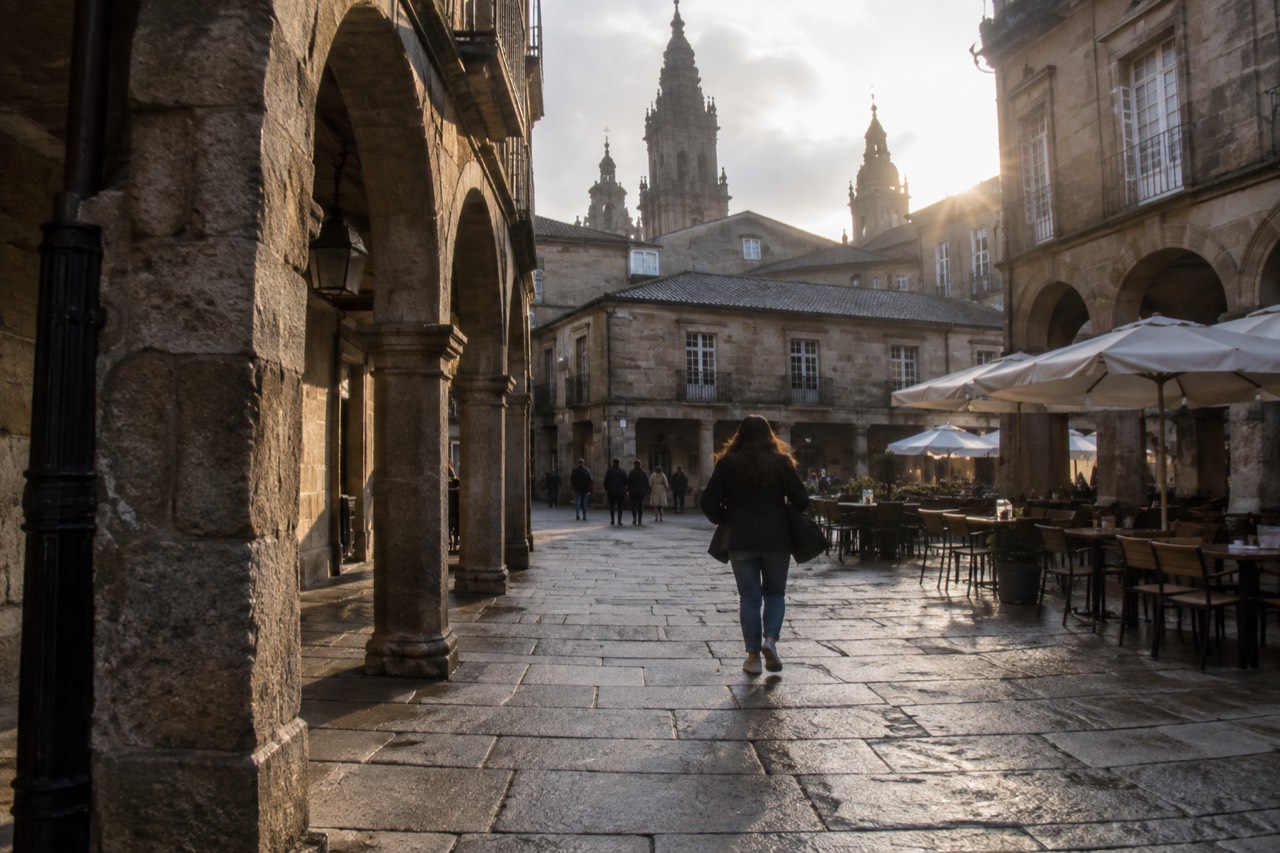
Santiago de Compostela's restaurant scene centers on Galician cooking: octopus, empanada, Padrón peppers, seafood from the Rías, and Tarta de Santiago. The densest clusters of restaurants sit around the old town, Rúa do Franco and the streets off Praza da Quintana, plus the tapas bars near the market. Eat on Spanish hours, order the local dishes rather than international menus, and book ahead for dinner on weekends and around the Feast of St. James on 25 July.
Santiago de Compostela is a small granite city with an outsized kitchen. Pilgrims arrive off the Camino de Santiago hungry after weeks of albergue dinners, and the city answers with some of the most distinctive regional cooking in Spain: octopus dressed in olive oil and paprika, empanada filled with cod or tuna, tiny green peppers fried and salted, and seafood pulled from the estuaries of the Rías Baixas. The Old Town, a UNESCO World Heritage site since 1985, holds most of the best eating within a ten minute walk of the cathedral.
This guide, from the Santiago de Compostela Travel Guide editors, walks through the dishes, the streets and the practical rhythms of eating here. It is based on what the Cathedral's own pages, the city's tourism listings and the Galician food tradition actually say, not on anyone's single visit, because nobody at this site has walked the Camino for it.
What Should You Order In Santiago de Compostela?
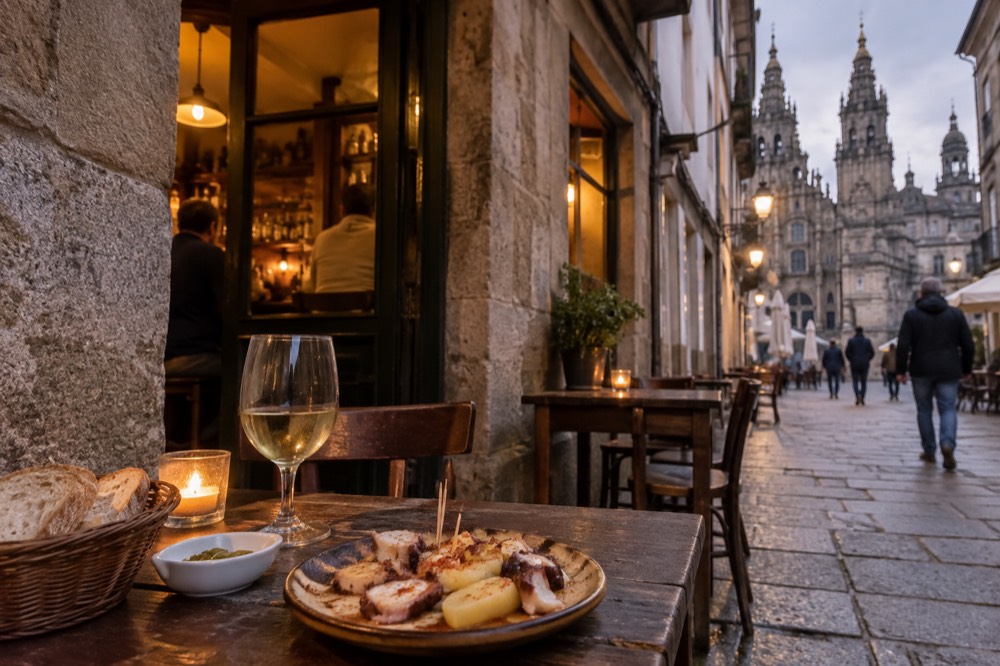
Order the Galician classics rather than an international menu: pulpo á feira, octopus with olive oil and paprika served on a wooden plate, empanada gallega with cod or tuna, Padrón peppers, lacón con grelos, pork with turnip tops, and Tarta de Santiago, the almond cake stamped with the cross of Saint James. The seafood, percebes, barnacles, razor clams, scallops and hake, comes from the Galician estuaries, and the scallop shell is the pilgrim symbol of the city itself. That list is the core of nearly every serious menu here.
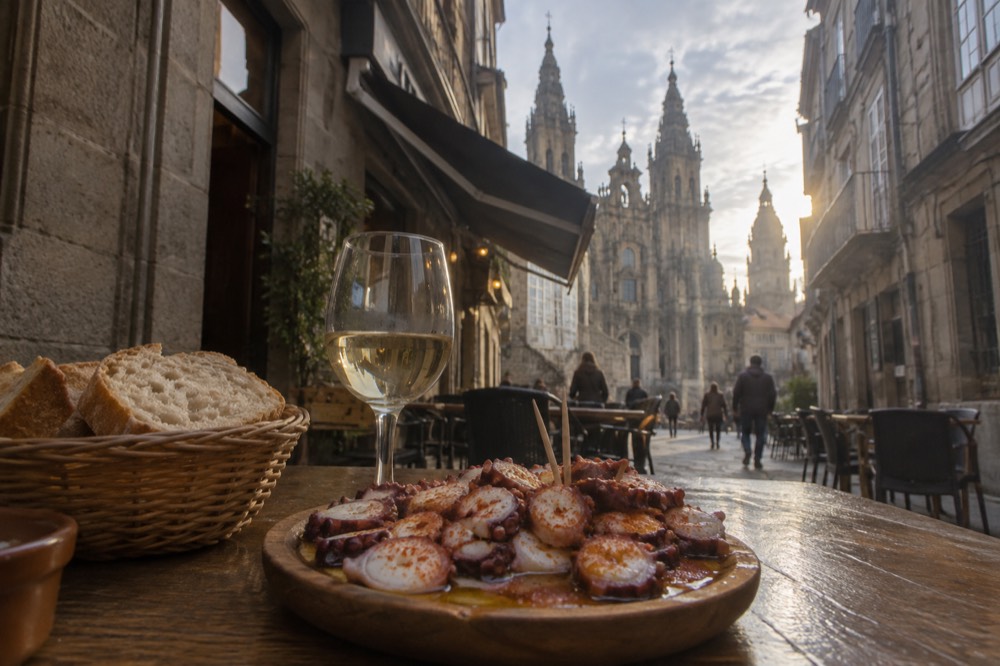
Pulpo á feira is the emblem. The octopus is boiled, cut into rounds with scissors, dressed with olive oil, coarse salt and pimentón, and eaten with toothpicks at celebrations across Galicia all year. A good version is tender, not rubbery, and the paprika should taste of smoked dried pepper, not dust.
Padrón peppers carry the famous saying: some are hot and some are not. They come from the town of Padrón, southwest of the city, they are fried in olive oil, hit with coarse salt and eaten whole by the stalk. Tarta de Santiago, which has its own dedicated guide, is a dense almond cake with a paper stencil of the apostle's cross dusted in icing sugar. It has protected geographical status under European food law, as do Padrón peppers, so the named versions are certified from their home regions.
| Dish | What It Is | Notes For Ordering |
|---|---|---|
| Pulpo á feira | Boiled octopus, olive oil, pimentón, coarse salt | Served on wood, eaten with toothpicks; the signature Galician dish |
| Empanada gallega | Savory pie, typically cod, tuna or meat | Sold by the slice in bars and at the market; good for a quick lunch |
| Padrón peppers | Small green peppers fried and salted | Protected name; "some are hot, some are not" |
| Lacón con grelos | Cured pork shoulder with turnip tops | A cold-weather dish, most common in winter |
| Percebes | Goose barnacles from the Rías | Expensive and prized; order where turnover is high |
| Tarta de Santiago | Almond cake with the cross of St. James | Protected name; the standard dessert and souvenir cake |
The scallop deserves a word of its own. The vieira is the shell stamped on Camino waymarks, worn by pilgrims for a thousand years, and the same shell appears on every bakery counter in the city. The creatures themselves, when in season, come from the Rías and appear grilled or in the shell.
Where Are The Best Streets To Eat On In Santiago de Compostela?
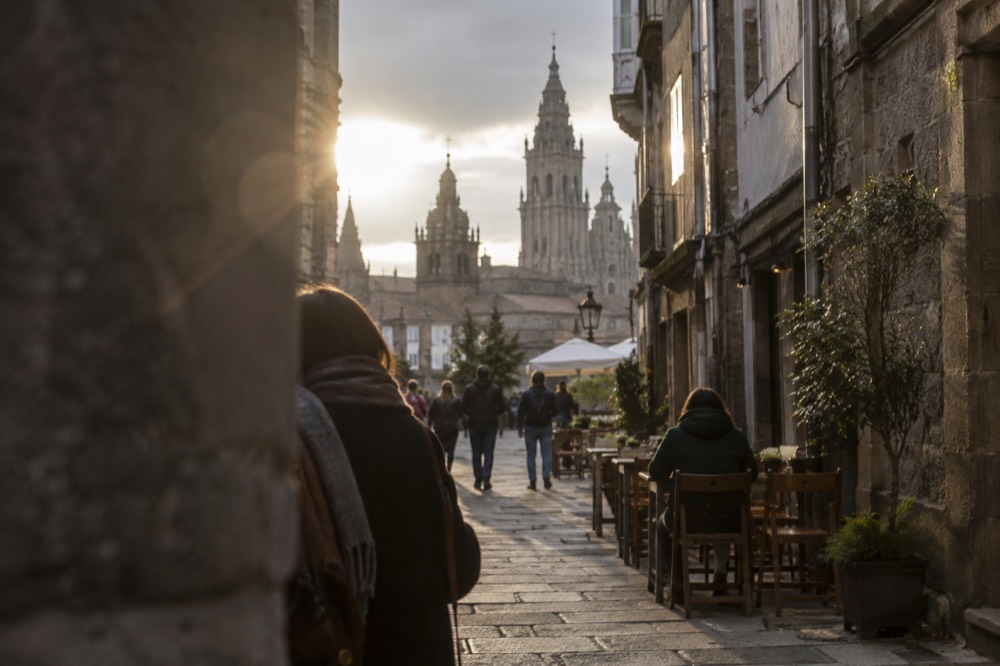
Rúa do Franco, running south from the cathedral toward Praza de Toural, is the historic restaurant street, a whole avenue of dining rooms with menus posted outside. The tighter, quieter lanes around Praza da Quintana and Rúa das Carretas hold smaller kitchens and bars popular with pilgrims, and Rúa da Raíña and the streets off Praza de Cervantes mix tapas bars with sit-down rooms. Almost any street off the main squares works if the menu is short and Galician.
Rúa do Franco got its restaurant row reputation from the pilgrim trade: it is the direct descent from the cathedral's south side, so arriving walkers pass it on their way into the city. The street's kitchens range from large, old dining rooms to smaller modern ones. The classic caution applies to any heavily trafficked street in any tourist city: a posted menu with photos of every dish and a host outside calling to passers-by is a different proposition from a room full of locals at two in the afternoon.
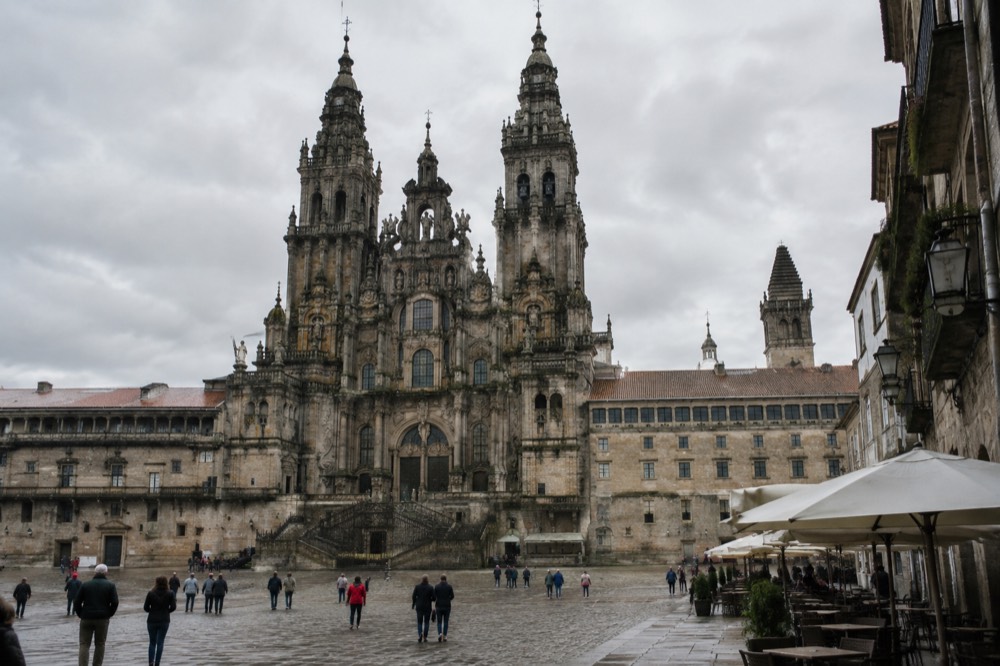
The Quiroga "Colexiata" district and the streets around the Mercado de Abastos are where the city eats when it is not serving pilgrims. The market, which has its own guide on this site, sits a few minutes east of the old town, and the bars around it serve whatever came in that morning. That rule, eat near the market, works in most Spanish cities and works here too. Most visitors end up eating within a five minute radius of Praza do Obradoiro.
For planning where to sleep relative to the food, our where to stay in Santiago de Compostela guide maps the neighborhoods, since the old town is small enough that anywhere central puts dinner within a short walk.
| Area | Character | Best For |
|---|---|---|
| Rúa do Franco | The historic restaurant street, dense and busy | Choice and capacity; groups; first-time visitors |
| Praza da Quintana lanes | Small kitchens, bars, pilgrim crowds | Post-Camino dinners, atmosphere at night |
| Rúa da Raíña | Tapas bars and mid-sized rooms | Bar hopping, glass of Albariño and a bite |
| Around Mercado de Abastos | Market-side bars and casual counters | Lunch, whatever is fresh that day |
| Praza de Cervantes | Mix of tapas and sit-down, central | Stopping between sightseeing stops |
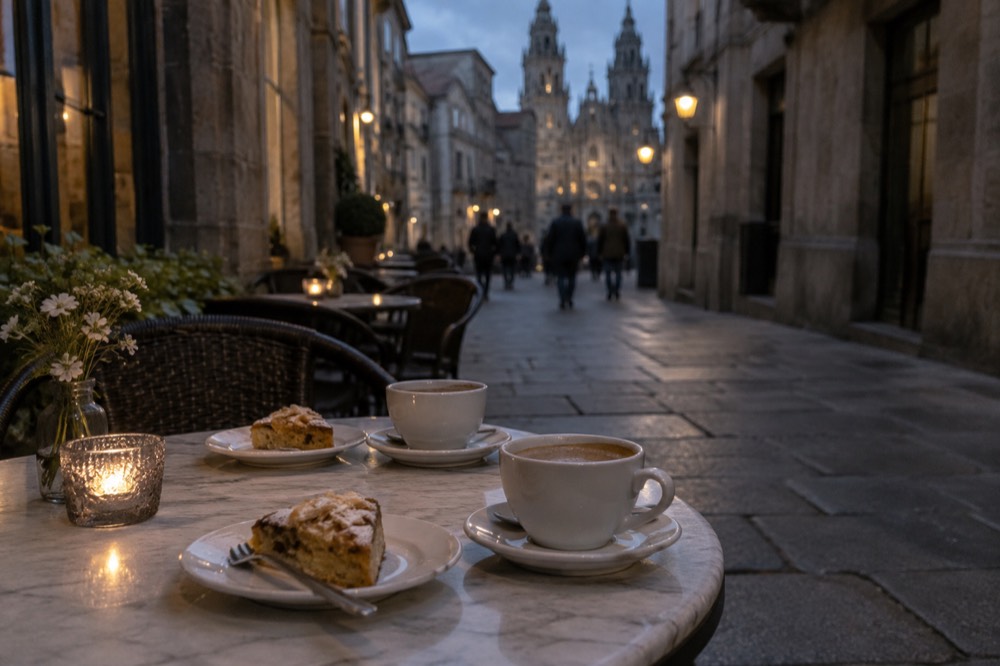
| Rúa do Vilar | Cafes and lighter options | Breakfast, coffee, Tarta de Santiago |
A guided first evening sorts the streets quickly. The Santiago: Guided Foodie Tour with Drinks, Tapas & Live Music runs from $51 per person and is rated 4.7 from 227 reviews, and the Historic Walking Tour in Small Group runs from $29 per person, rated 4.9 from 16 reviews, for the geography. The listing says prices, times and inclusions for each.
When Do Santiago de Compostela Restaurants Open And Close?
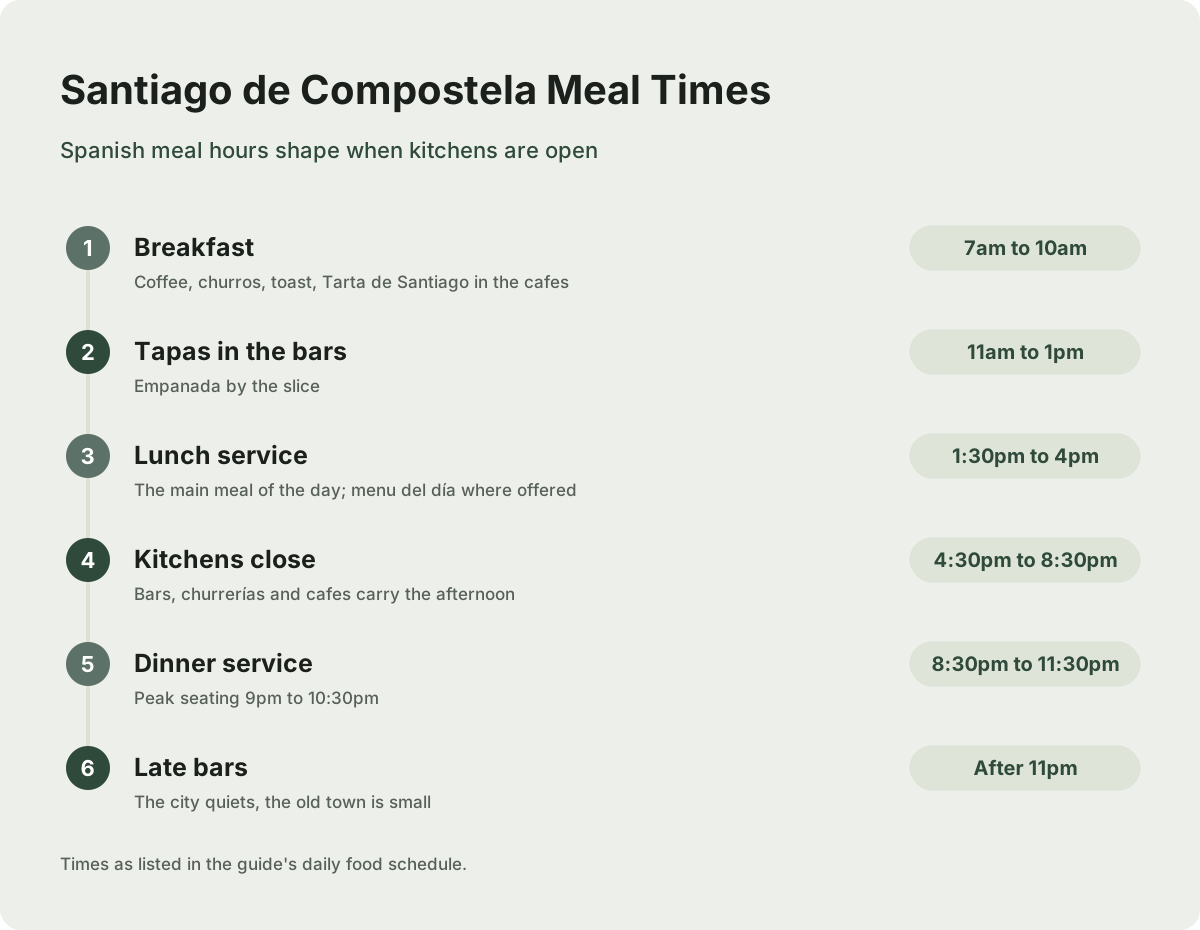
Santiago de Compostela runs on Spanish meal times: lunch is the main meal, roughly 1:30pm to 4pm, with many kitchens closing by 4:30pm, and dinner starts late, around 8:30pm or 9pm, with the busiest seating between 9pm and 10:30pm. Bars serving tapas fill the afternoon gap from late morning onward. Some old-town kitchens close on Sunday or Monday, and nearly everything pauses during the afternoon. Adjust your day to the Spanish clock or you will find locked doors at 6pm.
The afternoon closure is the detail that catches most visitors from northern Europe and North America. Between roughly 4:30pm and 8:30pm, the old town's sit-down restaurants are largely dark, and only the bars, the churrerías and the cafes by the cathedral stay open. This is not a tourist-town quirk, it is the national rhythm: the Spanish dinner hour is among the latest in the world, and Galicia keeps it.
Pilgrim mass schedules interact with mealtimes. The Oficina del Peregrino's and Cathedral's own liturgy pages list daily masses at 7:30am, 9:30am, noon and 7:30pm, and from 16 October 2026 the 9:30am, noon and 7:30pm masses relocate from the Cathedral's High Altar to the nearby Church of San Agustín, with only the 7:30am mass staying in the Cathedral's own Communion chapel. Until 15 October 2026 all four remain at the main altar. A pilgrim who attends the noon mass and then eats lunch at 1:30pm is already on local time. Our pilgrim mass guide carries the full dated detail.
| Time | What Is Happening Food-Wise |
|---|---|
| 7am to 10am | Breakfast: coffee, churros, toast, Tarta de Santiago in the cafes |
| 11am to 1pm | Tapas and a glass of wine in the bars; empanada by the slice |
| 1:30pm to 4pm | Lunch service, the main meal of the day; menu del día where offered |
| 4:30pm to 8:30pm | Kitchens close; bars, churrerías and cafes carry the afternoon |
| 8:30pm to 11:30pm | Dinner service; peak seating 9pm to 10:30pm |
| After 11pm | Late bars; the city quiets, the old town is small |
Booking matters on Friday and Saturday nights in the warmer months, and matters enormously in late July around the Feast of St. James on 25 July, when the city fills for the national offering to the Apostle, fireworks and concerts. The Feast of St. James guide covers that week in full. And if you are timing a whole trip around eating outdoors on the squares rather than under cover, the city's climate is temperate oceanic, wet year-round and wetter October to March with the driest stretch in July and August, per AEMET's data for the city's station; our Santiago de Compostela weather and best time to visit guides break that down.
How Much Does Eating Out In Santiago de Compostela Cost?
Santiago de Compostela is a mid-priced Spanish city for food, cheaper than Madrid or Barcelona for equivalent quality, and its cheapest eating is genuinely cheap: market stalls, empanada by the slice, and menu del día lunches keep a full day's food spend low for Spain. The upper end, the seafood and the dining rooms on the main squares, climbs steeply. Treat any specific figure as a range to verify on each menu, not a promise.
The honest way to frame this is structurally rather than numerically. A slice of empanada and a coffee near the market is at the cheap end of Spanish eating-out. A menu del día, the fixed three-course weekday lunch that most of urban Spain still runs, is the best value mechanism in the country, and plenty of kitchens in Santiago de Compostela offer one; ask for "menú del día" rather than hunting a printed sign. Dinner with fresh shellfish and a bottle of Albariño is the expensive end, and the same dish ranges widely between a market-side bar and a room overlooking Praza do Obradoiro. Percebes and other Rías shellfish are priced as luxury items anywhere in Galicia.
| Tier | What It Looks Like | Where It Sits |
|---|---|---|
| Market and counter eating | Empanada, churros, coffee, tapas standing at the bar | Cheapest, and where locals break the day |
| Menu del día lunch | Fixed multi-course weekday lunch with drink included | Best value; ask rather than look for signs |
| Casual dinner | Shared plates, pulpo, peppers, a glass of Albariño | Mid-range, tapas-bars territory |
| Seafood splurge | Percebes, scallops, hake, and Rías shellfish by weight | Priced as luxury; ask prices per portion before ordering |
| Square-front dining | The same food with the view of Praza do Obradoiro | You pay for the address, not just the plate |
Two cautions that cost money if ignored. First, shellfish priced by weight: ask the price per unit or per 100 grams before the plate arrives, because percebes and barnacle-class seafood can shock a bill anywhere in Galicia. Second, the streets nearest the cathedral carry a location premium; walking three minutes further buys either a lower price or a better plate for the same one. For the wider budget picture around a stay, including that Santiago de Compostela has charged a municipal tourist tax since 1 October 2025 (from 1 EUR to 2.50 EUR per person per night for up to five nights, with under-18s exempt), the practicalities in our arrival guides hold the detail.
What Should You Drink With Dinner In Santiago de Compostela?
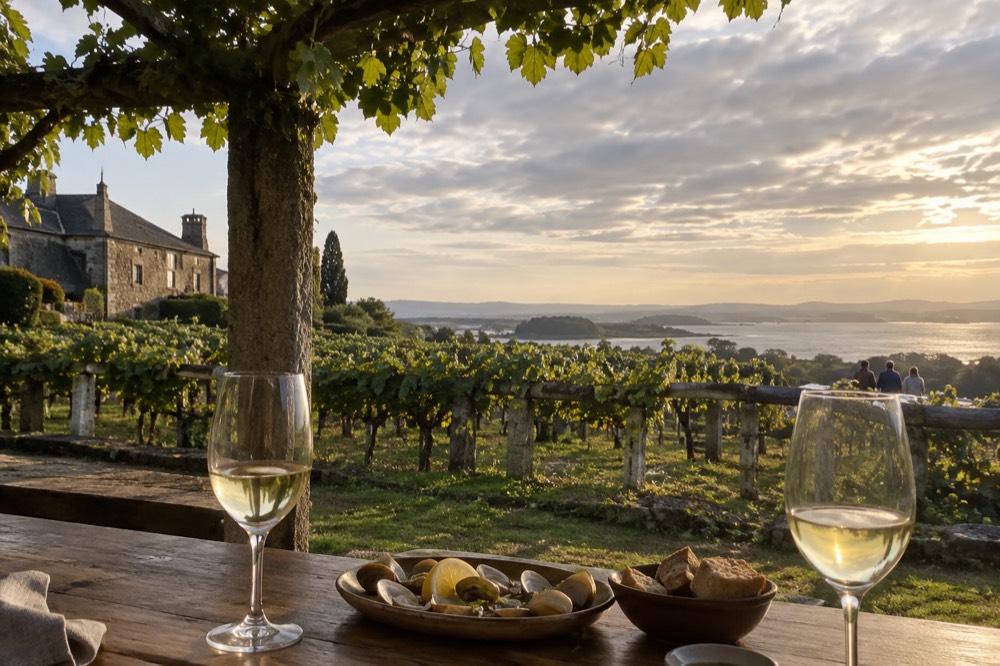
Order Albariño, the white wine of the Rías Baixas just south of the city, with seafood and octopus, and try the local reds from the Ribeira Sacra inland, made from Mencía grapes on river-canyon terraces. Estrella Galicia is the local beer, and queimada, the flamed aguardiente ritual with sugar, lemon peel and coffee beans, is Galicia's ceremonial drink, recited and set alight. Water from the tap is safe. Coffee after the meal, never with it, closes a Galician dinner.
Albariño is the pairing the whole region is built on: crisp, saline, and grown within an hour of the city, it is the reason Rías Baixas wine tours run out of Santiago de Compostela as a full-day excursion. Our Albariño guide covers the grape, the wineries and the tasting rooms. The Ribeira Sacra, whose canyons and Sil river cruises also run as day trips, gives you the red side of Galicia, and Mencía is the grape to look for on any local list.
Queimada is the one to witness at least once. The aguardiente is set with sugar, lemon peel and coffee beans in an earthenware bowl, the conxuro, an old Galician incantation, is recited, and the mixture is set alight and ladled burning into cups. It is theater with folk roots, and shows in the city stage it for groups and visitors. The Queimada Experience Show and Tasting, at $17 per person and rated 4 from 70 reviews, is the direct way to see it done properly rather than hoping your restaurant stages one on your night.
Estrella Galicia, brewed in A Coruna, is the default beer across the region and needs no explanation in the city; you will be handed one if you do not specify. And the coffee rule is a real Spanish rule: café after the meal, espresso-sized, not a bucket beside it. Order the cortado or café con leche at the end and the kitchen takes you seriously.
| Drink | What It Is | Order It With |
|---|---|---|
| Albariño | White wine from Rías Baixas, crisp and saline | Octopus, shellfish, fish, anything from the Rías |
| Mencía / Ribeira Sacra red | Red from canyon terraces inland | Meats, empanada, heartier plates |
| Estrella Galicia | The regional lager, from A Coruna | Tapas, anytime |
| Queimada | Flamed aguardiente with sugar, lemon, coffee beans | As an event after dinner, not a casual order |
| Café con leche / cortado | Milk coffee / espresso with a dash | At breakfast and after the meal |
Where Do Pilgrims Eat After Finishing The Camino?
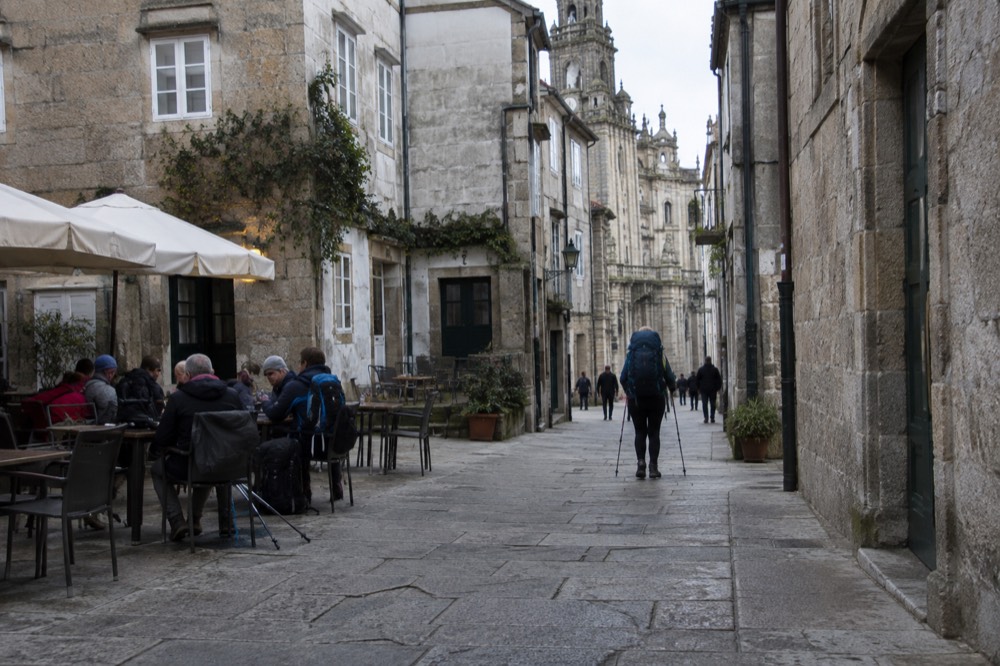
Pilgrims arriving in Santiago de Compostela eat in the bars and small kitchens around Praza da Quintana, Rúa das Carretas and the lanes off Rúa do Franco, the streets between the cathedral and the pilgrim infrastructure, and the tradition is the celebratory first proper dinner after weeks of albergue cooking. The Oficina del Peregrino on Rúa das Carretas 33 issues the Compostela in person, and the eating streets sit within minutes of it. Many walkers treat the first night as the meal of the trip.
The geography drives it. Arriving pilgrims come over the hill from Monte do Gozo, drop into the old town, and the first real food they meet is the Rúa do Franco corridor and the Quintana lanes. The arriving in Santiago on the Camino guide covers that final-day sequence, and the pilgrim office guide covers the certificate: the last 100km walked, or the last 200km cycled, with two stamps per day on the credencial, issued in person only.
The Compostela numbers put the flow in scale: the Oficina del Peregrino's figures show 530,987 Compostelas issued in 2025, a record year, per press reporting citing the office. That is more than half a million people finishing hungry, and the city's kitchens are built around them. The pilgrim passport guide explains the credencial that gets them there, and the Camino routes guide explains the paths, all of which end at the same dinner tables.
A tapas tour is the efficient first-night move for a group, since someone local decides the route and the standing-versus-sitting question answers itself bar by bar.
Which Food Day Trips From Santiago de Compostela Are Worth Taking?
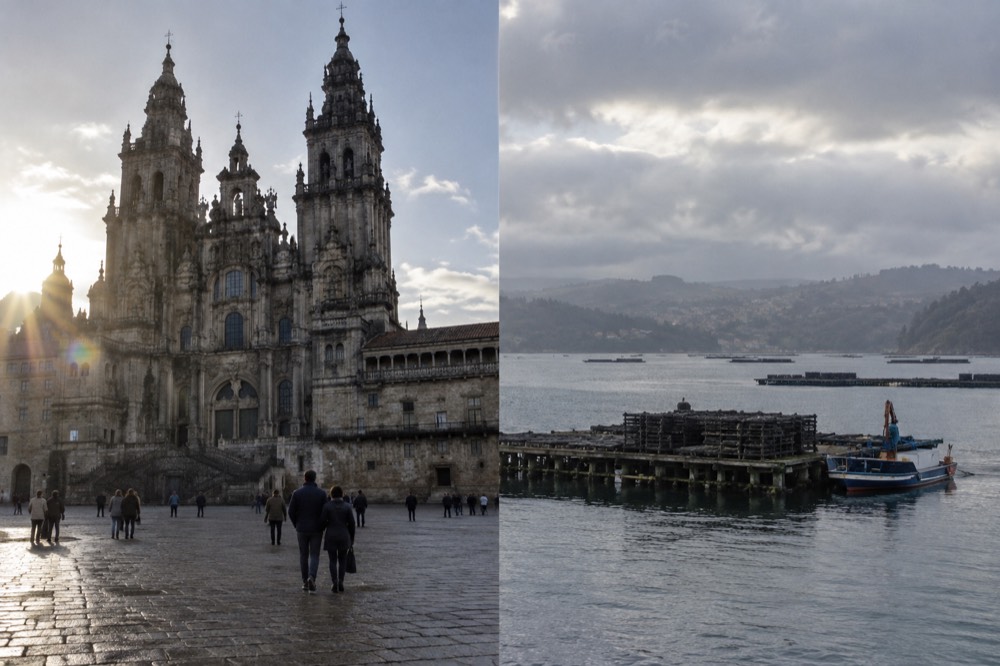
The two food-focused day trips from Santiago de Compostela both run south: the Rías Baixas winery tours, which visit Albariño country in and around Cambados with an optional mussel-boat trip on the estuary, and the coastal runs west to Fisterra, Muxía and the Costa da Morte, which are about the ocean and the lighthouse food culture. A third heads inland to the Ribeira Sacra canyons for a Sil river cruise and Ourense, Mencía country. All are full-day trips leaving from the city.
The Rías Baixas is the food-and-wine day trip, full stop. Albariño wineries, the mussel barges that farm the estuaries, and the fishing towns of the coast are all in one loop south, and the tours from the city combine winery visits with an optional boat. The 7-stop Fisterra, Muxía and Costa da Morte excursions are the ocean alternative: lighthouse at the "end of the world," fishing villages, and the coast that gave the region its dramatic name.
| Day Trip | What You Get | From (Per Person) | Rating |
|---|---|---|---|
| Rías Baixas winery with optional mussel boat | Albariño winery, estuary, optional boat with mussels and wine | from $54 | 4.8 from 322 reviews |
| Rías Baixas: boat trip and winery | Full-day boat plus winery combination | from $53 | 4.7 from 482 reviews |
| Arousa island, Combarro and mussel boat | Island, old fishing village, mussel boat | from $45 | 4.7 from 30 reviews |
| Fisterra, Muxía, Costa da Morte (7 stops) | Lighthouse, coast, fishing villages, full day | from $60 | 4.8 from 1,714 reviews |
| Ribeira Sacra cruise, monasteries, Ourense | Sil river canyon cruise, Mencía country, thermal town | from $68 | 4.6 from 166 reviews |
The food logic of each: Rías Baixas puts you where the Albariño and the mussels come from, the Costa da Morte puts you at the Atlantic edge where the fish land, and the Ribeira Sacra trades the coast for red-wine canyons and the hot springs at Ourense. Our Rías Baixas and Cambados guide and Finisterre guide cover the destinations themselves, and every price and rating above is the operator's live listing's own figure, check current availability there before planning around it.
How Do You Avoid Tourist Trap Restaurants In Santiago de Compostela?
A tourist trap in Santiago de Compostela announces itself in four ways: a photographed menu covering every regional dish at once, a host outside working the passers-by, a dining room empty at peak Spanish hours, and a location directly on Praza do Obradoiro with prices to match the view. The reliable counters are a short menu, locals eating at lunch, a kitchen that closes in the afternoon like a real Spanish kitchen, and shellfish prices stated before you order.
The photographed-menu test is the strongest single one. A kitchen making pulpo á feira properly has a short list, because octopus and the day's fish are what it does. A laminated folio with photographs of thirty dishes, including international ones, is a kitchen cooking for people who will never come back. The emptiness test follows: at 2pm a good room in Spain has people in it. At 9:30pm the same is true. An empty room at those hours, on a street with tourist traffic, is telling you something.
Two more structural cautions. The shellfish-by-weight rule from the cost section applies doubly in trap-avoidance terms: a legitimate kitchen states the unit price without being pressed, and if you have to ask twice, leave. And be careful with the "pilgrim menu" label itself; a fixed menu aimed at arriving walkers is a genuine local tradition and often good value, but the label alone does not make it either cheap or good, so compare what is actually on it with what the same kitchen charges à la carte. Bar prices, standing at the counter rather than sitting at a table, are lower than table prices in the same room in much of Spain, and often here too.
For travelers arriving from further afield, the practical sequencing is covered in our flights and Madrid to Santiago by train guides, roughly three to four hours by high-speed rail from the capital. And the airport guide covers the last leg, with the note that the airport bus fare, currently around 1 euro paid to the driver on line 6A, is expected to change under a new contract in late 2026, so verify the fare on the city's transport page before assuming it.
Common Questions About Eating In Santiago de Compostela
What food is Santiago de Compostela famous for?
Octopus, pulpo á feira, Padrón peppers, empanada gallega, seafood from the Rías Baixas, and Tarta de Santiago, the almond cake with protected geographical status. The scallop shell of the pilgrim is the city's symbol and also its classic dish.
Is Santiago de Compostela expensive for food?
It is mid-priced for Spain, generally cheaper than Madrid or Barcelona at equivalent quality. Market eating, empanada and menu del día lunches keep costs low, while Rías shellfish priced by weight can be expensive anywhere in Galicia. Treat prices as a range to verify on each menu.
What time do people eat dinner in Santiago de Compostela?
Dinner starts around 8:30pm or 9pm, with peak seating between 9pm and 10:30pm. Many kitchens close between roughly 4:30pm and 8:30pm in the afternoon, Spanish style, so plan the late afternoon around bars and cafes rather than sit-down restaurants.
What wine should I drink in Santiago de Compostela?
Albariño, the white of the Rías Baixas an hour south, with seafood and octopus, and Mencía-based reds from the Ribeira Sacra with meatier plates. Estrella Galicia is the local beer, and queimada, the flamed aguardiente ritual, is the ceremonial after-dinner drink.
Where do pilgrims eat after finishing the Camino de Santiago?
In the small kitchens and bars around Praza da Quintana, Rúa das Carretas and Rúa do Franco, the streets between the cathedral and the Oficina del Peregrino at Rua das Carretas 33, where the Compostela is issued in person. The first dinner after weeks on the trail is treated as the meal of the trip.
Do I need to book restaurants in Santiago de Compostela?
Book for Friday and Saturday nights, for July generally, and especially for the Feast of St. James on 25 July, when the city fills for the national offering, fireworks and concerts. On quiet winter weekdays, walk-ins are usually fine outside peak hours, but check the kitchen's afternoon closure before planning a late lunch.
Eating well in Santiago de Compostela comes down to three moves: order the Galician short list rather than a long international one, run your day on the Spanish clock instead of your own, and walk the extra three minutes off the main square. Do that, and the same city that has fed arriving pilgrims for a thousand years will feed you properly too.