Pilgrim Office Santiago de Compostela
The Pilgrim Office at Rua das Carretas 33 is where every qualifying Camino walker, cyclist and rider collects the Compostela certificate. Here is exactly how it works, what it checks, and what changes in the city in late 2026.
Short answer
The Pilgrim Office (Oficina del Peregrino) sits at Rua das Carretas 33, a short walk from Praza do Obradoiro in Santiago de Compostela. It issues the Compostela certificate in person only, to pilgrims who walked the last 100km (or rode horseback) or cycled the last 200km of a recognized Camino route with at least two credencial stamps per day. It issued a record 530,987 Compostelas in 2025.
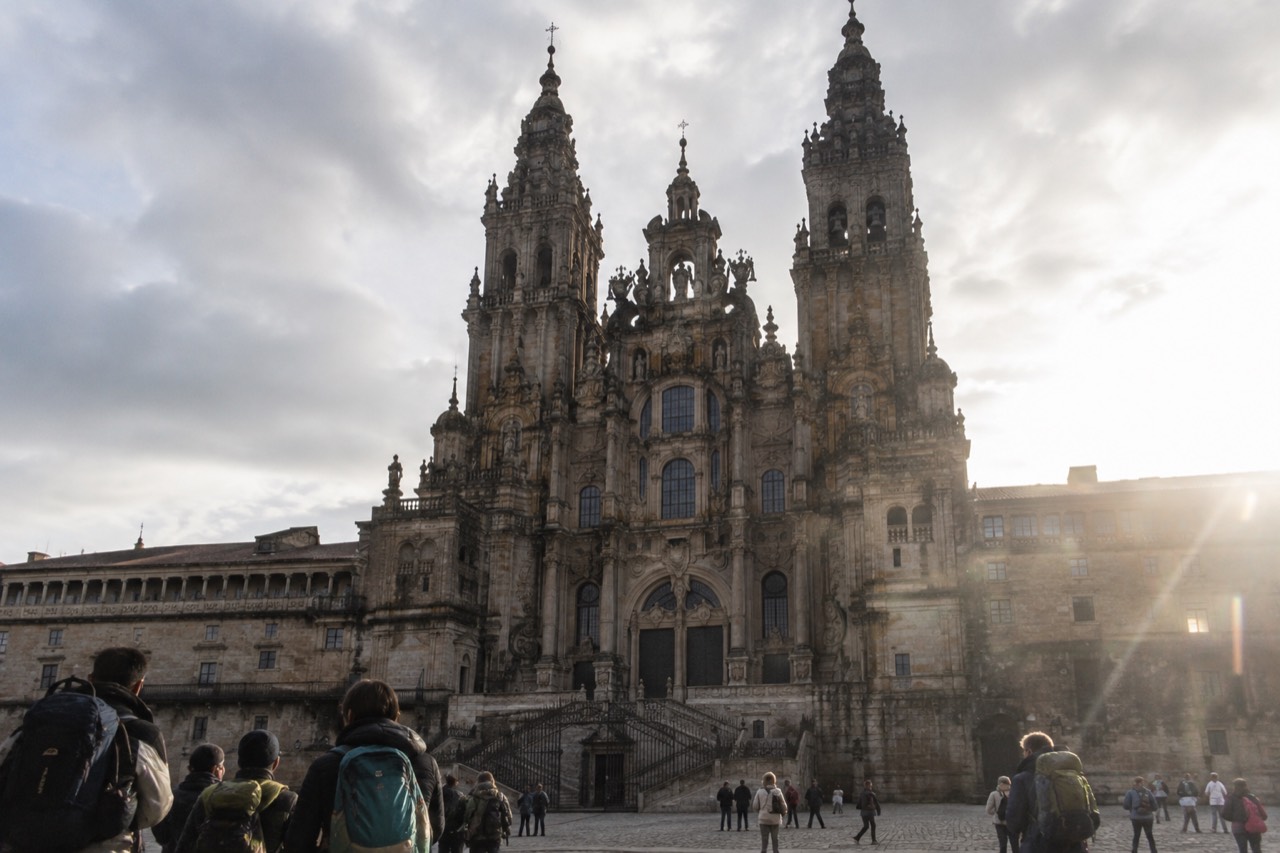
The Pilgrim Office in Santiago de Compostela issued a record 530,987 Compostela certificates in 2025, according to figures from the Oficina del Peregrino reported in the Spanish press. Every one of those certificates was handed over in person, at one address, Rua das Carretas 33, a few minutes' walk downhill from the Cathedral's towers. That single fact shapes the whole arrival experience in this city: the Camino does not formally end at the tomb of St. James, it ends at a counter in a narrow street, where an official reads your credencial, checks your stamps and prints your name on a document written in Latin. This guide covers what the office is, what it requires, when it opens, what changes for pilgrims in late 2026 and 2027, and what to do with your first afternoon in the city once the certificate is in your hand.
The office sits at the practical heart of the pilgrim city, close to the end of the final stage of every route described in the Camino de Santiago overview. If you are still choosing a route or planning credential logistics, the pages on the pilgrim passport and credencial and the Camino routes compared cover the decisions that come before the ones described here.
What Is The Pilgrim Office In Santiago de Compostela?
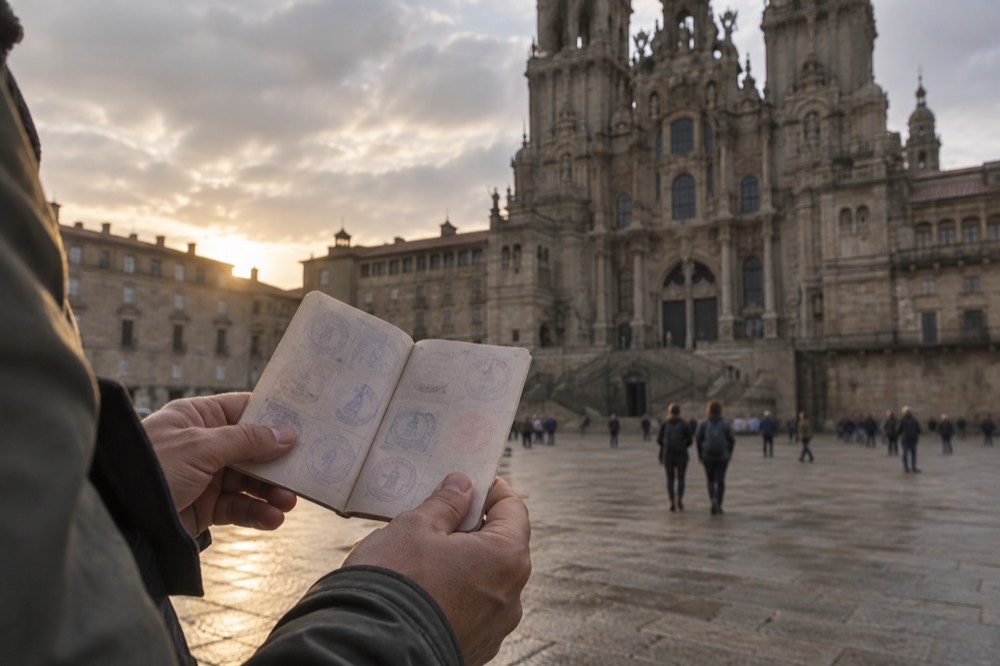
The Pilgrim Office, or Oficina del Peregrino, is the official institution of the Archdiocese of Santiago de Compostela that verifies completed Camino pilgrimages and issues the Compostela certificate, the traditional document confirming that a pilgrim reached the tomb of the Apostle St. James. It exists for one purpose: reading the credencial, the stamped pilgrim passport, and deciding whether the walk, ride or ride on horseback meets the Church's rules. The Compostela itself is a certificate with roots in medieval pilgrimage, printed with the pilgrim's name in Latin, and it can only be collected in person. No digital, postal or third-party channel exists for it, and no other office in the city can issue it.
The Oficina del Peregrino's own FAQs state the two thresholds plainly. The last 100km of a recognized route must be covered on foot or on horseback, or the last 200km by bicycle, and the credencial must carry at least two stamps per day from official stamping points along the way. The office reads those stamps and the distances they imply. That is the entire test, and it is the same whether you began in Saint-Jean-Pied-de-Port, Porto, Roncesvalles or, as huge numbers now do, Sarria, the most popular starting point covered in the Sarria to Santiago guide.
It helps to understand what the office is not. It does not sell Cathedral tickets, run the museum, or manage the rooftops, those are separate operations covered in the Cathedral tickets and opening hours guide. It does not run pilgrim masses, although the times of those masses matter enormously to arriving pilgrims and are covered further down this page. It is a verification office, small, human-scaled, and busiest in the hours after midday when walkers from the final stages reach the old town.
Where Is The Pilgrim Office And When Is It Open?
The Pilgrim Office stands at Rua das Carretas 33 in Santiago de Compostela, inside the UNESCO-inscribed old town and only a few minutes' walk from Praza do Obradoiro and the Cathedral facade. Opening hours vary seasonally, roughly from 8, 9 or 10am in the morning to 7 or 8pm in the evening, and the office is closed on 25 December and 1 January. The Oficina del Peregrino publishes its current hours on its own site, and because the pattern shifts with the seasons, checking there before you set out on your final stage is the reliable move.
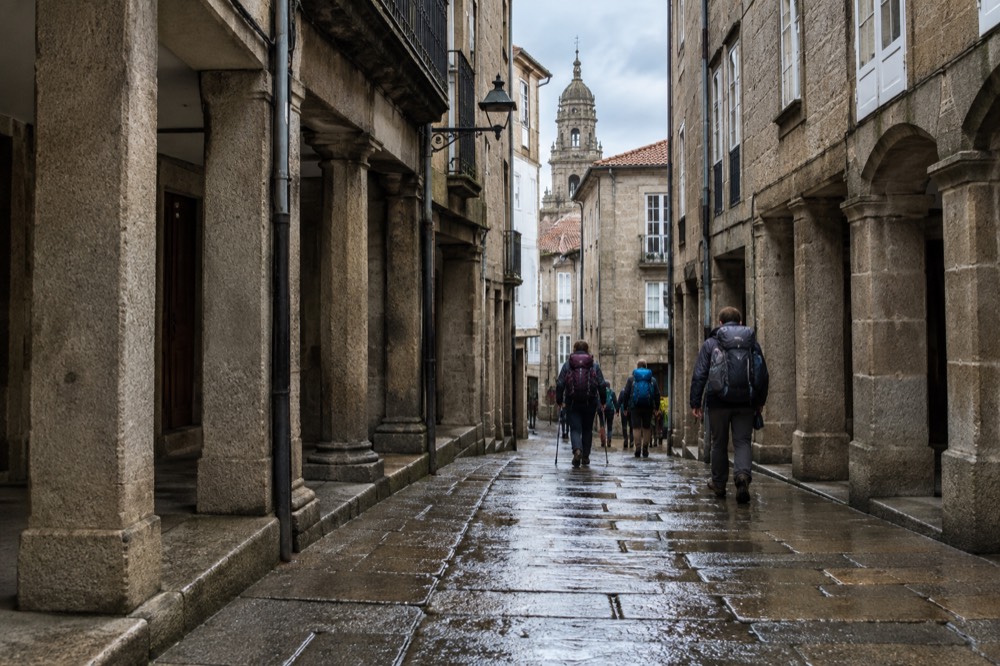
Rua das Carretas is a small street in the historic core, and pilgrims arriving on foot from the west or north generally reach it within ten minutes of entering the old town. The location is deliberate: it sits on the natural pilgrim flow between the final approach routes and the Cathedral, so the walk from collecting your Compostela to standing in front of the tomb is short. The old town around it was inscribed on the UNESCO World Heritage list in 1985, a listing entirely separate from the 1993 inscription of the Routes of Santiago de Compostela themselves, two distinct recognitions that are often wrongly merged into one.
The seasonal opening pattern matters for planning your last day. Arrive in the city in the morning and you can reasonably expect to complete the whole arrival sequence, office visit, Cathedral visit, mass, on the same day. Arrive late in the evening after a long final stage, and the office may already be closed, which is one reason many pilgrims book their first night in the city in advance, a decision covered in detail in where to stay in Santiago de Compostela.
| Period | Approximate opening | Approximate closing | Notes |
|---|---|---|---|
| Winter season | Around 10am | Around 7pm | Shorter days, far fewer pilgrims |
| Spring and autumn | Around 9am | Around 7pm | Busiest weeks fall in this window |
| Summer season | Around 8am | Around 8pm | Longest hours, highest demand |
| 25 December | Closed | Closed | Annual closure |
| 1 January | Closed | Closed | Annual closure |
The hours above are the office's own seasonal ranges, not timetabled commitments, and they can shift around the Feast of St. James on 25 July and the Holy Year calendar. Treat them as a planning frame and confirm current hours on the office's own site during your walk.
How Do You Qualify For The Compostela Certificate?
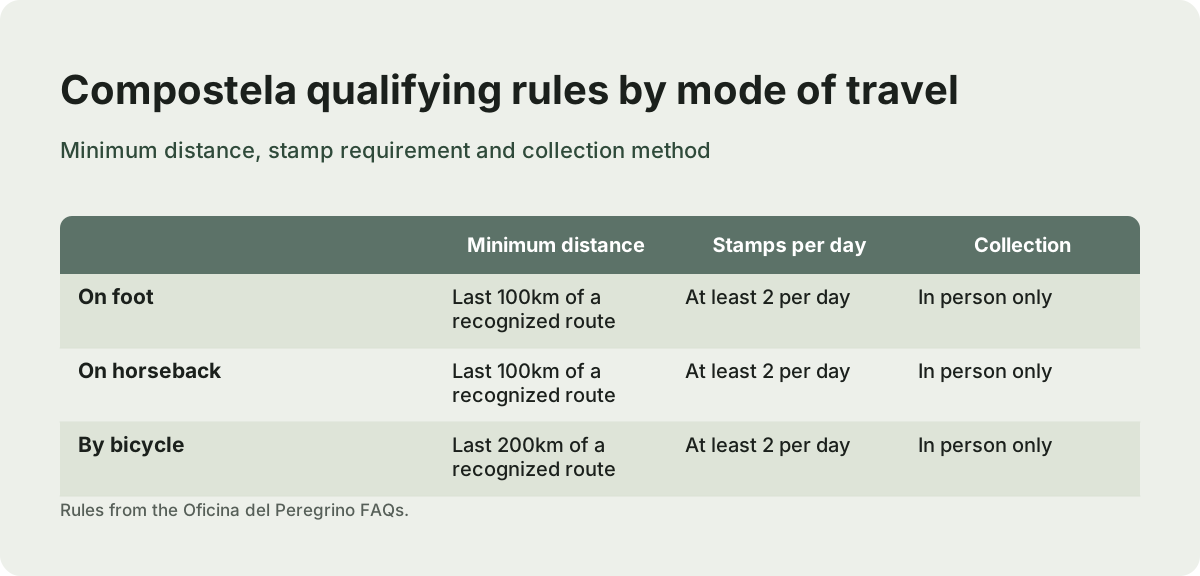
To qualify for the Compostela you must cover at least the final 100km of a recognized Camino route on foot or on horseback, or the final 200km by bicycle, continuously and in order, with your credencial stamped at least twice per day at official stamping points along that qualifying distance, and you must present that credencial in person at the Pilgrim Office in Santiago de Compostela. These rules come directly from the Oficina del Peregrino's FAQs, and there is no flexibility in them: the distance, the continuity, the stamp density and the in-person presentation are all mandatory parts of the same test.
The two-stamps-per-day rule is the one that catches walkers out. Stamps from accommodation alone do not always satisfy the office if they leave gaps, because the requirement is written as a minimum of two per day from official points, which typically means a mix of places you sleep, churches, town halls, bars and albergues that display the official stamp. A credencial with one stamp on a short day can be queried. The pilgrim passport and credencial guide explains how to obtain the document and where the official stamps sit along each route.
| Mode of travel | Minimum qualifying distance | Stamp requirement | Collection |
|---|---|---|---|
| On foot | Last 100km of a recognized route | At least 2 per day | In person only |
| On horseback | Last 100km of a recognized route | At least 2 per day | In person only |
| By bicycle | Last 200km of a recognized route | At least 2 per day | In person only |
Continuity is the second quiet condition. The qualifying distance must be the last stretch of the route, walked in sequence into Santiago de Compostela, not a collection of segments gathered on different trips or with motorized gaps inside the final 100km. The office reads stamps in order, so a credencial that jumps between places or misses the sequence of towns on the final stage will read as incomplete. Walkers planning shorter itineraries can see how the classic minimum-distance route works in the Camino map guide.
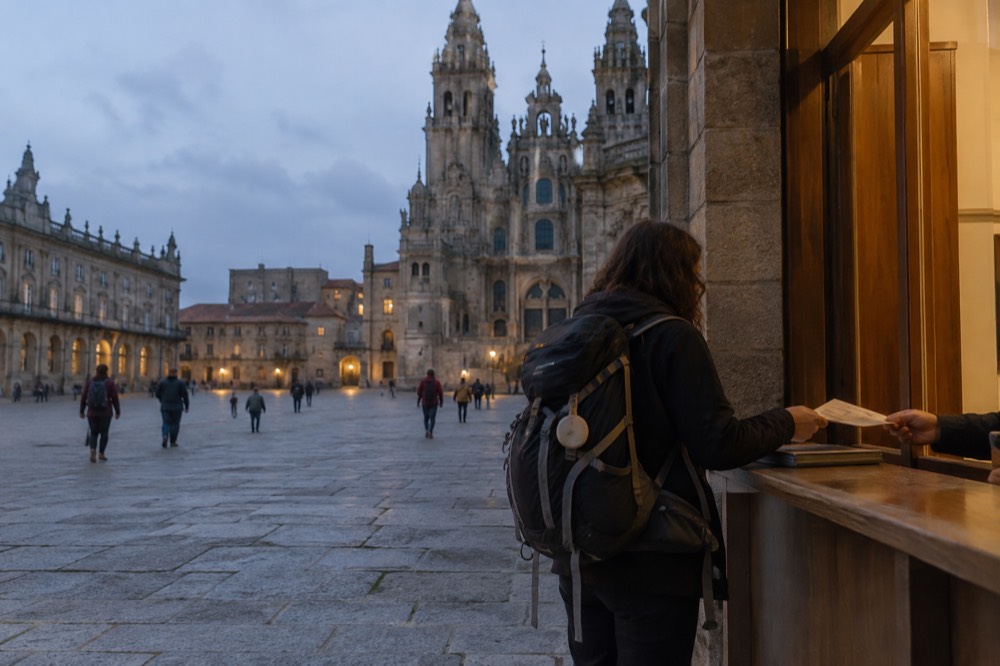
For cyclists the bar is deliberately higher, 200km rather than 100km, because a bike covers the distance in a fraction of the time. The same two-stamps rule applies per day on the road. If you are weighing the two options, the bicycle question is covered alongside route choice and timing in the Camino routes guide.
What Should You Bring To The Pilgrim Office?
Bring your completed credencial with its full sequence of stamps, including at least two per day across your qualifying distance, and present it in person at the counter at Rua das Carretas 33; that stamped document is the single item the office needs to judge your pilgrimage, and nothing substitutes for it. The office does not run on uploaded routes, fitness-app traces or photographs of lost booklets. The stamped credencial is the evidence, and its physical state matters: keep it dry on the Galician stages, where rain is a real feature of the climate, wettest from October to March and driest in July and August, as AEMET's climate data for the city shows.
The simplest way to think about the arrival is as three stages, each with its own document or action. Before the walk, obtain the credencial. During the walk, collect the stamps. At the end, hand it over in person. The office's role is confined to the third stage, but the first two determine whether the third goes smoothly. Everything else covered here is indexed on Santiago de Compostela Travel Guide.
| Stage | What the office verifies | Practical takeaway |
|---|---|---|
| Before the Camino | Credencial issued or accepted as valid | Obtain one before starting, see the pilgrim passport guide |
| On the Camino | At least 2 official stamps per day, in route order | Stamp at churches, albergues, bars, town halls |
| In Santiago de Compostela | Qualifying distance and continuity of the final 100 or 200km | Hand the credencial over in person at Rua das Carretas 33 |
One habit worth adopting on the road: stamp in pairs. Two stamps from different points each day, rather than one big stamp at the night's albergue, leaves no ambiguity for the reader at the counter. Pilgrims who mix official and unofficial-looking stamps usually resolve any question on the spot, but the cleanest credential is the one that never raises one. Where you sleep shapes your stamp pattern too, so the albergue and accommodation guide is worth reading before the final week of walking.
What Happens Once You Reach Santiago de Compostela?
Arriving pilgrims typically move through a short sequence in the old town: enter the historic centre from the final stage of their route, walk to the Pilgrim Office at Rua das Carretas 33 to collect the Compostela, then continue to the Cathedral, where the naves and the Apostle's tomb are open daily with free entry, generally from around 7:00am to 9:00pm through the Praterias door. The order matters less than the opening hours behind it: the office closes in the evening, while the Cathedral's free public access runs longer, so a late arrival can still reach the tomb even if the certificate waits until morning.
The emotional geography of the arrival is concentrated in a few hundred metres. The final approach into the city, described stage by stage in the arriving in Santiago on the Camino guide, delivers walkers into the old town, where the granite closes in and the towers appear above the rooftops. The Pilgrim Office sits on that path, the Cathedral sits at the end of it, and everything a newly arrived pilgrim needs, food, a bed, a mass, sits between the two.
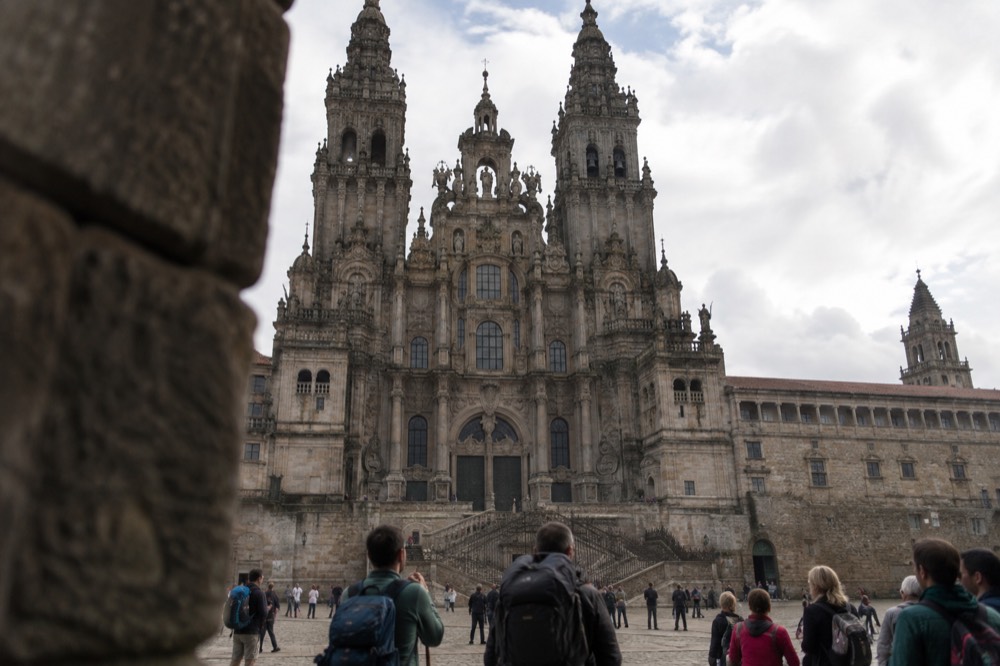
Two practical notes about the first evening. First, the Compostela is not the only paper ritual of the arrival: the pilgrim mass at the Cathedral is the spiritual counterpart to the certificate, and its times and its 2026 relocation are set out in the next section. Second, the first evening in the city is famously a come-down after weeks of walking, and many pilgrims plan a buffer day before travelling on, a rest that pairs well with the where to eat in Santiago de Compostela recommendations, from pulpo a la gallega to a slice of tarta de Santiago.
For travellers heading onward, the city is well connected. Direct high-speed trains to Madrid run the corridor in roughly three to four hours, the regional run to Vigo takes about an hour, and there is no direct rail line to Porto, travellers change at Vigo for the cross-border connection, details covered in the Madrid to Santiago train guide and the Porto to Santiago guide. Those flying home leave through Santiago de Compostela Airport, about 12km from the old town, with the airport logistics explained in the airport guide.
How Many Compostelas Does The Pilgrim Office Issue Each Year?
The Pilgrim Office issued 530,987 Compostela certificates in 2025, a record year, a figure reported by the Spanish press citing the office's own statistics, and demand of that scale is exactly why the office's seasonal hours, in-person-only rule and stamp discipline exist in their current form. Half a million certificates means the counter at Rua das Carretas 33 reads an enormous volume of credentials each year, and the rules that look bureaucratic from outside, the two-stamp minimum, the strict distance thresholds, are what make that volume processable at all.
The record also explains the rhythm of the city. Santiago de Compostela's population is small for a place with this footprint, but through the walking season the old town runs on pilgrim arrivals, and the busiest weeks concentrate in the milder months, a pattern the best time to visit guide breaks down alongside the city's wet, oceanic climate.
| Pilgrim Office fact | Detail |
|---|---|
| Address | Rua das Carretas 33, Santiago de Compostela |
| What it issues | The Compostela certificate, in Latin, in person only |
| Annual closure days | 25 December and 1 January |
| Record year | 530,987 Compostelas issued in 2025 |
Growth of this kind feeds directly into planning. A walker starting the classic final 100km from Sarria in July will share the trail and the office queue with the largest crowds of the year, while the same walk in May or late September meets a fraction of that pressure, with weather that the city's rainfall pattern makes a genuine consideration on either side. The Camino history guide puts the modern numbers in the context of nine centuries of pilgrimage, which is the longer answer to why a small office in a narrow street issues half a million documents a year.
Where Do Pilgrim Masses Take Place In Santiago de Compostela?
Pilgrim masses are held daily at 7:30am, 9:30am, 12:00 noon and 7:30pm, currently at the Cathedral's main altar, but from 16 October 2026 the 9:30am, noon and 7:30pm masses relocate to the nearby Church of San Agustin while main-chapel works prepare the Cathedral for the 2027 Holy Year, and only the 7:30am mass stays inside the Cathedral, in its Communion chapel. Any pilgrim arriving in late 2026 or during 2027 needs both arrangements, dated, because the change is permanent until further notice.
The relocation is tied to preparation for the Holy Year, not to any closure of the Cathedral to visitors. The basilica itself remains open with free entry as normal, and the museum, rooftops and Portico da Gloria visits continue. What moves is the mass, and specifically the three most-attended services, which shift to San Agustin, a church close enough to the Cathedral that the walk between the two is trivial.
| Mass time | Until 15 October 2026 | From 16 October 2026 |
|---|---|---|
| 7:30am | Cathedral, main altar | Cathedral, Communion chapel |
| 9:30am | Cathedral, main altar | Church of San Agustin |
| 12:00 noon | Cathedral, main altar | Church of San Agustin |
| 7:30pm | Cathedral, main altar | Church of San Agustin |
One further change reaches further into the experience of the pilgrim mass. The Botafumeiro, the giant incense burner that normally swings on twelve fixed solemnities a year, is currently out of action: scaffolding for the restoration of the Cathedral's dome, the cimborrio, covers its hanging mechanism, the Cathedral confirmed the suspension in writing on 5 September 2026, and no return date has been published. The twelve solemnity dates, from Epiphany on 6 January to the Transfer of the Apostle on 30 December, remain the normal annual pattern, but no visitor should currently plan around seeing it swing. The full story is in the pilgrim mass guide.
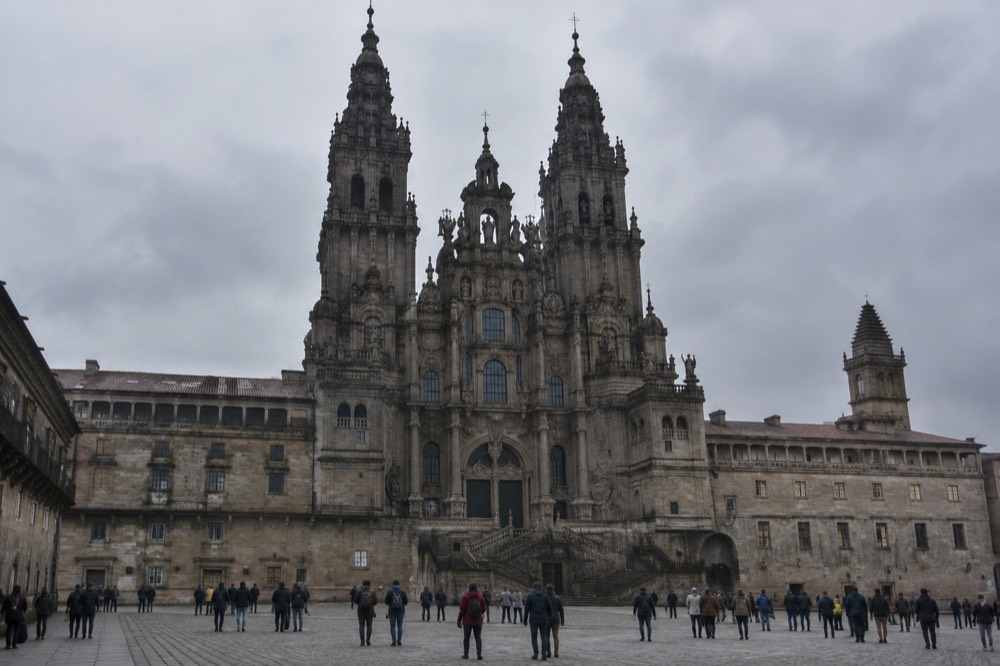
For pilgrims who want a guide's framing for the Cathedral and the old town around these services, a guided old town walk with an official guide adds history and context to buildings you would otherwise walk past, and pairs naturally with the mass schedule once you know which church is holding which service.
Is 2026 A Holy Year In Santiago de Compostela?
No, 2026 is not a Holy Year. The next Xacobeo, or Jacobean Holy Year, is 2027, because the Feast of St. James on 25 July falls on a Sunday that year; the Holy Door opens solemnly on the evening of 31 December 2026 and the Holy Year then runs through 31 December 2027, as confirmed by the city's official tourism site. A Holy Year is declared whenever 25 July falls on a Sunday, which follows the calendar rather than any anniversary, and in 2026 it does not, so the Holy Door stays closed throughout this year.
The distinction matters for two reasons. First, expectations: pilgrims arriving in 2026 will not pass through the Holy Door, and guides that imply otherwise are simply out of date. Second, timing: anyone planning a pilgrimage to coincide with the Xacobeo should aim for 2027, while accepting that Holy Years bring the heaviest crowds of the cycle, concentrated around the opening weeks and the July feast day. The Holy Year 2027 guide covers the full calendar, and the Feast of St. James guide covers the annual celebrations that happen every 25 July regardless of the Holy Year cycle.
| Date | What happens | Source detail |
|---|---|---|
| 16 October 2026 | Pilgrim masses relocate to San Agustin | 9:30am, noon and 7:30pm move; 7:30am stays in the Cathedral |
| 31 December 2026 | Holy Door opens for the Xacobeo | Ceremony in the evening at Praza da Quintana |
| Throughout 2027 | Holy Year runs to 31 December 2027 | Next Holy Year after that falls in 2032 |
| 25 July (every year) | Feast of St. James | Mass, national offering, concerts and fireworks |
The Feast of St. James deserves its own line in any pilgrim's calendar, because it transforms the city every summer regardless of the Holy Year cycle. The fixed date of 25 July brings a pontifical and civic mass, a national offering to the Apostle, and an evening of concerts and fireworks that fills the granite squares. Arriving pilgrims whose final stage lands on that weekend experience the city at its loudest and most crowded, and the Pilgrim Office at its busiest outside the Holy Year opening itself.
What To Do After The Pilgrim Office In Santiago de Compostela
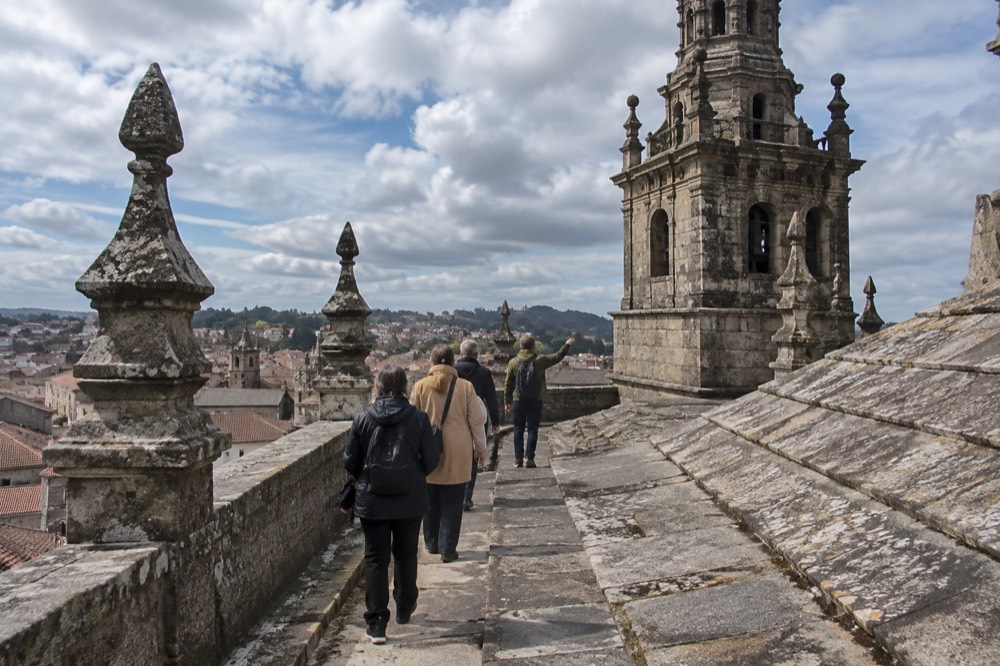
After collecting the Compostela, most pilgrims head straight for the Cathedral, where free entry to the naves runs roughly 7:00am to 9:00pm through the Praterias door, the museum opens around 10:00am to 8:00pm with tickets ranging from EUR9 to EUR23 depending on type, and the guided rooftop and Carraca tower tour costs EUR15 general or EUR12 reduced, lasting about 60 minutes, 140 steps and 72 metres of height. Those are the Cathedral's own published figures, and together they turn the hour after the office visit into a full afternoon.
The rooftop tour deserves the emphasis. It is operated by the Cathedral itself, bookable with timed slots through its official ticket channel, and it includes access to the permanent museum collection and the other Cathedral-run spaces, valid for seven days. The climb is real, 140 steps, and the reward is the view over the old town's granite roofscape from about 72 metres up, with the Berenguela tower works visible in season, exterior restoration running through 2026 and 2027 that does not affect visits.
| Stop after the office | What it is | Verified detail |
|---|---|---|
| Cathedral naves and tomb | Free public entry | Roughly 7:00am to 9:00pm, Praterias door |
| Cathedral Museum | Permanent collection and Gelmirez Palace | Around 10:00am to 8:00pm, EUR9 to EUR23 by ticket type |
| Rooftops and Carraca tower | Guided visit | EUR15 general, EUR12 reduced, about 60 minutes, 140 steps |
| Pilgrim mass | Daily services | Times above; location depends on the date, see the mass section |
Beyond the Cathedral, the city rewards a slow loop. The old town's squares, the market at Mercado de Abastos, the parks on the Alameda, and the long Galician lunches on Rua do Franco fill most pilgrims' first full day comfortably, and none of it needs a ticket. For those with more energy than a rest day requires, the coast calls: the full-day excursion to Finisterre, Muxia and the Costa da Morte follows the ancient extension of the Camino to what was long considered the end of the world, and a complete Finisterre and Costa da Morte day tour is the most bookable way to trace it, rated highly across hundreds of reviews.
Pilgrims who walked to Fisterra rather than stopping at the Cathedral have already seen that coast on foot, and the day-trip version simply reverses the direction. Either way, the pairing is apt: the Pilgrim Office certifies the walk's end, and the Costa da Morte marks the older, farther ending at the Atlantic. Check availability on the operator's live listing for the date you want, especially in the busy weeks around the Feast of St. James.
Common Questions About The Pilgrim Office In Santiago de Compostela
Where is the Pilgrim Office in Santiago de Compostela?
The Pilgrim Office, the Oficina del Peregrino, is at Rua das Carretas 33, inside the old town and a few minutes' walk from Praza do Obradoiro and the Cathedral. It is the only place that issues the Compostela certificate.
What are the opening hours of the Pilgrim Office?
Hours vary seasonally, roughly from 8, 9 or 10am to 7 or 8pm depending on the season, and the office closes on 25 December and 1 January. Check the office's own site during your walk for the current hours on your arrival date.
How far do you have to walk to get the Compostela?
The Oficina del Peregrino's rules require the last 100km on foot or on horseback, or the last 200km by bicycle, on a recognized route, completed continuously with at least two credencial stamps per day from official stamping points, presented in person.
Can someone else collect my Compostela for me?
No. The Compostela is issued in person only. The office must read your stamped credencial at the counter at Rua das Carretas 33, and there is no postal, digital or third-party channel for collecting it.
How many Compostelas were issued in 2025?
A record 530,987 Compostela certificates were issued in 2025, according to figures from the Oficina del Peregrino reported in the Spanish press, the highest annual total to date.
Is 2026 a Holy Year in Santiago de Compostela?
No. The next Holy Year is 2027, when 25 July falls on a Sunday. The Holy Door opens on the evening of 31 December 2026 and the Holy Year runs through 31 December 2027.
The Pilgrim Office is a small institution with an enormous job, and half a million certificates a year prove it. Arrive with a cleanly stamped credencial, know the mass arrangement that applies to your date, and the last hundred metres of the Camino, from Rua das Carretas 33 to the tomb in the Cathedral, will close the walk exactly as a thousand years of pilgrims have closed theirs.