Is St. James Actually Buried In Santiago?
The evidence, the legend and what you can actually see beneath the high altar of Santiago de Compostela Cathedral, from the early medieval find to the modern crypt.
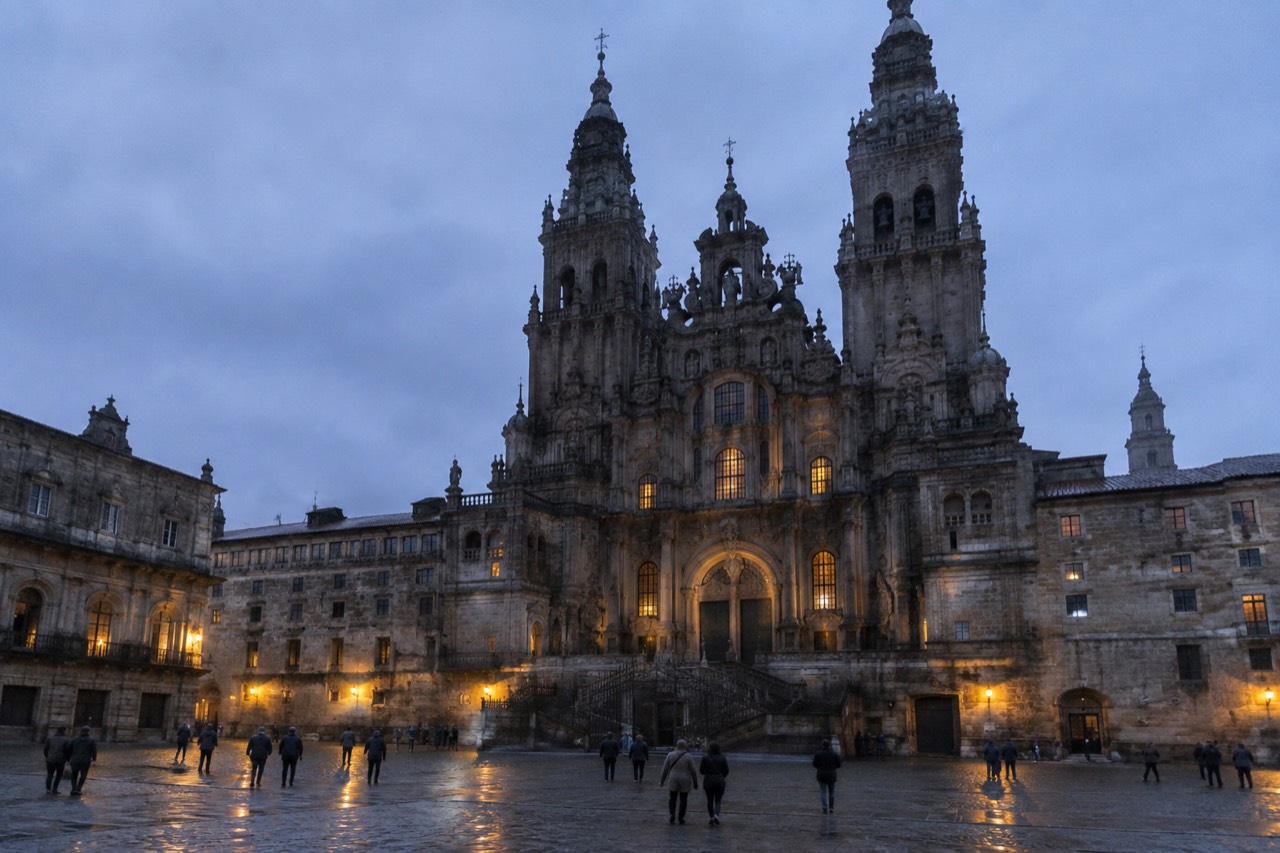
Every year, pilgrims arrive in Santiago de Compostela, Spain, walk into the Cathedral, and descend a short staircase behind the high altar to touch a marble chest that tradition says holds the bones of the Apostle St. James. The Oficina del Peregrino counted 530,987 Compostela certificates issued in 2025, a record year, and every one of those pilgrims earned the document by reaching this city. The question of what is physically beneath the altar, and whether those bones are really the Apostle's, has been asked for over a thousand years, and it deserves a straight answer rather than a shrug.
Is St. James Actually Buried In Santiago?
Tradition, the Cathedral and the Catholic Church all say yes: a tomb beneath the high altar of Santiago de Compostela Cathedral has been venerated as the burial place of the Apostle St. James since the early medieval period. What can be verified is that a tomb cult existed there early, that the present crypt holds a marble reliquary containing human remains, and that no scientific study has ever contradicted the identification. The claim rests on tradition, not on a modern forensic proof.
That split between tradition and proof is the honest core of the answer, and it is how the Cathedral itself frames the site. The basilica that stands on Praza do Obradoiro today is the fourth or fifth church built over the same spot, each one constructed around the tomb that pilgrims came to visit. The crypt you can enter today is the surviving link in that chain: a small Romanesque chamber directly under the high altar, rebuilt when the baroque Cathedral rose above it, holding a silver-lined chest that contains the relics.
Nobody has dissected the question more than historians, and their position is more interesting than a simple yes or no. The early medieval account of the tomb's discovery names a hermit named Pelayo and the local bishop Teodomiro, and it is preserved in sources the Church treated as authoritative for the cult. Skeptical historians note the convenient timing, the political usefulness of an apostolic tomb in a remote corner of Galicia, and the silence of earlier texts about where James was buried after his execution in Jerusalem. None of that disproves the tomb; it simply means the identification was accepted on the authority of the Church rather than established by evidence that would satisfy a modern court.
What Lies Beneath The High Altar Of Santiago de Compostela Cathedral?
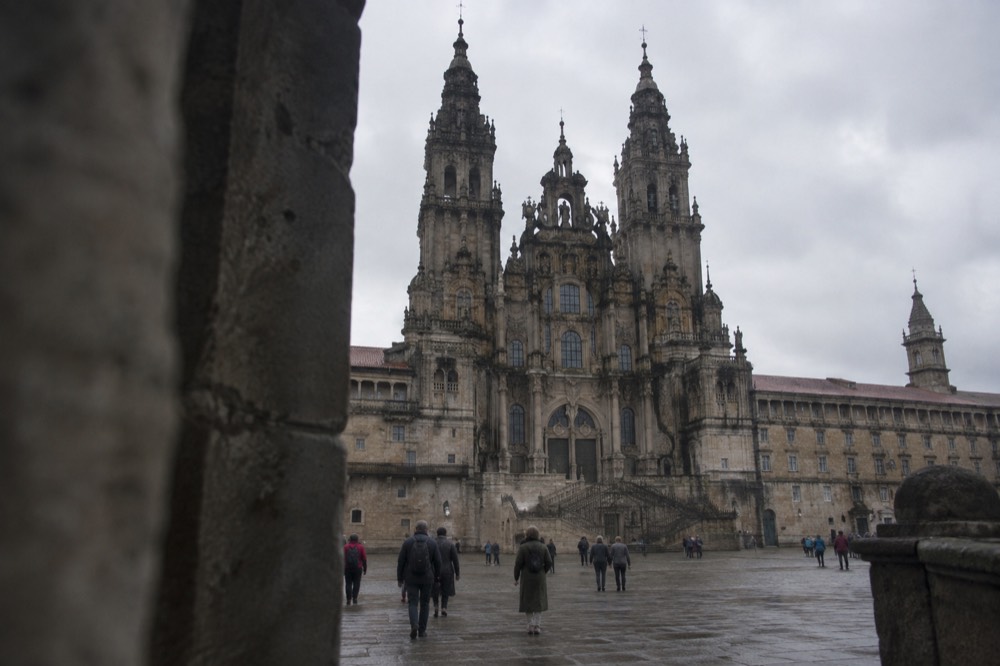
Beneath the high altar of Santiago de Compostela Cathedral sits a small crypt containing a marble reliquary chest that holds the relics of St. James and two of his disciples, traditionally identified as Athanasius and Theodore. Visitors descend behind the statue of the seated apostle and can embrace the silver-clad chest through an opening. The crypt is the oldest continuously venerated element of the building complex.
The layout matters, because the whole Cathedral is oriented around it. The pilgrim route through the building runs past the Portico da Gloria, into the nave, up to the high altar where St. James stands in his pilgrim robes, and then behind and below, into the crypt. The embrace of the statue from behind, and the descent to the tomb, are the ritual movements that tens of thousands of people perform each July around the Feast of St. James on 25 July, which the city marks with a Pontifical Mass, fireworks and concerts.
What the mortal remains represent is a question the Church answers in liturgical language and historians answer in documentary language. The relics were hidden during the era of English raids on the Galician coast, and their exact location was lost for a period before they were rediscovered and returned to the crypt generations later. That hiding-and-finding sequence is a genuinely useful fact for anyone weighing the question, because it explains why the physical chain of custody has gaps that no document fully bridges.
The story of the apostle himself is the frame for all of it. St. James the Greater, son of Zebedee, was executed in Jerusalem in apostolic times according to the Acts of the Apostles, and the Spanish tradition holds that his body was carried by boat to Galicia and buried inland. The story of St. James and Santiago is covered in its own guide on this site, along with how a Galician tomb became the destination for a network of routes across Europe.
Can You Visit The Tomb Of St. James Today?
Yes: the tomb crypt of Santiago de Compostela Cathedral is open to visitors with general entry, which is free, and the Cathedral's own pages list the interior as open daily from about 7:00am to 9:00pm via the Praterias door. The Cathedral, including the Apostle's tomb and the embrace area, remained fully open as of late September 2026 despite ongoing restoration works on the dome.
The works deserve a dated note, because they touch exactly this part of the visitor experience. Restoration scaffolding over the cimborrio, the dome above the crossing, has grounded the Botafumeiro, the giant swinging censer that normally flies on twelve fixed solemnities each year; the Cathedral confirmed in writing on 5 September 2026 that it is temporarily out of action, with no return date published. The Botafumeiro's suspension does not affect access to the naves, the tomb or the embrace area. Separately, the pilgrim masses at the High Altar, normally held at 7:30am, 9:30am, noon and 7:30pm daily, continue there only until 15 October 2026; from 16 October 2026 the 9:30am, noon and 7:30pm masses move to the nearby Church of San Agustin while main chapel works proceed ahead of the 2027 Holy Year, with only the 7:30am mass remaining in the Cathedral's Communion chapel.
| What You Visit | Where It Is | Entry | Verified Detail |
|---|---|---|---|
| Cathedral interior and tomb crypt | Beneath the high altar | Free | Open about 7:00am-9:00pm, Praterias door |
| Cathedral Museum and Gelmirez Palace | adjoining the basilica | Paid | EUR9-23 depending on ticket type, open about 10:00am-8:00pm |
| Rooftops and Torre de la Carraca | above the crossing | Paid | EUR15 general, EUR12 reduced, guided, about 140 steps |
| Pilgrim Mass | High Altar until 15 Oct 2026 | Free | From 16 Oct 2026 most masses move to San Agustin |
A guided visit changes what you take away from the descent, because the layers of the building, Romanesque, baroque and modern, are easier to read with someone pointing at them. The Cathedral and Museum skip-the-line guided visit pairs the basilica with the museum collection, and the listing shows it from $26 per person with a 4.8 rating from 2,425 reviews.
The Cathedral of Santiago de Compostela has its own full guide covering tickets, the museum and the rooftop tour in detail, useful if this page has settled the burial question and moved you on to planning.
What Does The Historical Evidence Actually Support?
The historical record firmly supports these points: a tomb cult at this site existed in the early medieval period, a church was built over it and expanded repeatedly, and the relics kept there today were authenticated by the Church after their rediscovery and return to the crypt. The record cannot support, and no document can, the burial of a specific named individual in apostolic times, because no contemporary account of the transport of the body from Jerusalem survives.
Put plainly, the gap is at the beginning of the chain, not the end. The veneration of the site, the building of the Cathedral, the growth of the Camino, the papal recognition of the cult and the modern scientific examination of the remains in the relic chest are all documented stages. The claim that the remains are those of the Apostle is a matter of faith resting on that early identification, and the Catholic Church, which owns and operates the basilica, states the identification as fact in its liturgy and its pilgrim certificates.
For context, the wider recognition of the destination is not in doubt either: the Old Town of Santiago de Compostela was inscribed by UNESCO in 1985, and the Routes of Santiago de Compostela, the Camino Frances and the Northern routes, received a separate UNESCO inscription in 1993. The two listings are distinct, one for the city and one for the pilgrimage network that feeds it, and both ultimately exist because of the tomb.
The next Holy Year adds its own weight to the question. The Holy Door opens on 31 December 2026 and the Holy Year runs through 31 December 2027, because 25 July 2027 falls on a Sunday, and the city expects a surge of pilgrims arriving precisely to visit the apostle's tomb. That expectation is itself a measure of how many people, across many centuries, have answered this page's question with their feet.
How The Tomb Answer Shaped The City And The Camino
Without the tomb there is no Santiago de Compostela as we know it: the city, the Cathedral, the Camino de Santiago and the Compostela certificate all exist as institutions because an early medieval tomb cult at this spot drew pilgrims from across Europe. The Compostela itself, issued only in person at Rua das Carretas 33, requires the last 100km walked or the last 200km cycled on a recognized route with at least two stamps per day.
The scale of the modern answer to that medieval question is worth a number. Those 530,987 certificates in 2025 each represent a walker or rider who covered the minimum distance and collected the required stamps, and the flow shows no sign of shrinking ahead of the 2027 Holy Year. The pilgrim's office, the Oficina del Peregrino, is the body that checks the credencial and issues the certificate, and its FAQs are explicit that the document is a religious recognition of the pilgrimage, not a souvenir.
The routes themselves are the network that grew around the answer. Pilgrims ask how long it takes to walk the Camino de Santiago and what the average cost is to walk the Camino de Santiago, and both answers, in days and in euros, depend on which of the recognized routes you choose, from the Camino Frances out of the Pyrenees to the Camino Portugues out of Lisbon and Porto. All of them end at the same marble chest.
A skeptic's Santiago is still a rewarding city, which is a fair closing thought for this question. Whether you accept the identification or read the tomb as a magnificent medieval institution, the crypt, the Cathedral above it and the Old Town around it are one of Europe's most significant monumental ensembles, and the Santiago de Compostela Travel Guide covers every corner of it. You can arrive as a believer, as a historian or as a tourist who simply followed a stone path across Galicia, and the staircase behind the high altar will be open to you on the same terms.
Common Questions About St. James In Santiago de Compostela
Is St. James actually buried in Santiago?
The Cathedral, the Catholic Church and the tradition of the site all affirm that the relics of St. James lie in the crypt beneath the high altar of Santiago de Compostela Cathedral. The identification dates to the early medieval discovery of the tomb and has never been disproven, though it rests on Church tradition and early sources rather than forensic proof, since no contemporary account of the transport of the body survives.
Can I see the tomb of St. James myself?
Yes. The crypt is reached from inside the Cathedral, which the Cathedral's own information lists as open daily about 7:00am to 9:00pm with free entry via the Praterias door. Visitors descend behind the high altar and can embrace the reliquary chest.
Was the Botafumeiro affected by the restoration works?
The Botafumeiro is currently out of action: scaffolding for dome restoration covers its hanging mechanism, and the Cathedral confirmed this in writing on 5 September 2026 with no return date published. The suspension does not affect access to the naves, the tomb or the embrace area.
Do the pilgrim masses still happen at the Cathedral?
Until 15 October 2026 the pilgrim masses are held at the Cathedral's High Altar at 7:30am, 9:30am, noon and 7:30pm. From 16 October 2026, the 9:30am, noon and 7:30pm masses move to the nearby Church of San Agustin, and only the 7:30am mass stays in the Cathedral's Communion chapel.
What do I have to do to get the Compostela certificate?
Walk at least the last 100km on a recognized Camino route, or cycle at least the last 200km, collecting at least two stamps per day in the credencial from official stamping points. The certificate is issued in person only at the Oficina del Peregrino, Rua das Carretas 33.