How Difficult Is The Walk From Sarria To Santiago de Compostela?
An honest difficulty assessment of the Sarria to Santiago de Compostela walk: terrain, fitness needs, weather and the Compostela rules, based on verified Cathedral and pilgrim office sources.
Sarria, a small town in Galicia's Lugo province, is the single busiest launching point on the entire Camino de Santiago, and the reason is bureaucratic rather than scenic: starting there puts a pilgrim inside the distance requirement for the official Compostela certificate. The Oficina del Peregrino's own FAQs state the rule plainly, the last 100km walked, or the last 200km cycled, with at least two stamps per day in the credencial. That single rule turned Sarria into the gateway for hundreds of thousands of walkers, and it shapes everything about how the final stretch to the cathedral city feels underfoot.
How Difficult Is The Walk From Sarria To Santiago de Compostela?
In difficulty terms the walk is moderate and beginner-friendly rather than alpine: it demands no climbing skill, no navigation experience and no technical gear, and the challenge is cumulative daily distance on rolling terrain in a climate that rains heavily from October to March. A reasonably healthy adult who walks regularly can finish it, and the Oficina del Peregrino's 2025 record of 530,987 Compostelas issued shows the full age range does.
The honest way to frame the difficulty is repetition. Nobody climbs a mountain on this stretch. What a walker does instead is put in day after day of distance on a body that is not used to it, carrying a pack, on ground that is wet more often than not in the cooler half of the year. The feet, knees and shoulders are where the difficulty actually lives.
Context helps too. The Old Town of Santiago de Compostela has held UNESCO World Heritage status since 1985, and the Routes of Santiago de Compostela, the Camino Frances and the Northern routes, were inscribed separately in 1993. Those two inscriptions are distinct listings, never one date, and the walk from Sarria runs along the final portion of the most-travelled of those historic routes.
For walkers comparing options, the full Camino length question covers the whole-route picture, and the Sarria section is widely treated as the gentlest introduction to it. This page is part of the Camino coverage on Santiago de Compostela Travel Guide, where every route question is answered from primary sources.
Why Do So Many Pilgrims Start In Sarria?
Sarria's popularity is a direct product of the Compostela certificate rules: the Oficina del Peregrino requires the last 100km of the route to be walked on foot, or the last 200km cycled, completed continuously with at least two credencial stamps per day, and the certificate is issued in person only. Starting at Sarria is the best-known way to satisfy the walking minimum, which is why the town's trails carry the densest pilgrim traffic of the whole Camino.
The certificate itself, the Compostela, is the document that makes the last stretch different from every other multi-day walk in Spain. The Pilgrim's Office at Rua das Carretas 33 in Santiago de Compostela is the only place it is issued, in person, to walkers who show a properly stamped credencial from official stamping points along the way.
The volume matters when assessing difficulty, because the busiest stretch is also the best-served. Albergues, cafes, luggage transfer services and stamped credencial checkpoints cluster thickly along the final kilometres, which removes most of the logistical hardship that older or remote Camino sections impose. A first-time walker is never far from a bed, a meal or a pharmacy.
The trade-off is crowds. High season on the Sarria stretch means shared dormitories that fill by early afternoon and village streets that feel closer to a moving festival than a solitary pilgrimage. Walkers who want quiet should read the best month question before choosing dates, because the shoulder seasons thin the crowds and the weather at the cost of shorter days.
What Is The Terrain Like Between Sarria And Santiago de Compostela?
The terrain is rolling rural Galicia: farm tracks, quiet lanes, woodland paths and gentle hill country crossed repeatedly rather than climbed once, with no section requiring scrambling, exposure or route-finding skill, and with the walk finishing on city pavement into Santiago de Compostela's old granite streets. The gradients are short and the ground is green, soft and frequently muddy after rain.
Galicia's landscape is small-scale. Fields are divided by granite walls and hedges, hamlets arrive every few kilometres, and the walking day is broken into a rhythm of short rises and descents rather than long sustained climbs. Underfoot, the mix favours dirt and farm track over rock, which is kind to ankles but punishing for shoes that are not waterproof in the wetter months.
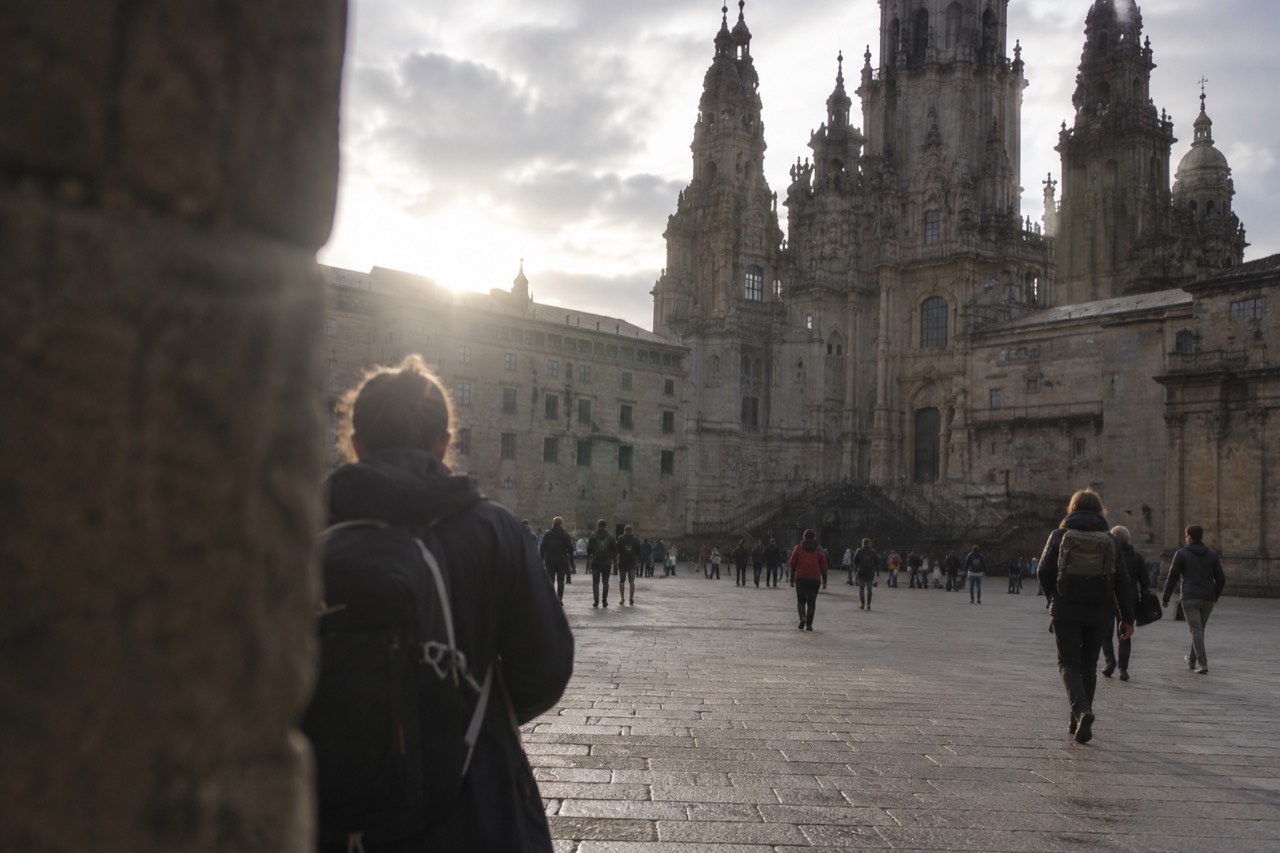
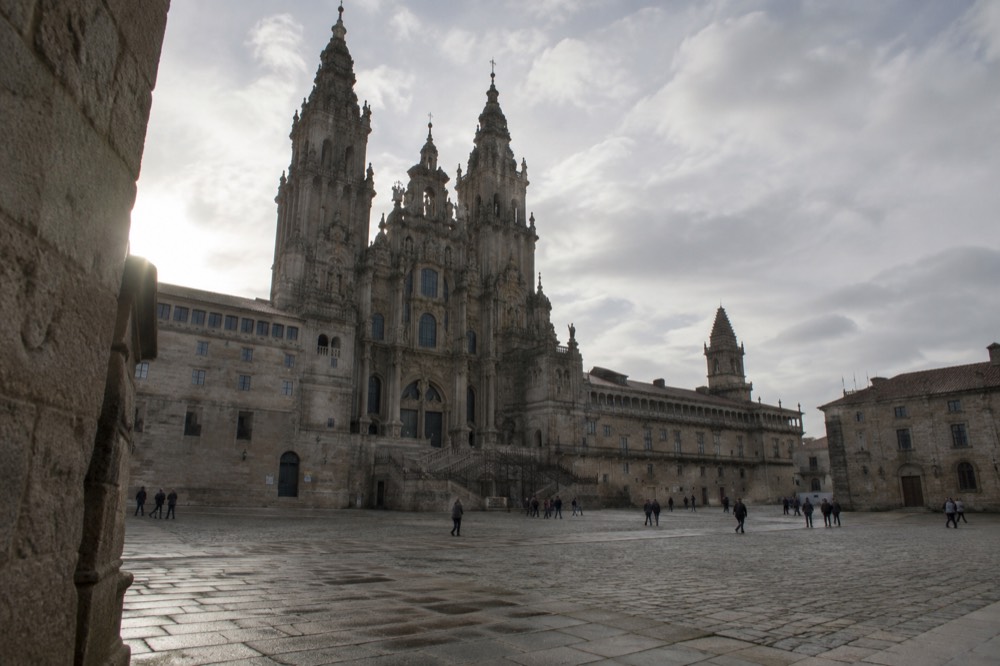
The final approach changes character completely. The walk drops into Santiago de Compostela from Monte do Gozo, and the last stretch is urban pavement ending at Praza do Obradoiro in front of the cathedral. By that point the difficulty question is answered; what remains is arrival logistics, covered in detail in the arriving in Santiago on the Camino guide.
Weather deserves more weight in the difficulty calculation than most first-timers give it. AEMET's climate data for the Santiago de Compostela station shows a temperate oceanic pattern, wet year-round, wetter from October to March, and driest in July and August, with annual precipitation on the order of 1,690 to 1,890mm depending on station and year. That is a lot of rain by Spanish standards, and it means mud, wet shoes and reduced visibility on rural tracks for much of the walking calendar.
| Difficulty factor | What it is like on this stretch | How much it matters |
|---|---|---|
| Gradient | Short rolling hills, repeated across each day, no sustained alpine climbing | Low to moderate |
| Underfoot conditions | Dirt farm tracks, quiet lanes, woodland path, city pavement at the end | Moderate when wet |
| Weather | Wet and cool October to March, driest July and August, rain possible any month | High in the wet season |
| Navigation | Waymarked throughout, dense pilgrim traffic, services in every hamlet | Low |
| Daily repetition | Consecutive walking days on an untrained body, carrying a pack | High |
| Altitude and exposure | None technical, no ridges, no scrambling, no via ferrata | Negligible |
How Fit Do You Need To Be To Walk From Sarria?
A walker of ordinary health and modest regular fitness can complete this route, and the evidence is the demographics of who does: the Oficina del Peregrino issued a record 530,987 Compostelas in 2025 to a population spanning teenagers through walkers in their seventies and beyond. No climbing skill, endurance-sport background or technical training is needed, only the ability to walk a multi-day distance and recover overnight.
Preparation still pays. The failure mode on this stretch is not exhaustion on a single day; it is blisters, tendon pain and knee trouble that appear on day two or three of an untrained body doing repeated distance. A few weekends of long walks beforehand, in the actual shoes to be worn, removes most of that risk.
Age is far less of a barrier than walkers assume, a question examined in full in the can a 70-year-old walk the Camino answer. The route's infrastructure, beds every few kilometres, taxi coverage, luggage transfer between stages, is what converts a physically modest challenge into a genuinely accessible one.
Solo walking is also common on this stretch, and the safety picture for women walking alone is covered in the lone female walker question. The density of other pilgrims on the Sarria section is, for once, a genuine safety feature.
What Makes The Sarria Walk Harder Than It Sounds?
Three things make this walk harder than a map suggests: consecutive days of distance on an untrained body, a wet oceanic climate that turns soft Galician tracks to mud and soaks gear from October to March, and pack weight carried every day, each one fully within a walker's control through training, waterproof kit and luggage transfer. None of them is terrain difficulty, and none of them requires specialist skill to manage.
Pack strategy is the first lever. Luggage transfer services operate along the whole stretch, carrying a main bag between accommodations so the walker carries only a daypack. That single decision removes the most common source of shoulder and back pain on the route.
Footwear is the second. Waterproof shoes or boots matter more here than on drier Spanish routes, because the AEMET data shows rain is possible in every month and heavy through the winter half of the year. Two pairs of socks, changed midday, and blister treatment carried from day one prevent the small injuries that end more Camino attempts than any hill does.
Pacing is the third. Starting each stage early, in the coolest and often driest part of the day, leaves margin for a long lunch and an early arrival at the next bed. Walkers who push through the mid-afternoon hours in July and August trade comfort for heat, while those same hours in November can be simply wet.
Cost pressures are mild on this stretch and are laid out in the average cost to walk the Camino answer, which matters because financial stress is a real, if underrated, part of route difficulty for budget pilgrims.
How Do You Earn The Compostela Certificate From Sarria?
The Compostela requires the last 100km walked on foot, or the last 200km cycled, on a recognized Camino route, completed continuously with at least two stamps per day in the credencial from official stamping points, and it is issued in person only at the Pilgrim's Office, Rua das Carretas 33, Santiago de Compostela, which closes on 25 December and 1 January. Every Sarria starter is walking this exact rule.
The credencial is the document, the pilgrim passport, that turns the walk into a verifiable record. Stamps are available at albergues, churches, cafes and town halls along the route, and the two-per-day minimum exists to prove the walker covered the distance themselves rather than skipping sections by bus.
The certificate is free in the sense that it costs no fee to be issued, but it cannot be mailed, downloaded or collected by anyone else. Arriving pilgrims join the queue at the Pilgrim's Office in person. Seasonal opening hours at the office vary, roughly from morning to evening with the exact bounds shifting across the year, so the office's own site is the place to confirm times for a specific arrival date.
| Requirement | Rule as stated by the Oficina del Peregrino | What it means for a Sarria walker |
|---|---|---|
| Minimum distance on foot | Last 100km of a recognized route walked | Sarria sits inside the minimum, which is why it is the classic start |
| Minimum distance by bike | Last 200km cycled | Cyclists need a start further back than Sarria |
| Stamping rule | At least 2 credencial stamps per day from official points | Stamp at albergues, churches and cafes every day |
| Issue method | In person only, Rua das Carretas 33, Santiago de Compostela | Attend the office after arriving; no postal or proxy option |
| Closures | 25 December and 1 January | Arrivals on those dates collect the next working day |
| Scale | 530,987 Compostelas issued in 2025, a record year | The system handles volume smoothly; queues move |
Should Beginners Choose The Sarria Start?
Yes: the Sarria start is the beginner-recommended Camino entry because it combines the shortest qualifying distance for the Compostela, the densest accommodation and service infrastructure of any route section, gentle rolling terrain with no technical demands, and arrival in a major city with direct trains and an airport, a combination no other minimum-distance start matches. The difficulty is real but ordinary, and it is the kind training solves.
The comparison with other beginner options is covered in the which Camino is best for beginners answer, and the Portuguese Camino's own difficulty is assessed separately for walkers weighing the two routes against each other. The Sarria stretch remains the reference point against which those alternatives are measured.
For walkers who finish the route and want a structured introduction to the city they have just walked into, a guided option is worth considering before the legs stiffen up.
Common Questions About The Sarria To Santiago de Compostela Walk
How difficult is the walk from Sarria to Santiago de Compostela?
Moderate. There is no technical terrain, no altitude and no navigation challenge, only repeated daily distance on rolling Galician ground in a wet oceanic climate. Fit walkers find it easy, untrained walkers find the second and third days the hardest part, and the 2025 record of 530,987 Compostelas issued shows every age group completes it.
Do I need to train before walking from Sarria?
Some. A few weekends of long walks in the shoes you will wear removes the blister and knee problems that end most attempts. No endurance-sport background is required, because the difficulty is repetition, not intensity.
What weather should I expect on the Sarria stretch?
AEMET's data for the Santiago de Compostela station shows a temperate oceanic climate: wet year-round, wetter from October to March, driest in July and August, with 1,690 to 1,890mm of annual precipitation. Pack for rain in any month.
Does starting in Sarria qualify me for the Compostela?
Yes. The Oficina del Peregrino requires the last 100km walked, at least two credencial stamps per day, and in-person collection at Rua das Carretas 33 in Santiago de Compostela. Sarria is the classic qualifying start.
Will I see the Botafumeiro swing when I arrive?
Not currently. The Botafumeiro is out of action because dome restoration scaffolding covers its mechanism, confirmed by the Cathedral in writing on 5 September 2026, with no return date published. Do not plan an arrival around seeing it swing.
Can I attend the pilgrim mass in Santiago de Compostela after arriving?
Check the dates. Until 15 October 2026 the pilgrim masses are at the Cathedral's High Altar; from 16 October 2026 the 9:30am, noon and 7:30pm masses move to the Church of San Agustin, with only the 7:30am mass remaining in the Cathedral.
Walking into Praza do Obradoiro after the final stage, with the cathedral's facade ahead and the credencial full of stamps, is the moment every kilometre from Sarria was spent earning. Difficulty on this route is a planning problem, not a talent problem, and planning is what this guide is for.