What Is Santiago de Compostela Famous For?
What Santiago de Compostela is famous for: the Cathedral and the tomb of St James, the Camino de Santiago, the UNESCO-listed Old Town, Galician food and the coast of Galicia beyond it.
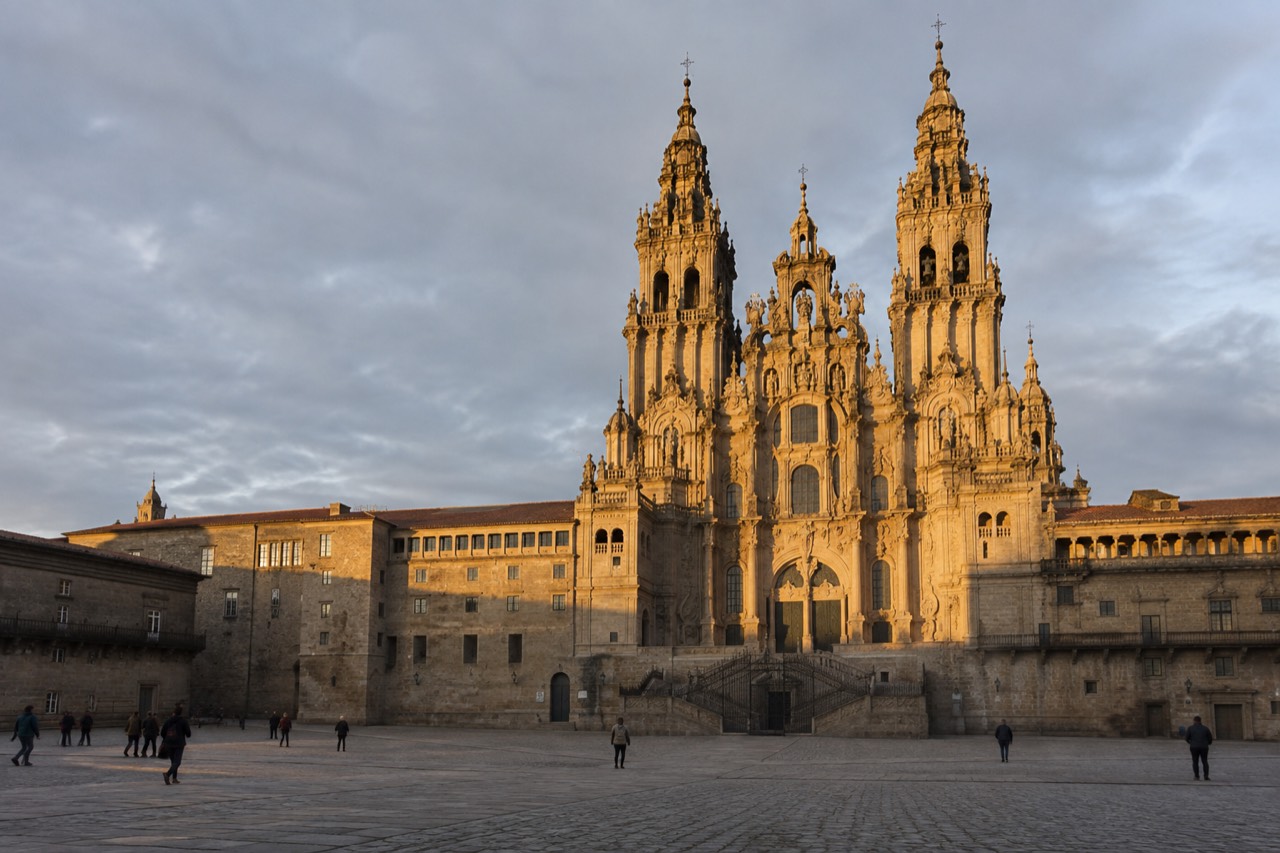
Santiago de Compostela, the capital of Galicia in Spain's rainy green northwest, is famous for one thing before all others: it is the end of the Camino de Santiago, the medieval pilgrim road network that has funnelled travellers toward the tomb of the Apostle St James for over a thousand years. That single fact explains almost everything else the city is known for, from its enormous Cathedral to its granite squares, its pilgrim bureaucracy and its annual crowds. The Oficina del Peregrino's own figures record 530,987 Compostela certificates issued in 2025, a record year, which means more than half a million people finished a recognized walk or ride here in twelve months. Few cities of its size carry a global name for one reason so completely.
But the pilgrim city is only the headline. Santiago de Compostela is also famous for a UNESCO-listed Old Town of weathered granite, a food culture built on octopus, peppers and almond cake, a famously wet oceanic climate, and a position at the hinge of Galicia's coast and inland wine country. This page from the Santiago de Compostela Travel Guide editors sets out each strand of that fame with the verified figures behind it.
What Is Santiago de Compostela Famous For?
Santiago de Compostela is famous for being the finishing point of the Camino de Santiago and the city containing the Cathedral built over the tomb of St James the Apostle. It is also known for its UNESCO World Heritage Old Town, inscribed in 1985, its pilgrim masses and Botafumeiro, its granite plazas, and its Galician food, all inside the wettest corner of Spain.
The city's fame rests on a chain of consequences. A believed apostolic burial made it a pilgrimage goal in the Middle Ages. Pilgrims made it wealthy. Wealth built the Cathedral, the monasteries, the hospitals and the hostelries that still shape the street plan. And the modern revival of walking the Camino, accelerating strongly in recent decades, turned a regional holy city into a destination with arrivals in the hundreds of thousands per year.
The table below gives the short version. Every figure in it comes from the primary sources gathered on this site.
| Claim to fame | What it actually is | Verified figure or fact | Source basis |
|---|---|---|---|
| The Camino de Santiago | A network of pilgrim routes across Europe converging on the city | 530,987 Compostelas issued in 2025 | Oficina del Peregrino figures |
| The Cathedral | Basilica over the traditional tomb of St James | General entry free, open roughly 7am to 9pm | Cathedral and city listings |
| The Old Town | Granite historic centre around the Cathedral | UNESCO listing, inscribed 1985 | UNESCO World Heritage list |
| The Camino routes themselves | The French and Northern Spanish routes as cultural landscape | Separate UNESCO inscription, 1993 | UNESCO World Heritage list |
| The Botafumeiro | Giant swinging censer, normally flown on 12 solemnities a year | Currently out of action, no return date | Cathedral written confirmation |
| The Holy Year | Xacobeo, whenever 25 July falls on a Sunday | Next one is 2027, door opens 31 December 2026 | santiago.es news pages |
One distinction that most first pages of search results blur: the two UNESCO inscriptions are separate listings, not one. The Old Town of Santiago de Compostela was inscribed in 1985 on its own merits as an urban ensemble. The Routes of Santiago de Compostela, the Camino Frances and the Routes of Northern Spain, were inscribed separately in 1993 as a cultural landscape of the roads themselves. A city that holds two independent World Heritage designations for two different reasons is genuinely rare, and it is the cleanest single answer to this question.
What Makes The Cathedral Of Santiago de Compostela So Famous?
The Cathedral of Santiago de Compostela is famous as the building over the reputed tomb of St James the Apostle, the goal of every Camino route since the pilgrimage began in the Middle Ages. General entry is free, the interior stays open from roughly 7am to 9pm, and the complex also sells a museum visit from 9 to 23 euros and a guided rooftop tour at 15 euros general, 12 reduced.
The Cathedral's own liturgy page and the city's Cathedral listing state the practical arrangement plainly: the basilica is free to enter, the museum runs from around 10am to 8pm with ticket prices between 9 and 23 euros depending on ticket type, and the rooftop and Carraca Tower visit is a guided hour covering about 140 steps to a height of roughly 72 metres, priced at 15 euros general or 12 reduced, with English-language visits at a flat 15. Those cathedral-run numbers matter because third-party guided packages sold at higher prices are not the official channel.
Inside, the fame is concentrated in three objects. The tomb itself, in the crypt beneath the high altar, is the reason the building exists at all. The Pórtico da Gloria, the great Romanesque stone portal at the west front, is one of the defining works of Romanesque sculpture, restored in a major project completed in 2018. And the Botafumeiro, the enormous censer that normally swings across the transept on 12 fixed liturgical solemnities a year, is the cathedral's single most famous moving spectacle.
On the Botafumeiro, honesty matters more than drama. The Cathedral confirmed in writing on 5 September 2026 that it is currently out of action: scaffolding for the cimborrio, the dome restoration, covers its hanging mechanism, and no return date has been published. The normal rhythm, flying on fixed solemnities from Epiphany on 6 January through the Transfer of the Apostle on 30 December, is how it ordinarily works, clearly flagged as currently suspended. No visitor should plan a trip around seeing it swing.
For readers who want the full story of the building, the site carries a dedicated long read, why the Cathedral is so famous. For those who simply want to see inside with a guide, the listing for the guided sightseeing tour is worth checking: from $28 per person, rated 4.6 from 542 reviews on the operator's live listing. Check availability
Why Is Santiago de Compostela The End Of The Camino de Santiago?
Santiago de Compostela is the terminus of the Camino de Santiago because the pilgrimage is, at root, a journey to the Apostle's tomb. To earn the Compostela certificate, a pilgrim must walk at least the last 100km, ride horseback over the same, or cycle the last 200km, collecting two stamps per day, and collect the certificate in person at Rua das Carretas 33.
The Oficina del Peregrino's FAQs spell out the rules, and they are stricter than most first-time walkers expect. The distance requirement is measured on a recognized Camino route, the credencial must carry at least two stamps per day from official stamping points, and the certificate is issued in person only. The office sits at Rua das Carretas 33, with hours that shift seasonally between roughly 8am and 10am opens and 7pm to 8pm closes, closed on 25 December and 1 January.
The scale of the modern pilgrimage is the city's biggest headline number. The Oficina del Peregrino's most recent annual figure, 530,987 Compostelas in 2025, is a record. That count only includes people who finished a qualifying distance and requested the certificate, so the real footfall, counting shorter walkers, companions and ordinary tourists, runs higher still.
Pilgrim masses are part of the fame. The Cathedral's liturgy page lists daily pilgrim masses at 7:30am, 9:30am, noon and 7:30pm at the high altar. That arrangement runs only until 15 October 2026. From 16 October 2026, because of main chapel remodelling ahead of the 2027 Holy Year, the 9:30am, noon and 7:30pm masses relocate to the nearby Church of San Agustin, and only the 7:30am mass stays in the Cathedral, in its Communion chapel. Both arrangements are dated here because both are true within weeks of each other.
The next Holy Year is the final piece. A Xacobeo is declared whenever 25 July, the feast of St James, falls on a Sunday. The next one after 2026 is 2027, with the Holy Door opening on 31 December 2026 and the Holy Year running through 31 December 2027. Expectations of huge crowds in 2026 are mistaken; 2027 is the date the city is preparing for, and the main chapel works are part of that preparation. Walkers comparing routes can start with the site's answer on how long the Camino takes.
Walking the whole way in is not the only way to meet the city. Two guided options cover the story on foot for visitors who arrive by plane or train: a small-group historic walking tour from $29 per person, rated 4.9 from 16 reviews on its listing, and an old town walk with an official guide from $12 per person, rated 4.8 from 338 reviews.
What Is The Old Town Of Santiago de Compostela Known For?
The Old Town of Santiago de Compostela is known for its granite plazas stacked around the Cathedral, Praza do Obradoiro above all, and for its cluster of monumental buildings: the Hostal dos Reis Catolicos, San Martino Pinario, the Colexio de Fonseca and Rua do Franco's eating strip, all inside the UNESCO inscription of 1985.
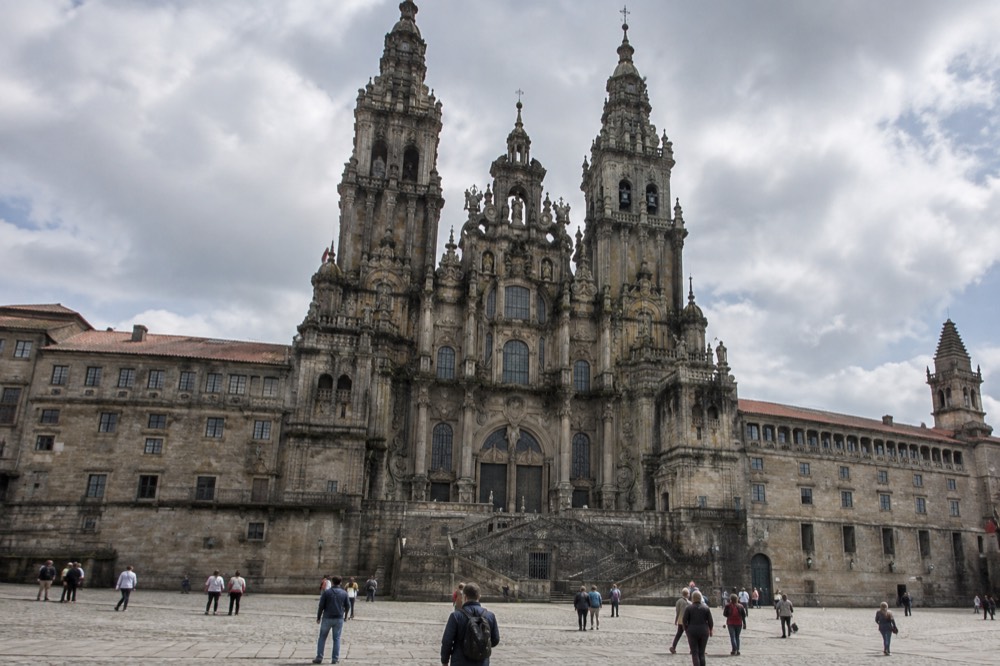
Praza do Obradoiro is the image the city exports. The square closes the Cathedral's baroque Obradoiro facade between the Hostal dos Reis Catolicos, one of Spain's oldest continuously operating hotels and now a parador, on one side and San Martino Pinario, a vast former monastery, on the other. Granite here weathers to a dark charcoal, and that colour, not the honey stone of southern Spain, is the signature look of Galician cities.
A short walk covers the rest of the ensemble. Praza da Quintana, at the east end, holds the Holy Door that opens only in Holy Years. The Alameda park gives the classic postcard view of the Cathedral skyline from across a valley of trees. Rua do Franco, running downhill from the Obradoiro, is the traditional tapas street, and the Mercado de Abastos is the working food market behind it, though its opening hours should be checked on the venue's own site because this site's research did not verify them.
For planning purposes, it helps to know the answers to two neighbouring questions before deciding how the Old Town fits a trip. The site's page on whether Santiago de Compostela is worth visiting addresses the common doubt directly, and the one on how many days to spend gives a pacing breakdown.
What Food Is Santiago de Compostela Famous For?
Santiago de Compostela is famous for Galician food: pulpo a la gallega, octopus with paprika and olive oil, Padrón peppers with their unpredictable heat, empanada, and Tarta de Santiago, the almond cake stamped with the cross of St James, alongside queimada, the flaming orujo ritual, and Albarino white wine from the Rias Baixas.
Galician cooking is one of Spain's most distinctive regional kitchens, and Santiago de Compostela is its showcase city. The fame is not a single dish but a short list, and the city's tapas bars and market stalls run through all of it. Prices vary by establishment, so check the room rather than trusting a quoted number.
| Dish or drink | What it is | Where it sits in the city's fame |
|---|---|---|
| Pulpo a la gallega | Boiled octopus sliced over boiled potatoes with olive oil and paprika | The signature Galician plate, served in tapas bars citywide |
| Padrón peppers | Small green peppers, fried in oil and salted, most mild, some hot | A Galician original named for the Padron growing area south of the city |
| Tarta de Santiago | Almond cake marked with the cross of St James | The city's namesake dessert, sold everywhere from market stalls to bakeries |
| Empanada gallega | Savoury pie, classically with fish or meat in a bread crust | Everyday market and bar food |
| Queimada | Orujo spirit, flamed with the traditional esconjuro verse | Performed as a show and tasting in the city, from $17 per person on tour listings |
| Albarino | White wine from the Rias Baixas, south of the city | The region's flagship wine, tied to the Rias Baixas day trips |
The queimada deserves a specific note because it is the one dish performed as theatre. Two listed experiences in the city run the flaming ritual with a tasting, one from $17 per person rated 4.4 from 69 reviews, the other from $17 per person rated 4 from 70 reviews, both priced on the operator's live listing. A tapas tour, from $52 per person rated 4.7 from 243 reviews, is the broader introduction for visitors who want the bars chosen for them.
AEMET's climate data explains why this food culture leans on rain-fed pasture and coastal seafood rather than the dry-land cooking of southern Spain. The station at Labacolla records a temperate oceanic climate, wet year round, wetter from October to March, driest in July and August, with annual precipitation on the order of 1,690 to 1,890mm. Green hills, cows, octopus boats and white wine are all products of the same weather.
What Famous Places Sit Within Reach Of Santiago de Compostela?
Santiago de Compostela is also famous as a base for Galicia's headline sights: Fisterra and the Costa da Morte, where the Camino meets the Atlantic, the Cies Islands, the Rias Baixas wine country around Cambados, and the cities of A Coruna, Vigo, Lugo, Ourense and Pontevedra, most reachable as full-day trips from the city.
Fisterra, the Finisterre of Spanish spelling, is the symbolic "end of the world" where some pilgrims traditionally walked on past Santiago de Compostela to burn a boot at the ocean. The Costa da Morte, the Coast of Death, is the shipwreck-littered shoreline around it, and day tours from the city cover it in a full day, with listings ranging from about $45 for a half-day express to about $60 for full-day versions, ratings between 4.1 and 4.8 from their review counts.
The Rias Baixas to the south pair the Albarino wineries of Cambados with mussel-boat trips through the estuary, on listed full-day tours from around $53 and $54. East of the city, Ribeira Sacra's Sil river canyons and the Roman walls of Lugo make a second inland circuit, and A Coruna and Vigo, both short rail hops north and south, are cities in their own right. Direct trains run from Santiago de Compostela to Madrid in roughly three to four hours, to A Coruna as a short hop, and to Vigo in about an hour; there is no direct line to Porto, travellers change via Vigo.
The question of which of these is worth the day is a real one, and the site answers it in detail on its page about the best day trip from Santiago de Compostela.
For visitors who want the coast handled for them, the two most-reviewed day tours are a Finisterre, Muxia and Costa da Morte excursion from $59 per person rated 4.7 from 2,312 reviews, and a Rias Baixas tour with boat trip and winery from $53 per person rated 4.7 from 482 reviews, both on the operators' live listings.
Common Questions About Santiago De Compostela's Fame
What is Santiago de Compostela famous for?
It is famous as the end of the Camino de Santiago and the city of the Cathedral over the tomb of St James, plus its UNESCO-listed Old Town, Galician food, and its role as the capital of Galicia. The Oficina del Peregrino recorded 530,987 Compostela certificates issued in 2025.
Is Santiago de Compostela a UNESCO World Heritage Site?
Yes, twice over, as two separate listings. The Old Town was inscribed in 1985, and the Routes of Santiago de Compostela, the Camino Frances and the Routes of Northern Spain, were inscribed as their own cultural listing in 1993.
Can you see the Botafumeiro swing in Santiago de Compostela?
Not currently. The Cathedral confirmed in writing on 5 September 2026 that the Botafumeiro is out of action because dome-restoration scaffolding covers its hanging mechanism, and no return date has been published. It normally flies on 12 fixed liturgical solemnities a year.
What is the best known food of Santiago de Compostela?
Galician dishes: pulpo a la gallega, Padrón peppers, empanada, Tarta de Santiago, and queimada, with Albarino white wine from the Rias Baixas as the region's flagship drink.
When is the next Holy Year in Santiago de Compostela?
2027, not 2026. The Holy Door opens on 31 December 2026 and the Xacobeo Holy Year runs through 31 December 2027, because 25 July 2027 falls on a Sunday.
Why do so many people walk to Santiago de Compostela?
Because the pilgrimage to the Apostle's tomb, a tradition reaching back over a thousand years, requires walking at least the last 100km, cycling the last 200km, or covering the final stretch on horseback to earn the Compostela certificate, issued in person at Rua das Carretas 33.
In one sentence, Santiago de Compostela is famous because a tomb, a road and a city grew around each other for a millennium, and each of the three still draws the other two.