2 Days In Santiago de Compostela
Two days covers the Cathedral, the rooftops, the old town lanes and one good day trip, with time left over for padron peppers and a queimada show.
Short answer
Yes, two days is enough for the Cathedral, its rooftops, the old town and one half-day excursion. Book Cathedral and rooftop tickets in advance, keep Day One inside the old town, and give Day Two to Fisterra or the Rias Baixas.
Santiago de Compostela packs an entire pilgrimage destination into a compact UNESCO-listed old town, and the city's own figures explain why two days works: the Oficina del Peregrino recorded 530,987 Compostela certificates in 2025, a record year, yet almost every one of those pilgrims spent only a day or two in the city itself before heading home. Two days is the sweet spot. It is long enough for the Cathedral, the rooftops, the old town lanes, the market and a plate of padron peppers, and long enough to add one coastal excursion on the second morning. This itinerary from the Santiago de Compostela Travel Guide editors lays out both days hour by hour, with verified ticket prices, the mass schedule in both its current and post-October 2026 form, and a cost table built only from published figures.
Is Two Days In Santiago de Compostela Enough Time?
Two days is enough for the Cathedral interior, the rooftop tour, the Cathedral Museum, the old town lanes, the market and one full-day or half-day excursion to the coast, provided you book the rooftop and museum tickets in advance, since both run on timed slots that sell out in peak season. It is not enough to walk any Camino route into the city, and pilgrims who arrive on foot typically add a rest day, which has its own itinerary. The Cathedral's own liturgy page lists four pilgrim masses daily, so the rhythm of the city is built around a short, dense visit.
The reason two days works is geography, not optimism. Praza do Obradoiro, the Cathedral, the Hostal dos Reis Catolicos, Praza da Quintana and the market all sit within a few minutes' walk of one another. The city's UNESCO inscription from 1985 covers the Old Town specifically, and the separate 1993 inscription covers the Camino routes, so a visitor staying in the centre is inside the first listing the whole time.
The main squeeze is the Cathedral complex itself. The basilica interior is free and generally open about 7:00am to 9:00pm, but the museum, the rooftops and the Portico da Gloria all ticket separately. Trying to do all of them plus a walking tour on one afternoon is where first-time visitors run out of hours. Splitting the Cathedral across both mornings is the fix.
| What you want to cover | Days realistically needed |
|---|---|
| Cathedral interior plus one square-side stroll | Half a day |
| Cathedral, museum, rooftops, old town, market | Two full days |
| The above plus one coastal day trip | Two days plus an early start |
| Camino route walked in from Sarria | Add a week, see how long the Camino takes |
What Should You Do On Day One In Santiago de Compostela?
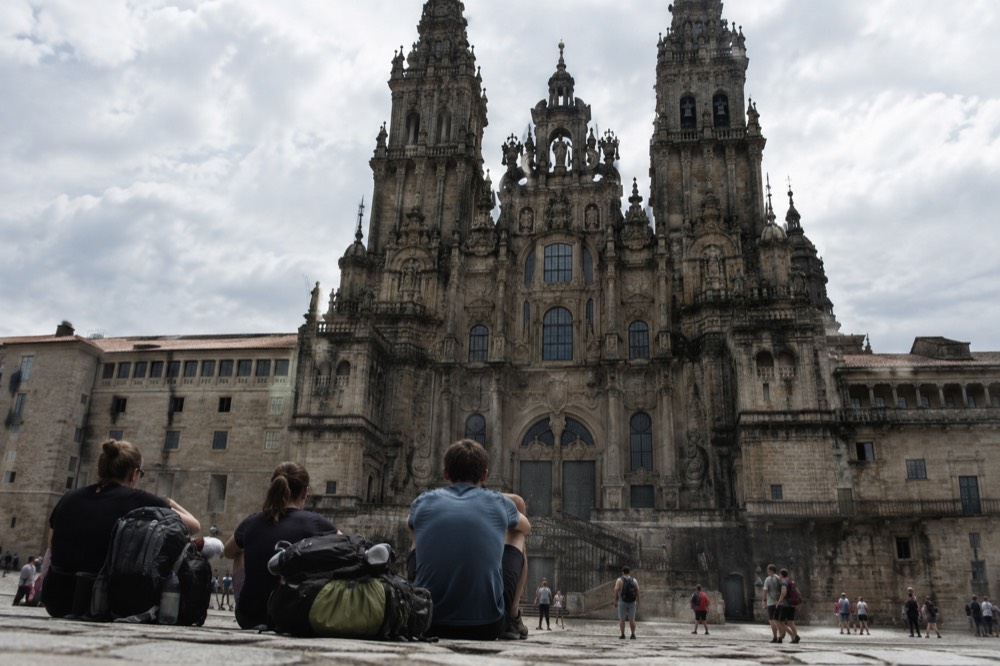
Day One belongs to the historic core: start at Praza do Obradoiro at opening light, enter the free Cathedral interior before the queues build, book a mid-morning rooftop tour on the Carraca Tower, spend the afternoon in the old town lanes and the Cathedral Museum, and finish with a tapas evening on Rua do Franco or a queimada show. Do the Cathedral's paid spaces on Day One rather than Day Two, because if a rooftop slot is sold out you still have Day Two morning as a fallback. The old town is compact enough that nothing on this list is more than a few minutes apart on foot.
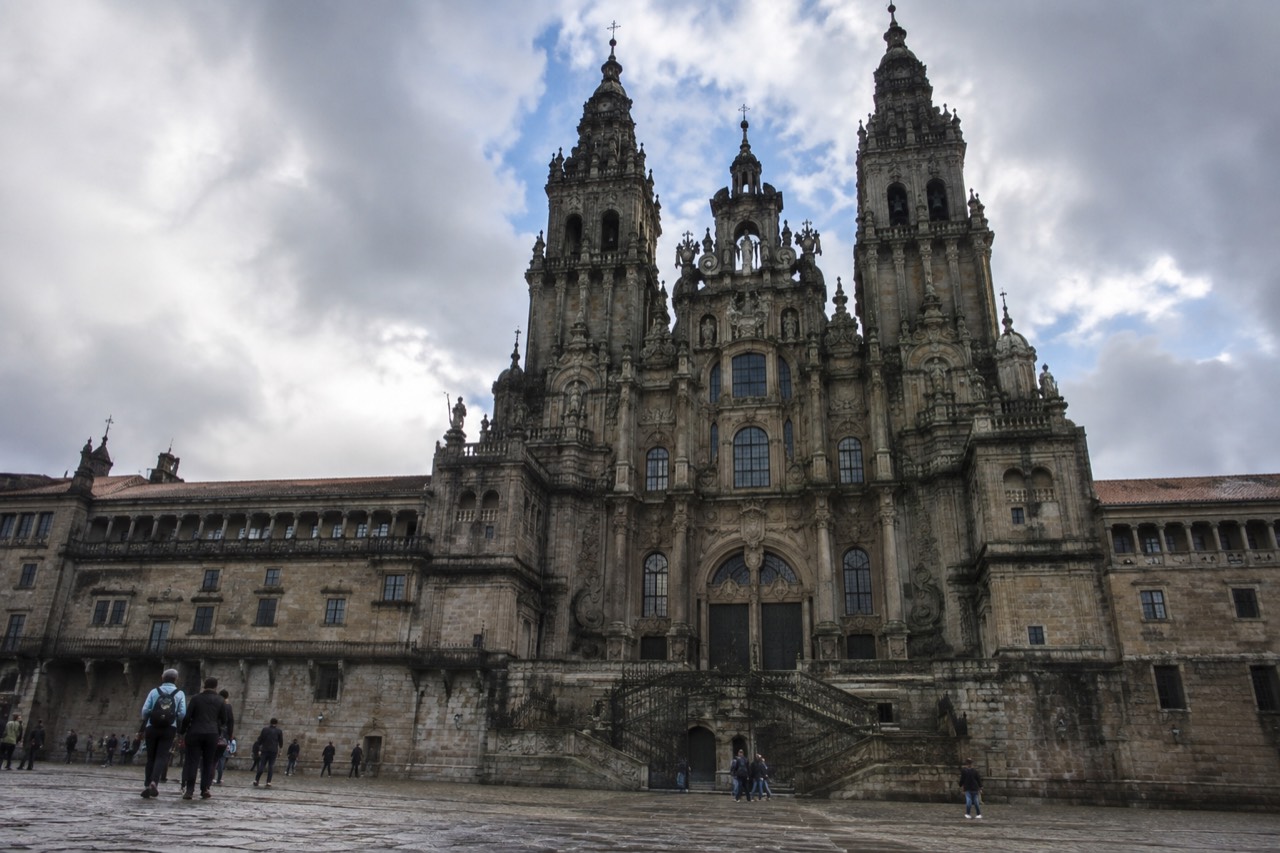
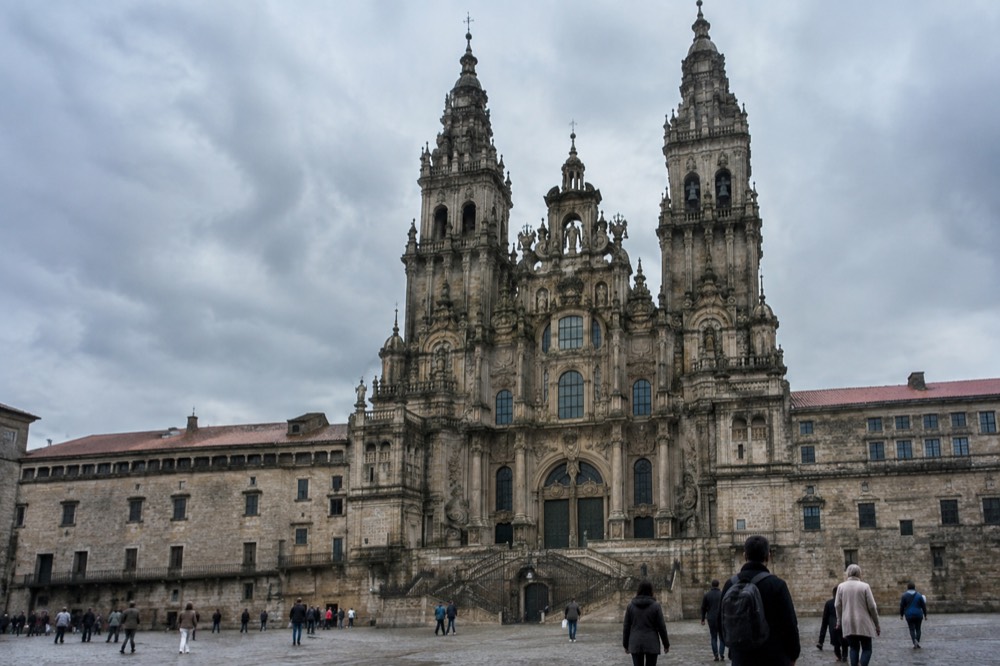
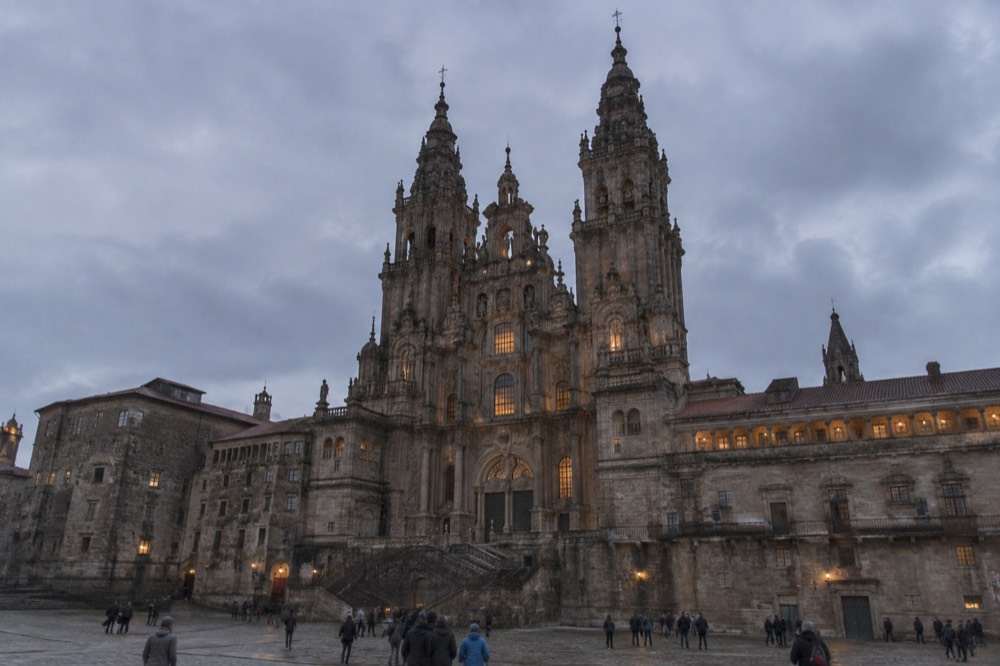
Morning is the time to be on Praza do Obradoiro. The square holds the Cathedral's Obradoiro facade, the Hostal dos Reis Catolicos, which began as a pilgrim hospital and now operates as a parador, and the clock tower works currently wrapped in scaffolding for a restoration that runs through 2026 and 2027. The exterior works do not affect visits, but they do shape photographs, so frame the facade from the square's edges.
Inside, the Cathedral's own liturgy page lists pilgrim masses at 7:30am, 9:30am, noon and 7:30pm at the High Altar, and that arrangement runs until 15 October 2026. From 16 October 2026 the 9:30am, noon and 7:30pm masses relocate to the nearby Church of San Agustin while main-chapel remodelling for the 2027 Holy Year continues, with only the 7:30am mass remaining in the Cathedral's Communion chapel. Any visit after mid-October should plan around the San Agustin relocation.
Two things are currently out of action that a first-time visitor might expect. The Botafumeiro is suspended because dome-restoration scaffolding covers its hanging mechanism, confirmed in writing by the Cathedral on 5 September 2026, with no return date published. And the 2026 calendar is not a Holy Year: the next Xacobeo begins when the Holy Door opens on 31 December 2026 and runs through 2027.
| Day One block | What it covers | Verified figure |
|---|---|---|
| Early morning | Praza do Obradoiro, Cathedral interior | Free entry, roughly 7:00am-9:00pm |
| Mid-morning | Rooftop and Carraca Tower tour | EUR15 general, EUR12 reduced, about 60 minutes |
| Midday | Pilgrim mass or museum | Museum EUR9-23 depending on ticket type |
| Afternoon | Old town lanes, Praza da Quintana, Holy Door | Free to wander, door opens only in Holy Years |
| Evening | Tapas on Rua do Franco, or queimada show | Queimada experience from $17 |
A guided visit makes the first hours count. The Cathedral and Carraca Tower roofs tour is the single most time-efficient paid ticket in the city, and a hidden city walking tour covers lanes most visitors never find, with the options below covering both.
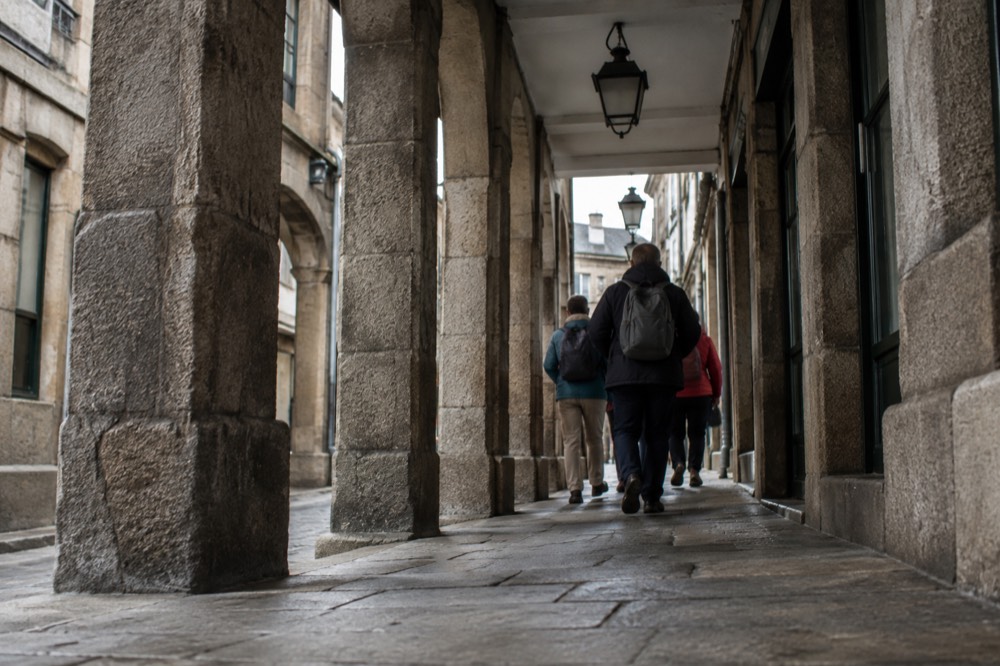
After the tour, give the afternoon to the Cathedral Museum, whose permanent collection in the Gelmirez Palace runs about 10:00am to 8:00pm with the ticket office closing 30 minutes earlier. The same complex ticketing covers the Portico da Gloria crypt, and the Portico's time-limited visits exist for conservation reasons, a policy detail the 2018 restoration made permanent.
The evening is Santiago at its best. Rua do Franco is the classic tapas street, and the market city plan covers how to split a food-first visit if you would rather eat than sightsee. If you want one scheduled event, the queimada show, a flame-and-punch ritual with a recited spell, runs nightly in the old town from $17 per person.
The queimada ritual is the one evening event in Santiago de Compostela that doubles as theatre: the punch is set alight, the conxuro spell is recited, and the room watches the flames burn off before anyone drinks. It slots neatly into the end of Day One because it needs no planning around daylight or ticket queues, and the tasting version fits two days better than a full dinner show.
How Do You Book Cathedral Rooftop Tickets In Santiago de Compostela?
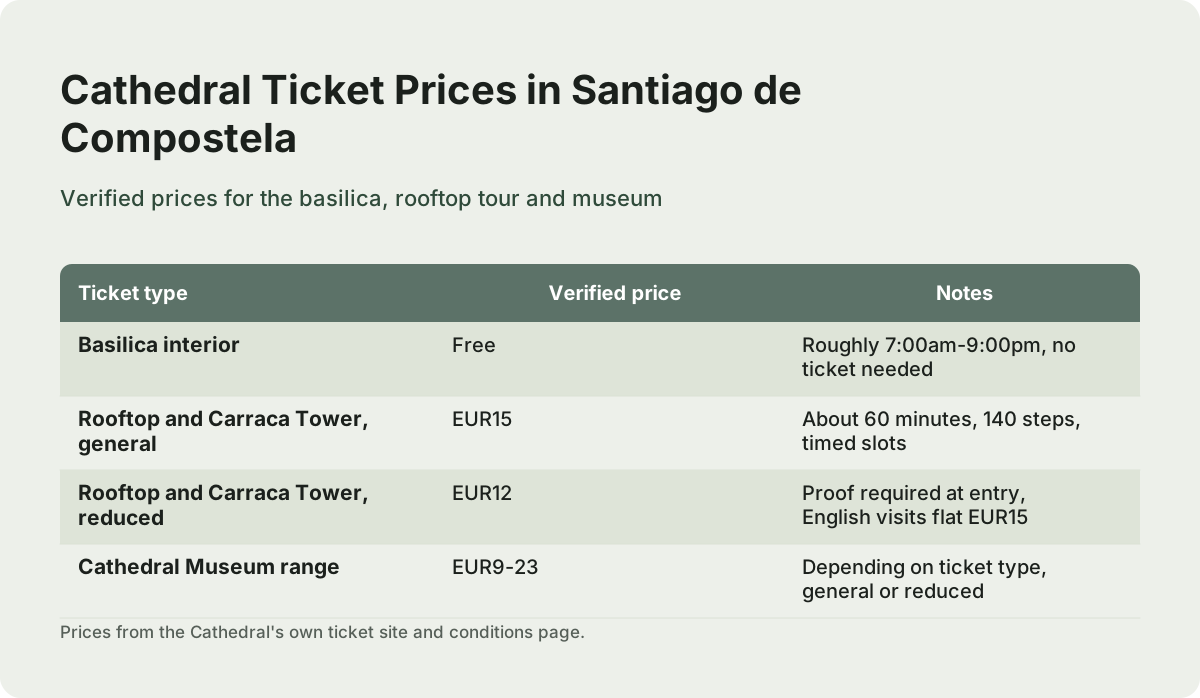
The rooftop and Carraca Tower tour is booked on the Cathedral's own ticket site at visitas.catedraldesantiago.es, costs EUR15 general or EUR12 reduced, takes about 60 minutes, climbs roughly 140 steps to a height near 72 metres, and includes free access to the Cathedral Museum's permanent collection for seven days from your visit. English-language visits are a flat EUR15 with no reduced rate, and reduced-rate buyers must show proof, such as pilgrim accreditation or ID for over-65s, at entry. Timed slots sell out, so book before you travel in July, August or Holy Year season.
The reduced EUR12 rate applies to accredited pilgrims, students, unemployed visitors, large families, disabled visitors, over-65s and under-12s. Priests, religious, ICOM members and Friends of the Cathedral enter free. These categories come from the ticket site's own conditions page, and the proof requirement is enforced at the door rather than at checkout.
One structural detail most visitors miss: the rooftop ticket's museum access is valid for seven days and one use per space, covering the permanent collection, the Gelmirez Palace, the Portico da Gloria crypt and the Diocesan Museum. That means a two-day visitor can buy the rooftop ticket for Day One and use the museum access on Day Two without paying twice. It is the single best value move in the whole itinerary.
| Cathedral ticket type | Verified price | Notes |
|---|---|---|
| Basilica interior | Free | Roughly 7:00am-9:00pm, no ticket needed |
| Rooftop and Carraca Tower, general | EUR15 | About 60 minutes, 140 steps, timed slots |
| Rooftop and Carraca Tower, reduced | EUR12 | Proof required at entry, English visits flat EUR15 |
| Cathedral Museum range | EUR9-23 | Depending on ticket type, general or reduced |
Booking a guided version through an operator bundles the skip-line access with a guide, which matters when the noon pilgrim mass lets out and the ticket lines peak. The operator's live listing carries the current slot availability, and the seven-day museum access makes the guided ticket the better arithmetic for a two-day stay.
If the rooftop slots for your dates are already thin, the same operator listing shows the remaining times side by side, which is easier than refreshing the Cathedral's own calendar. Pick whichever mid-morning slot is left, then build the rest of Day One around it rather than the reverse.
Where Should You Eat During Two Days In Santiago de Compostela?
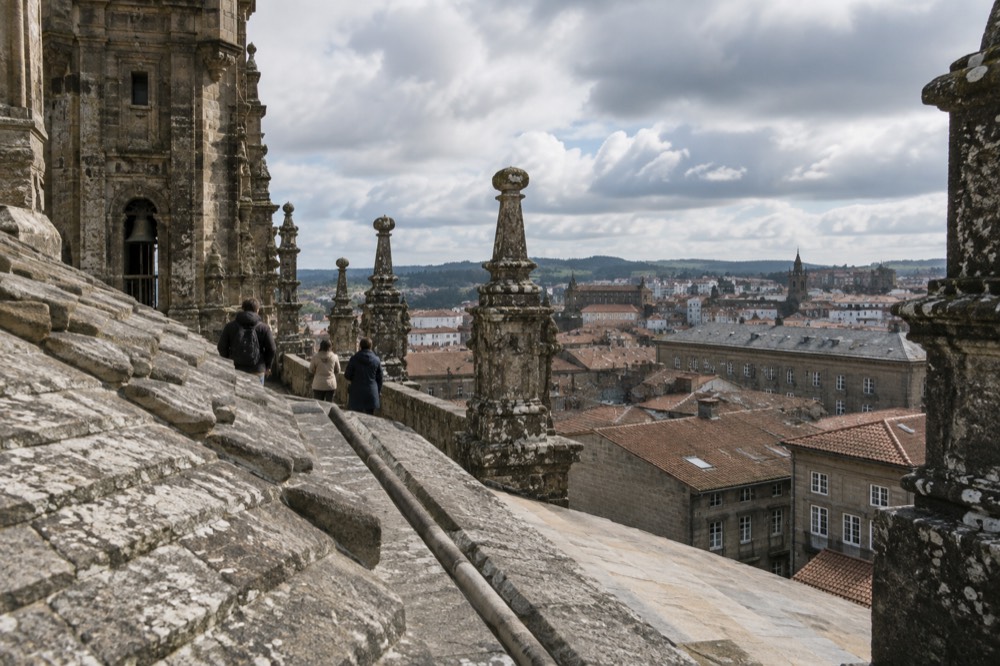
Plan eating around the market and the tapas bars rather than sit-down restaurants: the Mercado de Abastos is the city's working food market and the place Galicians actually shop, Rua do Franco and its side streets carry the densest tapas concentration, and the three dishes to hunt are padron peppers, pulpo a la gallega and tarta de Santiago, all covered in dedicated guides on this site. Market hours should be checked on the venue's own site before you go, since they are not officially published. Lunch runs later than northern Europe expects.
What is not verified is a specific closing day or opening hour, so treat the market as a morning activity and check the venue's own site rather than trusting a third-party listing.
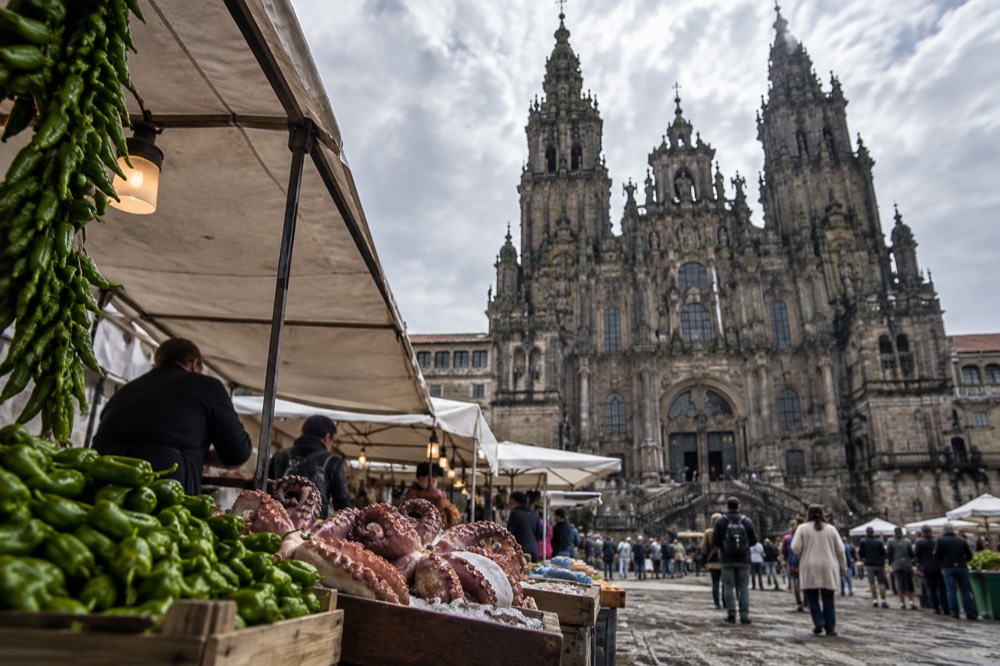
Padron peppers carry the saying that some are hot and some are not, and that gamble is the point of the dish. Pulpo a la gallega, octopus with paprika and olive oil on a wooden plate, is the region's signature, and tarta de Santiago, the almond cake stamped with the cross of Santiago, is the dessert that travels home in hand luggage. If two days forces a choice, one plate of octopus and one slice of almond cake cover the essentials.
For visitors who want the food explained rather than just served, a guided option solves the ordering problem. A private tapas tour from $52 per person, rated 4.7 from 243 reviews, walks the old town's bars with a guide who handles the Galician menu, and there is a rainy-day city plan for planning a self-guided version on a wet afternoon.
| Meal | Where | Signature order |
|---|---|---|
| Day One breakfast | Old town cafe | Tarta de Santiago and coffee |
| Day One lunch | Rua do Franco side streets | Pulpo a la gallega |
| Day One dinner | Queimada show venue | Queimada and shared plates |
| Day Two morning | Mercado de Abastos | Whatever looks best at the stalls |
| Day Two lunch | Coastal day-trip stop | Fresh seafood if you head to the Rias Baixas |
What Should You Do On Day Two In Santiago de Compostela?
Day Two splits into two good shapes: either a slow city morning finishing the Cathedral's paid spaces, San Martino Pinario, the Alameda park view of the Cathedral and an afternoon flight or train, or an early start on a full-day excursion to Fisterra and the Costa da Morte or the Rias Baixas wine country, returning for a final evening in the old town. The choice is weather-dependent, and AEMET's station data for Santiago shows a wet and cool season from October to March with the driest months in July and August, so check the forecast before committing to a coastal day.
If the sky is grey, the city shape is better. San Martino Pinario, the former monastery beside the Cathedral, and the Museo das Peregrinacions fill a museum morning, and the Alameda park holds the classic postcard view of the Cathedral's towers framed by eucalyptus. Neither museum's hours are officially published, so check each venue's own site before setting out, and the rainy-day itinerary covers a full wet-weather plan.
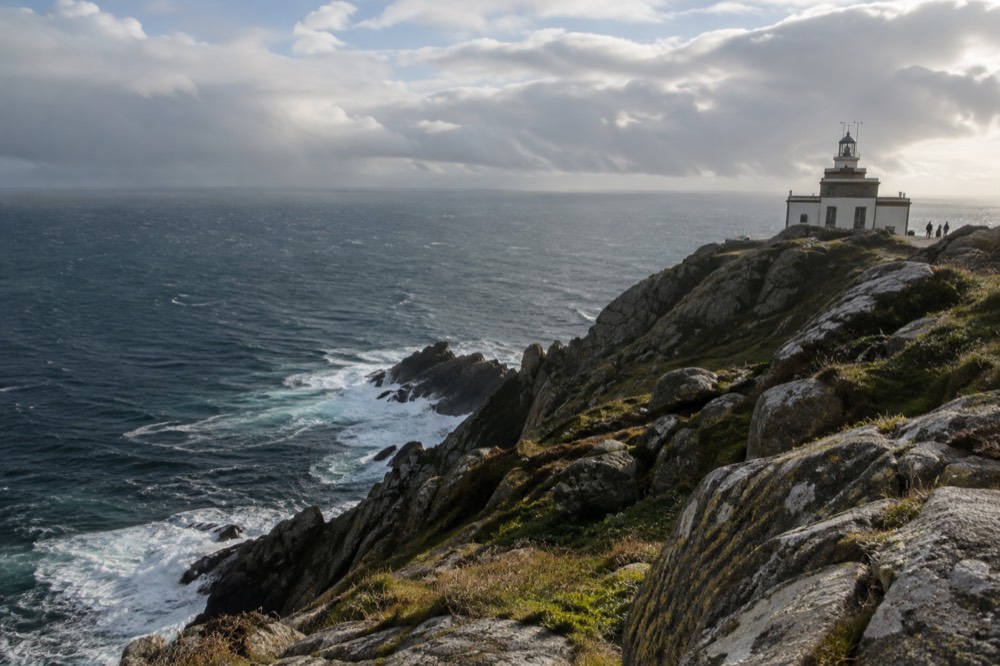
If the sky is clear, the coast wins. Fisterra, the Galician name also rendered as Finisterre in Spanish, sits at what the Romans considered the end of the world, and the full-day tours that reach it also stop in Muxia and along the Costa da Morte. The Rias Baixas alternative pairs an Albarino winery visit with an optional mussel-boat trip, and there is a guide to the best day trip question comparing them in detail.
| Day Two shape | Morning | Afternoon | Evening |
|---|---|---|---|
| Slow city day | Museum and San Martino Pinario | Alameda park, last old-town lanes | Early dinner, night train or rest |
| Costa da Morte trip | Fisterra lighthouse and Muxia | Costa da Morte coastal stops | Return and final tapas |
| Rias Baixas trip | Albarino winery near Cambados | Mussel boat and Combarro | Return by evening |
| Kids in tow | Market and squares | Interactive museum stops | See the with-kids itinerary |
Should You Add A Day Trip On Day Two From Santiago de Compostela?
Yes, if you have two full days, a coastal day trip is the highest-value use of Day Two, and the strongest reviewed option is the full-day Finisterre, Muxia and Costa da Morte excursion at from $59 per person rated 4.7 from 2,312 reviews, with the Rias Baixas winery and mussel-boat trip at from $53 rated 4.7 from 482 reviews as the food-and-wine alternative. If your second day is a half day before a flight, skip the full excursion entirely, since the city's airport is only about 12km from the old town and an express half-day Fisterra option exists for exactly that case.
The transport math makes the excursion painless. Airport bus line 6A, operated by Tussa, currently costs EUR1 paid to the driver or EUR0.36 with a rechargeable card, though the city's own transport page flags that a new Monbus contract with a fare near EUR6 is expected to start by late 2026, so treat the EUR1 fare as subject to change. A visitor doing Day Two as a day trip and flying out the next morning still has a short transfer back to the airport.
Trains matter for the onward leg. Santiago to Madrid runs direct high-speed services in roughly three to four hours, Santiago to Vigo is about one hour, and there is no direct rail line to Porto, so Portugal-bound travellers change at Vigo. If two days in Santiago is the start of a longer northern Spain route, the three-day itinerary adds the extra depth.
| Transport | Verified range | Note |
|---|---|---|
| Airport bus, line 6A | EUR1 to driver, EUR0.36 on card | Fare subject to change under the 2026 Monbus contract |
| Santiago to Madrid train | Roughly 3-4 hours | Direct high-speed services |
| Santiago to Vigo train | About 1 hour | Regional services |
| Santiago to Porto | No direct line | Change at Vigo |
| Airport to old town | About 12km | A short drive by car or taxi |
What Does Two Days In Santiago de Compostela Cost?
Santiago de Compostela has charged a municipal tourist tax since 1 October 2025, a surcharge on Galicia's tourist-stay tax, from 1 EUR per person per night in private albergues, campsites and tourist apartments up to 2.50 EUR in five-star hotels, for a maximum of 5 nights, with under-18s and stays in Xunta-run public albergues exempt.
The table below uses only figures confirmed by this site. Anything not officially published, such as restaurant prices or hotel rates, stays out of the table rather than being estimated. Hotel and transfer prices shown through booking links change by date and demand, so check the live price on the linked page rather than trusting any number printed here.
| Cost line | Verified figure | Source basis |
|---|---|---|
| Basilica interior | Free | Cathedral entry |
| Rooftop and tower tour | EUR15 general, EUR12 reduced | Cathedral ticket site, September 2026 |
| Cathedral Museum | EUR9-23 by ticket type | Cathedral ticket site |
| Airport bus each way | EUR1, subject to change | santiago.es transport page |
| Queimada show | From $17 | Operator listing |
| Free walking tour, GuruWalk | Tip-based, never a printed price | GuruWalk with the individual guide named |
| Tourist tax | Charged since 1 October 2025: a municipal surcharge on Galicia's tourist-stay tax, from 1 EUR to 2.50 EUR per person per night for up to 5 nights, under-18s and Xunta-run public albergues exempt | Regional policy check |
For visitors on foot rather than a flight, the free walking tours deserve the honesty note. GuruWalk runs a free tour of Santiago's fundamentals, tip-based, rated 4.95 from 6,342 reviews, and naming GuruWalk and the individual guide is the correct way to book it, never a printed price. The paid guided walks start from $12 with the official-guide old-town version rated 4.8 from 338 reviews, and the cost of walking the Camino guide covers the pilgrim-side budget in full.
Common Questions About Two Days In Santiago de Compostela
Is two days in Santiago de Compostela enough?
Two days covers the Cathedral interior, the rooftop tour, the museum, the old town lanes, the market and one coastal day trip. It is not enough to walk a Camino route in, which is a multi-day undertaking on any route.
Can you see the Botafumeiro during a two-day visit?
Currently no. The Botafumeiro has been out of action since the Cathedral confirmed in writing on 5 September 2026 that dome-restoration scaffolding covers its hanging mechanism, with no return date published. Do not plan a visit around seeing it swing.
How much do the Cathedral rooftop tickets cost?
The rooftop and Carraca Tower tour costs EUR15 general or EUR12 reduced on the Cathedral's own ticket site, takes about 60 minutes, climbs roughly 140 steps, and includes seven days of access to the museum's permanent collection.
What is the best day two trip from Santiago de Compostela?
The Finisterre, Muxia and Costa da Morte full-day tour is the strongest reviewed coastal option, and the Rias Baixas winery trip with optional mussel boat is the food-and-wine alternative. Both return to Santiago by evening.
Is 2027 a Holy Year in Santiago de Compostela?
Yes. The Holy Door opens on 31 December 2026 and the Xacobeo Holy Year runs through 31 December 2027, when 25 July falls on a Sunday. 2026 itself is not a Holy Year.
Two days in Santiago de Compostela is the itinerary length the city was built for, dense, walkable and finished off with the coast an hour away. Book the rooftop slot first, keep the market for a morning, and let the second day's weather decide between the sea and the museums.