Galician Food In Santiago de Compostela: What To Eat And Where To Find It
Galician food is the reason many pilgrims remember Santiago de Compostela longer than the walk itself: octopus on wooden plates, empanada, Albariño from the Rias Baixas and a tapas street that has fed travellers for centuries. Here is what to order, where to order it and how the city's food culture actually works.
Short answer
Galician food in Santiago de Compostela centres on octopus (pulpo a la gallega), empanada, Padrón peppers, Albariño wine and the day's catch from the Atlantic coast. Eat tapas on Rua do Franco and the streets off Praza do Obradoiro, shop the Mercado de Abastos, and book a guided tapas or queimada experience to taste it all with context. Tour prices start around $17 per person.
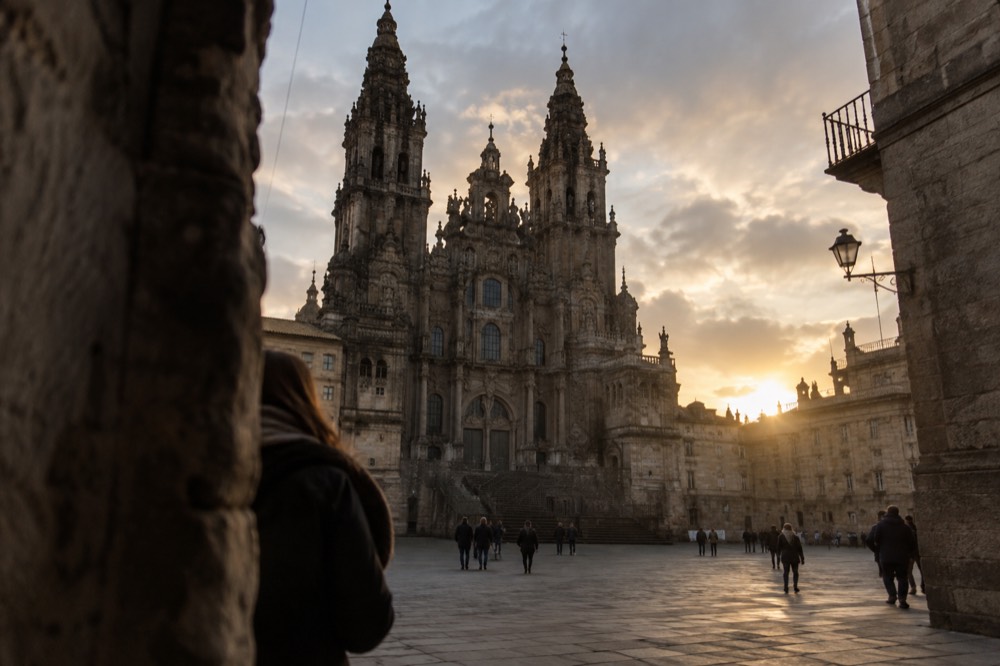
Santiago de Compostela sits about 30km from the Atlantic coast in a region that has always eaten better than most of Spain, and the city's food scene reflects it. Galicia supplies the octopus, the peppers, the shellfish and the white wine; the pilgrim city supplies the crowd that has been eating in its taverns since the Middle Ages. The result is a compact old town where a single street, Rua do Franco, has been serving food to travellers for centuries, and where the evening tapas crawl is treated as seriously as the cathedral visit. This guide covers the dishes, the ordering culture, the wine, the markets and the tours that tie it all together.
What Is Galician Food, And Why Does Santiago de Compostela Eat So Well?
Galician food is Atlantic-coast cooking built on octopus, shellfish, empanada pies, peppers, potatoes, hearty stews and white Albariño wine, with pork and beef from the green interior. Santiago de Compostela, as Galicia's capital and the endpoint of a thousand-year-old pilgrim route, is where all of it converges: the coast sends the day's catch inland, the farming country sends its produce, and the city has centuries of tavern tradition ready to cook it.
Two things make the food culture here distinct. The first is geography. Galicia's coastline, the longest of any Spanish region, is cut by flooded river valleys called rias: the Rias Baixas to the south around Pontevedra, the Rias Altas to the north. Cold, clean Atlantic water means exceptional mussels, octopus, barnacles, clams and scallops, and the region is one of Europe's main mussel producers. The second is history. Pilgrims have been arriving for a thousand years, and the Camino de Santiago brought wheat, cooking techniques and appetite into a city that otherwise would have been a small regional market town. Even the pilgrim menu that lines the Camino Frances is part of the food story; read more in our Camino de Santiago overview.
What you will not find is the fried, heavy image some travellers have of Spanish food. Galician cooking is boiled, grilled and stewed. Olive oil exists but so does pork fat, and the octopus is boiled, not fried. Sauces are minimal because the ingredients carry the flavour. That restraint is what makes the food worth planning a trip around, and it explains why the city's restaurants can serve a fixed pilgrim-style menu at modest prices: simple food, cooked well, priced for people who have walked 30km that day.
The Dishes You Should Not Miss In Santiago de Compostela
The five essentials are pulpo a la gallega (octopus with paprika), empanada (a filled pastry pie), Padrón peppers, Tarta de Santiago (almond cake) and the day's Atlantic catch, usually clams, scallops or hake. Around them sit lacón con grelos, a pork-and-turnip-green stew, and queixo de Tetilla, a cone-shaped soft cow's cheese. Every one of these appears on menus across the old town, from Rua do Franco to the side streets off Praza do Obradoiro, so you can cover the list in two evenings.
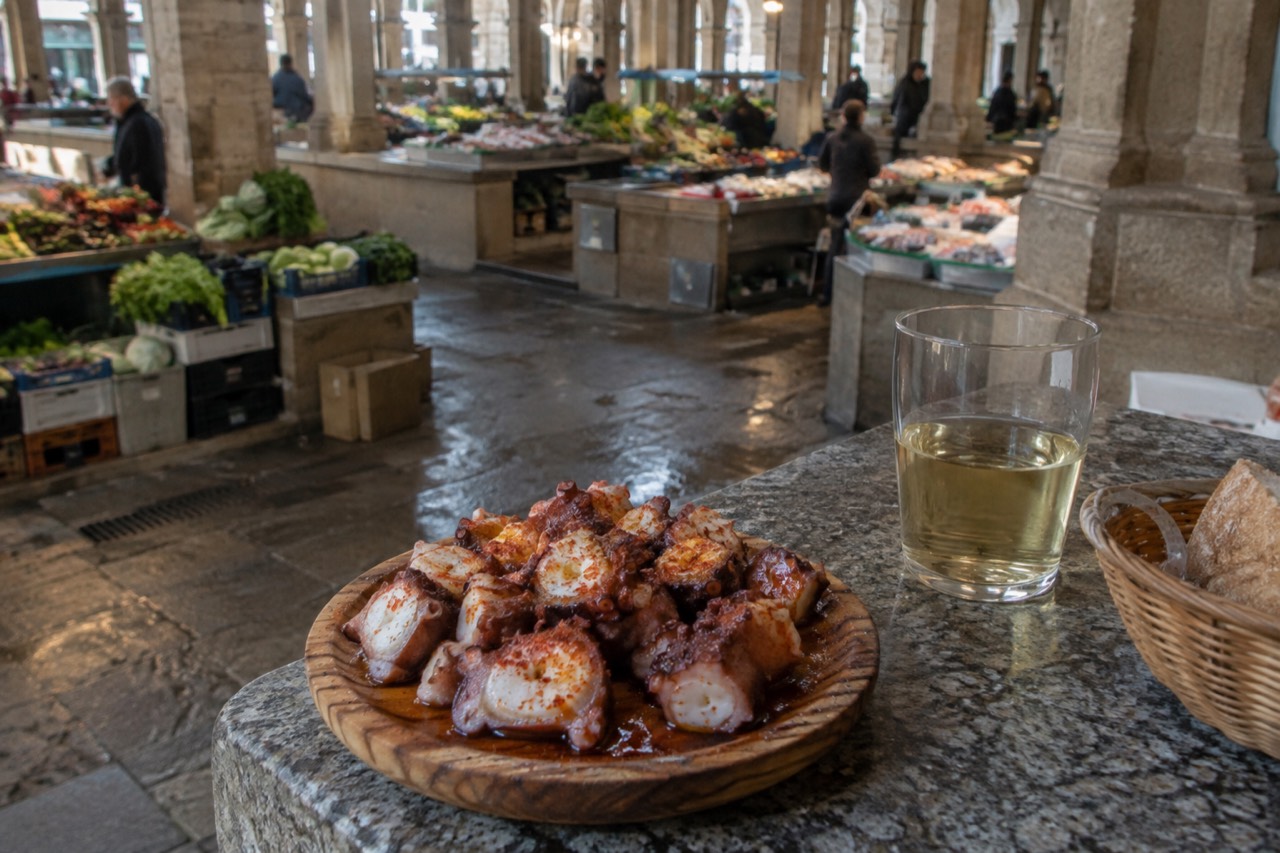
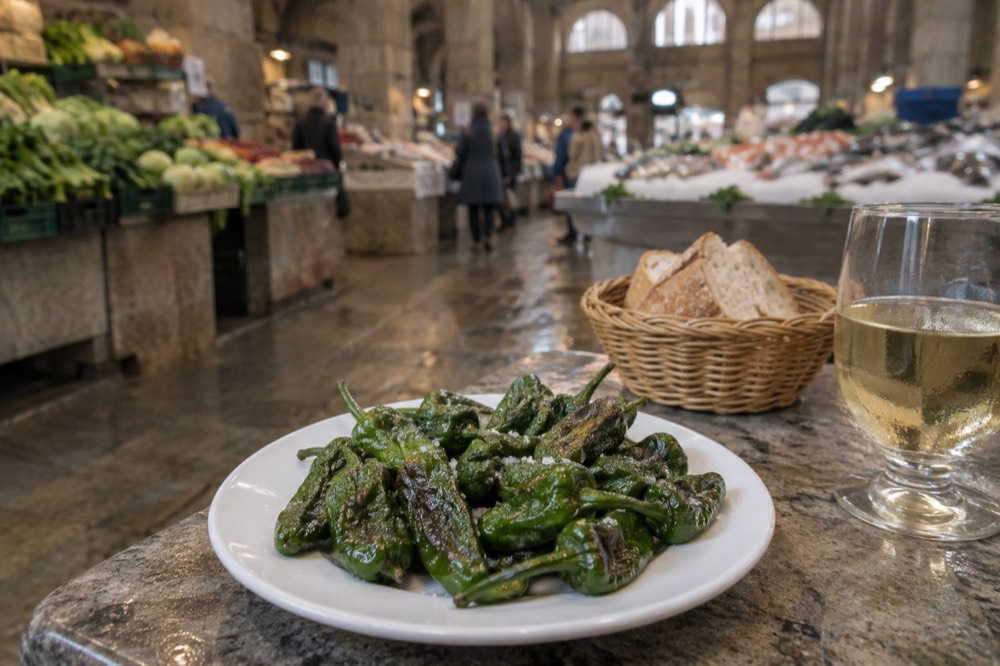
Pulpo a la gallega is the region's signature: octopus boiled until tender, snipped with scissors over sliced potatoes, dressed in olive oil and pimenton (paprika) and served on a wooden plate. The wooden plate matters; it is a folk tradition from the ferias, the country festivals where octopus is cooked in copper pots. Padrón peppers, fried in oil and salted, come with the famous local lottery: most are mild, a few are fierce, and the Galician saying goes that some are hot and some are not.
Empanada is a double-crusted pie, half bread dough and half filling, traditionally filled with salt cod and raisins, tuna, or the beef and tripe of the inland kitchens. It is the food of markets and ferias, sold by the wedge. Tarta de Santiago, a dense almond cake marked with the cross of Saint James in icing sugar, is the dessert and the souvenir in one; its roots are explained in our dedicated Tarta de Santiago guide. The seafood list deserves its own attention, and the coast where it comes from is covered in our Rias Baixas wine and Cambados guide.
| Dish | What it is | Best place to try it |
|---|---|---|
| Pulpo a la gallega | Boiled octopus, potatoes, olive oil and paprika on a wooden plate | Traditional tabernas on and around Rua do Franco |
| Empanada | Double-crusted pie with cod and raisins, tuna or meat | Mercado de Abastos stalls and bar counters |
| Padrón peppers | Small green peppers fried and salted, mostly mild, occasionally hot | Any tapas bar; a classic accompaniment to beer |
| Lacón con grelos | Cured pork shoulder stewed with turnip greens and potatoes | Old-town restaurants in winter and early spring |
| Queixo de Tetilla | Soft, mild, cone-shaped cow's milk cheese | Cheese stalls at the market and dessert menus |
| Tarta de Santiago | Almond cake dusted with icing sugar and the cross of Saint James | Bakeries throughout the old town |
| Percebes | Goose barnacles, an Atlantic delicacy, served boiled | Seafood specialists when the price allows |
| Vieira | Grilled scallop in its shell, sometimes with a breadcrumb topping | Seafood bars; the scallop is the pilgrim's own symbol |
The scallop deserves a word because it carries a double meaning. On the plate it is a seafood dish; in the street it is the symbol of the pilgrimage itself, the shell medieval pilgrims carried home as proof they had reached the tomb of Saint James. The story of that route and its symbols is in our Camino routes comparison.
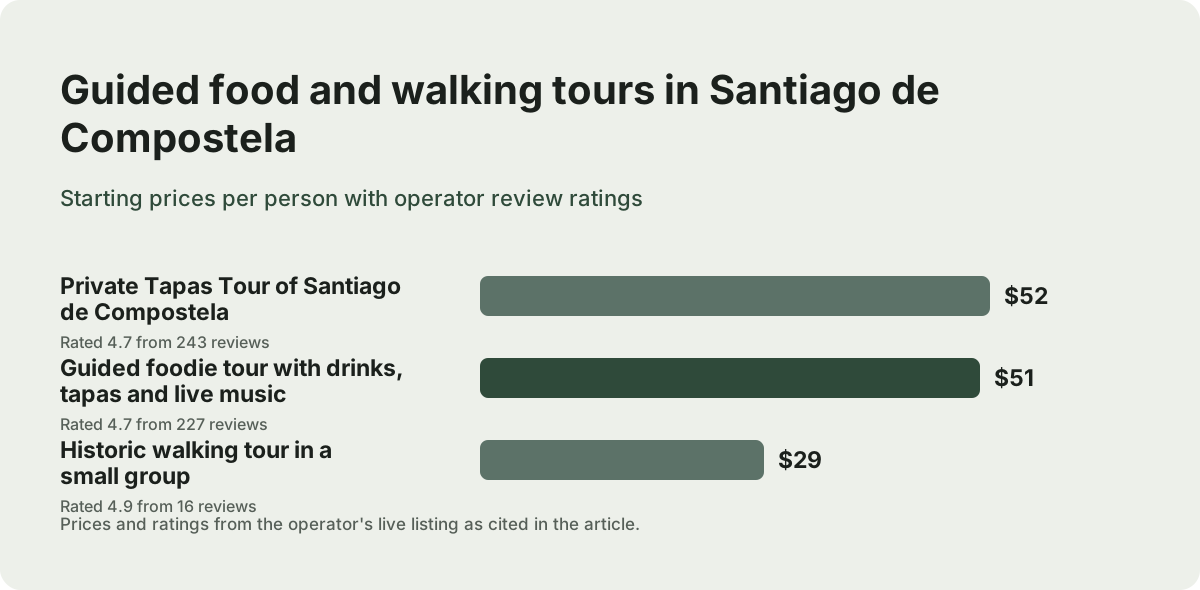
Trying all of this in one evening is exactly what a guided tapas tour is for, and the city has a strong one. The Private Tapas Tour of Santiago de Compostela runs from $52 per person and is rated 4.7 from 243 reviews on the operator's live listing; it moves through several old-town stops with the guide choosing the dishes. Check availability.
If you would rather walk first and eat later, the combination works well: a historic walking tour in a small group (from $29 per person, rated 4.9 from 16 reviews) covers the old town's architecture and legends in the morning, leaving the afternoon free for the market and the tapas crawl.
Where To Eat Galician Food In Santiago de Compostela
Eat tapas on Rua do Franco and the lanes around it, just south of the cathedral; sit-down Galician dinners in the restaurants off Praza do Obradoiro and Rua da Raíña; and shop-and-graze at the Mercado de Abastos, the city's working food market a five-minute walk east of the old town. The old town is small enough that any restaurant you book will be within ten minutes' walk of the cathedral, and lunch, not dinner, is when locals eat their biggest meal.
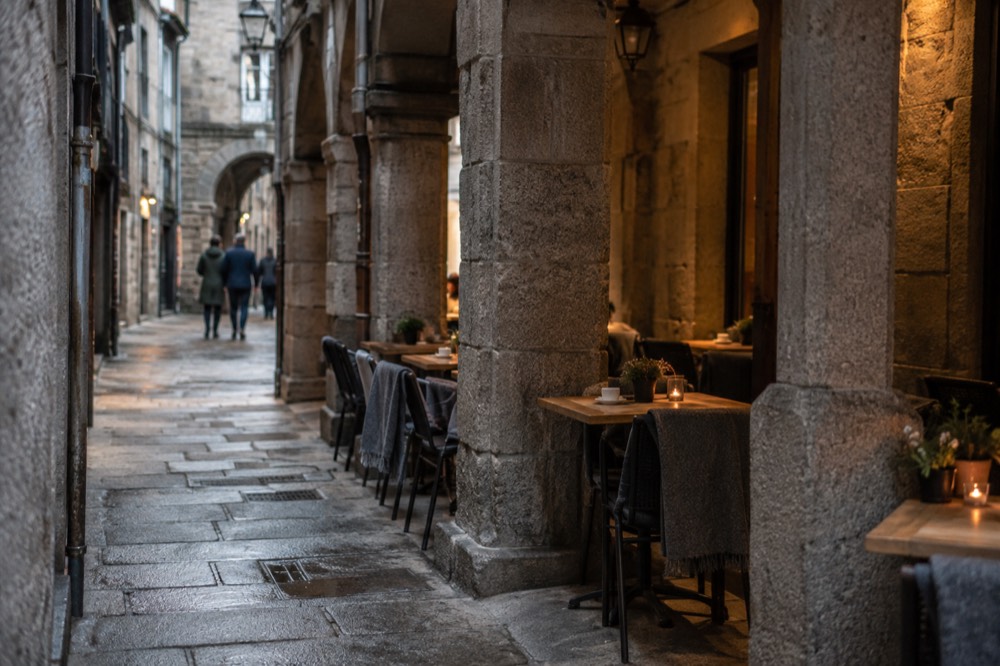
Rua do Franco is the historic pilgrim eating street: it runs directly away from the cathedral's west front and has fed arriving pilgrims for centuries. It is touristy in the best sense, packed with tabernas serving pulpo, empanada and grilled fish, and the parallel and crossing lanes hold the quieter places locals actually use. Rua da Raíña and the streets around Praza das Praterías hold more formal seafood restaurants where the catch of the day is chalked up. Our full restaurant-by-restaurant breakdown lives in where to eat in Santiago de Compostela, and the Mercado de Abastos guide covers the market in detail.
Timing matters more than address. Galicians eat lunch between 14:00 and 16:00, and many kitchens close entirely between lunch and dinner, with dinner service starting late in the evening rather than at the hour northern Europeans expect. Arriving at a restaurant early in the evening hungry is the classic visitor's mistake; the fix is tapas in a bar, which run continuously, or the market in the morning. The market's own opening hours should be checked on the venue's own site before you plan a visit around them, as we have not verified current hours in this guide. Fixed-price pilgrim-style menus, typically three courses plus wine or water, appear across the Camino; how they work is explained in our average cost guide to walking the Camino.
A tapas tour solves the first-night problem neatly. You arrive, you do not yet know which bar does the best pulpo, and a guide makes the decisions for three hours. The guided foodie tour with drinks, tapas and live music is another strong option, from $51 per person and rated 4.7 from 227 reviews on the operator's live listing, blending the food crawl with local music.
Tapa, Ración Or Menu: How Galicians Actually Order
A tapa is a small portion that arrives free or cheap with a drink in many bars; a ración is a full plate of one dish, ordered to share at the table; and a menu del día is a fixed lunch menu of first course, second course, bread, drink and often dessert, served mid-afternoon. Ordering in Santiago de Compostela means choosing between these three formats before you choose the dish, and the difference is mostly size and price, not the food itself.
The practical rhythm for an evening is the tapeo: bar to bar, a drink and a tapa in each, moving on when the plate is empty. Standing at the bar is normal and cheaper; sitting at a table usually adds a small premium and table service. A ración is what you order once you have found the dish you want more of: half a kilo of pulpo, a plate of clams, a wedge of empanada. Raciones arrive with plates and cutlery for the whole table and are meant to be shared, which is why groups of pilgrims end up ordering five or six of them and eating family style.
| Format | What you get | When to order it |
|---|---|---|
| Tapa | Small single-bite to few-bite portion, often with a drink | Evenings, bar to bar, standing at the counter |
| Media ración | Half a full plate of one dish | Two people, one or two dishes |
| Ración | Full plate of one dish, shared | A settled table of three or more |
| Menu del día | Fixed first course, second course, bread, drink, often dessert | Lunch, usually mid-afternoon, weekdays |
| Menu peregrino | Pilgrim-style fixed menu with local dishes | Along the Camino routes into the city |
| Queimada show | A flaming Galician punch ritual with tasting | Evenings, as a booked experience |
The queimada row in that table is not a restaurant format but an experience, and it is worth explaining because it sits between food and folklore. Queimada is a punch of aguardiente, sugar, lemon peel and coffee beans, set alight while a Galician spell, the conxuro, is recited to drive away evil spirits. You can see it performed live as a booked evening experience: the Queimada Experience Show and Tasting runs from $17 per person, rated 4.4 from 69 reviews on the operator's live listing.
One more ordering habit worth knowing: asking for the house wine, vino de la casa, by the short glass is standard, cheap and usually local. Water is served by the bottle, coffee comes after dessert rather than with it, and the bill arrives only when you ask for it. None of this is written down anywhere; it is just how the city works.
Albariño And Galician Wine: What To Drink With It
Albariño, a crisp white from the Rias Baixas wine country around the town of Cambados, is the wine Galicia is famous for and the default pairing for octopus and shellfish in Santiago de Compostela. Alongside it sit Godello, a fuller white from Valdeorras, and Mencía, Galicia's red, plus Ribeiro, a blended white with a long history. Albariño territory itself, the wineries around Cambados, is a day trip from the city with full-day tours from about $54 per person.
Albariño is the one to know. It is grown on pergola-trained vines in a wet Atlantic climate, which gives the grape its high acidity and citrus and stone-fruit character, and it is made to be drunk young with seafood. The Rias Baixas denominación de origen sits south and west of the city, centred on Cambados, and a vineyard visit there is one of the most popular food-focused day trips from Santiago de Compostela. Our dedicated Albariño wine guide covers the grape and the region in depth.
| Wine | Grape or blend | Region | Style and pairing |
|---|---|---|---|
| Albariño | Albariño | Rias Baixas | Crisp, citric, saline; octopus and shellfish |
| Godello | Godello | Valdeorras | Fuller, textured white; fish in sauce, cheese |
| Mencía | Mencía | Ribeira Sacra, Bierzo | Fresh, medium red; pork, beef, empanada |
| Ribeiro | Treixadura-led blend | Ribeiro | Traditional blended white; everyday meals |
| Licor de hierbas | Herb liqueur | Galicia-wide | Digestif, often complimentary after meals |
The classic winery day trip is the excursion to Rias Baixas with a winery visit and an optional mussel-boat cruise, from $54 per person and rated 4.8 from 322 reviews, a full day that combines a vineyard with a boat through the mussel rafts of the Arousa estuary. For a coastal variation, the Rias Baixas tour to Arousa Island, Combarro and the mussel boat runs from $45 per person and is rated 4.7 from 30 reviews, adding the stone granaries and old fishing quarter of Combarro. Other pages covering the same trip are gathered on Santiago de Compostela Travel Guide.
Food Day Trips From Santiago de Compostela
The strongest food day trips from Santiago de Compostela are the Rias Baixas winery and mussel-boat tours to the south, the coastal run west to Fisterra, Muros and Carnota where the fishing villages and the long sandy Carnota beach sit, and the Sil-river and Ourense route inland, where the hot-spring town and the canyon country of Ribeira Sacra make a very different table. All are full-day trips of roughly eight to ten hours, priced between about $45 and $75 per person depending on the itinerary.
The west-coast run is the one that combines food and the biggest scenery. The Finisterre, Costa da Morte, Ézaro, Muros and Carnota tour from $60 per person (rated 4.6 from 229 reviews) follows the Costa da Morte, the Coast of Death, past lighthouses and shipwreck coves to Fisterra, the cape the Romans believed was the end of the world, with stops in the old port town of Muros and at Carnota, which holds one of the longest beaches in Galicia. The fishing ports along this coast are where the octopus and the percebes in the city's restaurants actually come from; the background is in our Costa da Morte guide.
| Day trip | Food angle | Trip style | From price |
|---|---|---|---|
| Rias Baixas winery and mussel boat | Albariño winery, mussels off the boat | Full day, wine-led | $54 per person |
| Arousa, Combarro and mussel boat | Mussels, village bars, stone old quarter | Full day, coastal | $45 per person |
| Finisterre, Ézaro, Muros and Carnota | Fishing ports, beachside lunches | Full day, coast | $60 per person |
| Ribeira Sacra cruise, monasteries and Ourense | Canyon wines, hot-springs town | Full day, inland | $68 per person |
| Lugo and Cathedrals Beach | Roman walls, coastal rock arches | Full day, mixed | $75 per person |
The inland option is the surprise. The Ribeira Sacra, the Sacred Riverbank, is a system of river canyons where grapes grow on near-vertical slopes and monasteries line the Sil river; the cruise-and-Ourense tour from $68 per person (rated 4.6 from 166 reviews) includes a river cruise through the canyons and time in Ourense, a thermal town with its own food tradition. Ourense's hot springs get their own write-up in our Ourense hot-springs guide, and the wider regional picture is in the Galicia travel guide.
Markets, Bakeries And Food Souvenirs In Santiago de Compostela
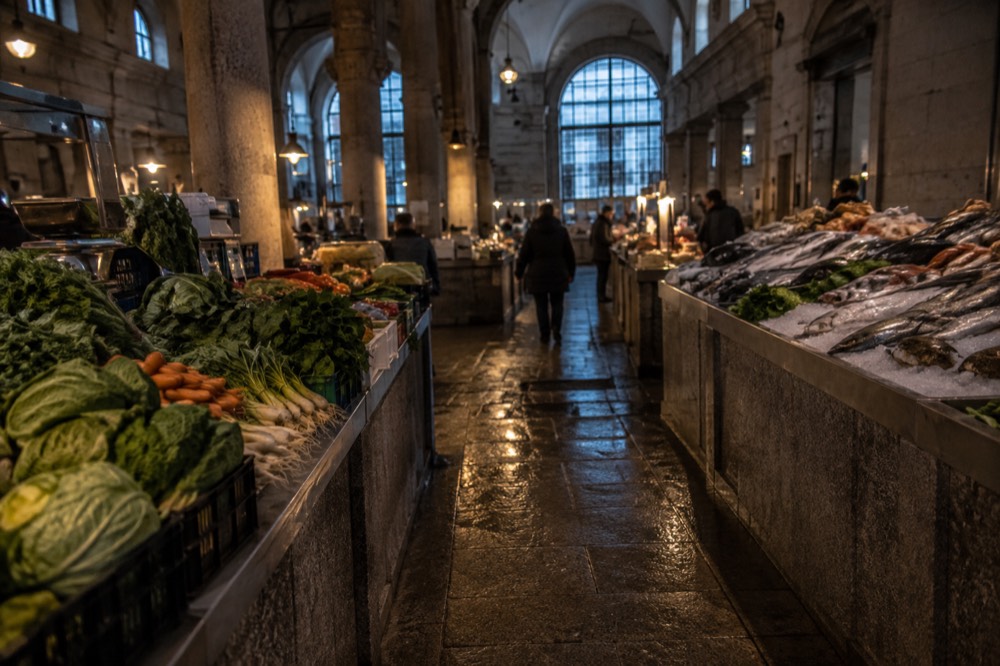
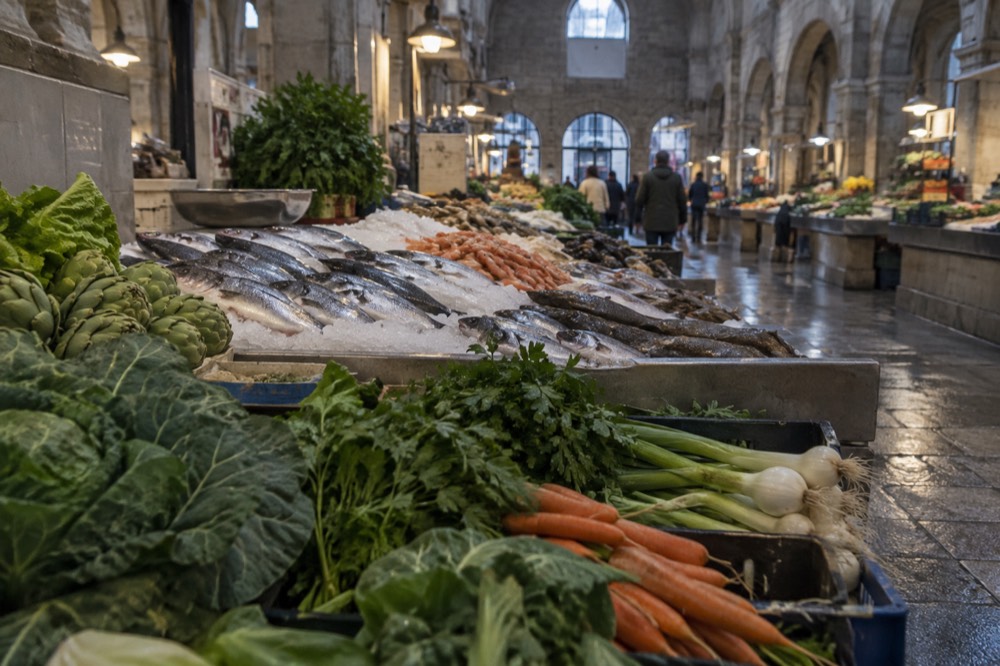
The Mercado de Abastos is the city's working food market and the best single place to understand Galician ingredients: stallholders sell the fish, octopus, peppers, cheeses and Tetilla, and several bars around it will cook what you buy for a small fee. Beyond the market, the old town's bakeries carry Tarta de Santiago, and cheese, tinned seafood and Albariño itself are the three souvenirs that travel well and say something about where they came from.
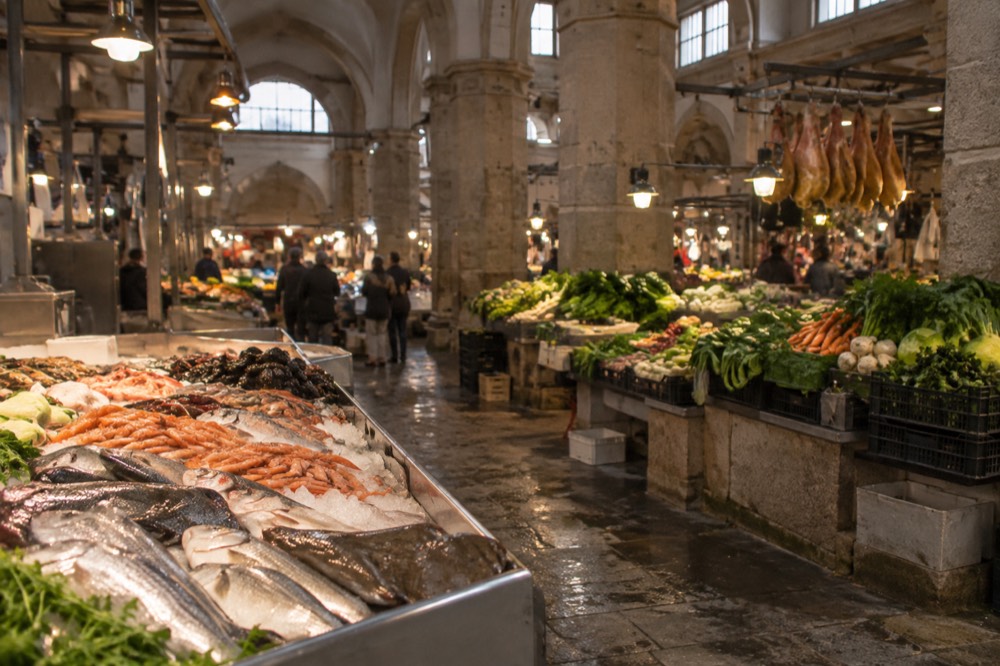
The market is where the restaurant kitchens source, and the cook-what-you-buy arrangement around it is a genuinely local way to eat: buy octopus or scallops at a stall, take them to a participating bar nearby, and pay a small per-dish fee to have them cooked. Current market opening hours should be checked on the venue's own site, as we have not verified them for this guide; the market is traditionally a daytime, weekday-and-Saturday institution rather than an evening one. The full detail is in our Mercado de Abastos guide.
| Souvenir | Why it works | Where to buy |
|---|---|---|
| Tarta de Santiago in a tin | Travels well, the city's signature sweet | Old-town bakeries, airport shop |
| Tetilla and cured cheeses | Vacuum-packed, holds for days | Market cheese stalls, delicatessens |
| Tinned Galician seafood | Mussel, octopus and scallop conservas, a Galician speciality | Delicatessens, market stalls |
| Albariño or Mencía bottles | The region's own wines, widely available | Wine shops, supermarkets, wineries |
| Pimenton and olive oil | The seasoning behind pulpo a la gallega | Market spice stalls |
| Coffee liqueur or orujo | Digestif tradition, small-bottle friendly | Liquor shops, delicatessens |
For eating on a strict budget, the market and the empanada wedge are the answer: a couple of euros of market produce, bread and cheese eaten in the Alameda park does more for the purse than any restaurant, and the pilgrim menus keep a full cooked lunch within reach. Our Santiago de Compostela on a budget guide goes deeper on the numbers.
When Food Is The Reason To Visit: Festivals And Seasons
The two dates that matter for eating in Santiago de Compostela are 25 July, the Feast of Saint James, when the whole city fills with events, and the autumn and winter months, when lacón con grelos and the hot stew cooking come into season and the visitor crowds drop away. Summer brings the crowds and the best festival atmosphere; late autumn and spring bring the hearty dishes and the city to yourself.
The Feast of Saint James on 25 July is the city's biggest annual celebration, marked by a pontifical mass, processions, fireworks, concerts and folk events, and the bars and terraces around the old town run at full pitch. The full programme and its meaning are covered in our Feast of St. James guide. Note that 2027 is the next Holy Year, the Xacobeo, opening with the Holy Door on 31 December 2026, so the 2027 festival falls in a year of maximum crowds; the planning implications are in our best time to visit guide and the Holy Year 2027 explainer.
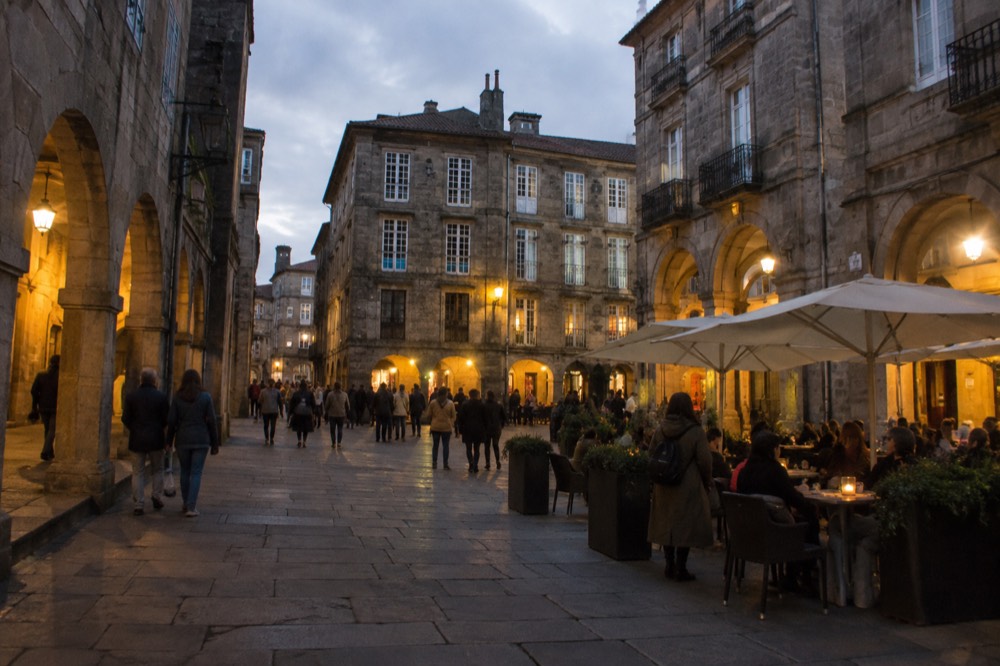
Whatever the season, the eating plan is the same: market in the morning, tapas at dusk, a table for the pulpo. Santiago de Compostela's food is the part of the trip that follows you home, in tins, in tarts and in a sudden need to find octopus wherever you live next.
Common Questions About Galician Food In Santiago de Compostela
What is the most famous Galician food?
Pulpo a la gallega, boiled octopus served on a wooden plate with sliced potatoes, olive oil and paprika, is the dish Galicia is most famous for, and it appears on virtually every menu in Santiago de Compostela.
Where should I eat tapas in Santiago de Compostela?
Rua do Franco, the historic pilgrim eating street running south from the cathedral, and the lanes around it hold the densest concentration of tapas bars; the Mercado de Abastos area is the daytime alternative, and our where-to-eat guide breaks the city down by neighbourhood.
What wine goes with Galician food?
Albariño, the crisp white from the Rias Baixas region around Cambados, is the classic pairing for octopus and shellfish; Mencía is the local red for pork and stews, and both are available by the glass in old-town bars.
How much does a food tour in Santiago de Compostela cost?
Food experiences on this site run from about $17 per person for a queimada show and tasting up to about $52 for the private tapas tour; exact prices are always shown on the operator's live listing before you book.
Is Galician food spicy?
Mostly not. The heat in the region comes from one famous gamble: Padrón peppers, which are usually mild but occasionally fierce, so part of the fun is never knowing which one you will get.
What food souvenir should I bring home from Santiago de Compostela?
Tarta de Santiago in a tin, vacuum-packed Tetilla cheese, tinned Galician seafood such as mussels or octopus, and a bottle of Albariño travel well and all say something specific about the region they came from.