Vigo Spain: A Day Trip Guide From Santiago de Compostela
Vigo is Galicia's biggest Atlantic port, an hour or so by train from Santiago de Compostela, and the gateway to the Cies Islands and the Rias Baixas.
Short answer
Vigo Spain sits on the southern shore of the Rias Baixas about an hour from Santiago de Compostela by direct train. Most visitors combine the old town and the seafood around Oyster Street with a boat trip or a Rias Baixas winery excursion, and organized tours from Santiago start at $45 per person.
Vigo is the largest city on Galicia's Atlantic coast, an hour or so by direct train from Santiago de Compostela, and it anchors the southern shore of the Rias Baixas, the drowned river valleys that define this stretch of Spain. Where Santiago de Compostela is granite, pilgrims and Baroque facades, Vigo is working port, canneries and oyster stalls. The two cities make a natural pairing for anyone based in the cathedral city with a spare day. This guide covers how the trip works, which tours run there from Santiago de Compostela, what the Cies Islands add, and what the day realistically costs.
Santiago de Compostela Travel Guide editors flag one thing up front: the numbers on this page come from the operator listings current at writing, and the transport notes reflect the ranges published by the rail references on file. Prices on live listings move with season and demand, so treat every figure here as the starting point of a check, not the last word.
Where Is Vigo Spain And Why Visit From Santiago de Compostela?
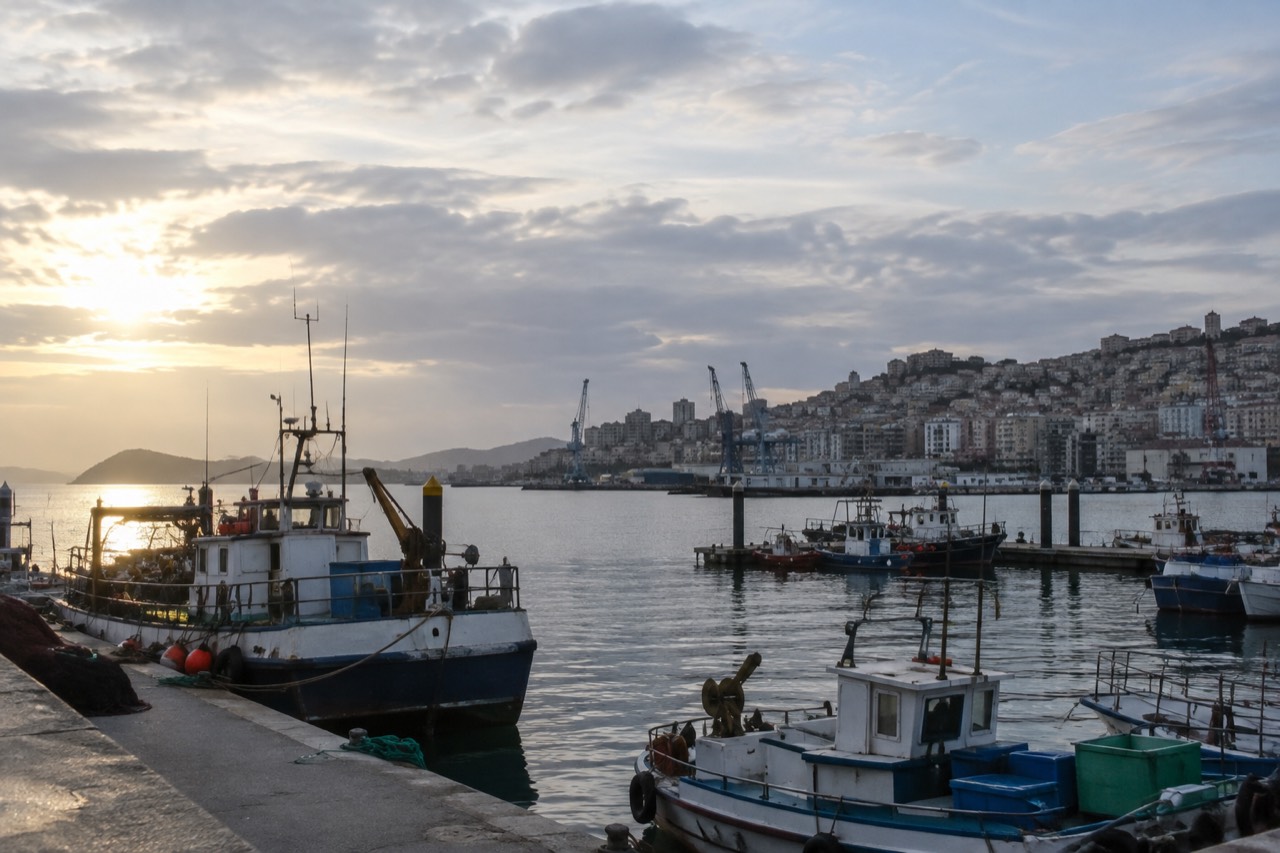
Vigo is a port city on the south side of the Ria de Vigo, one of the Rias Baixas inlets on Galicia's west coast, roughly an hour from Santiago de Compostela by direct train. It is Galicia's main fishing and cruise port, the base for boats to the Cies Islands, and the seafood capital of a region that takes its seafood seriously. The old town climbs the hillside above the harbor, and the city center is compact enough to walk in a day.
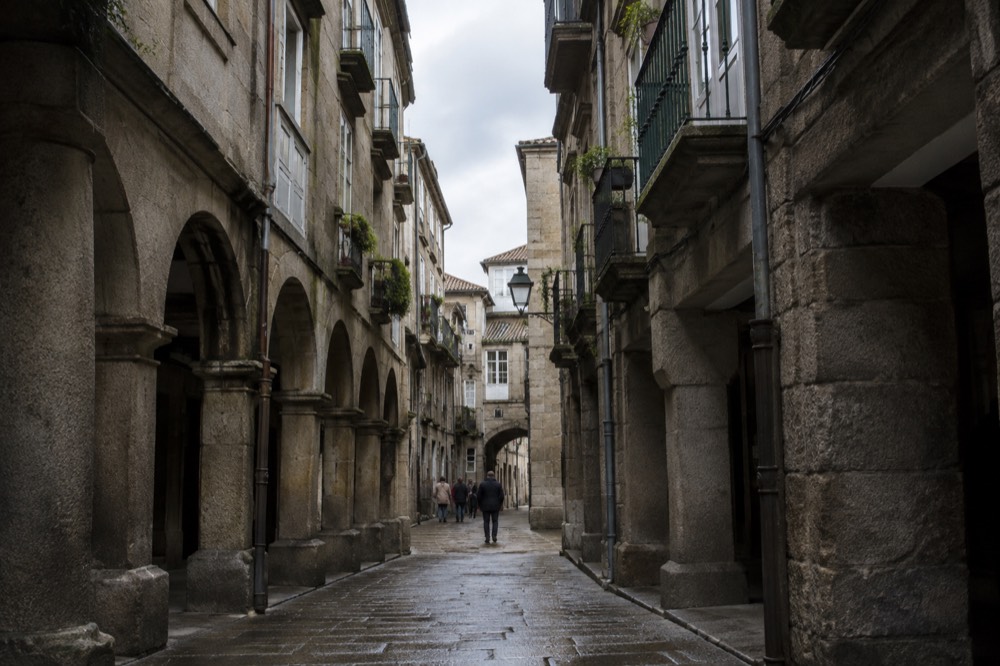
That compactness is the reason the trip works so well. Santiago de Compostela is small, and by the third or fourth day many visitors want a change of register without a change of hotel. Vigo supplies it. The contrast is architectural as much as anything: Santiago de Compostela's UNESCO-listed Old Town, inscribed in 1985, is a Baroque pilgrimage city, while Vigo's Casco Vello is a grid of narrow granite streets built around fishing and canning money.
The city also functions as a hub. The Rias Baixas wine country around Cambados, the mussel rafts of the Arousa estuary, and the Cies Islands offshore all orbit Vigo's port, and several full-day excursions from Santiago de Compostela pass through or near it. For a fuller picture of the region, our Galicia travel overview and the Rias Baixas wine and Cambados guide cover the wider territory.
How Do You Get From Santiago de Compostela To Vigo?
The simplest route from Santiago de Compostela to Vigo is a direct regional train, with the journey taking roughly one hour, per the rail references on file. There is no need to change trains, and both stations are city-center stations, so the transfer from Santiago de Compostela's old town to Vigo's harbor is short at both ends. Organized tours from Santiago de Compostela run there as full-day excursions by road.
The details below are confirmed: Santiago to Vigo is a direct regional service of roughly one hour, Santiago to A Coruna is a short hop, and Santiago to Madrid is a three-to-four-hour high-speed run. Those are ranges, not timetabled minutes: exact journey times shift with the service, and the current timetable should be checked before locking a day around a specific departure.
| Train route from Santiago de Compostela | Service type | Typical journey time |
|---|---|---|
| Santiago de Compostela to Vigo | Direct regional / media distancia | roughly 1 hour |
| Santiago de Compostela to A Coruna | Direct regional / high speed | a short hop |
| Santiago de Compostela to Madrid | Direct AVE / Avlo high speed | roughly 3-4 hours |
For anyone weighing Vigo against other day trips, the same rail spine serves the other candidates. A Coruna sits at the end of a short hop to the north, and Pontevedra lies between Santiago de Compostela and Vigo on the way south, which makes it possible to combine stops on a self-drive day. The A Coruna day trip guide and the Pontevedra day trip guide run through those alternatives.

One planning note for anyone flying out the same week: the airport bus situation in Santiago de Compostela is in transition. As of late September 2026 the santiago.es transport page still lists Tussa line 6A at 1 EUR to the driver, but a new Monbus contract with a fare around 6 EUR is expected to take over by December 2026, so treat the airport fare as subject to change. Our airport-closure answer page carries the detail on the 2026 flight situation.
Which Vigo And Rias Baixas Tours Run From Santiago de Compostela?
The strongest tour from Santiago de Compostela into Vigo's home waters is the Rias Baixas excursion with winery and optional mussel boat, from $54 per person and rated 4.8 from 322 reviews, which pairs a boat among the mussel rafts with Albarino wine country. A second full-day option runs from $53 per person at 4.7 from 482 reviews. All of these are full-day road trips, not city tours, so the tour gets you the estuary, not the old town lanes.
Both Rias Baixas excursions in the roster are built around the same logic: the inlets are the point. The Ria de Vigo and the neighboring Ria de Arousa are where Galicia grows its mussels on floating raft platforms, and where the Albarino grape ripens within sight of salt water. A self-guided train day in Vigo city can't reach the rafts, which is the practical argument for taking an organized excursion instead of, or as well as, the train.
| Tour from Santiago de Compostela | Decision name | Price | Rating | Duration |
|---|---|---|---|---|
| Excursion to Rias Baixas with Winery, optional mussel boat | Winery, Optional Mussel Boat | from $54 | 4.8 from 322 reviews | full day |
| Tour to Rias Baixas with Boat Trip and Winery | Boat Trip, Winery, Full Day | from $53 | 4.7 from 482 reviews | full day |
| Rias Baixas, Arousa Island, Combarro and Mussel Boat | Arousa Island, Combarro, Mussel Boat | from $45 | 4.7 from 30 reviews | full day |
The Arousa Island variant adds Combarro, the granite horreo village on the Arousa estuary, which has its own Combarro day trip guide on this site. Our dedicated tour page for the winery and mussel-boat excursion breaks down what the day includes, and live pricing and availability sit on the operator's live listing rather than on any figure printed here.
Should You Book A Tour Or Take The Train Yourself To Vigo?
Take the train if your day is about Vigo's old town, Oyster Street and the harbor, because the city is walkable and a direct service covers the journey in about an hour. Book an organized excursion if your day is about the water: the mussel rafts, the wineries and the Cies Islands need boats and driving legs that a city-center train arrival cannot supply. Many visitors split the week, one train day in the city, one tour day on the estuary.
Cost framing helps. The train is the cheap option by a wide margin, though our pack does not carry a verified Vigo fare, so check the operator's own fare table before budgeting. The Rias Baixas excursions run from $45 to $54 per person, which is a fair benchmark for a full guided day with transport from Santiago de Compostela included.
There is also a middle path worth naming: several food-and-wine experiences operate in Santiago de Compostela itself, from the tapas tour at $52 rated 4.7 from 243 reviews to the Queimada show at $17, and pairing a city food day with a separate Vigo train day covers both registers without a second full-day tour booking. For the specifics of eating in the cathedral city, the where to eat in Santiago de Compostela guide is the deeper resource.
What Should You Actually See In Vigo On Foot?
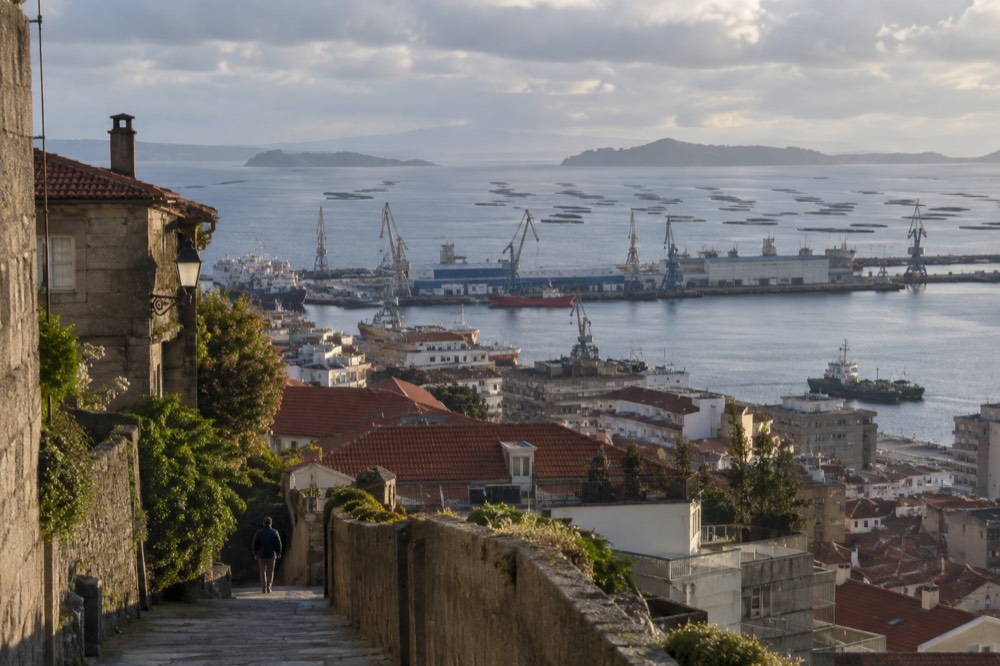
The core of a walking day in Vigo is the Casco Vello, the old town on the hillside behind the port, whose lanes run down to the seafood stalls of Oyster Street in the Praza da A Pedra area, then onward down to the waterfront promenade and the marina. The climb is real but short, the streets are granite, and the whole loop fits comfortably in half a day at a Galician pace.
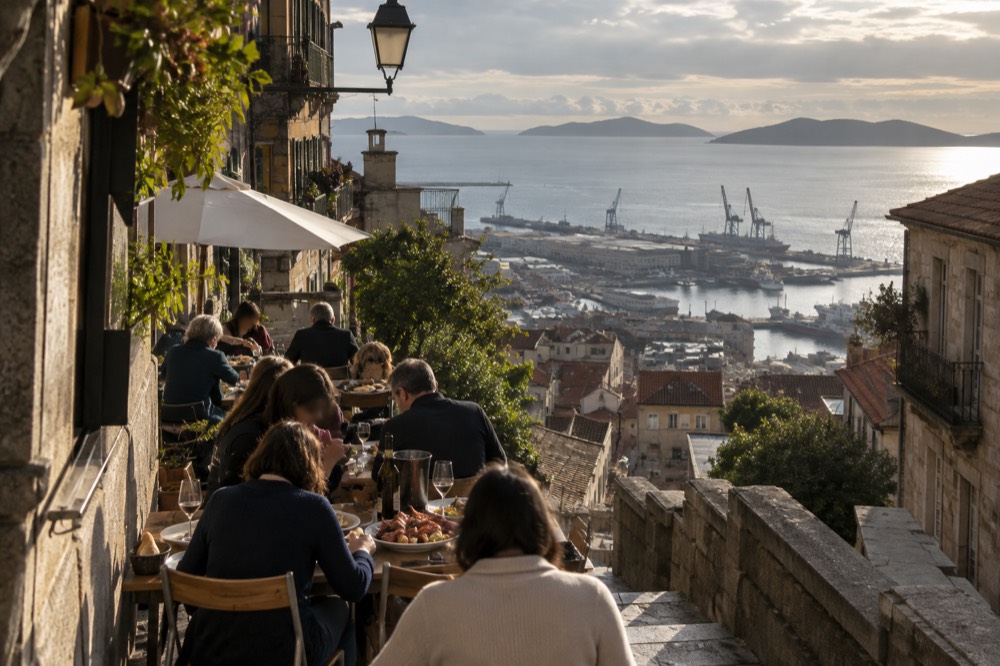
The Casco Vello is where the canning-city history shows. This was a town built on sardines and emigration, and the scale of the buildings says modest merchant money rather than aristocratic display. Oyster Street, Rua da Pedra, is the headline: flat oysters from the estuary are shucked at stalls in the open air, and the street's reputation rests on the Ria de Vigo beds themselves. Our pack carries no verified per-oyster or per-plate price, so check the stall boards on the day rather than trusting any figure quoted online.
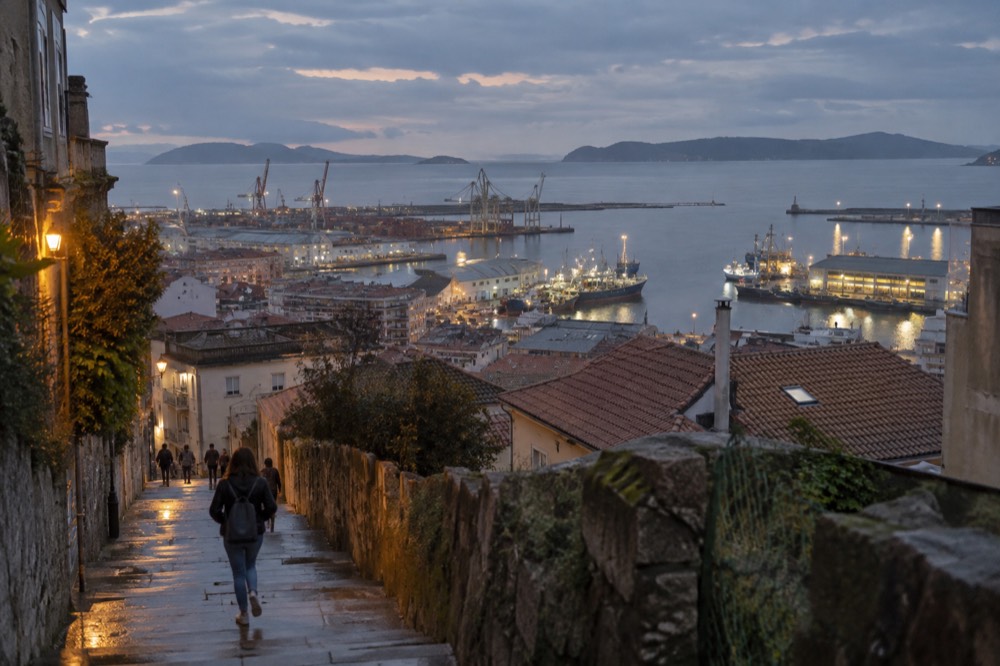
Below the old town, the harbor front runs along the working port. Cruise ships dock here, and the contrast between the terminal and the fishing fleet two berths over is Vigo in a single view. The funicular up to the Castro hillfort park gives the panorama: the estuary, the Cies Islands offshore, and the city stacked in amphitheaters.
A realistic walking sequence, with times as planning ranges rather than measurements:
| Stop on a Vigo walking day | What it is | Planning time |
|---|---|---|
| Casco Vello lanes | old town granite streets on the hillside | about an hour of slow wandering |
| Rua da Pedra, Oyster Street | open-air seafood stalls and bars | 45 minutes to an hour, longer with lunch |
| Waterfront promenade | marina and working port front | about 30 minutes end to end |
| Castro hillfort park | hilltop park over the estuary and islands | 45 minutes to an hour, plus the ride up |
Times are our editors' planning ranges for an unhurried day, not measured routes. Anyone deciding between this and other options in the region may find it useful to calibrate expectations first: Vigo is a working city, and visitors who want monumental architecture every step should weigh whether the estuary day is really their day.
Can You Visit The Cies Islands From Vigo?
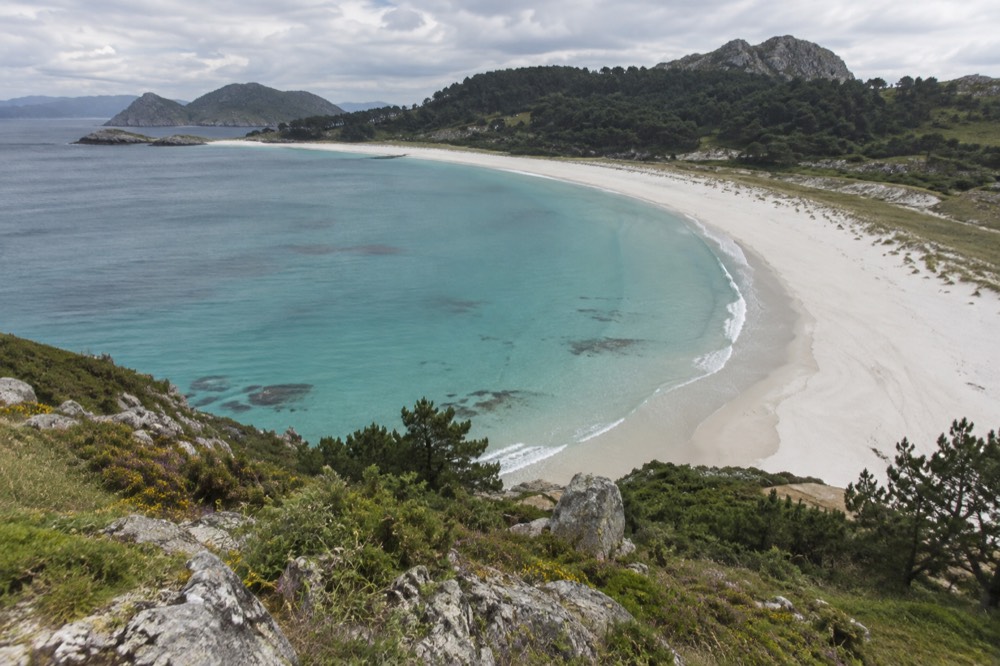
Yes, the Cies Islands sit just offshore from Vigo at the mouth of the Ria de Vigo, and a full-day visit from Santiago de Compostela runs from $101 per person, which carries no published rating. The islands are a protected maritime-terrestrial national park with white-sand beaches, and visitor numbers are capped, so advance booking matters more here than anywhere else in Galicia.
The Cies archipelago is the reason many people add Vigo to a Galicia itinerary at all. Its main beach, Rodas, is a white sandbar linking two islands inside a lagoon, and the islands' protected status means access is controlled. Our Cies Islands guide covers the practicalities in depth, including the booking question. Because the pack lists no rating for this product, we publish none.
Two cautions from our editors. First, the islands are a weather-dependent sailing, and ferries and tours can be suspended in rough Atlantic conditions, so keep a fallback plan. Second, a Cies day from Santiago de Compostela is a long day, since it stacks the transfer to the port on top of the sailing. If the islands are the priority, basing a night in Vigo itself is the more relaxed structure, and the two days in Santiago de Compostela itinerary shows how to carve the extra day out of a shorter trip.
Vigo Or Finisterre: Which Day Trip Fits Your Day Better?
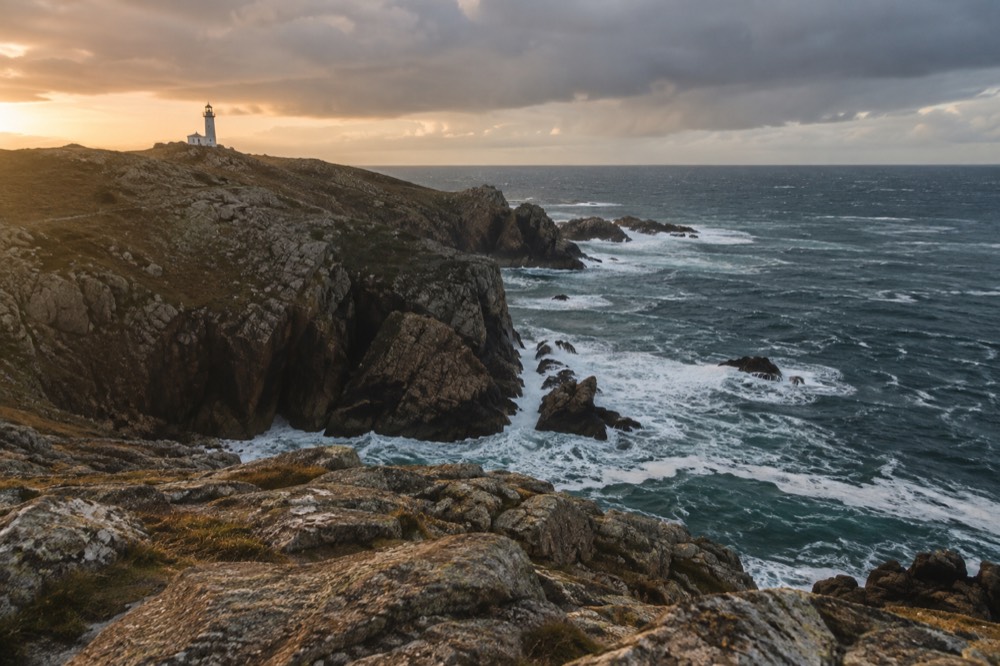
Vigo and Finisterre are opposite propositions: Vigo is a port city and an estuary day, reached by direct train in about an hour, while Finisterre is the Costa da Morte, the Atlantic end-of-the-world cape, reached only by road tour from Santiago de Compostela, with full-day excursions from $59 to $60 per person and the express half-day version from $45. Pick Vigo for seafood and boats among the mussel rafts, pick Finisterre for cliffs, lighthouses and the end of the ancient world.
The Finisterre options in our roster illustrate the spread. The full-day Costa da Morte excursions run from $60 at 4.8 from 860 reviews and from $59 at 4.7 from 2,312 reviews, both taking in Muxia and multiple Costa da Morte stops, while the half-day express runs from $45 at 4.4 from 50 reviews. The Finisterre day trip guide, the Muxia guide and the Costa da Morte guide detail the stops between them.
| Day trip from Santiago de Compostela | Best tour | Price | Rating | Character |
|---|---|---|---|---|
| Vigo and the Rias Baixas | Winery, Optional Mussel Boat | from $54 | 4.8 from 322 reviews | estuary, seafood, wine country |
| Cies Islands | Cies Islands Full-Day Visit | from $101 | no rating published | protected islands, sailing, beaches |
| Finisterre and Costa da Morte | Finisterre & Coast of Death | from $60 | 4.8 from 860 reviews | cliffs, lighthouses, capes |
| Finisterre and Muxia, express | Half-Day Express, Fisterra & Muxia | from $45 | 4.4 from 50 reviews | same coast, half the day |
There is no wrong answer between them, only a fit question. Pilgrims who have just walked into Santiago de Compostela often gravitate to Finisterre, the traditional zero-kilometer extension of the walk, while visitors who arrived by plane more often prefer the softer estuary day around Vigo. The express half-day version is the compromise when a trip has only one spare morning.
How Much Does A Vigo Day Trip From Santiago de Compostela Cost?
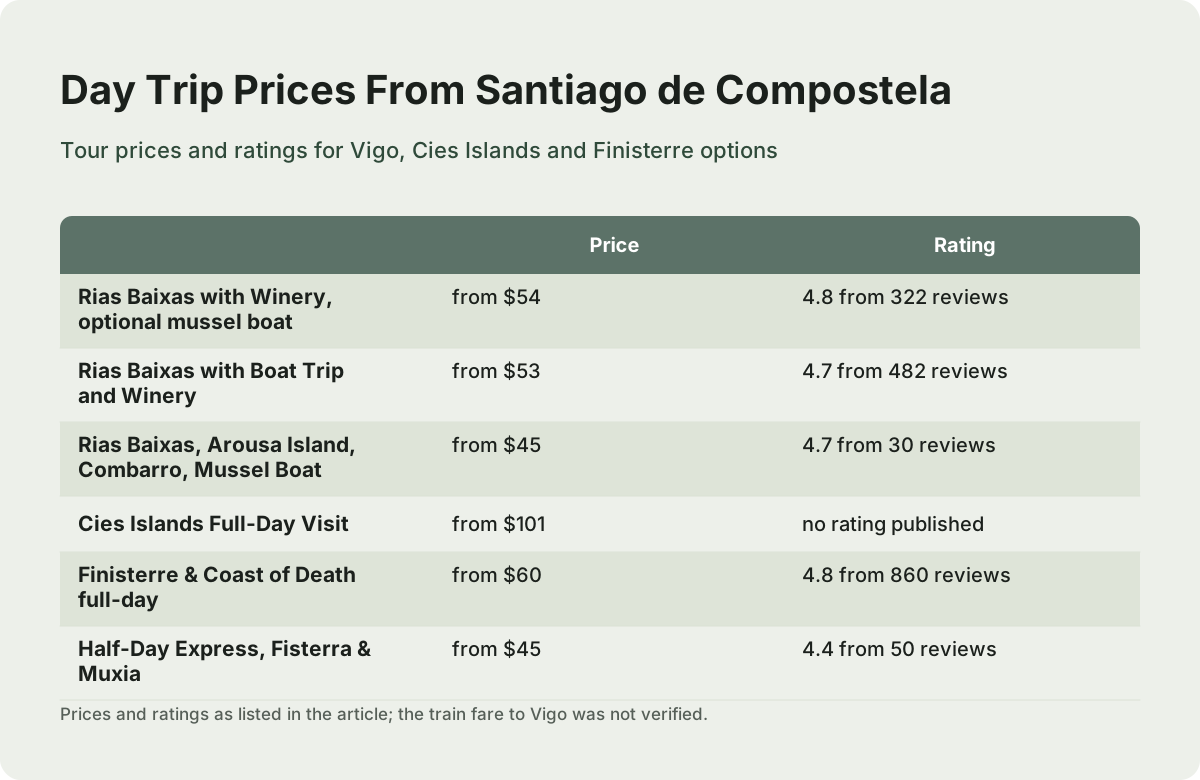
The tour-led day starts at $45 per person for the Arousa Island and Combarro excursion and runs to $54 for the winery and mussel-boat version, while the Cies Islands day is from $101, per the operator data on file. The independent train day costs the fare plus whatever is spent in Vigo itself, and no verified Vigo restaurant price band is available, so food budgets should be planned from the live menus, not from generic Spain figures.
The planning table below prices the day from the tour side, where our data is verified. Everything outside the tours is deliberately left as a range-free line, because printing a plausible-sounding oyster or menu price would be exactly the kind of invented figure this site does not publish.
| Cost element on a Vigo day | Verified figure or status |
|---|---|
| Arousa Island, Combarro and mussel boat tour | from $45 per person, rated 4.7 from 30 reviews |
| Rias Baixas winery tour, optional mussel boat | from $54 per person, rated 4.8 from 322 reviews |
| Rias Baixas boat trip and winery tour | from $53 per person, rated 4.7 from 482 reviews |
| Cies Islands full-day visit | from $101 per person, no rating published |
| Train fare Santiago de Compostela to Vigo | check the operator's own fare table, not in our pack |
| Food and drink in Vigo | plan from live menus, no verified band |
For the wider budget picture of a Galicia stay, the Santiago de Compostela on a budget guide is the sibling page, and it frames the same honesty rule: plan from live prices, not from remembered ones. Santiago de Compostela has charged a municipal tourist tax since 1 October 2025, a surcharge on Galicia's tourist-stay tax running from 1 EUR per person per night in private albergues, campsites and tourist apartments up to 2.50 EUR in five-star hotels, for a maximum of 5 nights, with under-18s and stays in Xunta-run public albergues exempt.
When Is The Best Time Of Year For A Vigo Day Trip?
AEMET's climate data for the Santiago de Compostela station shows a temperate oceanic pattern, wet year-round, wetter from October to March and driest in July and August, and the coastal Vigo side follows the same Atlantic rhythm with maritime moderation. That makes late spring through early autumn the dependable window for the boat-dependent parts of the day, the mussel rafts and the Cies Islands, while the old town itself is a year-round walk.
The seasonal logic matters more here than in most of Spain because the Rias Baixas experiences, the boat among the rafts and the islands sailing, are the first things rough weather cancels. July and August are the driest months on the AEMET record, which also means they are the most crowded on the water. May, June and September sit in the shoulder, with fewer boats on the estuary and a real chance of fine sailing weather.
What Do You Do After The Day Trip Back In Santiago de Compostela?
Back in Santiago de Compostela, the evening options are the Cathedral complex, whose ticketing our dedicated Cathedral guide covers in detail, the old town lanes, and the specialty experiences in our roster, from the Secrets of Compostela night tour at $17 rated 4.9 from 74 reviews to a single massage treatment at $68 rated 4.8 from 193 reviews, which is the after-a-long-walking-day pick. The Cathedral museum and rooftops are ticketed separately from general entry.
The massage option is not a joke entry: it is in the roster precisely because a large share of this city's visitors arrive on foot after weeks of walking, and recovery treatments are a genuine category here. For the sightseeing side, the Cathedral guide covers what the ticket options include and what currently sits behind restoration scaffolding.
The night tour deserves a specific mention. The Secrets of Compostela walk at $17 is rated 4.9 from 74 reviews and fits the slot after a Vigo train returns, since it runs in the hours when the day-trip buses have gone and the granite lanes are at their most atmospheric. Visitors who prefer a free, tip-based introduction to the city can join GuruWalk's Essential Free Tour of Santiago de Compostela, rated 4.91 from 4,797 reviews, with no fixed price at all: Check availability
Common Questions About A Vigo Day Trip From Santiago de Compostela
Is Vigo worth a day trip from Santiago de Compostela?
Yes, if you want a change of register from the pilgrimage city: a working port, oyster stalls and the estuary. The direct train covers the journey in roughly an hour, and organized Rias Baixas excursions from $45 to $54 cover the water-based parts a train arrival cannot.
How do I get from Santiago de Compostela to Vigo without a car?
A direct regional train runs between the two city-center stations in roughly one hour, per the rail references on file, and organized full-day tours from Santiago de Compostela cover the estuary and winery areas by road. Exact timetables should be checked before the day.
What is Vigo Spain famous for?
Vigo is known as Galicia's main Atlantic fishing and cruise port, for the oyster stalls around Rua da Pedra, and as the embarkation point for the Cies Islands, the protected archipelago at the mouth of the Ria de Vigo. Its canning-industry old town is the other half of its identity.
Can you visit the Cies Islands on a day trip from Santiago de Compostela?
Yes. A full-day Cies Islands visit runs from $101 per person, with no rating published. Access to the protected islands is capped, so booking well ahead matters, and sailings are weather-dependent.
Should I choose Vigo or A Coruna for my day trip from Santiago de Compostela?
Vigo gives you the southern estuaries, oysters and the Cies Islands; A Coruna, a short train hop north, gives you an Atlantic-city seafront and a different Roman lighthouse story. Both work by rail; the excursions differ, with Rias Baixas tours running south and the Lugo and Cathedrals Beach tours running north.
Is a Vigo day trip good in rainy weather?
The old town walk survives rain, since the lanes are compact and the bars are dense, but the boat-dependent parts, the mussel rafts and the Cies Islands, are the first casualties of Atlantic weather. In the wetter October-to-March half of the year, keep the old town as the core and treat the water as a bonus.
For planning the rest of a Galicia stay, our answers on how many days to spend in Santiago de Compostela and on the best day trip from the city both help place a Vigo day inside a wider itinerary, and both sit in the answers section of this site.
Vigo In One Paragraph: The Editors' Verdict
Vigo earns its place on a Santiago de Compostela itinerary as the estuary day: the one excursion where the point is water, shellfish and Albarino rather than granite and relics. Take the train for the city itself, book the winery and mussel-boat excursion for the Rias Baixas at $54 from and 4.8 rated from 322 reviews, and reserve the Cies Islands early if the beaches are the priority. It is the best seafood-anchored day trip available from the cathedral city.
The honest limitation is that Vigo is a working port first and a picture postcard second. Travelers expecting a second Santiago de Compostela, all monumental facades and quiet plazas, will find the city scruffier and livelier than that. That scruff is the point. Galicia's coast built itself on these harbors, and a week in the region that never leaves the inland granite only tells half the story, which is why Santiago de Compostela Travel Guide spends as many words on the Rias Baixas as it does on the Old Town.