Monte do Gozo In Santiago de Compostela: The Hill Where Pilgrims First See The Cathedral
Monte do Gozo, the Hill of Joy, is where centuries of Camino pilgrims have first caught sight of the towers of the Cathedral of Santiago de Compostela. It is a working part of the Camino rather than a polished monument, and this guide explains what is actually up there, how it fits into the pilgrim arrival, and what to combine it with in the city below.
Short answer
Monte do Gozo is a low hill on the eastern edge of Santiago de Compostela where pilgrims walking the Camino de Santiago traditionally see the Cathedral for the first time. It holds a modern pilgrim monument, a large municipal albergue and wide views over the city, and most visitors spend under an hour here unless staying overnight.
Monte do Gozo is the hill on the edge of Santiago de Compostela where, for as long as anyone has been walking the Camino de Santiago, tired pilgrims have stopped, looked west, and seen the towers of the Cathedral for the first time. The name means Hill of Joy, and the emotion it names is not a marketing invention: the spot sits on the final approach of the Camino Francés, the most-walked Camino route, so this grassy rise is genuinely the last high point between a walker and the tomb of St. James in the city below. The Oficina del Peregrino's own figures show what that arrival still means in numbers, with a record 530,987 Compostela certificates issued in 2025, and a large share of those walkers crossed this hill first.
What Is Monte do Gozo In Santiago de Compostela?
Monte do Gozo is a low, open hill on the eastern approach to Santiago de Compostela, crossed by pilgrims on the final stage of the Camino Francés before they descend into the city. It is not a formal monument or a ticketed site: it is a piece of working pilgrim landscape, with a modern pilgrim monument at its top, a large municipal albergue for overnight walkers, and an open westward view across the city toward the Cathedral towers.
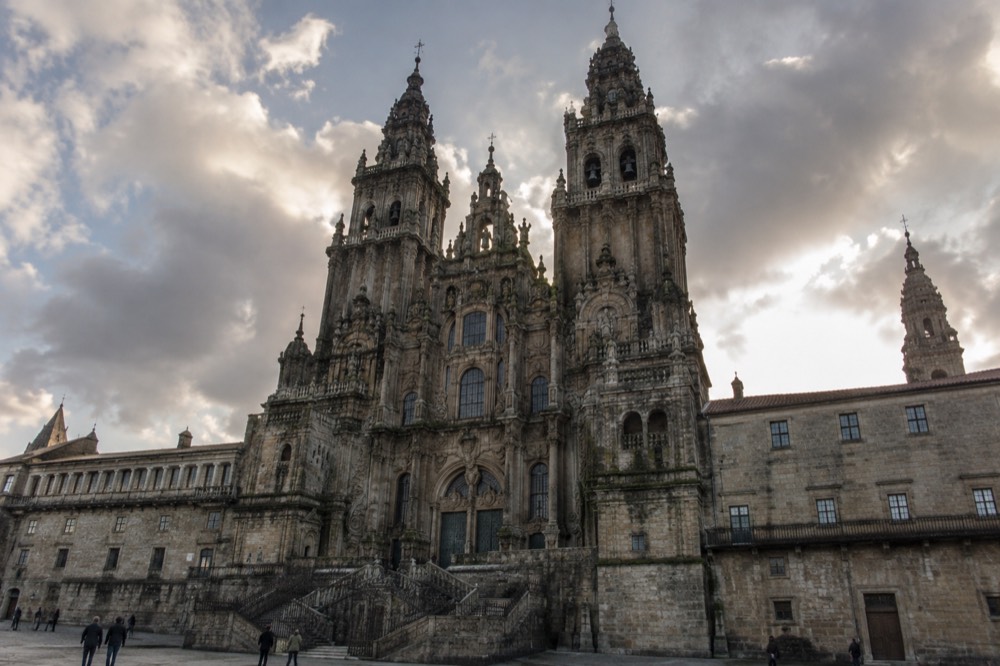
That last point is the whole reason the hill has a name and a reputation. Pilgrims have historically been able to pick out the Cathedral's towers and the Berenguela clock tower from the high ground here, and the moment of seeing them has been written about in pilgrim accounts for generations. The city itself recognises the hill as part of its pilgrim infrastructure rather than as a viewpoint attraction: it sits on the waymarked route, and the walkers you meet on it are usually on their last hours of a journey that, for many, started weeks earlier in France or elsewhere in Spain.
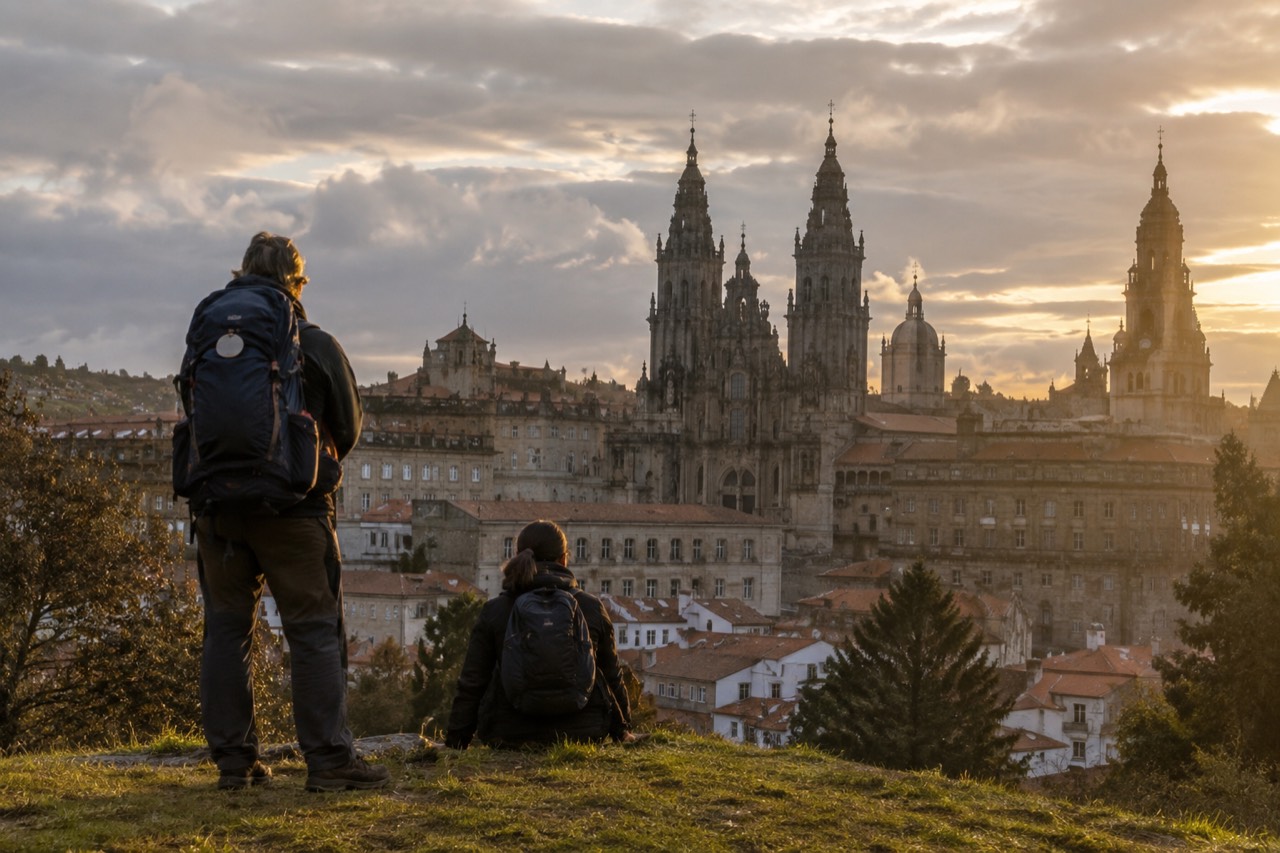
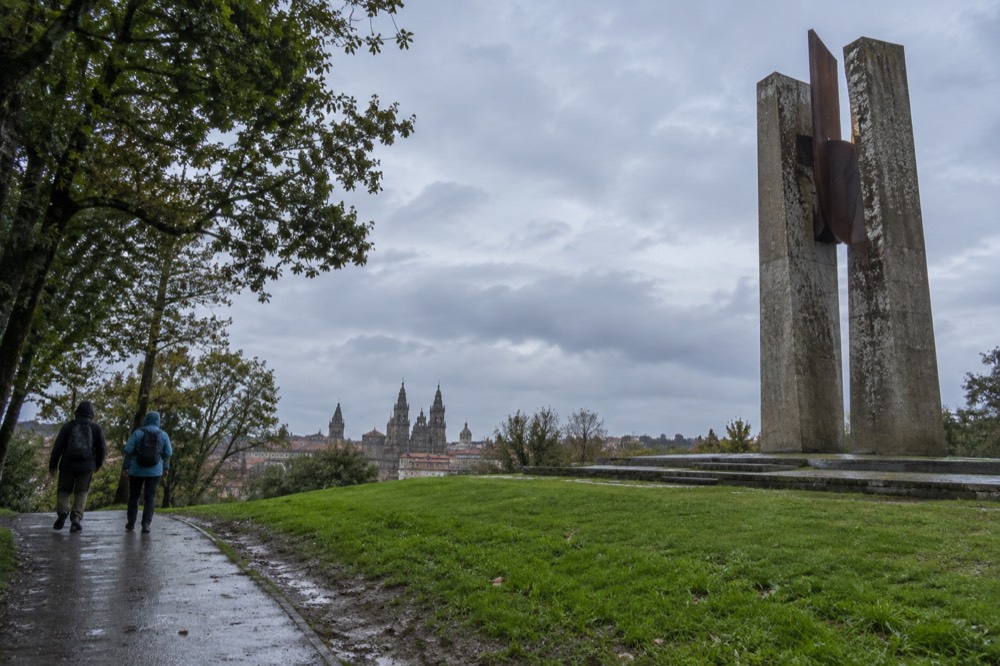
The hill is modest in every physical sense. There is no castle, no chapel at the summit and no visitor centre. What there is, in practice, is grass, eucalyptus and pine, a monumental concrete sculpture, the low white buildings of the albergue, and a broad horizon. On a clear evening the view over Santiago de Compostela, with the Cathedral ensemble dark against the sky, is one of the simplest and most affecting sights in Galicia, and it costs nothing.
Why Is The Hill Called The Hill Of Joy?
The Galician name Monte do Gozo translates as Hill of Joy, and the joy in question is the pilgrims': the hill marks the point on the approach to Santiago de Compostela where walkers traditionally see the Cathedral towers for the first time and know the walk is effectively done. The name is centuries old in the pilgrim tradition and refers to that emotional moment rather than to any event that happened on the hill itself.
Every generation of Camino walkers has stopped at roughly the same place for roughly the same reason. A walker who has covered the last 100 kilometres on foot, the minimum distance the Oficina del Peregrino requires for the Compostela certificate on foot, has usually spent the better part of a week getting here, and many have spent a month or more. The first sight of the destination from high ground gives that effort a visible endpoint, and pilgrim writing going back through the centuries records the pause, the cheering, the photographs and sometimes the tears.
It helps that the geography cooperates. Santiago de Compostela sits in a shallow basin, and the ground rises to the east of the city before dropping again toward the old town. A walker arriving on the Camino Francés from the east crosses that rising ground, and the natural line of sight runs straight over the rooftops to the Cathedral group on its own rise. The city's layout has changed enormously since the Middle Ages, but the towers are still tall enough, and the hill still clear enough, that the moment survives.
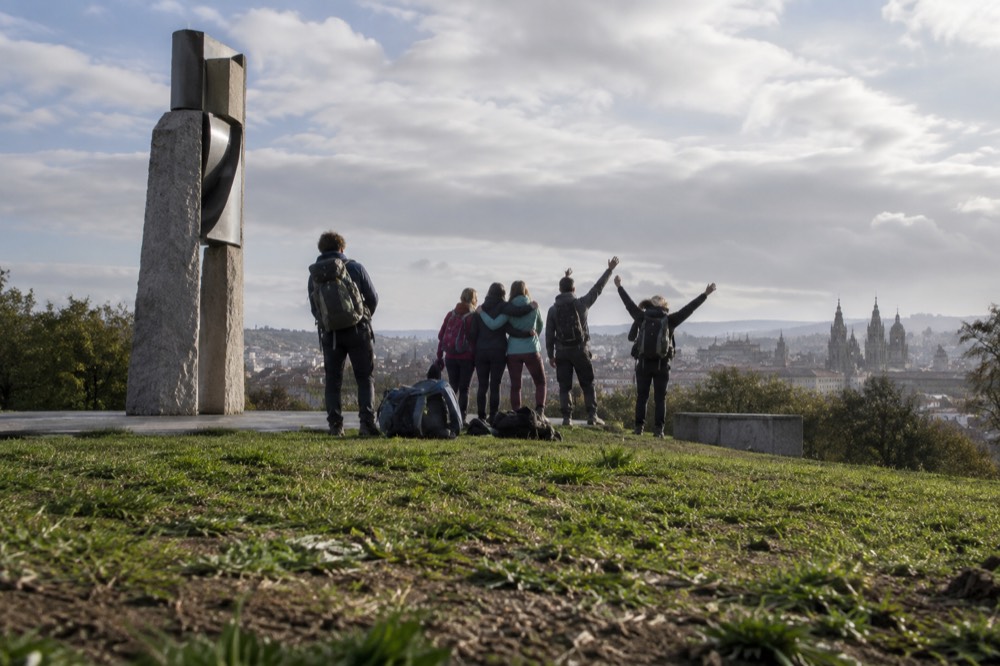
For modern pilgrims the joy is often shared rather than solitary. Groups who have walked together for days tend to arrive at the viewpoint at the same time, and the small crowd that forms most afternoons in peak season is part of what makes the place feel alive. An empty viewpoint is possible in winter, and it has a quieter appeal of its own.
What Can You See And Do At Monte do Gozo?
The main things to do at Monte do Gozo are to walk or pause at the west-facing viewpoint over Santiago de Compostela, look at the modern pilgrim monument that crowns the hill, and see the large municipal albergue complex that sleeps arriving pilgrims each night. There is no entry fee, no ticket and no set route: the hill is public open ground, and a visit can be as short as the time it takes to look at the view.
The viewpoint is the anchor. From the high ground you look across the whole spread of the city: the dense grey-stone mass of the old town, a UNESCO World Heritage listing since 1985, the green bowl of parks around it, and the newer districts beyond. The towers of the Cathedral of Santiago de Compostela dominate the old town, and on clear days the horizon beyond carries the hills of western Galicia. Sunset is the hour most photographers choose, when the low light picks out the stone of the old town and the sky behind the towers goes orange.
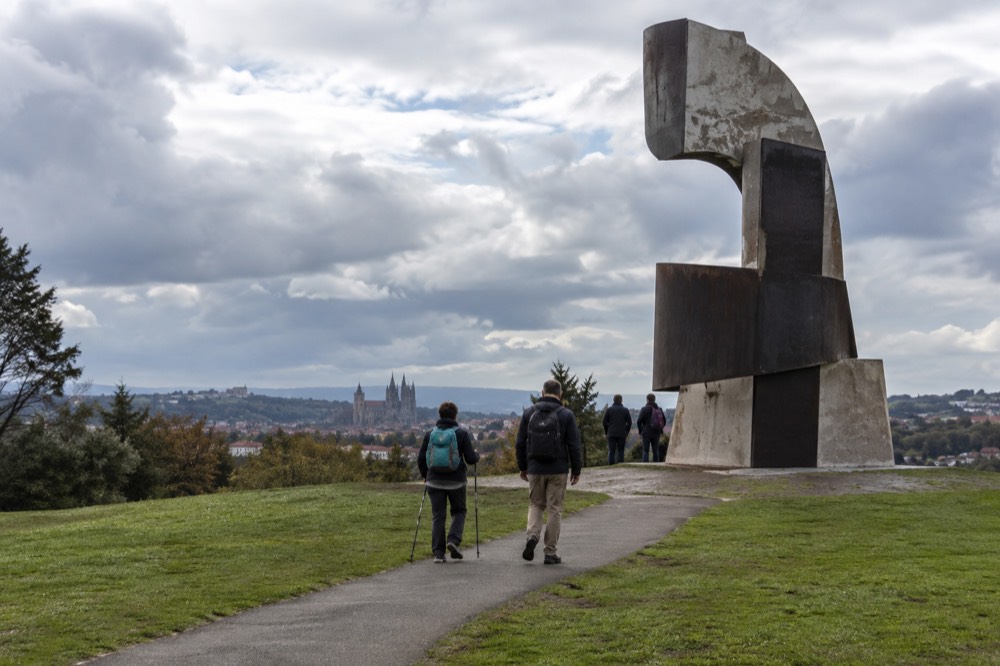
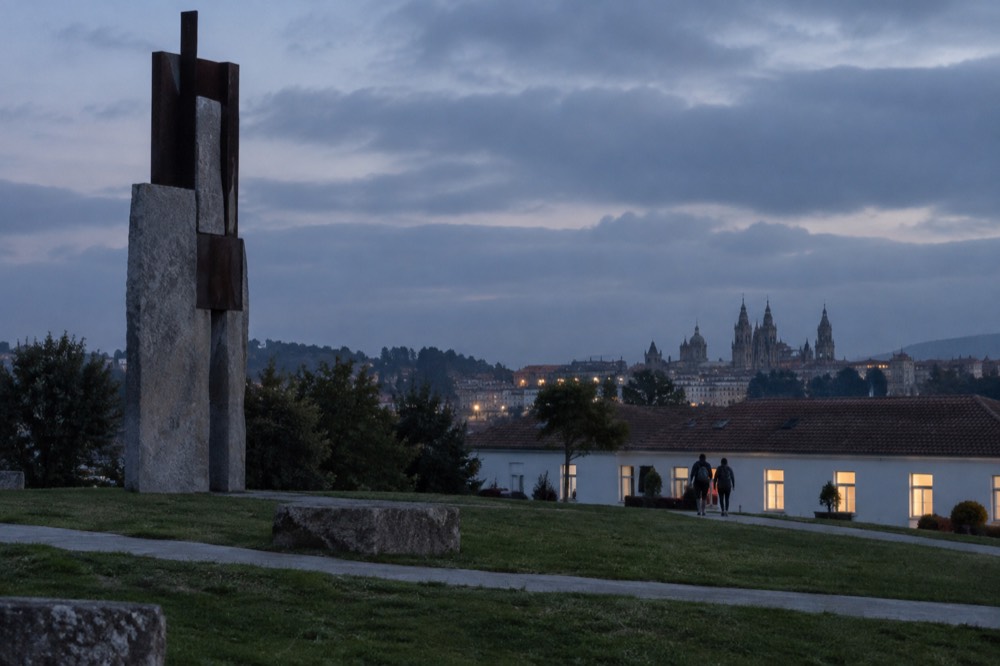
The pilgrim monument at the top is a large modern concrete and stone sculpture group that does not try to be ancient. It reads as what it is: a contemporary Galician statement about the pilgrimage, angular and slightly abstract, standing on the hill as a landmark that pilgrims aim for in the last hours of their walk. You can walk around it, under it and past it in a few minutes. It is a monument in the landscape rather than a museum piece, and nobody is selling you anything at its base.
The albergue is the third element, and it is the part most non-pilgrims underestimate in scale. Monte do Gozo can sleep hundreds of walkers a night in the busy season, and in a peak Holy Year summer it functions as an overflow valve for the entire city's pilgrim accommodation. Guests are usually assigned bunks, given a stamp in their credencial, and moved on toward the old town the next morning. If you are not staying there, you will still see its streams of walkers with backpacks heading down toward the city through the surrounding paths.
Beyond those three anchors, the hill is simply a pleasant place to be. Locals walk dogs here, families come for the air, and the surrounding woodland paths connect into longer walking routes. For a visitor based in the old town, the hill makes an easy half-day excursion on foot or a short hop by city bus or taxi, and it is one of the few places from which you can see the whole pilgrim city at once rather than being inside it.
How Does Monte do Gozo Fit Into The Camino de Santiago?
Monte do Gozo sits on the final stage of the Camino Francés, the most-walked of all Camino routes, so the hill is functionally the last landmark before Santiago de Compostela for the majority of arriving pilgrims. Walkers on the final stage pass the hill, take in the view, and then descend into the city to complete the walk at the Cathedral itself. The hill is part of the route, not a detour from it.
The Camino Francés approaches Santiago de Compostela from the east, and its last stage is the one most walkers remember in detail, because it is the day the journey ends. The hill sits directly on that line. For the hundreds of thousands of pilgrims who each year collect the Compostela, the certificate the Oficina del Peregrino issues from its office at Rua das Carretas 33, this grassy rise is the point where the end becomes visible. The office's FAQs set out the requirements that bring walkers here in the first place:
| Requirement | On foot or horseback | By bicycle |
|---|---|---|
| Minimum distance on a recognized route | Last 100km | Last 200km |
| Stamps in the credencial | At least 2 per day | At least 2 per day |
| Where the certificate is issued | In person only, Rua das Carretas 33 | In person only, Rua das Carretas 33 |
| Office closed | 25 Dec and 1 Jan | 25 Dec and 1 Jan |
That 100-kilometre minimum is why the final stretch into the city is the busiest part of the entire Camino network. Sarria, the town where the 100km boundary sits on the Francés, pours walkers onto the last stages, and nearly all of them cross this hill in their final hours. The record 530,987 Compostelas issued in 2025 mean that on an average day in that year well over a thousand walkers finished in the city, and the majority of them came over this ground. Everything else covered here is indexed on Santiago de Compostela Travel Guide.
The hill also marks a psychological boundary that pilgrims describe again and again in their accounts. Before Monte do Gozo, the walk is still a walk, with stages ahead of it. After it, the walk is over in all but the last hour, and the mood on the descent changes accordingly. Pilgrims slow down, take the last photographs, and start thinking about the rituals that finish the Camino: the Pilgrim's Office, the mass, the embrace of the Apostle's statue in the Cathedral.
If you are planning your own Camino rather than reading about it, the hill is worth building into your expectations honestly. It is an open, exposed stretch of ground, and Galicia's weather applies to it fully: AEMET's climate data for the Santiago de Compostela station shows a temperate oceanic pattern, wet year-round, wetter from October to March, and driest in July and August, with annual precipitation on the order of 1,690 to 1,890mm. The joy of the hill is real, but so is the rain, and walkers who cross it in a wet Galician November see the towers through weather as much as through distance.
What Do Pilgrims Do After Passing Monte do Gozo?
After Monte do Gozo, pilgrims descend into Santiago de Compostela and carry out the traditional closing rituals of the Camino: collecting the Compostela certificate at the Pilgrim's Office if eligible, attending the Pilgrim Mass at the Cathedral, and visiting the tomb of St. James beneath the main altar. The hill is the threshold, and the old town is where the walk formally concludes.
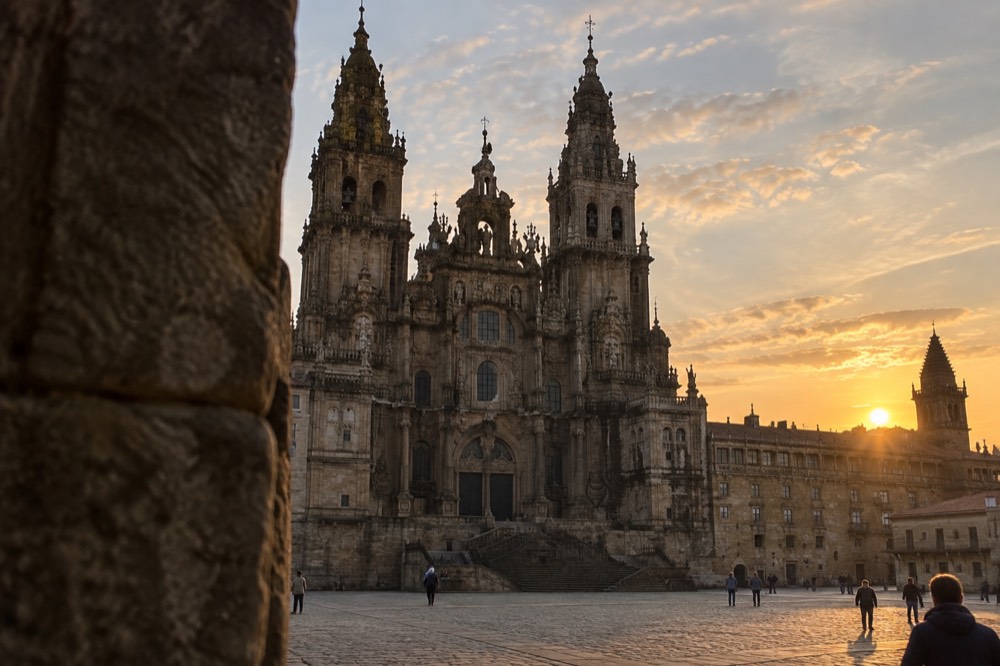
The descent leads into the eastern edge of the city and then through the streets toward the old town, where most walkers make for Praza do Obradoiro, the grand square in front of the Cathedral's west facade. Arrivals cluster there through the afternoon, backpacks dropped, photos taken, and the square's stone surface doubles as the informal finishing line of the entire Camino network.
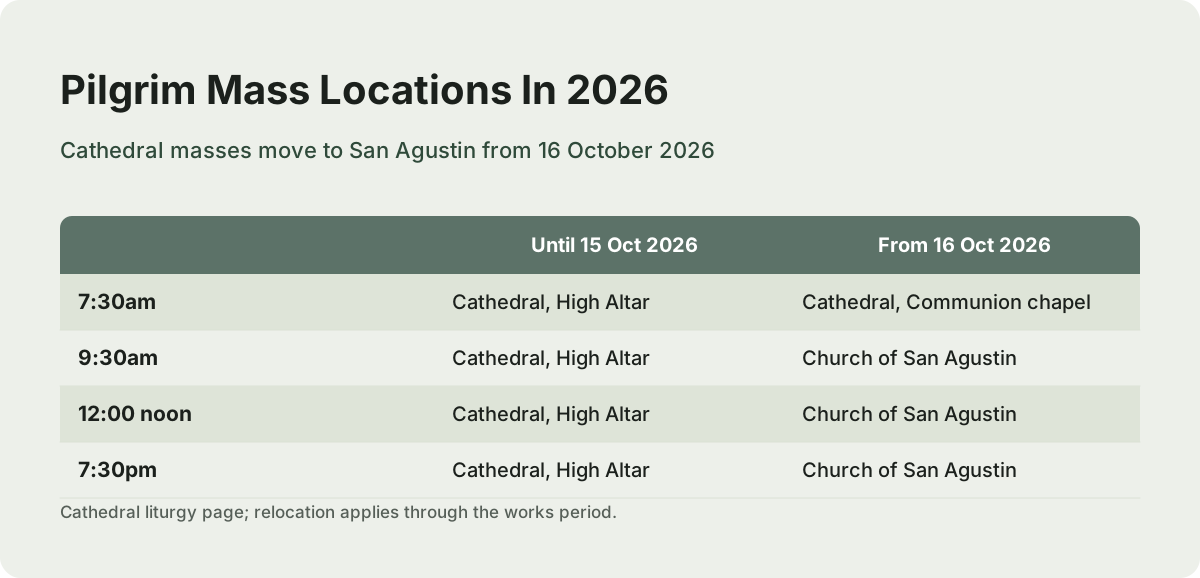
The Pilgrim Mass is the ritual most walkers aim to attend, and in 2026 there is a change everyone arriving should know about. Through 15 October 2026, the Cathedral's own liturgy page lists Pilgrim Masses at 7:30am, 9:30am, noon and 7:30pm at the High Altar. From 16 October 2026, the 9:30am, noon and 7:30pm masses relocate to the nearby Church of San Agustin while main chapel works proceed, and only the 7:30am mass stays in the Cathedral itself, in its Communion chapel. Both arrangements are summarised here because pilgrims arriving across that date will meet different ones:
| Mass time | Until 15 Oct 2026 | From 16 Oct 2026 |
|---|---|---|
| 7:30am | Cathedral, High Altar | Cathedral, Communion chapel |
| 9:30am | Cathedral, High Altar | Church of San Agustin |
| 12:00 noon | Cathedral, High Altar | Church of San Agustin |
| 7:30pm | Cathedral, High Altar | Church of San Agustin |
One thing no arriving pilgrim should expect in 2026 is the Botafumeiro, the Cathedral's famous swinging censer. It is currently out of action: scaffolding for the restoration of the cimborrio, the dome over the crossing, covers its hanging mechanism, the Cathedral confirmed the suspension in writing on 5 September 2026, and no return date has been published. It normally swings on 12 fixed solemnities a year, including the Feast of St. James on 25 July, but that schedule is suspended for now, and no visitor should plan a trip around seeing it fly. The Botafumeiro remains one of the great spectacles of European liturgy when it operates, which is exactly why its current status needs stating plainly.
For walkers finishing in the city, a guided walk is a common way to make sense of what you have just walked into, and a good one costs little. The Historic Town Walk with an official guide pairs well with the arrival afternoon, and there is a well-reviewed option led by an official guide:
When Is The Best Time To Visit Monte do Gozo?
The best time to visit Monte do Gozo is late afternoon toward sunset in the drier months, roughly May to September, when AEMET's data for Santiago de Compostela shows the region at its driest and the low evening light picks out the old town and the Cathedral towers most clearly. In a Holy Year, and in the July weeks around the Feast of St. James on 25 July, the hill is at its busiest and most atmospheric.
The climate pattern matters more here than at most city viewpoints, because the hill is open ground with almost no shelter. The wetter half of the year, October to March, delivers most of the region's 1,690 to 1,890mm of annual precipitation, and a winter arrival on the hill often means arriving in cloud, with the view reduced to a few hundred metres of grass. The summer months of July and August are the driest, and they are also when the pilgrim flow peaks, so the trade is simple: better views and bigger crowds, or empty paths and a gamble on the sky.
| Season | Typical conditions in Santiago de Compostela | What it means at Monte do Gozo |
|---|---|---|
| October to March | Wettest period of a wet year-round climate | Views often clouded, paths muddy, crowds small |
| April to June | Wetter than summer, milder than winter | Good balance of views and walking weather |
| July and August | Driest months per AEMET station data | Clearest views, busiest pilgrim arrival |
| Late July | Feast of St. James on 25 July | Peak atmosphere, city events, most crowded |
The calendar around the hill is about to change character. 2027 is the next Holy Year, the Xacobeo, not 2026: the Holy Door opens on 31 December 2026 and the Holy Year runs through 31 December 2027, because 25 July 2027 falls on a Sunday. Holy Years concentrate pilgrim numbers sharply, and the hill will see a great deal more traffic through 2027 than in an ordinary year. The official Xacobeo calendar lists the subsequent Holy Years as 2032, 2038 and 2049, so for most readers there is exactly one Xacobeo on the near horizon:
| Holy Year | Status on the official calendar |
|---|---|
| 2027 (Xacobeo) | Holy Door opens 31 December 2026, runs through 31 December 2027 |
| 2032 | Listed as a subsequent Holy Year |
| 2038 | Listed as a subsequent Holy Year |
| 2049 | Listed as a subsequent Holy Year |
If you want the hill almost to yourself with a fair chance of a view, the shoulder months are the honest answer. Late September and October still carry warm light in the evenings, the summer pilgrim tide has eased, and the October rains have usually arrived but not settled in for good. Dress for the possibility of a shower, and the hill will give you the quieter version of itself.
Can You Combine Monte do Gozo With A Cathedral Rooftop Visit?
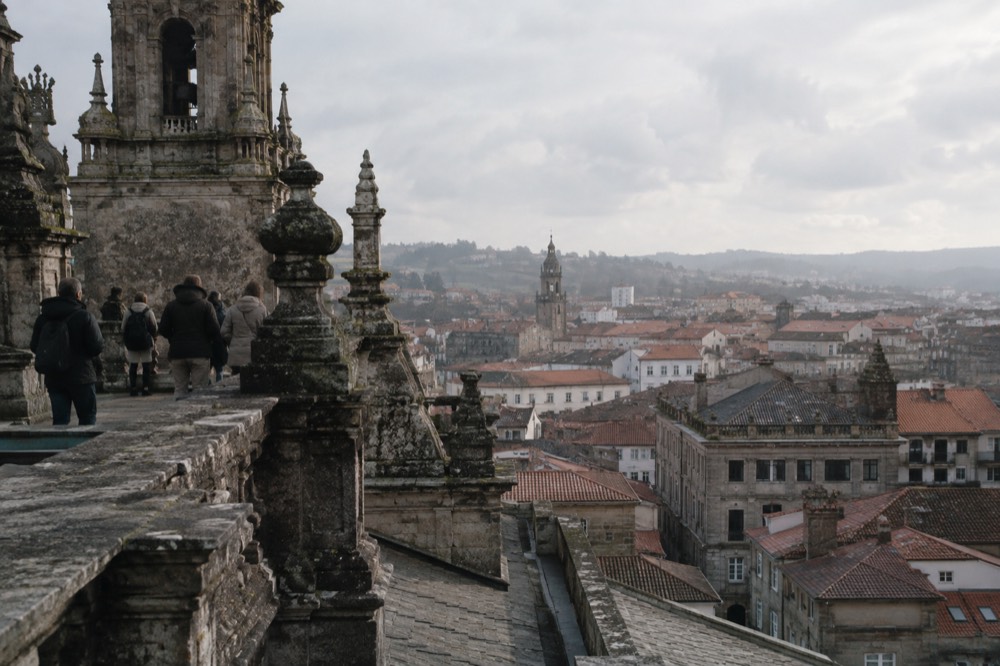
Yes, and the pairing is a natural one: Monte do Gozo gives you the city seen from a distance, while the Cathedral's own rooftop and Carraca Tower tour gives you the same world seen from about 72 metres above the old town. The cathedral-run rooftop visit costs EUR15 general, EUR12 reduced, runs about 60 minutes with roughly 140 steps, and includes entry to the Cathedral Museum's permanent collection and several other cathedral sites valid for 7 days.
The rooftop tour is booked with timed slots through the Cathedral's own ticketing, and it is one of the few ways to stand above the old town's stone canopy rather than inside it. From the roofs you look back east over the ground the pilgrims walk in on, which is the same line of sight as the hill but reversed, compressed and made vertical. The cathedral rooftops tour deserves its own planning, and the official ticket price structure is straightforward:
| Cathedral visit option | General price | Reduced price | What it covers |
|---|---|---|---|
| Basilica interior | Free | Free | Naves, Apostle's tomb area, general entry |
| Cathedral Museum permanent collection | From EUR9 (ticket type dependent) | EUR9-23 range by ticket | Museum, Gelmirez Palace, dependent sites |
| Rooftops and Carraca Tower, guided | EUR15 | EUR12 | Roofs, tower, plus museum collection entry valid 7 days |
Reduced rates on the rooftop tour apply to accredited pilgrims, students, unemployed visitors, large families, disabled visitors, over-65s and under-12s, with proof required at entry, and English-language visits are a flat EUR15. Advance booking is recommended in peak season because the guided groups are limited in size. A popular combined version of the visit is also available through tour operators:
Is Monte do Gozo Worth Visiting If You Are Not Walking The Camino?
Monte do Gozo is worth visiting for non-pilgrims as a free, open viewpoint over Santiago de Compostela and as the one place where the Camino's meaning is visible in a single scene: arriving walkers, the pilgrim monument and the Cathedral on the horizon together. If you have limited time and no interest in the pilgrimage, the Cathedral, its roofs and the old town should come first, and the hill is a strong second-choice half hour.
The honest ranking matters, because the hill is not a monument in the European grand-tour sense. There is no gilded interior, no collection, nothing to queue for. What there is, is a piece of living geography: on most afternoons you can watch the walkable history of the city come toward you one backpack at a time. Visitors who connect with that idea tend to rate the hill among their favourite memories of Galicia, precisely because it is uncurated. Visitors who want curated go to the Cathedral Museum or the Museo das Peregrinacions, and both are the right answer for them.
For travellers building a fuller Galicia trip, the hill also works as a bookend. The city around it rewards several days, and questions like how long the Camino itself takes or which month suits you best are answered in detail elsewhere on this site, including how long it takes to walk the Camino de Santiago and the best month to walk the Camino. Santiago de Compostela's old town and the Routes of Santiago de Compostela hold two separate UNESCO listings, from 1985 and 1993 respectively, which is a useful reminder that this is a landscape-scale heritage destination, not a single-building one.
What Should You Know Before You Go To Monte do Gozo?
Before visiting Monte do Gozo, know four things: there is no entry fee or ticket and the hill is public open ground; the surface is uneven grass and path, so wear real shoes; there is little shelter, so bring a layer or rain protection depending on the season; and the site has no cafe at the viewpoint itself, so carry water. The hill is on the city's edge, reachable by city bus or taxi from the centre.
Weather planning should follow the honest Galician rule rather than the optimistic one. This is one of the wettest cities in Spain, with annual precipitation on the order of 1,690 to 1,890mm, and the rain falls somewhere in every month of the year. The driest window is July and August, and even then a light jacket is prudent for an evening on exposed high ground. In the October-to-March wet season, proper rain gear is not optional for a hill with no cover.
A few current practical notes for the city below the hill are worth carrying with you. The Botafumeiro is suspended with no return date published, as covered above, so do not build an itinerary around it. Pilgrim Mass times change on 16 October 2026, with three of the four daily masses moving to San Agustin. Santiago de Compostela has charged a municipal tourist tax since 1 October 2025, a surcharge on Galicia's tourist-stay tax upheld by Galicia's high court in September 2026, ranging from 1 EUR per person per night in private albergues, campsites and tourist apartments up to 2.50 EUR in five-star hotels, for a maximum of 5 nights, with under-18s and stays in Xunta-run public albergues exempt. And the best day trip from Santiago de Compostela question, for anyone stretching a visit beyond the city, has its own answer page.
Finally, consider what your legs will want. For walkers who have just crossed the hill at the end of a multi-week Camino, a massage treatment is one of the more popular first bookings in the city, and a well-rated one is available from around the old town:
Common Questions About Monte do Gozo
Is Monte do Gozo free to visit?
Yes. The hill is public open ground with no gate, ticket or entry fee. The albergue on the hill charges overnight pilgrims for bunks, but the viewpoint, the monument and the paths are free and open at all hours.
How far is Monte do Gozo from the Cathedral of Santiago de Compostela?
The hill sits on the eastern edge of the city, and pilgrims walk from it into the old town as the final part of their last Camino stage. It is close enough to reach easily by city bus or taxi from the centre, and walkers cover it on foot as part of the waymarked route. For exact distances and times, check the city's own transport page before you set out.
Can you stay overnight at Monte do Gozo?
Yes. The hill holds a large municipal albergue that sleeps arriving pilgrims, and in peak season it operates as overflow accommodation for the whole city. Beds are aimed at credencial-carrying walkers, so leisure travellers should look at hotels and hostels in the old town instead.
Do all Camino routes pass Monte do Gozo?
No. The hill sits on the eastern approach used by the Camino Francés and routes that share its final stages into Santiago de Compostela. Pilgrims arriving from other directions, such as the Portuguese Camino from the south, enter the city along different streets and do not cross this hill.
What is the best time of day to visit Monte do Gozo?
Late afternoon into sunset. The viewpoint faces west over Santiago de Compostela, so the evening light falls on the old town and the Cathedral towers, and the hill is at its clearest in the drier July and August period. Arrivals of pilgrim groups are usually thickest through the afternoon.
Can you see the Botafumeiro from Monte do Gozo?
No, and the Botafumeiro is not currently swinging anywhere: it is out of action while restoration scaffolding covers its hanging mechanism, with no return date published as of the Cathedral's written confirmation on 5 September 2026. From the hill you see the Cathedral's exterior and towers, which is the view the hill exists for.
Monte do Gozo will never top a list of Europe's grand monuments, and that is precisely its point. It is a hill, a view and a name for an emotion, and the walk it belongs to is still drawing more than half a million people a year to the city below it. Go for the sunset, go for the understanding of the Camino, or simply go to see the Cathedral the way pilgrims have seen it for centuries: from a distance, at the end of a long road, for the first time.