Santiago de Compostela Nightlife
Santiago de Compostela after dark is a compact city of granite squares, tapas lanes and one very large floodlit cathedral, and this guide covers exactly what opens, what charges what, and which night experiences are worth booking.
Short answer
Santiago de Compostela nightlife runs small and early: tapas around Rua do Franco and the old town from about 8pm, a Queimada show or guided night tour from about $17 per person, and quiet streets by around 1am on most nights.
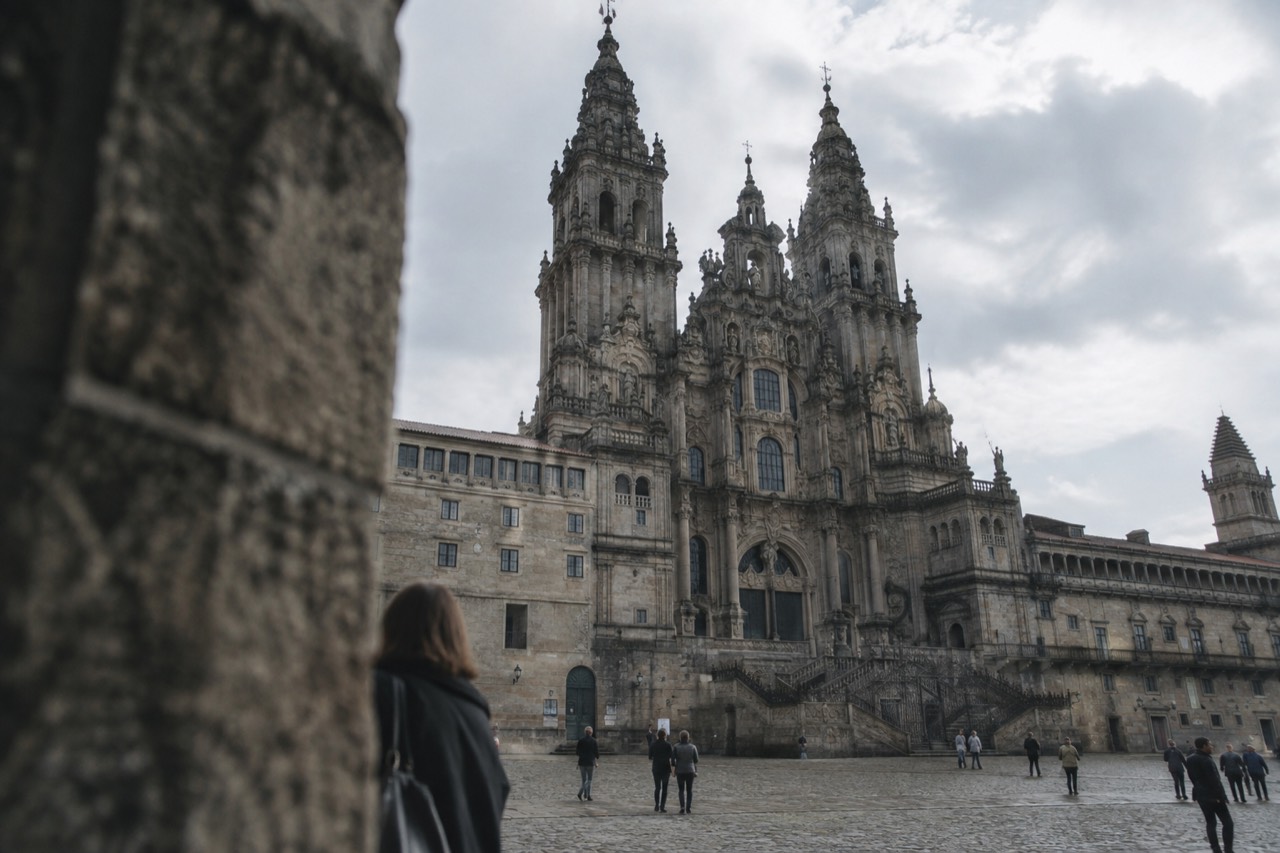
By the time the floodlights come on above the Cathedral of Santiago de Compostela, the day's pilgrims have collected their Compostelas, the queues at the tomb have thinned, and the granite of Praza do Obradoiro starts throwing warm light back at anyone still standing in it. Nightlife in this city is not Madrid-scale. It is a compact, walkable evening economy built around tapas, wine, one famous flaming punch ritual, and a handful of guided tours that cost less than dinner. This guide, from the editors at Santiago de Compostela Travel Guide, lays out what actually happens after dark in Galicia's pilgrim capital, what the bookable night experiences cost, and what to do when the bars go quiet.
What Is Santiago de Compostela Nightlife Actually Like?
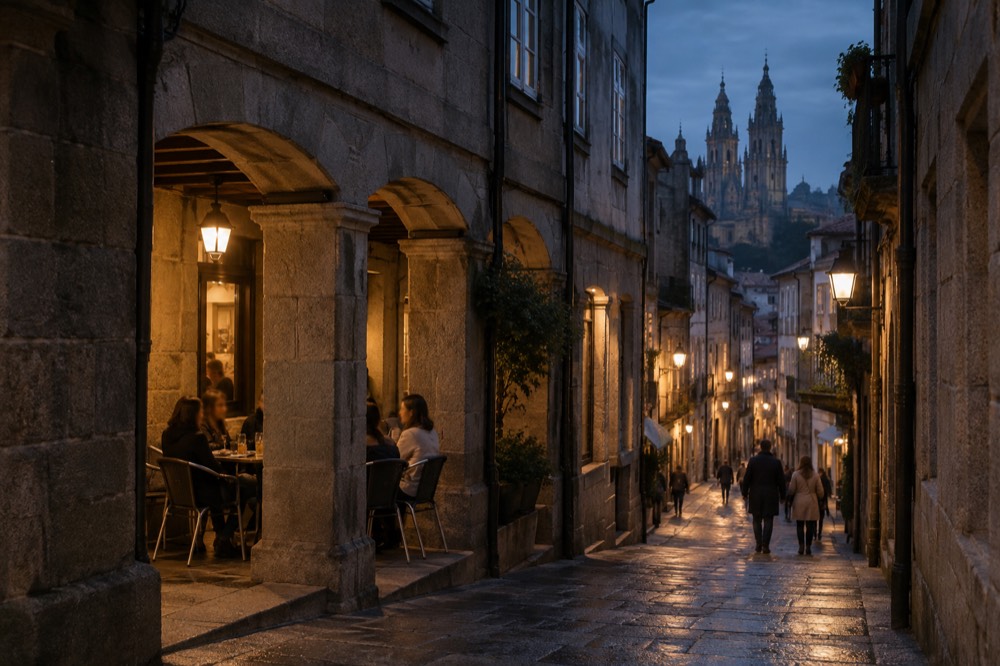
Nightlife in Santiago de Compostela is small, early and food-centred rather than club-centric: tapas bars fill the old town lanes from around 8pm, the liveliest strip runs between Rua do Franco and the Rua da Raínha stretch near Praza de Cervantes, and the whole scene compresses into a walkable UNESCO-listed quarter that is barely a kilometre end to end. The city's old town was inscribed on the UNESCO World Heritage list in 1985, and the night atmosphere is a direct product of that: no tall buildings, no neon canyons, just arcades, lanterns and the cathedral mass glowing over everything.
The rhythm differs from Spain's bigger cities. Santiago de Compostela is a university town as well as a pilgrimage destination, so there are student bars and late venues, but the mainstream evening peaks earlier and quieter than in Madrid or Bilbao, both of which sit far outside the range this guide covers. Visitors who arrive expecting all-night dancing tend to recalibrate by the second night. Visitors who arrive expecting a long, unhurried tapeo with Albariño wine tend to think the city got it exactly right.
A few fixed points shape every evening. The Cathedral's own liturgy schedule lists pilgrim masses at 7:30am, 9:30am, noon and 7:30pm, though an important change is dated for this autumn: from 16 October 2026 the 9:30am, noon and 7:30pm masses relocate from the Cathedral's High Altar to the nearby Church of San Agustin, with only the 7:30am mass remaining inside the Cathedral, because main-chapel remodelling work is under way ahead of the 2027 Holy Year. The basilica interior itself stays free to enter during visiting hours, generally until around 9pm through the Praterias door.
| What | Typical Night Timing | What It Costs |
|---|---|---|
| Cathedral interior visiting hours | Generally ~7:00am to ~9:00pm | Free entry |
| Pilgrim mass (evening) | 7:30pm, relocating to San Agustin from 16 Oct 2026 | Free |
| Tapas bars filling up | From about 8pm | Varies by bar, check the room |
| Queimada show and tasting | Evening sessions, from $17 per person | From $17 |
| Guided night walking tour | Evening sessions, from $17 per person | From $17 |
| Quiet streets | Around 1am on ordinary nights | Nothing |
Which Night Tour Of Santiago de Compostela Is Best?
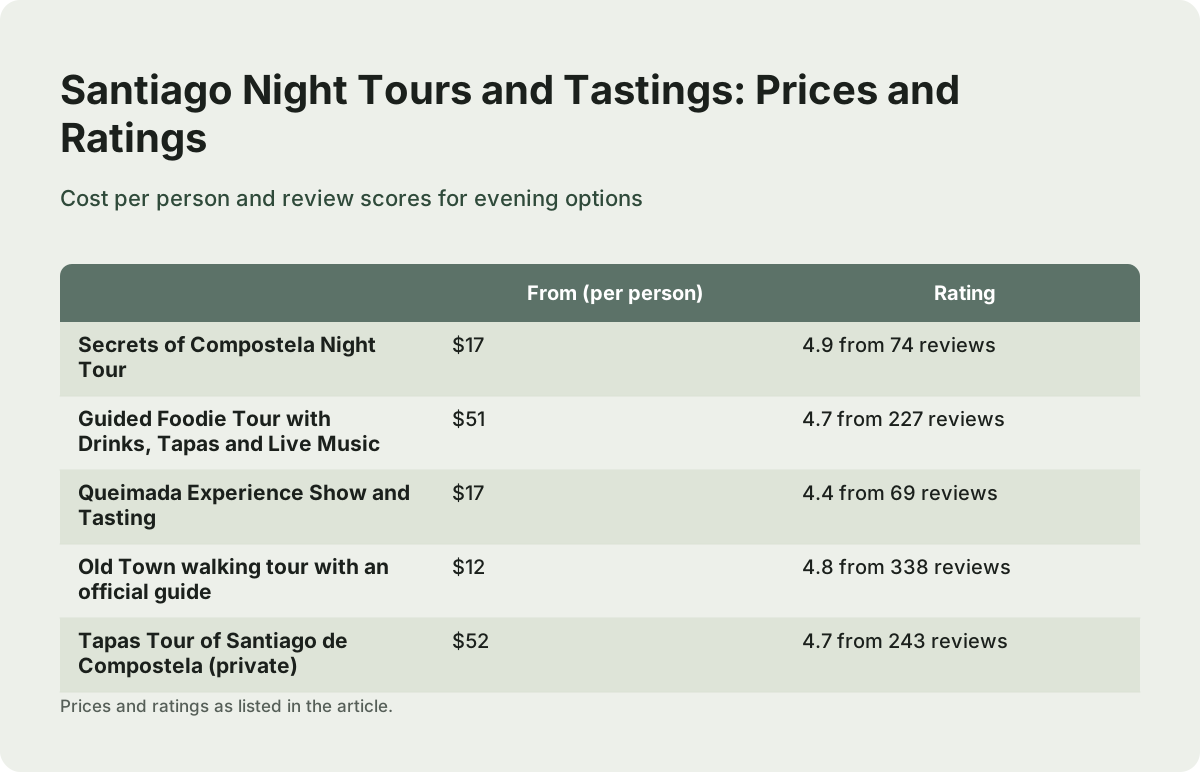
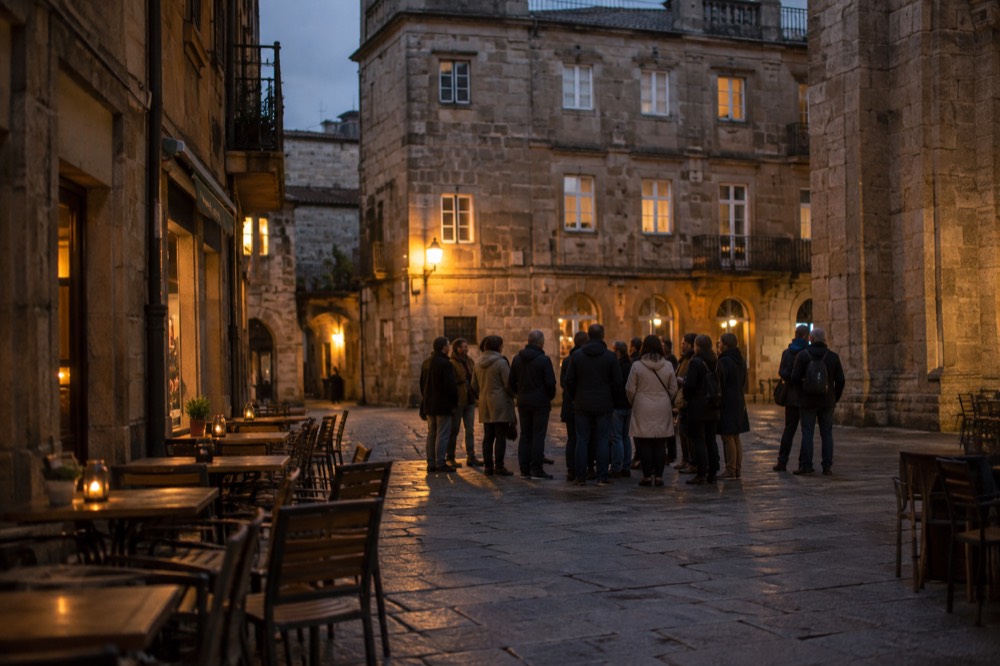
The best-value night tour for most visitors is the Secrets of Compostela Night Tour, from $17 per person with a 4.9 rating from 74 reviews, which walks the lit old town while telling its legends; for a food-led evening the Guided Foodie Tour with Drinks, Tapas and Live Music runs from $51 per person with a 4.7 rating from 227 reviews, and the Queimada Experience Show and Tasting, from $17 with a 4.4 rating from 69 reviews, is the shortest and most theatrical option. All of them stay inside the city at night, unlike the day trips that leave the coast until morning.
The choice comes down to what you want the evening to do. A legends walk works as a first-night orientation: you finish knowing the squares, the stories and which lane leads back to your hotel. The foodie tour replaces dinner with a moving one. The Queimada show is a half-hour spectacle with a tasting, best booked as an after-dinner exclamation mark rather than a plan in itself.
The evening also pairs well with daytime products, and plenty of visitors stack one guided day experience on top of one night one. These three are the most useful pairings for a short stay:
The Old Town walking tour with an official guide, from $12 per person and rated 4.8 from 338 reviews, is the cheapest structured introduction to the city, and doing it by day before a legends tour by night means you never waste an evening just learning street names. The Complete Tour with city, Portico and Cathedral tickets, from $47, covers the ticketed interior sights so your night stays free for food. The Finisterre, Costa da Morte, Ézaro, Muros and Carnota excursion is a full-day coastal outing, listed from $60 and rated 4.6 from 229 reviews, and it belongs on the day after a late night, not the same day.
What Time Does Nightlife Start In Santiago de Compostela?
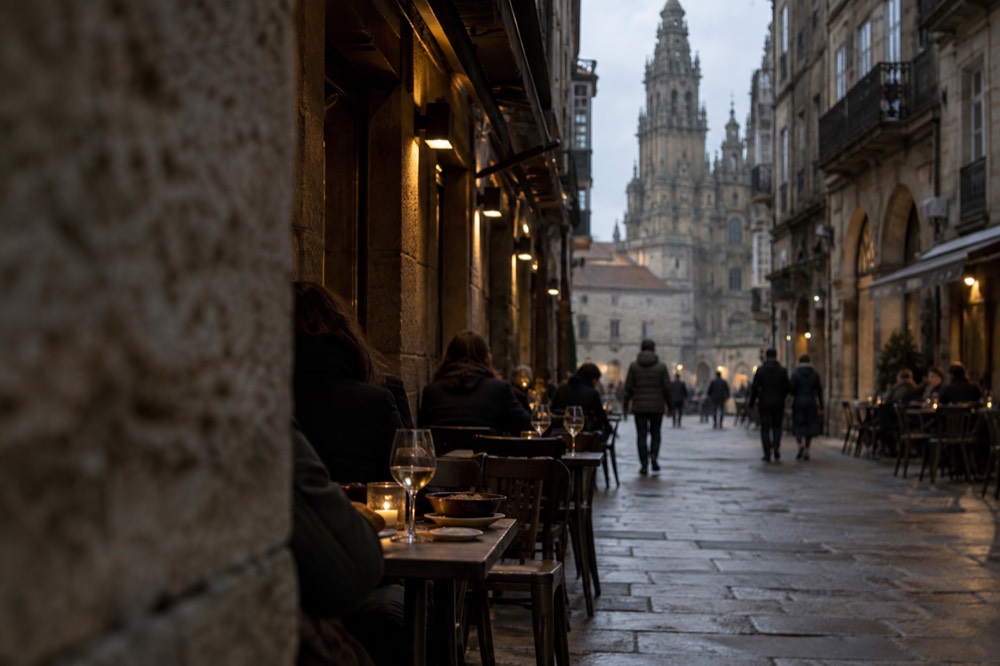
Evenings in Santiago de Compostela start later than most northern European visitors expect: shops and attractions wind down between 8pm and 9pm, tapas bars fill from about 8pm onward, sit-down dinner sits between 9pm and 11pm in the busier restaurants, and on ordinary weeknights the streets are largely empty by 1am to 2am, with the real late scenes reserved for weekends, graduation weeks and the July festival period. Planning a 6pm dinner is the classic mistake; half the kitchens will barely be warm.
Two calendar anchors change the whole equation. The Feast of St James on 25 July brings a pontifical mass, a national offering to the Apostle, fireworks and concerts into the city, and that is the one night a year when Santiago de Compostela genuinely stays loud until dawn. And the next Holy Year, Xacobeo 2027, opens with the Holy Door ceremony on the evening of 31 December 2026 at Praza da Quintana, with the Holy Year then running through 31 December 2027, so New Year's Eve 2026 will be unusually crowded and unusually expensive. 2026 itself is not a Holy Year.
| Evening Slot | What Is Happening | Where |
|---|---|---|
| 7:30pm | Pilgrim mass (relocates to San Agustin from 16 Oct 2026) | Cathedral, then Church of San Agustin |
| 8pm to 9pm | Tapas and first drinks, cathedral closes to visitors | Rua do Franco, Praza de Cervantes lanes |
| 9pm to 11pm | Sit-down dinners, foodie tours | Old town restaurants |
| 10pm onward | Legends tours, Queimada shows | Old town squares |
| After midnight | Student bars, weekends mainly | University side of the centre |
The weather matters more here than in most Spanish cities. AEMET's climate data for the Santiago de Compostela station shows a temperate oceanic pattern, wet year-round and wetter from October to March, with July and August the driest months. Terrace nights in July are close to reliable. Terrace nights in November are a gamble with an umbrella, and the indoor tapas bar becomes the plan.
Where To Eat And Drink At Night In Santiago de Compostela?
The classic night-eating ground is Rua do Franco and the lanes around Praza de Cervantes, a dense strip of tapas bars and seafood restaurants a two-minute walk from the Cathedral, with the Rua da Raínha stretch as the smarter alternative; expect padron peppers, pulpo a la gallega, empanada and tarta de Santiago on nearly every menu, with a structured tapas tour from $52 per person, rated 4.7 from 243 reviews, as the shortcut. The full food picture, including where to book, sits in the dedicated where to eat guide.
The dining hour etiquette is simple: bars first, then tables. Galicians treat the tapeo as the evening's first act, moving between bars rather than settling in one. Rua do Franco is the tourist-facing spine and prices reflect it; the lanes off it hold more locals. For the signature dishes themselves, the site carries separate deep dives on padron peppers, pulpo a la gallega and tarta de Santiago, so this page sticks to the night itself.
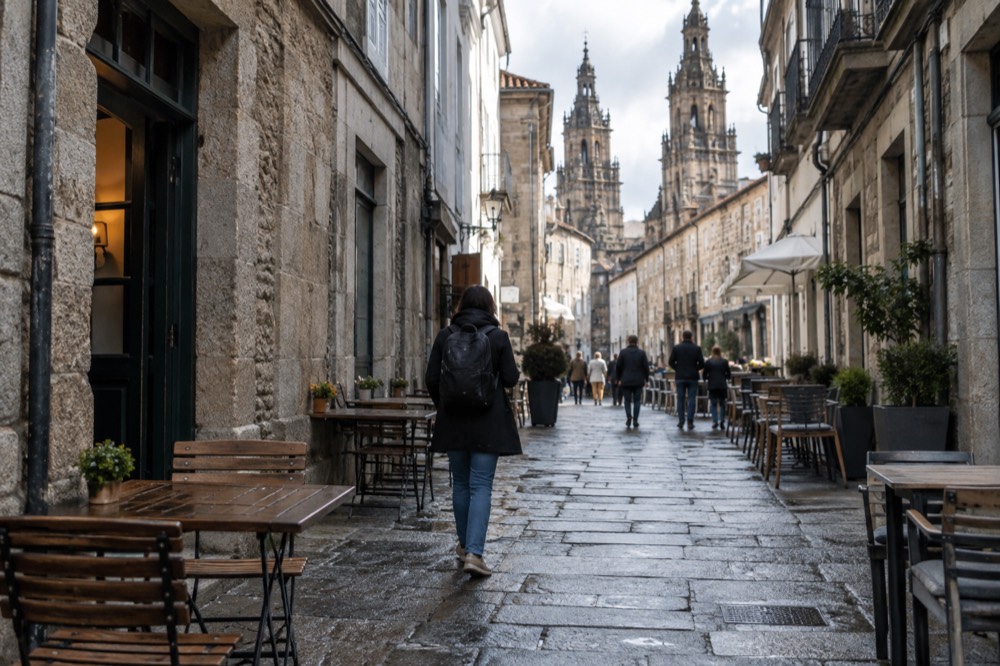
Wine deserves a word, because Galicia's answer to evening drinking is not Rioja. Albariño, the white wine of the Rias Baixas, is the default pour by the glass in this city, and the site's Albariño wine guide covers how it is made and where it comes from. Ribeiro, another local white, appears on most bar lists too. None of this needs a booking. What needs a booking is anything with a guide in front of it.
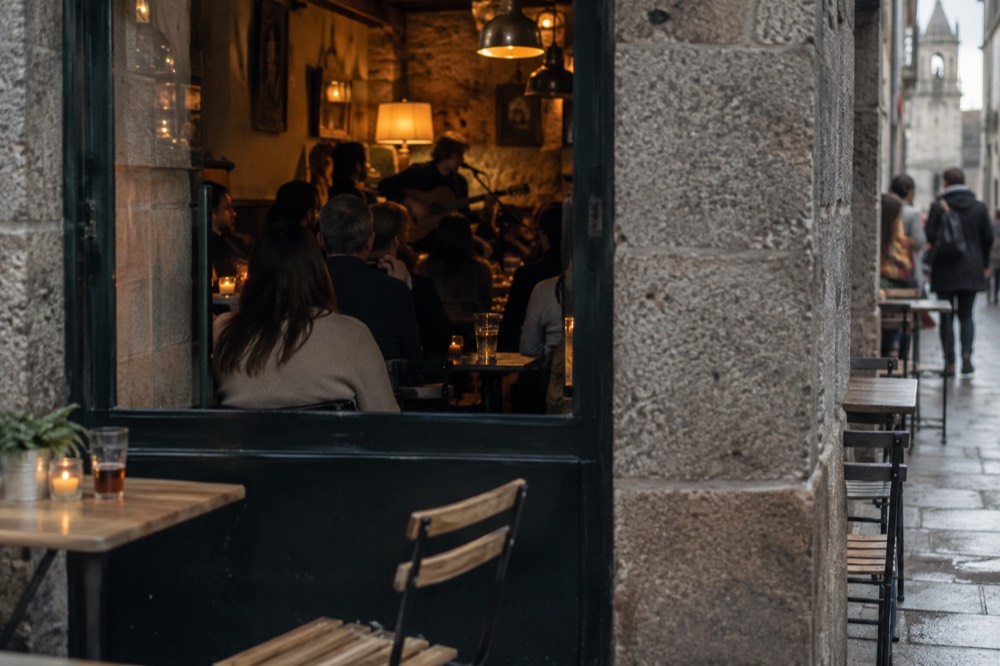
Two food-led night products stand out from the roster. The Tapas Tour of Santiago de Compostela, a private tapas tour from $52 per person rated 4.7 from 243 reviews, and the Guided Foodie Tour with Drinks, Tapas and Live Music, from $51 per person rated 4.7 from 227 reviews. The foodie tour's live-music element is the differentiator: you get the moving dinner and the night's soundtrack in one booking.
What Is The Queimada Experience In Santiago de Compostela?
The Queimada Experience is a staged version of Galicia's traditional flaming-punch ritual: orujo spirit is set alight in an earthenware bowl while a chant, the conxuro, is recited, and the audience then drinks the warm, sweetened result; in Santiago de Compostela it is bookable as a show and tasting from $17 per person, rated 4.4 from 69 reviews on one listed version and 4 from 70 reviews on the other. It is the single most distinctive night-out ritual this city offers a visitor, and sessions run in the evening so it slots after dinner rather than replacing it.
The conxuro itself is the point. It is a spell-chant, traditionally recited over the burning bowl to drive off meigas, the witches of Galician folklore, and it is performed in Galician. Even a staged tourist version keeps the language, the fire and the ladle-poured flame streams, and the room goes properly quiet while it runs. The drink that follows is strong, orangey and warmer than it looks.
One honesty note, because this site reports rather than sells: the ritual as sold to tourists is a show. Queimada is a real Galician tradition, historically a rural, communal one, and the bars and show venues condensed it into a ticketed half hour. That does not make it a fake. It makes it theatre with a genuine folk script, and for $17 it is cheaper theatre than most cities can offer.
| Element | What It Is | Night-Out Use |
|---|---|---|
| The bowl | Earthenware pot, orujo, sugar, citrus peel | The visual centrepiece |
| The conxuro | Chanted spell in Galician, drives off witches | The performance |
| The fire | Ladled flame streams, ~1 to 2 minutes | Photo moment, keep distance |
| The tasting | One warm serving per guest | The finish |
| Typical slot | Evening, around 30 to 45 minutes | After dinner or after a walk |
Is Santiago de Compostela Safe At Night?
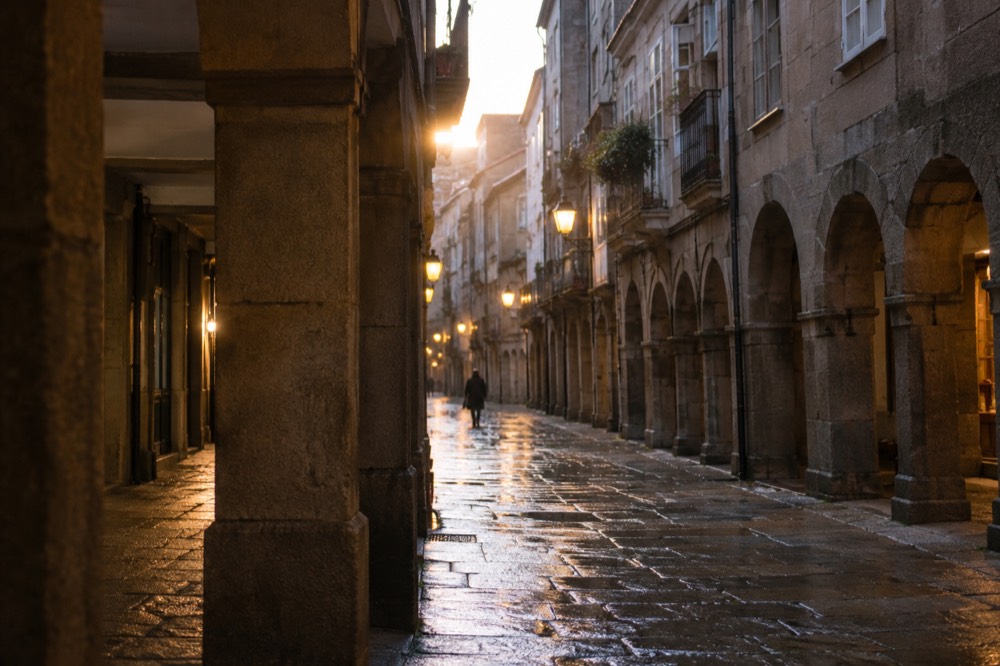
Santiago de Compostela is considered a very safe small city at night: the old town is compact, well lit around its main squares and, on most evenings, full of pilgrims, students and families rather than the crowd levels that strain big-city nightlife districts, though standard city care still applies around the usual petty-theft risks in crowded pockets near Rua do Franco and Praza do Obradoiro on peak nights. The site's longer answer on the subject lives in the general safety discussion, and nothing in the verified research for this destination flags a nightlife-specific hazard.
The practical points are unglamorous. The old town's granite is polished and rains make it slick, so footwear matters more than crime awareness on a wet night. The city is hilly in parts. Taxis and the urban bus network, listed on the city's transport page, cover the short distances out to hotels beyond the centre, and line 6A connects the airport side, though its 1 EUR driver fare and 0.36 EUR card fare are due to change as a new Monbus contract with a fare near 6 EUR takes effect from autumn 2026, so treat the airport figure as subject to change and check the live fare.
For a city of this size, the honest summary is that the night-time risk profile is closer to a country town than a capital. The most likely bad outcome of a night out here is an overpriced plate of frozen octopus on the tourist spine, and the fix for that is one street of research.
What About Feast Nights, Holy Year And The Botafumeiro?
The two nights that transform Santiago de Compostela are the Feast of St James on 25 July, with its pontifical mass, national offering, fireworks and concerts, and the Holy Door opening on the evening of 31 December 2026 at Praza da Quintana, which launches Xacobeo 2027, the next Holy Year, running through 31 December 2027. On those nights the city stays up late and books out early. On ordinary nights it does not, and one thing no visitor should plan around right now is the Botafumeiro, which is currently out of action because dome-restoration scaffolding covers its swinging mechanism, with the Cathedral confirming this in writing on 5 September 2026 and no return date published.
The Botafumeiro point matters because half the internet still implies you can see the giant censer swing on a scheduled date. Normally it swings at twelve fixed solemnities a year, from Epiphany in January through the Feast of St James on 25 July to the Transfer of the Apostle on 30 December, but that schedule is currently suspended, and it is also unavailable for private requests until the restoration work clears. Any evening plan for the 2026 festive season that includes "and then the Botafumeiro flies" is not a plan.
Holy Year changes the night calendar in a second way. During 2027 the pilgrim volume will be higher than even the record-setting recent years, and evening masses, processions and the generally electric atmosphere on Praza do Obradoiro will run all year, not just in July. The Holy Year 2027 guide carries the full dates, and the best time to visit guide weighs the crowds against the weather for anyone choosing when to come.
Where Do You Go The Morning After A Night Out In Santiago de Compostela?
The standard morning-after move in Santiago de Compostela is a slow coffee in the old town followed by one of the city's free-to-enter sights, the Cathedral interior being free to visit during its opening hours, generally from about 7:00am, or a gentle walk up Alameda Park for the classic postcard view of the Cathedral's west front. For anyone with more recovery time, the full-day coastal excursions leave Santiago de Compostela in the morning and return by evening, from $54 to $68 per person depending on the itinerary, and the recovery menu is short but effective.
The coastal options are worth naming, because a night in the city followed by a day on the Costa da Morte is the single best two-day pattern this destination offers. The Excursion to Rias Baixas with a winery and optional mussel boat runs from $54 per person, rated 4.8 from 322 reviews. The Finisterre and Costa da Morte full-day tour is from $60, rated 4.8 from 860 reviews. The Catedrais Beach, Lugo and Asturias excursion is from $68, rated 4.9 from 181 reviews. All three are full days, so book them for the morning you can actually get up, not the morning you hope to.
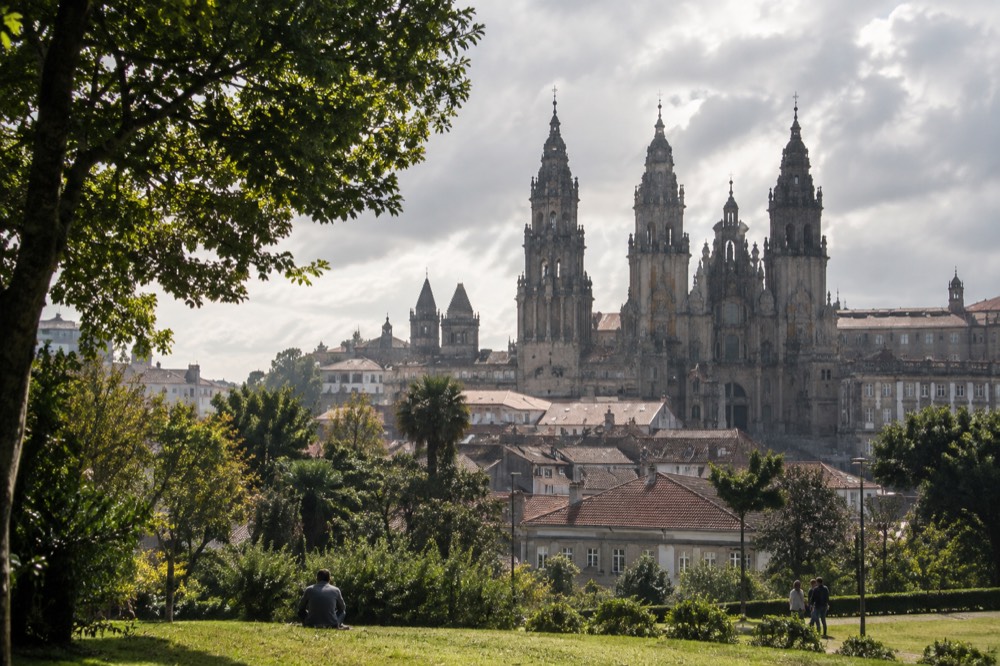
If the coastal day trips feel ambitious, the city itself absorbs a slow morning well. The Cathedral tickets and opening hours guide covers the interior, museum and rooftop options, where the rooftop and Carraca Tower guided visit is run by the Cathedral itself at EUR15 general or EUR12 reduced, about 60 minutes, 140 steps and a 72-metre height. The where to stay guide helps if the night out turned into a decision about where you wake up.
| Day-After Option | Cost | Duration | Rating |
|---|---|---|---|
| Cathedral interior visit | Free | Self-paced | Not rated, entry is free |
| Cathedral rooftop and tower tour | EUR15 general, EUR12 reduced | ~60 minutes | Run by the Cathedral itself |
| Rias Baixas winery excursion with optional mussel boat | From $54 | Full day | 4.8 from 322 reviews |
| Finisterre and Costa da Morte tour | From $60 | Full day | 4.8 from 860 reviews |
| Catedrais Beach, Lugo and Asturias excursion | From $68 | Full day | 4.9 from 181 reviews |
Whichever way the second day goes, one booking earns its keep repeatedly on a short stay: the official-guide old town walk. It costs less than a round of drinks, it runs at a civilised hour, and it leaves you oriented enough to find your way home from every night out that follows. Check availability, or read more about the old town walk, official guide, above.
Common Questions About Santiago de Compostela Nightlife
Is Santiago de Compostela good for nightlife?
It is good for a specific kind of nightlife: tapas, wine, a legends night tour and the Queimada fire ritual in a compact UNESCO-listed old town. It is not a clubbing city, and most ordinary nights wind down between 1am and 2am, with 25 July and the Holy Year opening night on 31 December 2026 as the big exceptions.
What time do bars close in Santiago de Compostela?
On ordinary weeknights the streets are largely quiet by around 1am, with the student bars on the university side running latest. The feast of St James on 25 July and major festive nights run far later. Check with your specific venue for a closing time, as hours vary.
Can you see the Botafumeiro at night?
Not currently. The Botafumeiro is out of action because scaffolding for dome restoration covers its swinging mechanism; the Cathedral confirmed this in writing on 5 September 2026 and no return date has been published. Normally it swings at twelve solemnities a year, but that schedule is suspended and private requests are unavailable too.
Is there an evening pilgrim mass in Santiago de Compostela?
Yes, at 7:30pm daily. From 16 October 2026 the 7:30pm mass, along with the 9:30am and noon masses, relocates from the Cathedral's High Altar to the nearby Church of San Agustin while main-chapel work is under way; only the 7:30am mass stays inside the Cathedral.
How much does a night out in Santiago de Compostela cost?
The bookable parts start low: the Queimada show and tasting is from $17 per person, the Secrets of Compostela night tour is from $17, and the tapas and foodie tours are from $51 to $52. Bar tabs vary by venue, so treat those as the structured costs and check each venue for food and drink prices.
Is it safe to walk around Santiago de Compostela at night?
The old town is compact, well lit around its main squares and generally considered very safe, with families, students and pilgrims on the streets into the evening. Standard care applies to bags and pockets on crowded peak nights near Rua do Franco and Praza do Obradoiro, and wet granite is a bigger practical hazard than crime.