Pulpo A La Gallega In Santiago de Compostela
Pulpo a la gallega is Galicia's most famous dish, and Santiago de Compostela is where most pilgrims taste it first. This guide explains what it is, how it is cooked, and where to eat it well.
Short answer
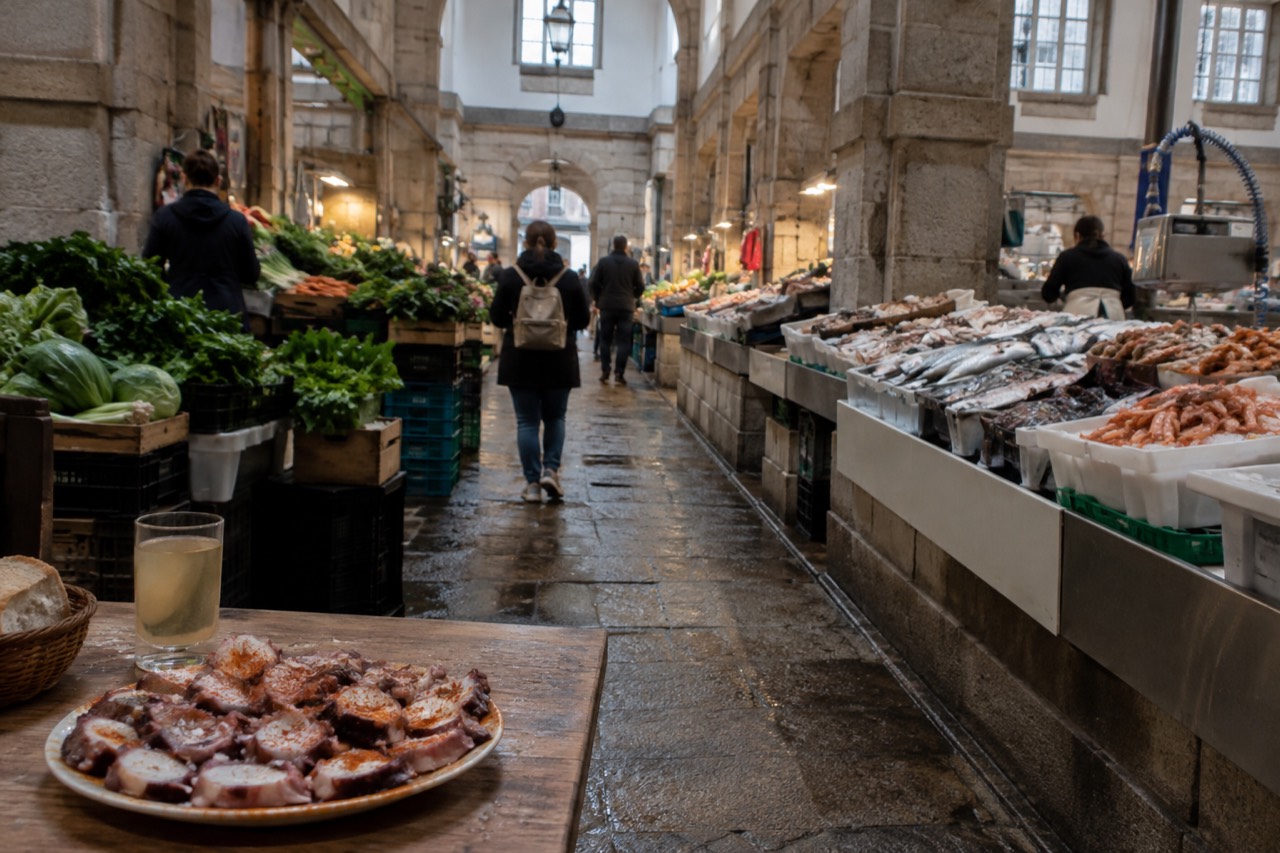
Pulpo a la gallega is boiled octopus sliced into rounds, dressed in olive oil, coarse salt and paprika, and served on a wooden plate with boiled potatoes. It is Galicia's signature dish, cooked traditionally by 'polbeiras' in copper pots, and served across Santiago de Compostela from market stalls to old-town restaurants.
Few dishes say more about Galicia than pulpo a la gallega, and in Santiago de Compostela it is nearly impossible to avoid, in the best sense. Pilgrims who arrive in Praza do Obradoiro after weeks on the Camino de Santiago routinely make it their first meal, and the markets and tapas bars of the old town serve it daily. It looks like a simple plate of octopus, olive oil and paprika. Behind that simplicity sits centuries of coastal cooking, a copper-pot technique, and a set of rules locals take seriously.
The editors of this Santiago de Compostela Travel Guide site have assembled what the verified record says about the dish: how it is made, where it fits in the city's food culture, and what to know before ordering it. What follows is drawn from established Galician culinary practice and the site's own verified fact base, not from anyone's claimed dinner. For the wider picture of the region's cooking, start with the guide to Galician food, then come back here for the octopus.
What Is Pulpo A La Gallega?
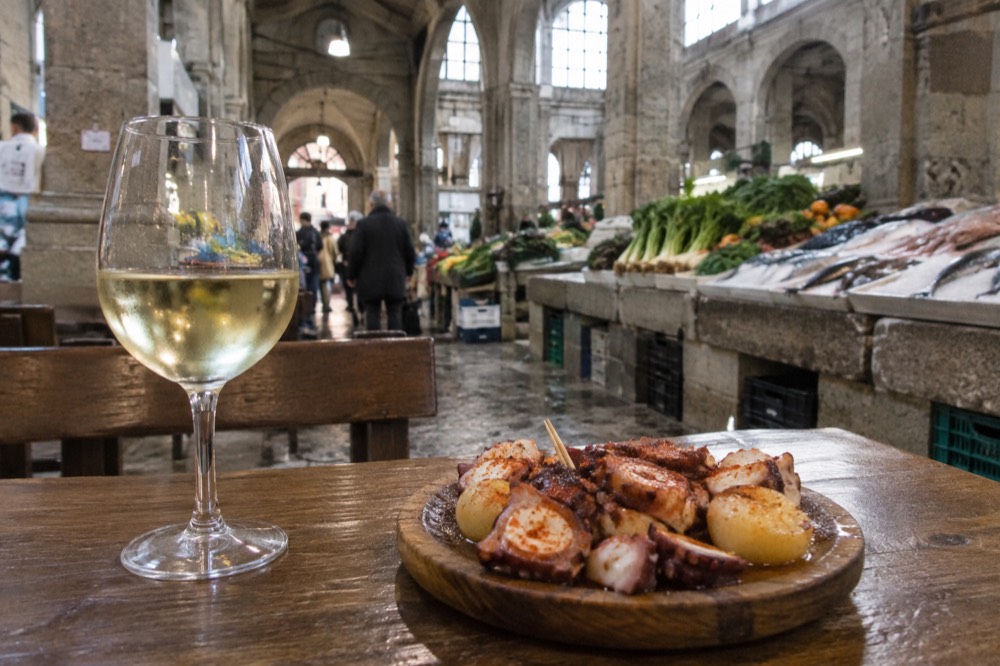
Pulpo a la gallega is boiled octopus, sliced into rounds, dressed with olive oil, coarse sea salt and sweet or hot paprika, and served warm, usually on a wooden plate with sliced boiled potatoes. It originated among fishing families on the Atlantic coast of Galicia, spread inland through fairs and festivals where specialist cooks called polbeiras worked copper pots, and it remains the single most iconic dish of the region, including in Santiago de Compostela.
The dish is deliberately spare. Octopus, oil, salt, paprika, potato. There is no sauce in the conventional sense, no tomato, no garlic in the classic version. Everything depends on the texture of the octopus itself, tender but with bite, never rubbery, and on the quality of the oil and pimenton, the paprika that gives the plate its rusty red colour.
The name itself is worth noticing. "A la gallega" means "in the Galician style," a label Spanish cuisine attaches to the preparation wherever it appears. In Galicia itself many people simply call it pulpo, or pulpo a feira, "fair-style octopus," a name that points to the dish's home in village fairs and romerias, the religious festivals that punctuate the Galician calendar. The octopus historically came from the rias, the flooded river valleys of the Atlantic coast, and from boats working the Costa da Morte and the Rias Baixas.
| Element | Role In The Dish | What To Look For |
|---|---|---|
| Octopus | The centrepiece, boiled then sliced into roughly 1cm rounds | Tender flesh, no chewy skin, clean flavour |
| Olive oil | Applied generously after slicing, never during the boil | Good-quality Spanish olive oil, enough to pool slightly |
| Paprika (pimenton) | Gives colour and smokiness | Sweet or hot, dusted evenly, never clumped |
| Coarse salt | Applied last, over the oil | Visible flakes, dissolves on the warm plate |
| Potatoes (cachelos) | The traditional accompaniment | Boiled in the octopus cooking water, plain |
For visitors, one of the pleasures of the dish is how democratic it is. It appears on white-tablecloth menus in the old town and on paper plates at street festivals for the same price philosophy: pay for the octopus, and the octopus is the point.
Where To Eat Pulpo A La Gallega In Santiago de Compostela?
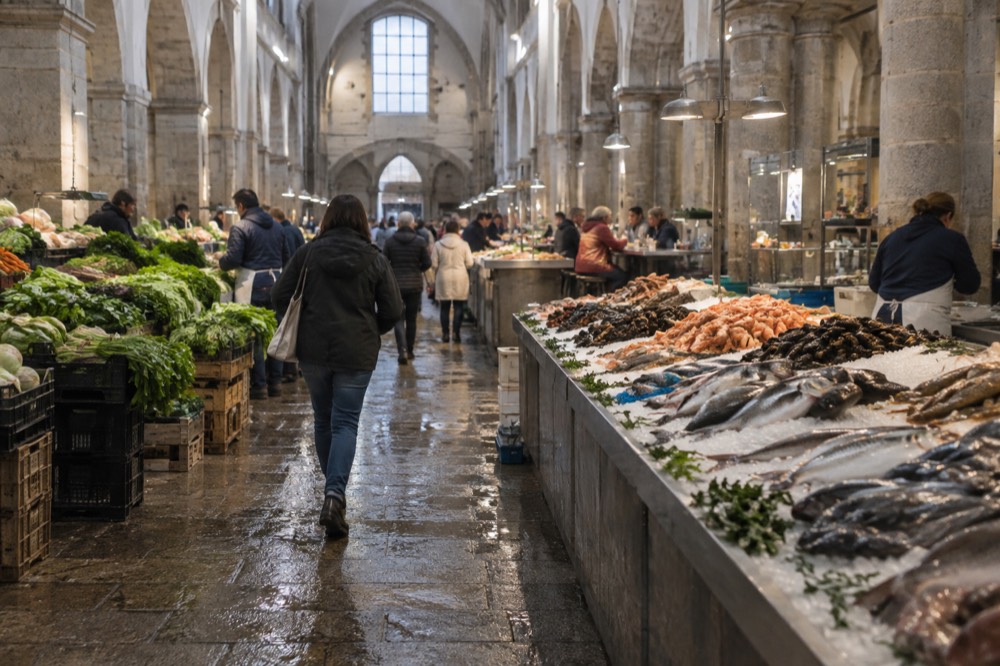
The best places to eat pulpo a la gallega in Santiago de Compostela cluster in the old town's tapas streets, around Rua do Franco and its side lanes, at the Mercado de Abastos market and its surrounding baraz, and at traditional a taberna-style restaurants where the plate arrives on wood with potatoes. Quality is judged by texture and turnover: busy kitchens with fresh octopus beat quiet ones, and the market area is where many locals buy and eat it.
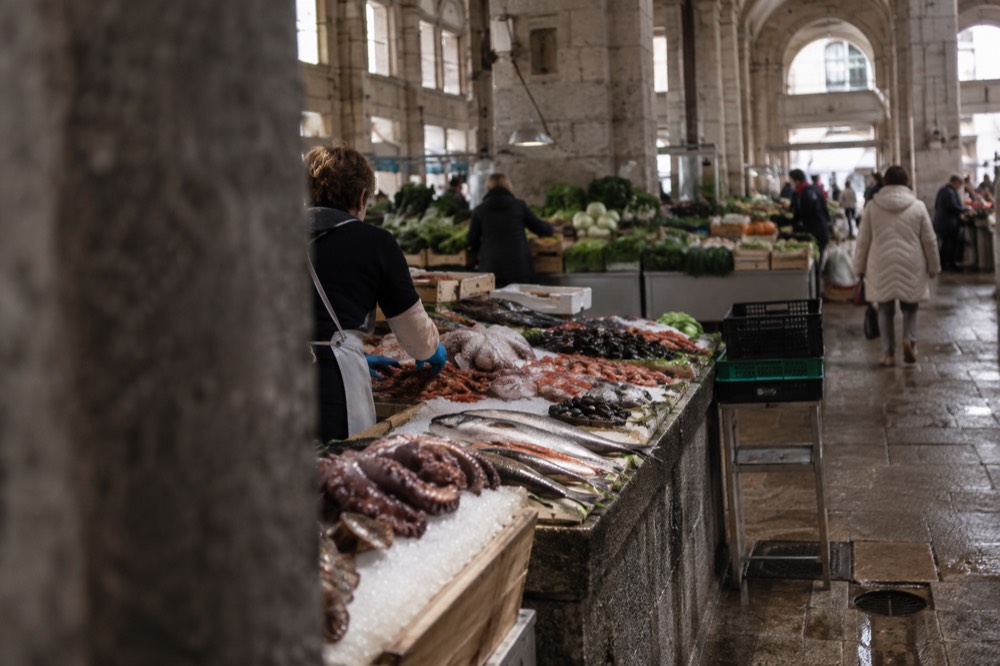
Rua do Franco is the classic first stop, a street so associated with eating that its Galician name, Rua do Franco, appears on most food maps of the city. The streets branching off it hold smaller bars where a racion of pulpo, a sharing plate, is standard. The market quarter is the other pole. Mercado de Abastos is the city's working food market, the second most visited spot in Santiago de Compostela after the Cathedral according to the city's own tourism promotion, and the bars around it cook whatever the stalls sell that morning. Specific opening hours for the market should be checked on the venue's own site, since the verified fact base does not confirm a current schedule.
| Area | Character | What An Octopus Order Looks Like |
|---|---|---|
| Rua do Franco and side streets | Tapas bars, tourist-friendly, central | Racion or media racion on a wooden plate, potatoes included |
| Mercado de Abastos quarter | Working market, early-hours, local crowd | Market-fresh octopus, simpler surroundings, daytime only |
| Praza do Obradoiro perimeter | Restaurant seating with Cathedral views | Full restaurant plates, larger portions, higher prices |
| Outlying neighbourhoods | Where locals eat weekly | Larger plates, fewer menus in English |
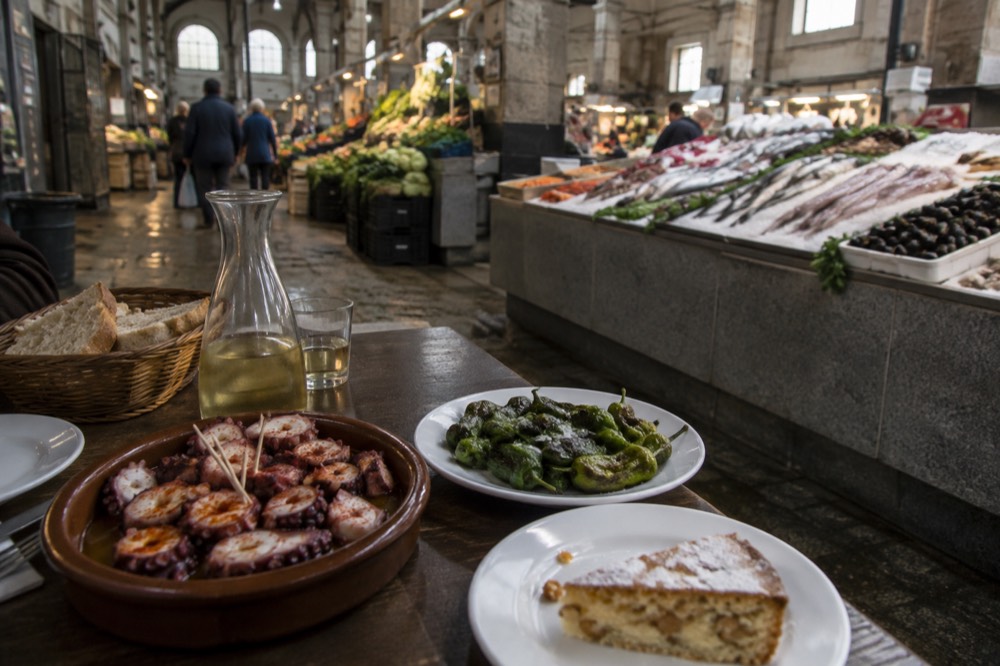
Two practical rules apply. First, octopus is sliced to order, and a plate that sits under a heat lamp is a plate worth refusing; the paprika bitters and the oil congeals. Second, portion words matter: a racion feeds two as part of a larger order, a media racion feeds one well. Ordering pulpo alongside padron peppers and a slice of tarta de Santiago is the standard Galician triad, and the guide to where to eat in Santiago de Compostela covers the full spread of restaurants.
For visitors who want the context as well as the plate, a guided walk through the historic town pairs the food streets with the story behind them.
How Do Galician Cooks Cook The Octopus?
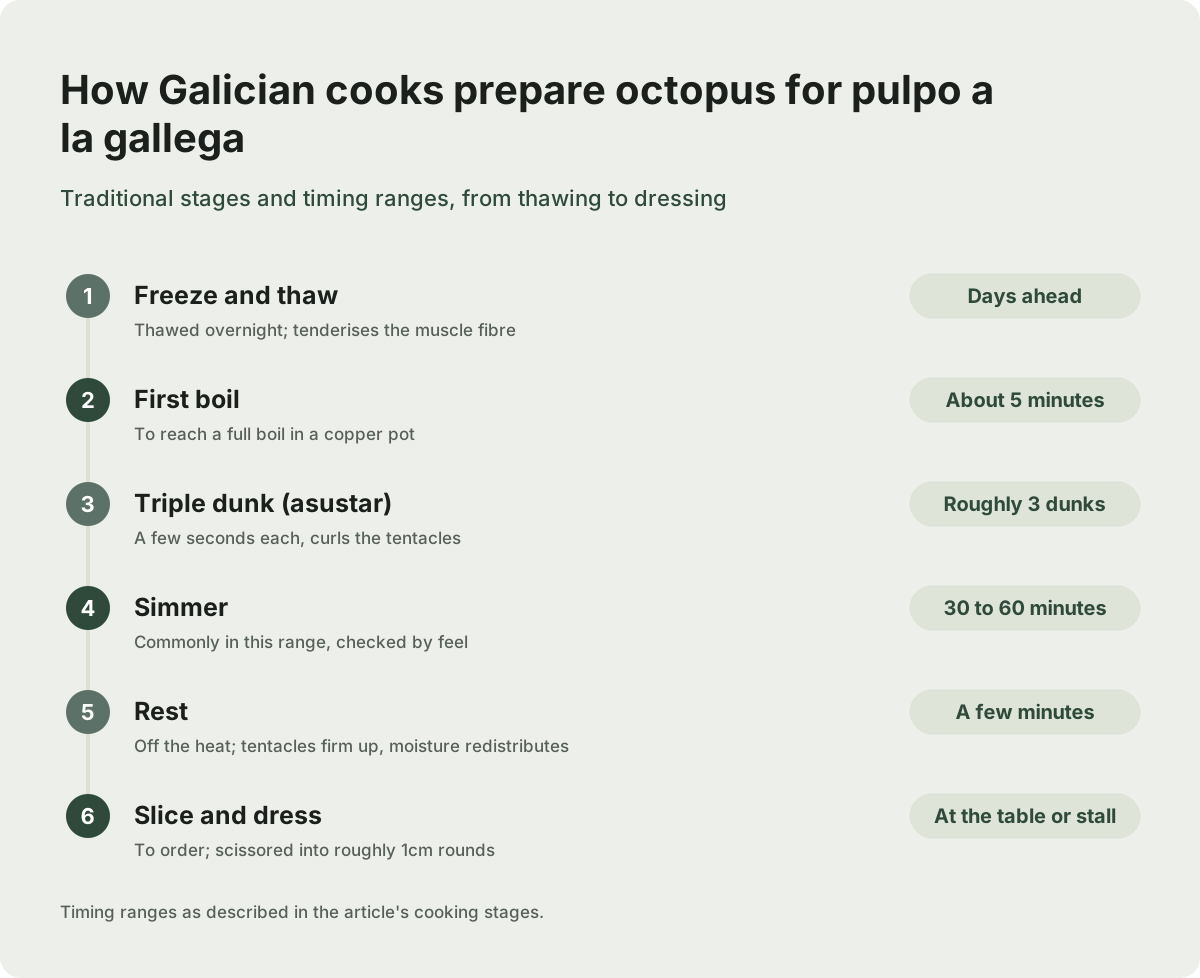
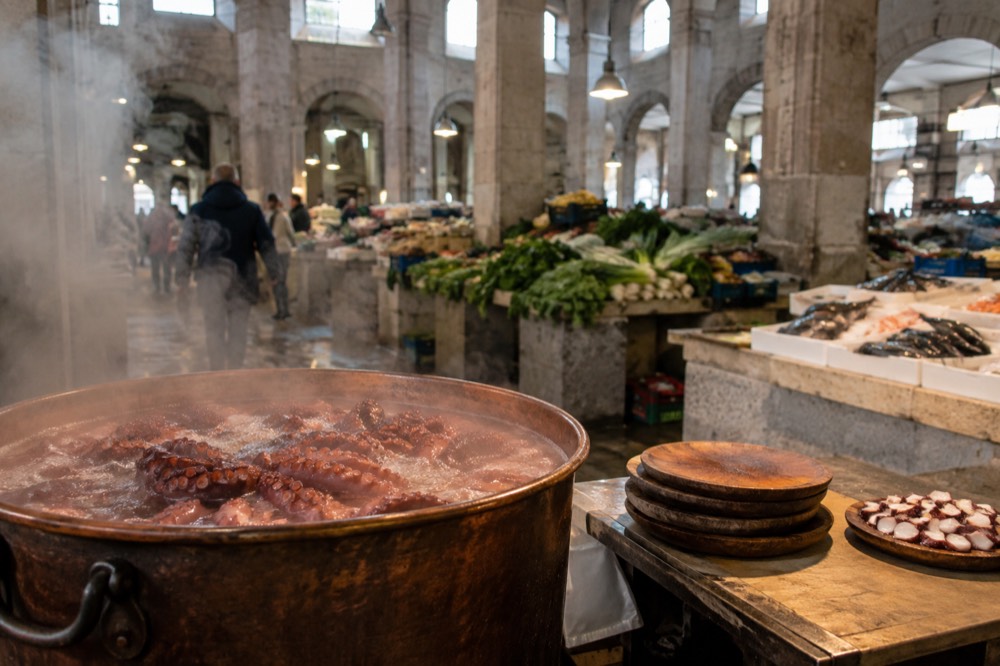
Traditional Galician cooking of pulpo a la gallega uses a copper pot, and the octopus is dunked three times into boiling water before it simmers until tender, which fair cooks time by eye and by feel rather than by clock. The copper matters: Galician practice holds that it keeps the flesh tender, and the triple dunking, called asustar, scares the octopus, curling the tentacles so they cook evenly. Cooks then rest it, slice it, and dress it while still warm.
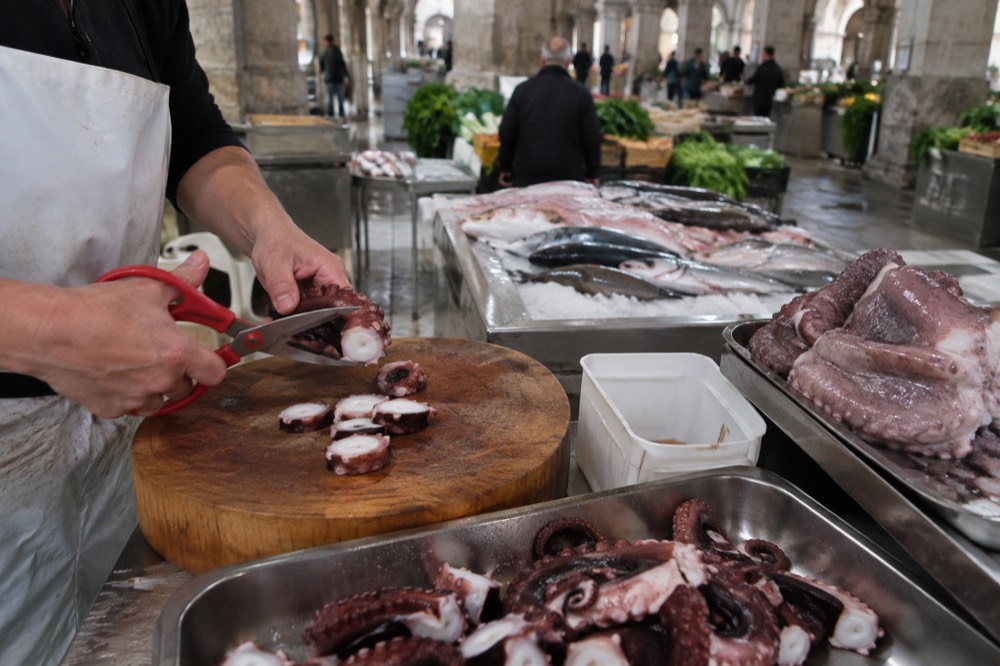
The sequence, as passed down among polbeiras, the fair cooks of inland Galicia, runs in clear stages. First the octopus is cleaned and often frozen, since freezing breaks down muscle fibre and is the widely used route to tenderness. The water is brought to a rolling boil in the copper pot. Holding the octopus by the head, the cook dips it three times, a few seconds each, lifting it out between dunks. Then it goes fully in to simmer. Potatoes, cachelos, go into the same water afterwards. The octopus is tested with a needle or by eye, rested briefly, sliced with kitchen scissors into rounds, and dressed at the last moment.
| Stage | What Happens | Typical Timing Range |
|---|---|---|
| Freeze and thaw | Tenderises the muscle fibre, standard modern practice | Days ahead, thawed overnight |
| First boil | Water at a rolling boil in a copper pot | About 5 minutes to reach a full boil |
| Triple dunk (asustar) | Octopus dipped three times to curl the tentacles | Roughly 3 dunks of a few seconds each |
| Simmer | Octopus cooks fully, checked by feel | Commonly in the range of 30 to 60 minutes, checked, not clocked |
| Rest | Tentacles firm up, moisture redistributes | A few minutes off the heat |
| Slice and dress | Scissored into rounds, oil, paprika, salt, potatoes | At the table or stall, to order |
Home cooks should treat those timings as planning ranges, not promises: the true test is the needle, which should slide into the thickest arm with slight resistance. Slicing happens only at the end, and dressing only after slicing, because paprika in hot oil for too long turns bitter.
Eating the dish well and understanding it are two different trips. A food-and-drink evening with a show turns Galician traditions into a single night out.
The queimada experience, listed from $17 per person with a 4 rating from 70 reviews, is a tasting built around the flaming orujo ritual that shares fairground roots with the octopus stalls. Free cancellation terms are shown on the operator's live listing.
Is Pulpo A La Gallega The Same As Pulpo A Feira?
Yes, in practice the two names describe the same plate: octopus boiled, sliced, dressed with oil, paprika and salt, served on wood with potatoes. Pulpo a feira, fair-style octopus, is the older and more local Galician name, tied to village feasts, while pulpo a la gallega is the Spanish-language label used on menus across Spain. Some restaurants distinguish them by portion or by plate, but the dish underneath is one dish.
The nuance is linguistic more than culinary. Ask for pulpo a feira in Santiago de Compostela and any bar will know exactly what is meant. The feira name carries the history: octopus was preserved and carried inland from the coast to feed crowds at patron-saint festivals, cooked in copper pots over wood fires by women who worked the fair circuit for generations. That circuit still runs. Galician towns hold their own octopus celebrations, the most famous of them in inland O Carballo country and the fisterra-side coastal belt, and the biggest single event, the Festa do Pulpo de O Carballino, draws tens of thousands each summer.
| Name | Where You See It | What It Signals |
|---|---|---|
| Pulpo a feira | Galicia, older bars, festival stalls | Traditional fair presentation, wooden plate |
| Pulpo a la gallega | Menus across Spain and beyond | The same dish under its Spanish label |
| Polbo a feira | Galician-language spelling | Same dish, local spelling of octopus |
| Octopus a la gallega | English-language menus | Translation of the Spanish label |
One warning worth printing: the version to be suspicious of is any plate where the octopus arrives pre-dressed and waiting. The classic order of operations, slice, then oil, then paprika, then salt, exists because the dressing does not keep.
A show-and-tasting evening such as the Queimada Experience, listed at from $17 per person, sits well after a pulpo dinner, since queimada is itself a fair and festival tradition.
What Should You Drink With Pulpo A La Gallega?
The classic pairing for pulpo a la gallega is a young Albarino white wine from the Rias Baixas, Galicia's Atlantic coastal wine region, whose acidity and saline edge cut through the olive oil and echo the dish's maritime origin. Estrella Galicia beer is the other common pairing at fairs, and orujo, Galicia's pomace spirit, arrives afterwards as a digestif, sometimes flamed as queimada.
Albarino is the headliner. Grown in the Rias Baixas, the drowned-valley region south of Santiago de Compostela around Cambados, the grape produces dry, high-acid whites with a mineral streak that locals say tastes of the sea, which is exactly the point next to octopus. The site's Albarino wine guide covers the region and the bodegas in detail, and several full-day tours run from the city to the wineries, some with a mussel-boat option on the ria.
| Pairing | Why It Works With Octopus | When To Choose It |
|---|---|---|
| Young Albarino | Acidity lifts the oil, saline notes match the seafood | The default restaurant pairing |
| Estrella Galencia beer | Cold, carbonated, cuts richness at street fairs | Festival and street settings |
| Ribeiro white | Another Galician white, slightly rounder | A softer alternative |
| Queimada (flamed orujo) | Ritual digestif, drunk after the meal | Evenings and festivals |
A private tapas tour of Santiago de Compostela, from $52 per person and rated 4.7 from 243 reviews, walks through several of these pairings in one evening.
When Is The Best Time To Eat Octopus In Santiago de Compostela?
Any time of year works, because pulpo a la gallega is a fixed feature of Santiago de Compostela's kitchens rather than a seasonal special, but the experience differs: summer brings festival season, outdoor stalls and the biggest crowds around the Feast of St. James on 25 July, while the wet, cool months from October to March mean eating indoors in taverns, often with fresher air on the plate and shorter queues.
AEMET's climate data for the Santiago de Compostela station describes a temperate oceanic climate, wet year-round, wetter from October to March and driest in July and August, with annual precipitation on the order of 1,690 to 1,890mm depending on the station and year measured. That weather shapes the eating calendar. Fair season runs warm-months, so the outdoor pulpo stall, the copper pot over wood, the paper plate eaten standing, is mostly a late-spring-to-early-autumn pleasure. In winter the dish moves inside, no less good for it.
The Feast of St. James on 25 July is the fixed high point of the city year, marked with a Pontifical Mass, fireworks, concerts and folk events. Anyone planning around it should know the calendar facts that the site's verified record states plainly: the next Holy Year is 2027, not 2026, with the Holy Door opening on the evening of 31 December 2026 and remaining open through 31 December 2027. The full seasonal picture is in the best time to visit Santiago de Compostela guide.
Can You Cook Pulpo A La Gallega At Home?
Yes, and the home method is a reasonable simplification of the fair technique: freeze and thaw the octopus first, simmer it in plenty of water until a needle slides into the thickest arm with slight resistance, rest it, then slice with scissors and dress with olive oil, paprika and coarse salt while still warm, with potatoes boiled in the same water alongside. A large pot stands in for copper, and the triple dunk is worth keeping because it curls the tentacles.
Copper pots are not realistic in most kitchens, and Galician cooks themselves are divided on how much of the copper effect is chemistry and how much is ritual. The steps that genuinely matter are the freeze, which tenderises; the dunking, which sets the tentacle shape; and the last-minute dressing, which protects the paprika. Boil the potatoes, cachelos, in the octopus water after the octopus comes out, and serve everything on a warm plate, ideally wood, with the oil applied at the table.
| Home Step | What To Do | What Can Go Wrong |
|---|---|---|
| Freezing | Freeze the raw octopus, thaw overnight in the fridge | Skipping it risks rubbery flesh |
| Water | A large pot, well salted, at a rolling boil | Too small a pot drops the temperature on adding the octopus |
| Triple dunk | Dip three times, a few seconds each, lifting out between | Rushing it leaves tentacles uncurled and uneven |
| Simmer and test | Check with a needle in the thickest arm, not by clock | Overcooking turns the skin slimy |
| Slice | Kitchen scissors, roughly 1cm rounds | Slicing early cools and toughens the plate |
| Dress | Oil first, paprika, salt last, at the table | Hot oil plus paprika sitting too long turns bitter |
The dish survives travel and home cooking better than most seafood classics precisely because its flavours are shelf-stable: oil, dried paprika, salt. The octopus itself is the only fresh element, which is why it became the fair food of inland Galicia in the first place.
How Does Pulpo Fit The Wider Galician Table In Santiago de Compostela?
Pulpo a la gallega anchors a Galician table that also includes padron peppers, empanada, laccon con grelos, razor clams and tarta de Santiago, and in Santiago de Compostela most of it arrives together as tapas rather than as separate courses. Octopus is the prestige plate, the one ordered to mark an arrival or a celebration, and around it the region's cooking shows its Atlantic and inland halves: shellfish and fish from the rias, pork and greens from the interior.
Understanding the table as a whole explains why the octopus matters so much. Galician cuisine is built on two geographies. The coast supplies percebes, gooseneck barnacles harvested off the Costa da Morte; navajas, razor clams; and the mussels of the Rias Baixas, the last of which appear on winery day trips by the boatload. The interior supplies the pork, the turnip greens and the potatoes that fill the plate. Pulpo sits exactly between the two: an Atlantic creature, cooked by inland fair cooks, dressed with a pantry shelf.
| Galician Classic | What It Is | How It Sits Next To Pulpo |
|---|---|---|
| Padron peppers | Small green peppers, fried in oil and salted, mostly mild | The standard co-starter, occasionally hot |
| Empanada | Filled pie, often with tuna, cod or octopus | The same octopus appears baked inside |
| Laccon con grelos | Pork shoulder with turnip greens and potatoes | The inland half of the table |
| Tarta de Santiago | Almond cake, sugar-dusted with the cross of St. James | The near-universal dessert |
| Queimada | Flamed orujo spirit with fruit and coffee, a ritual | The after-dinner ceremony |
The ritual side of that table deserves its own mention. Queimada, the flamed spirit drink whose name the tasting show borrows, is stirred and set alight while a spell, the conxuro, is recited, a fairground tradition as theatrical as the copper pots themselves. For travellers who want the food traditions explained rather than just served, an evening built around them is a compact way in.
The guided foodie tour with drinks, tapas and live music runs from $51 per person and carries a 4.7 rating from 227 reviews on its live listing, a survey of the table above in a single sitting.
For the deeper route into the region's produce, the wine country itself is a day trip: full-day Rias Baixas excursions from Santiago de Compostela run from the low $50s per person on this site's roster, pairing winery visits with the mussel boats of the ria.
Common Questions About Pulpo A La Gallega
What is pulpo a la gallega?
Boiled octopus sliced into rounds and dressed with olive oil, coarse salt and paprika, served warm on a wooden plate with boiled potatoes. It is the signature dish of Galicia and appears across Santiago de Compostela from market stalls to old-town restaurants.
Is pulpo a la gallega the same as pulpo a feira?
In practice yes. Pulpo a feira, fair-style octopus, is the older Galician name tied to village festivals, while pulpo a la gallega is the Spanish label used on menus across Spain. The plate underneath is the same dish.
Why do Galician cooks use a copper pot for octopus?
Galician tradition holds that copper keeps the octopus tender during the long simmer, and fair cooks have used copper pots for generations. The scientifically load-bearing steps are freezing the octopus first and testing it with a needle, but the copper tradition persists and costs nothing to respect.
What wine goes with pulpo a la gallega?
A young Albarino from the Rias Baixas is the classic pairing: dry, high-acid and saline, it lifts the olive oil and matches the dish's maritime origin. Estrella Galicia beer is the standard pairing at outdoor fairs, and queimada, flamed orujo, comes afterwards as a digestif.
Where should I eat pulpo a la gallega in Santiago de Compostela?
Start with the tapas streets around Rua do Franco and the bars around Mercado de Abastos, the city's working food market. Look for places that slice and dress the octopus to order rather than serving plates kept warm, and order it as a racion or media racion alongside padron peppers.
Can I cook pulpo a la gallega at home?
Yes. Freeze and thaw the octopus, simmer it until a needle slides into the thickest arm with slight resistance, rest it, then slice with scissors and dress with oil, paprika and coarse salt while still warm, with potatoes boiled in the same water. Treat timings as ranges and test by feel, not by clock.
The plate itself is the short version of Galicia: an Atlantic animal, an inland technique, a dressing of three pantry ingredients, and a city, Santiago de Compostela, that has been feeding arriving travellers for over a thousand years. Order it sliced to order, dress it at the table, and drink the Albarino cold.