Can You Do The Camino de Santiago With Kids?
Yes, families walk the Camino de Santiago with kids every year. What the rules require, which route suits children best, where families sleep, and what to do in Santiago de Compostela at the end.
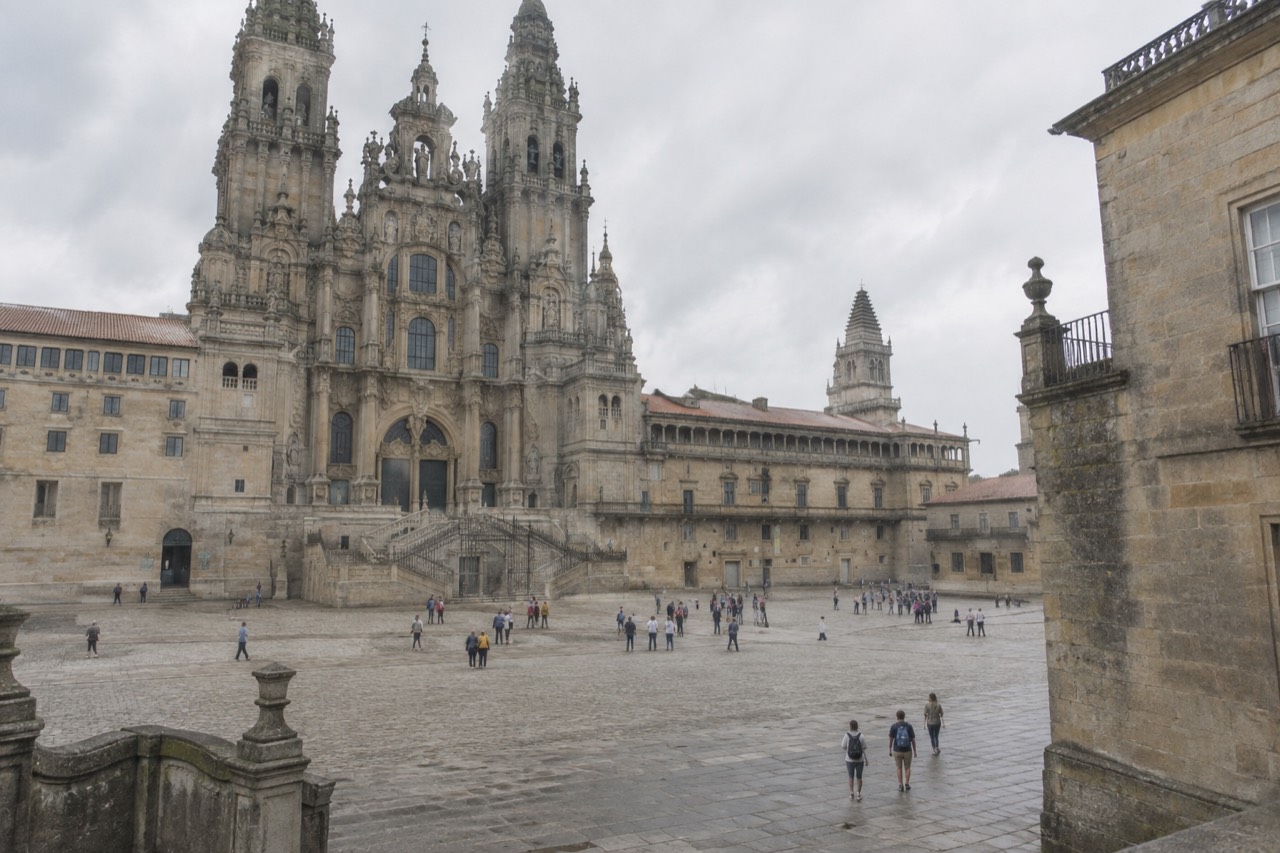
Families with children walk into Santiago de Compostela every summer, and the numbers behind the pilgrim traffic make that plain: the Oficina del Peregrino recorded 530,987 Compostela certificates in 2025, a record year, and a steady share of those pilgrims arrive as family groups rather than solo walkers. The Camino de Santiago is not an expedition requiring technical skill. It is a waymarked walking route ending at a cathedral city in Galicia, and the rules that matter most to a family, the credencial stamps and the qualifying distance, are published and stable. What varies is pacing, sleeping arrangements and how you handle the finishing city with tired children, and those are the parts worth planning properly.
Can You Do The Camino de Santiago With Kids?
Yes, children walk the Camino de Santiago every year, and the Camino Frances from Sarria is the stretch most families choose, because the Compostela certificate requires only the final 100km on foot. The Oficina del Peregrino's rules set two stamps per day in the credencial as the proof of walking, and the certificate itself is issued in person only, at Rua das Carretas 33 in Santiago de Compostela. No minimum age is written into those published rules.
In practice, families succeed on this route for the same reason many first-time adult pilgrims do: the qualifying stretch is short enough to break into manageable walking days, and the infrastructure along the busiest final stages is built around people who are not athletes. Children who can handle a full day of holiday walking can handle the Camino when the day is planned around them.
The honest caveat is the same one that applies to any long walk with children. Some days go badly, weather in Galicia is wet for much of the year, and the parent carrying the plan matters more than the route chosen. The rest of this page works through the decisions in order: route, daily distance, sleeping, the certificate rules, packing, and what to do in Santiago de Compostela once the walking stops.
Which Route Works Best For Families Walking To Santiago de Compostela?
The Camino Frances starting at Sarria is the family default, because the Compostela rules count only the final 100km on foot, and Sarria sits right at that qualifying line, letting parents keep the walking days short and still earn the children their certificate. The Camino Portugues and the Camino del Norte also finish in Santiago de Compostela, but both demand more consecutive walking before the qualifying section.
The choice is really a choice about how many days the family can give. Starting at Sarria means the walk qualifies in full while staying inside a school-holiday-sized window, and it is the stretch with the most family traffic, which matters socially for children who enjoy meeting other pilgrims. A family with more time and confident teenage walkers can look at the Camino Portugues from Tui or the northern routes, accepting a longer commitment before the finish.
One structural point is worth fixing early. Whichever route the family chooses, the last stretch into the city follows the same arrival sequence, the climb to Monte do Gozo and the descent into the old town, and every route ends at the same place, the Cathedral of Santiago de Compostela. The route guide on this site, including the full Camino de Santiago Routes Comparison, lays out the options route by route, and the parent-facing pages of the Santiago de Compostela Travel Guide cover each finish in detail.
Route choice also sets the seasons. AEMET's climate data for the Santiago de Compostela station shows a temperate oceanic pattern, wet year-round, wetter from October to March and driest in July and August. Families tied to school holidays usually walk in the dry summer weeks and accept the crowds; families with flexible dates walk in late spring for cooler walking days.
How Far Should Children Walk Each Day On The Camino de Santiago?
There is no official daily distance for children, and the Compostela rules impose none: the only figure the Oficina del Peregrino's requirements care about is the qualifying 100km walked overall, with two credencial stamps per day as evidence. Daily distance is therefore a family decision, not a rule, and most parents plan shorter days than solo adult pilgrims take, building in buffer time for rest days and slow mornings.
The practical approach that works on this route is to treat the qualifying stretch as a budget of kilometres to spend across whatever days the family has. More days means shorter days. A family with two weeks available can walk gently and still qualify comfortably from Sarria; a family with one tight week needs longer days and should be honest about whether the children can sustain them.
Three planning habits reduce the risk of the walk collapsing halfway:
- Walk the first two or three days deliberately shorter than the plan assumes, because early-stage enthusiasm fades faster than distance does.
- Decide in advance which town each day targets, so a tired child knows the walk ends at a place, not at an arbitrary number.
- Keep one spare day unused in the plan, so a bad weather morning in Galicia's wet climate does not force an impossible catch-up day.
Galicia's rain deserves its own mention. AEMET's station data for Santiago de Compostela puts annual precipitation on the order of 1,690-1,890mm, spread across a wet year rather than concentrated in a stormy season, and October to March is the wetter stretch. Waterproofs for children, checked before departure, matter more than almost anything else in the bags. For the timing question in full, the page on How Long Does It Take To Walk The Camino de Santiago covers the adult baseline families adapt downward.
Where Do Families Sleep On The Camino de Santiago?
Families sleep either in albergues, the shared pilgrim hostels that give the Camino its social character, or in private rooms in small hotels and casas along the route, and the mix matters because many shared albergues are dormitory-style, which suits some children and not others. Private rooms are the usual family answer, and in the busiest summer weeks they need reserving ahead rather than trusting to arrival.
The decision splits by family temperament. Children who enjoy crowds and early bedtimes often love albergue life, the shared meals and the stream of other pilgrims, while children who need their own space do better in a private room where the family controls lights-out and wake-up. There is no rule against mixing the two: many families use dormitory albergues on quiet stages and private rooms on the ones where a proper night's sleep matters.
The one operational reality to plan for is the peak season. July and August, which AEMET's data confirms as the driest window, are also when demand is highest, and a family arriving late in a town with two private rooms left has no negotiating position. Reserving ahead for the busiest stages, and staying flexible on the quiet ones, is the compromise most families land on.
The full accommodation picture, including what albergues are and how the credencial interacts with where you stay, is laid out in the Camino Accommodation And Albergues Guide. The short version for parents: know each night's target town before the morning starts, and treat the sleeping plan as part of the walk rather than an afterthought.
What Do The Certificate Rules Mean For Children Walking?
The Oficina del Peregrino's published rules award the Compostela to anyone who completes the final 100km on foot or on horseback, or the final 200km by bicycle, on a recognized route, collecting at least two stamps per day in the credencial from official stamping points, and the certificate is issued in person only at the Pilgrim's Office, Rua das Carretas 33, Santiago de Compostela. Children meeting those requirements are certificated the same way adults are.
The mechanics are worth understanding before the first walking day, because the credencial, the pilgrim passport, is the document the whole system hangs on. It needs stamping at least twice a day across the qualifying stretch, and the stamps have to come from official stamping points, which the Pilgrim's Office itself defines. Families typically collect stamps at the start of the day, at a caf or church, and again at the end in the place they sleep.
The rules in table form:
| Requirement | On Foot Or Horseback | By Bicycle |
|---|---|---|
| Minimum qualifying distance | Final 100km | Final 200km |
| Minimum credencial stamps | Two per day | Two per day |
| Where stamps come from | Official stamping points | Official stamping points |
| Where the Compostela is issued | Rua das Carretas 33, in person | Rua das Carretas 33, in person |
The credencial itself is the first practical errand. It can be obtained before the walk starts or at points along the route, and the Pilgrim Passport And Credencial Guide explains where and how. Children walking with parents are usually given their own credencial rather than being listed on a parent's, which is what turns the finish into a certificate ceremony for each child rather than one shared document.
One note on the finish line itself. The Compostela is a religious certificate, and the Pilgrim's Office frames it that way; families of any background can and do collect it, but it is worth knowing what the document is before queueing with excited children. The office closes on 25 December and 1 January, and its hours shift seasonally, so on an arrival day it pays to go early.
What Should Families Pack For The Camino de Santiago With Kids?
Families should pack for wet, changeable Galician weather first and distance second: waterproof jacket and trousers for every walker, broken-in footwear, one change of walking clothes, sun protection for the dry summer weeks, and the credencial carried somewhere it cannot be lost. The lightest realistic bags win, because a parent carrying a child's excess weight pays for it every afternoon, not once.
The packing errors families make are consistent. Bags packed for every weather rather than the likely weather. New shoes brought on their first long walk. Umbrellas in place of proper waterproofs, which Galician wind turns into a lost cause. The full checklist, sized for adults but adaptable item by item, sits in the Camino Packing List, and the differences for children are mostly about spares: a spare pair of socks matters more to a ten-year-old with a blister starting than any gadget.
A few items earn their weight specifically with children:
- A small day-pack the child carries personally, holding their own snack and waterproof, so the walk feels like theirs.
- Blister treatment bought before departure, because pharmacies in small villages keep short hours.
- A paper credencial, not a photograph of it, because the stamp has to land on the physical document.
The rule of thumb on luggage applies doubly with children. Whatever a family imagines it needs, the version that works is smaller, and the same clothes worn repeatedly bother adults more than children, who rarely notice.
What Is There To Do In Santiago de Compostela After The Walk Ends?
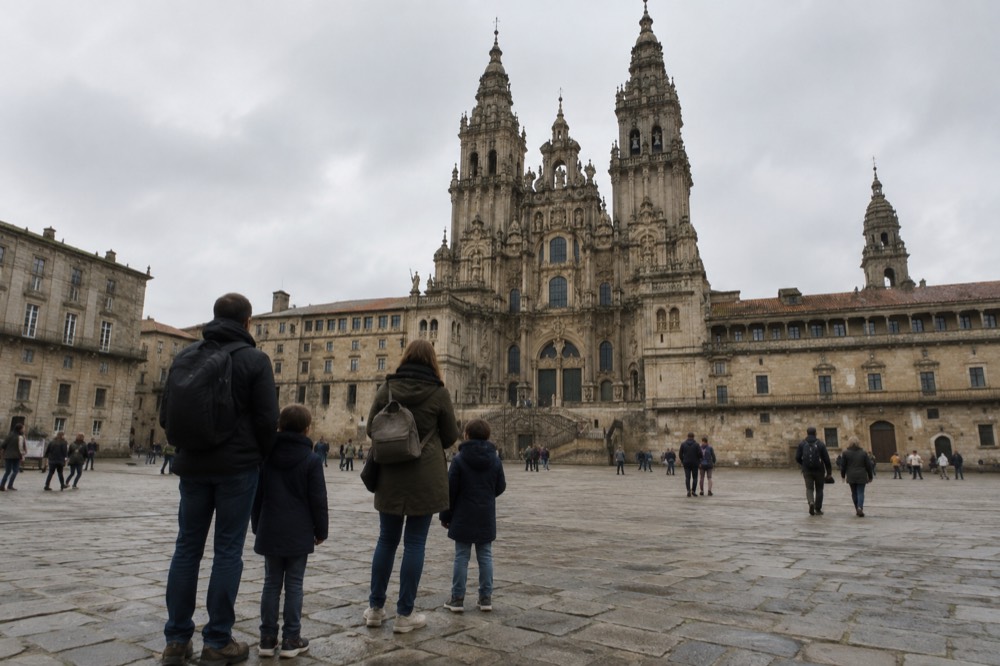
The finish in Santiago de Compostela centres on the Cathedral: pilgrim masses, the old town's UNESCO-listed streets, the Praza do Obradoiro, and museum and rooftop visits inside the Cathedral itself, with two UNESCO inscriptions in play, the Old Town since 1985 and the Camino routes since 1993. Children who have walked in usually want to climb things, and the Cathedral's own rooftop tour exists precisely for that.
The first thing most families want is the pilgrim mass, and the current arrangement needs stating carefully, because it changes mid-autumn 2026. Until 15 October 2026, the Cathedral's daily pilgrim masses are held at the High Altar at 7:30am, 9:30am, noon and 7:30pm. From 16 October 2026, while main chapel works prepare for the 2027 Holy Year, the 9:30am, noon and 7:30pm masses relocate to the nearby Church of San Agustin, and only the 7:30am mass stays in the Cathedral, in its Communion chapel.
| Mass time | Until 15 October 2026 | From 16 October 2026 |
|---|---|---|
| 7:30am | Cathedral, High Altar | Cathedral, Communion chapel |
| 9:30am | Cathedral, High Altar | Church of San Agustin |
| Noon | Cathedral, High Altar | Church of San Agustin |
| 7:30pm | Cathedral, High Altar | Church of San Agustin |
The Botafumeiro, the giant censer most children have seen in photos, needs an honest mention: it does not currently swing. The Cathedral confirmed in writing on 5 September 2026 that restoration scaffolding over the dome covers its hanging mechanism, and no return date has been published. It normally flies at the end of the main solemn mass on twelve fixed liturgical dates a year, but families planning a trip around seeing it should not promise children a swinging censer until the Cathedral says otherwise.
What does deliver, immediately and reliably, is the Cathedral's own rooftop tour. Operated by the Cathedral itself, the Cubiertas and Torre de la Carraca visit runs about 60 minutes, climbs about 140 steps and reaches a height of about 72 metres over the city, with the general ticket at EUR15 and a reduced EUR12 rate, bookable with timed slots on the Cathedral's own ticketing site. For a child who has just walked the final stage, looking down on the roofs they walked in among is the reward that lands hardest. Check availability
Beyond the Cathedral, the old town works at children's pace: Praza do Obradoiro for the open square moment, Rua do Franco for eating, the Alameda park's viewpoint over the Cathedral's towers, and the Mercado de Abastos for the food hall atmosphere, with hours best checked on the venue's own site before going. The arrival sequence, including the last stage from Monte do Gozo, is walked through in Arriving In Santiago de Compostela On The Camino, and the day-by-day plan for the city itself with children in tow is in Santiago de Compostela With Kids.
Common Questions About The Camino de Santiago With Kids
Can you do the Camino de Santiago with kids?
Yes. Children walk the route every year, most commonly on the Camino Frances from Sarria, because the Compostela certificate requires only the final 100km on foot with two credencial stamps per day, collected from official stamping points, and is issued in person at the Pilgrim's Office in Santiago de Compostela.
Do children get a Compostela certificate too?
Children who complete the qualifying distance and credencial requirements are issued the Compostela on the same basis as adults, in person at Rua das Carretas 33 in Santiago de Compostela. Each child walking should carry their own credencial so the stamps land on their own document.
How old should a child be to walk the Camino de Santiago?
The published Compostela rules set no minimum age, only the distance and stamp requirements. The honest answer is that it depends on the child's walking stamina, and parents are the best judge of that; shorter daily distances and a longer overall window are what make the route work for younger children.
Can we cycle the Camino de Santiago as a family?
Yes, and the qualifying rule for cyclists is the final 200km rather than the final 100km that applies on foot. The same two-stamps-per-day credencial requirement applies. The distance and route implications of cycling are covered separately in the page on doing the Camino de Santiago by bike.
Will we see the Botafumeiro swing when we arrive?
Not currently. The Cathedral confirmed in writing on 5 September 2026 that the Botafumeiro is out of action because restoration scaffolding over the dome covers its mechanism, and no return date has been published. It normally swings on twelve fixed liturgical dates a year, but no family should plan a trip around seeing it until the Cathedral announces its return.
Is 2026 a Holy Year in Santiago de Compostela?
No. The next Holy Year, the Xacobeo, is 2027: the Holy Door opens on 31 December 2026 and the Holy Year runs through 31 December 2027. Families walking in 2026 will find the door closed, and those walking in 2027 will find the city at its busiest.