Tapas Santiago de Compostela
Tapas in Santiago de Compostela are paid Galician plates, not free southern style snacks. Here is where to eat them, what to order, and what an evening crawl realistically costs.
Short answer
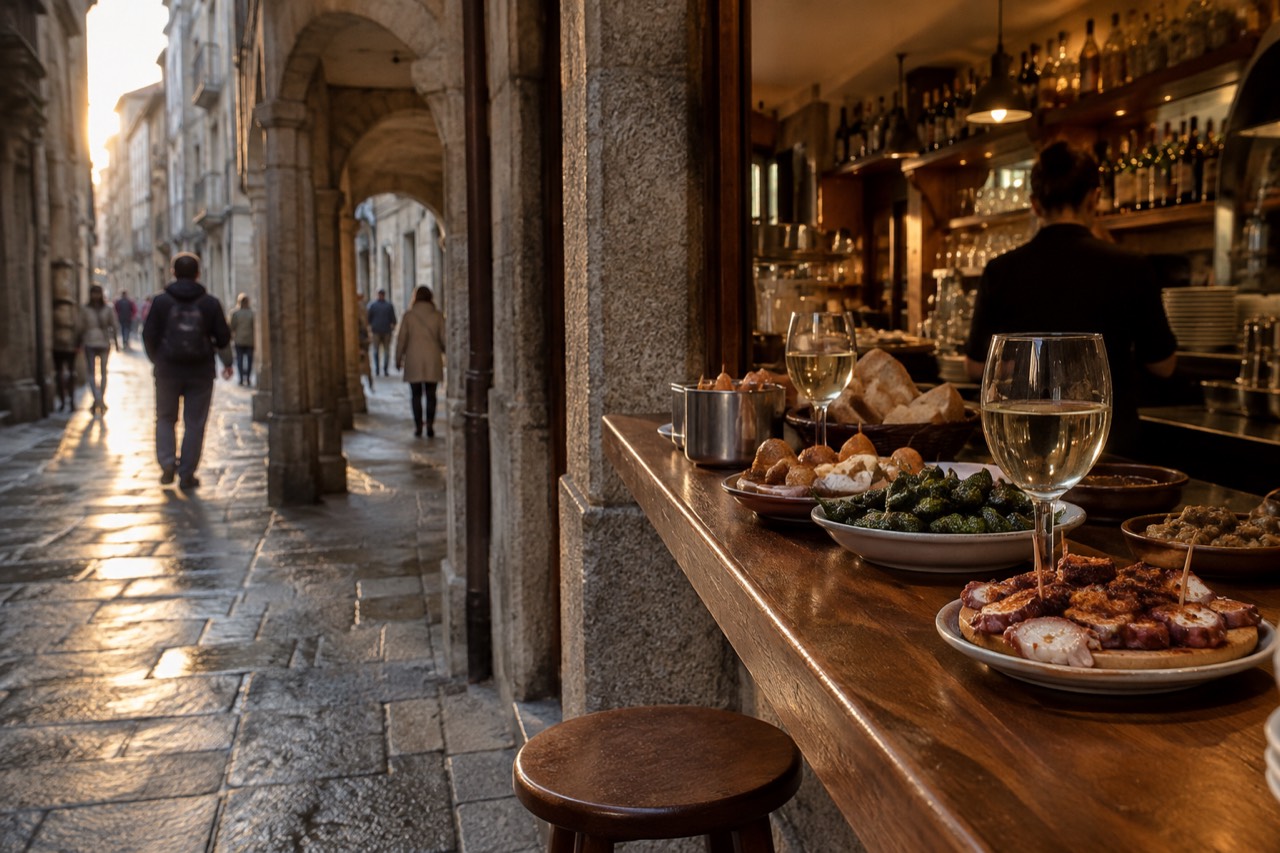
Tapas in Santiago de Compostela are ordered tapas or half rations of Galician dishes like octopus and Padron peppers, eaten standing at the bar or at small tables with local Ribeiro or Albarino wine, mostly in the lanes around Rua do Franco, Rua da Rainha and the Mercado de Abastos.
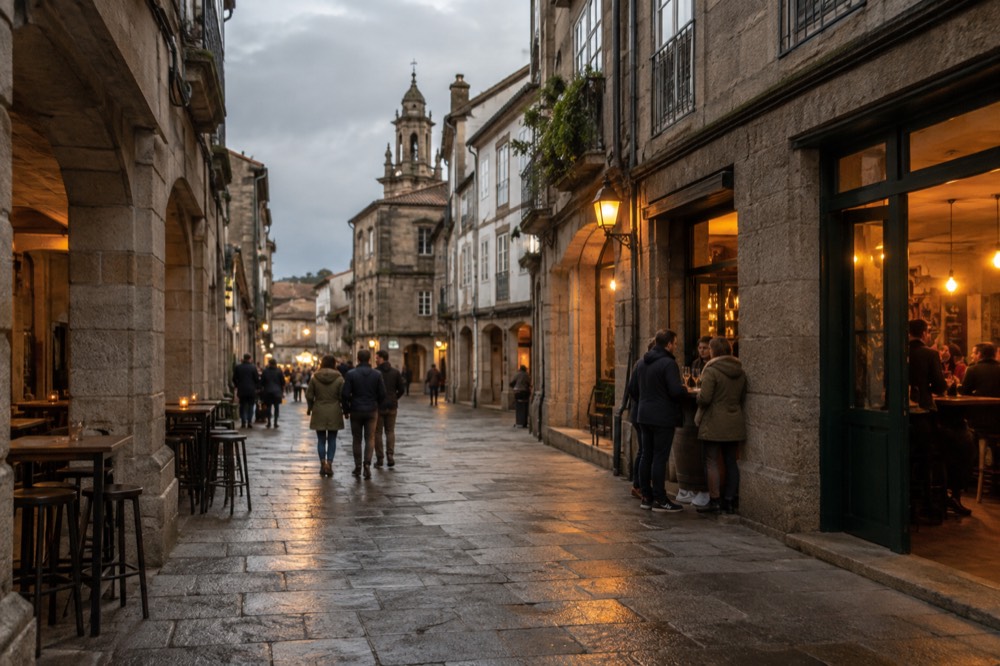
Santiago de Compostela eats differently from the rest of Spain, and the difference matters the moment you sit down at a counter. This is a pilgrim cathedral city in Galicia, in the green northwest corner of the country, and its tapas culture runs on Galician products: octopus, Padron peppers, empanada, tetilla cheese and the sharp local whites poured by the glass. There is no free plate with every drink here, the way there is further south. What you get instead is a compact UNESCO listed old town in which a serious evening of bar hopping takes place entirely on foot, often within four or five streets of the Cathedral itself.
The whole subject fits the way the city is built. The Santiago de Compostela Travel Guide eating coverage is organized around the old town's walkable scale, and tapas is the clearest case of it: one evening can move from a market side kitchen to a Rua do Franco counter to a quiet lane off Praza de Cervantes without a single taxi. This page lays out how the culture works, which bars carry the most weight, what to order, what it costs, and how to build a realistic route.
What Is Tapas Culture Like In Santiago de Compostela?
Tapas in Santiago de Compostela are small, fork and plate Galician dishes rather than the free snacks of southern Spain, ordered as a tapa or a media racion and eaten standing at the bar or at a small table, with local Ribeiro and Albarino wine served by the glass. Because the old town is compact and UNESCO listed, an evening moves easily from one counter to the next entirely on foot.
The first thing to understand is that the tapa is a paid item here. In Andalusia a small plate often arrives with a drink at no charge. In Galicia, the tapa is a deliberately small portion you order deliberately, priced accordingly, and the media racion, the half ration, is the size most locals actually eat when they are making an evening of it. The full racion is a plate to share between two or three people.
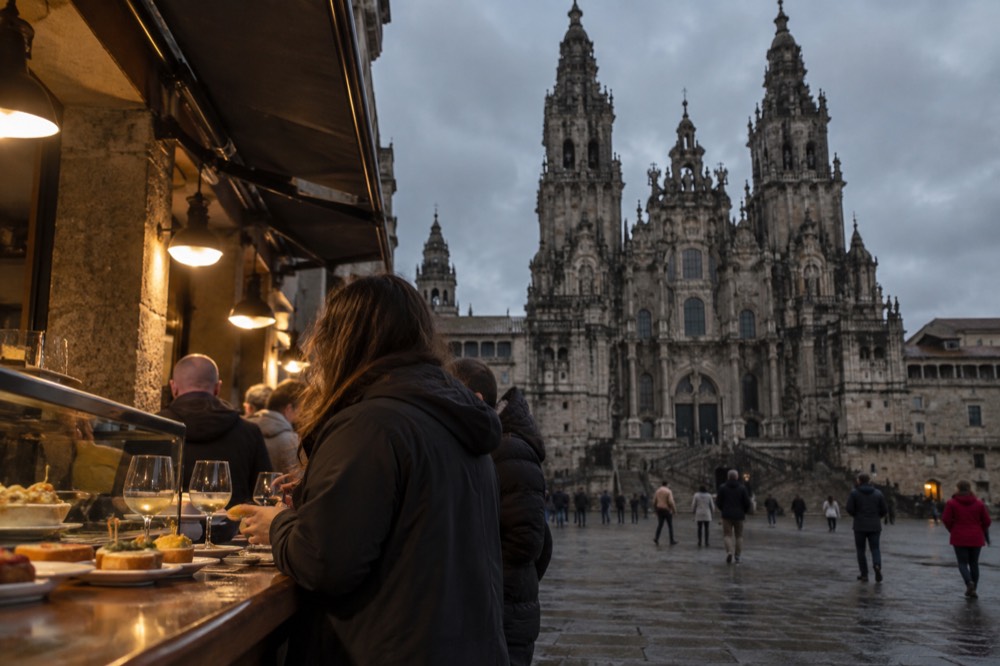
The second thing is the standing culture. The best bars in Santiago de Compostela have a counter and very few tables, and the counter is where the action is. You order by pointing at the glass case or the chalkboard, you eat where you stand, and you move on. An evening that covers five bars is not unusual and not rushed, because none of them is more than a few minutes' walk from another.
The third thing is the wine. Galicia drinks its own whites: Ribeiro, fruity and slightly rustic, often poured from small flat sided bottles called tazas; Albarino from the Rias Baixas coast, brighter and more citric; and the reds of Ribeira Sacra, which are increasingly present on good lists. A tapas evening in this city is as much a wine tasting as a dinner, and the bars with the longest local lists treat it that way.
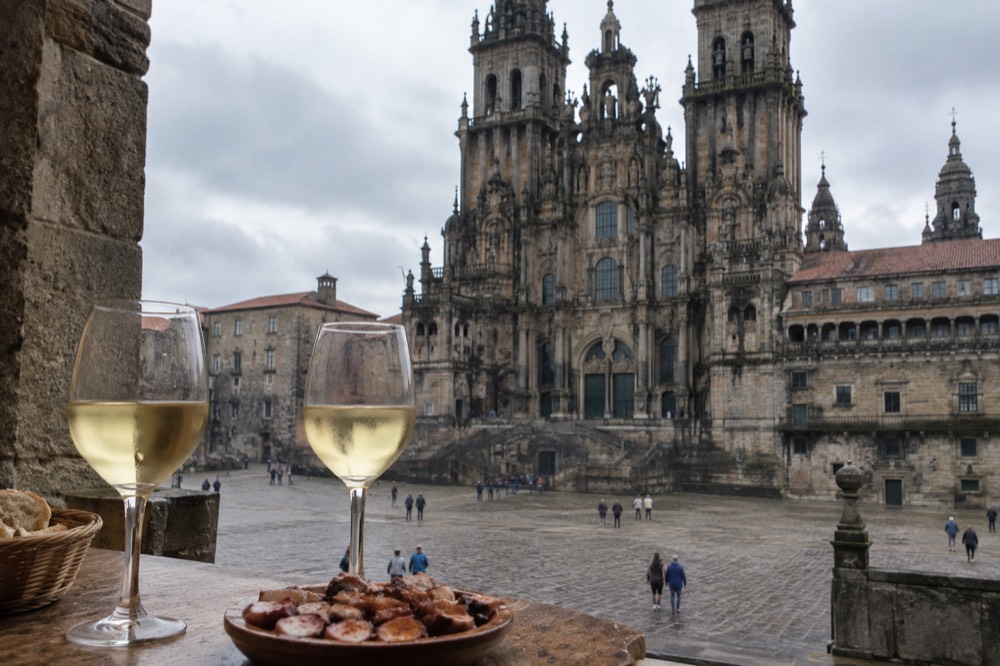
None of this needs a big budget or a plan made weeks ahead, with one exception: the chef driven rooms described below fill their few tables every night in high season. Everything else, the counters and the wine bars, works on a walk in basis, and that walk is the entire point.
Which Are The Best Tapas Bars In Santiago de Compostela?
The strongest lineup pairs the old school counter of A Taberna do Bispo on Rua do Franco with Casa Marcelo near Praza de Cervantes, the market side kitchen Abastos 2.0, the creative Galician small plates of A Tafona and O Curro da Parra, and the deep local wine list at O Beiro on Rua da Rainha. All of them sit inside the compact old town, a short walk from the Cathedral.
Every one of these is a real institution with a distinct job. The table below is the honest division of labour for an evening or a week of evenings.
| Bar | Area | Known For | Best For |
|---|---|---|---|
| A Taberna do Bispo | Rua do Franco | Long Galician and Spanish tapas list, counters and casual tables | First stop, classic order anything evening |
| O Beiro | Rua da Rainha | One of the deepest Galician wine lists in the city, tapas sized to the glass | Wine first, food second |
| Casa Marcelo | Near Praza de Cervantes | Small chef driven room, Galician products with a broader kitchen | A booked sit down tapas dinner |
| Abastos 2.0 | Beside the Mercado de Abastos | Market produce tapas, standing and bar seating, no table service | Lunch after the market |
| A Tafona | Rua das Hortas direction | Creative Galician small plates, own bread and preserves | A slower, booked evening |
| O Curro da Parra | Rua da Trinidade | Produce led small plates, natural leaning wine list | Couples wanting a quiet stop |
Two honest caveats. First, Rua do Franco is the street every guide names, and it deserves it, but it is also where the highest volume of one visit traffic eats. The bars listed above on that street hold up because their lists are long and local. Second, hours and days open change by season and by the tourist calendar, so the pattern to follow is to treat any single bar's schedule as checkable rather than fixed, and to keep two backups in mind for any given evening.
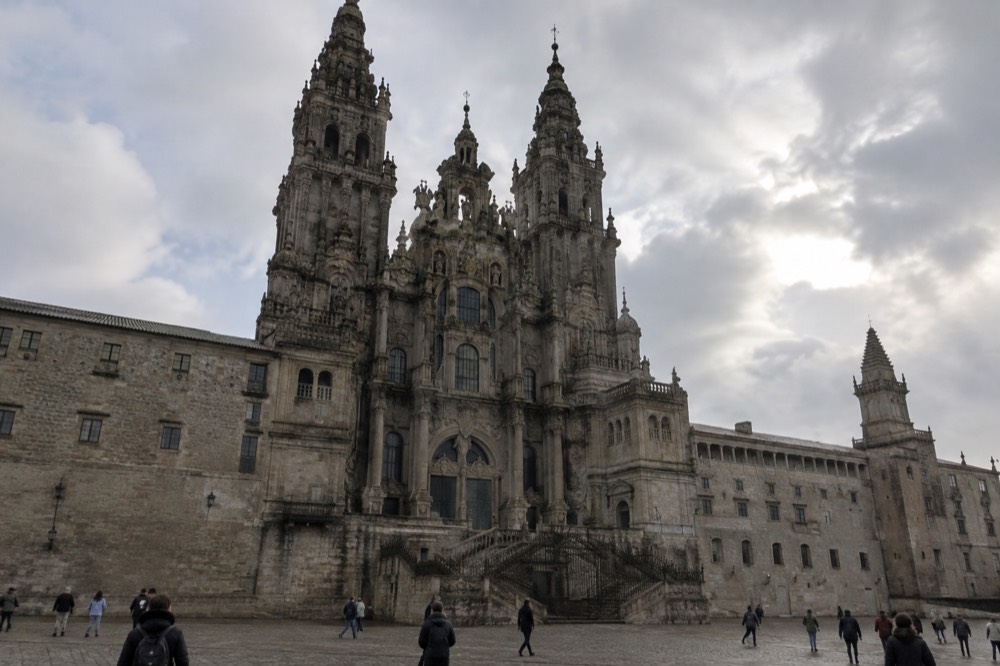
If choosing between counters feels like work before you have even arrived, the guided option solves it: a tapas walk run by a local who decides what to order at each stop covers exactly this job in one evening. Check availability for the date that suits, since the operator's live listing carries the current price.
Each of those three covers a different itch: the tapas walk, a half day city and Cathedral visit with tickets included for the sightseeing half of the day, and a full day out to the Rias Baixas coast when the city needs a break. Between them they cover the two halves of any Santiago de Compostela visit, the plates and the pilgrimage city itself.
What Should You Order At Tapas Bars In Santiago de Compostela?
Order the Galician canon: pulpo a la gallega, octopus with olive oil and paprika on a wooden plate; pementos de Padron, the small green peppers where roughly one in a handful is hot; empanada, the savoury pastry pie; tetilla cheese; zamburinas, small scallops; and laccon con grelos, pork shoulder with turnip greens, all matched with a glass of Ribeiro or Albarino.
The canon is small and it is worth knowing cold, because chalkboards in Galician move fast and half the pleasure is ordering with confidence. The Galician food tradition rewards the same few dishes done properly, and tapas kitchens are where those dishes appear in the most edible, least ceremonial form.
| Dish | What It Is | How To Order It |
|---|---|---|
| Pulpo a la gallega | Boiled octopus, olive oil, coarse salt, paprika, often on a wooden plate | As a media racion to share, the definitive tapa |
| Pementos de Padron | Small green peppers fried in olive oil with coarse salt | As a tapa; watch for the occasional hot one |
| Empanada | Savoury pie, classic fillings tuna, cod with raisins, or meat | As a tapa portion cut from the tin |
| Queixo de tetilla | Soft, mild, tear shaped Galician cow's cheese | With a glass of Albarino |
| Zamburinas | Small scallops, usually a la plancha with oil and garlic | As a tapa when on the board |
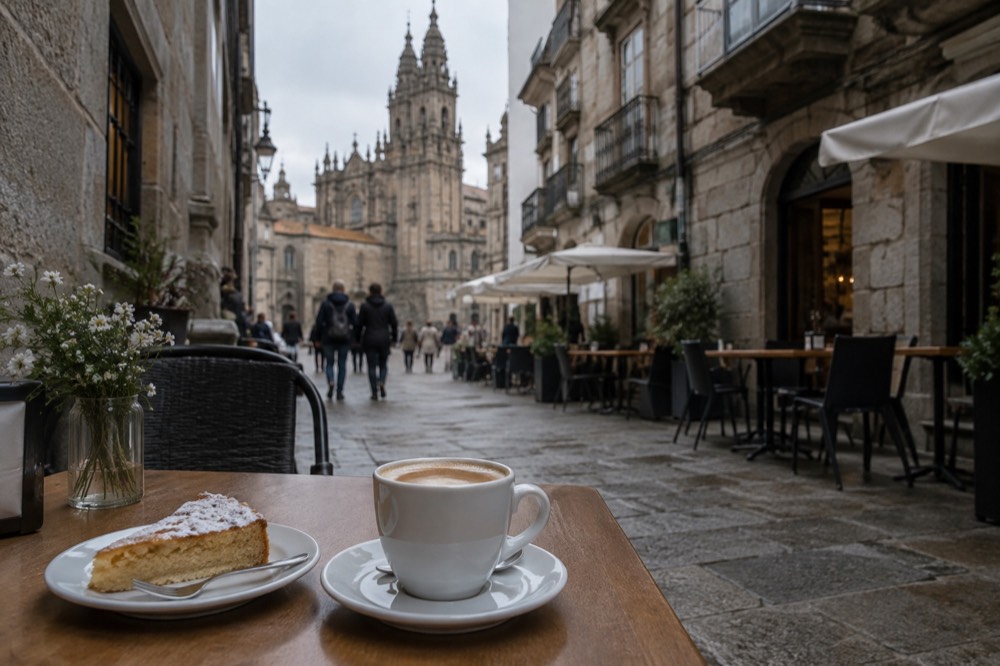
| Tarta de Santiago | Almond cake, often with the cross of St James stencil | To close the evening with coffee |
The deep background on each dish sits elsewhere on this site, including the dedicated tarta de Santiago page, but the short version for the bar is this: order one tapa or half ration per person per stop, share everything, and let whoever is working the counter tell you what came in that morning. In a market city like this, the honest answer to what should I order is always partly what arrived today.
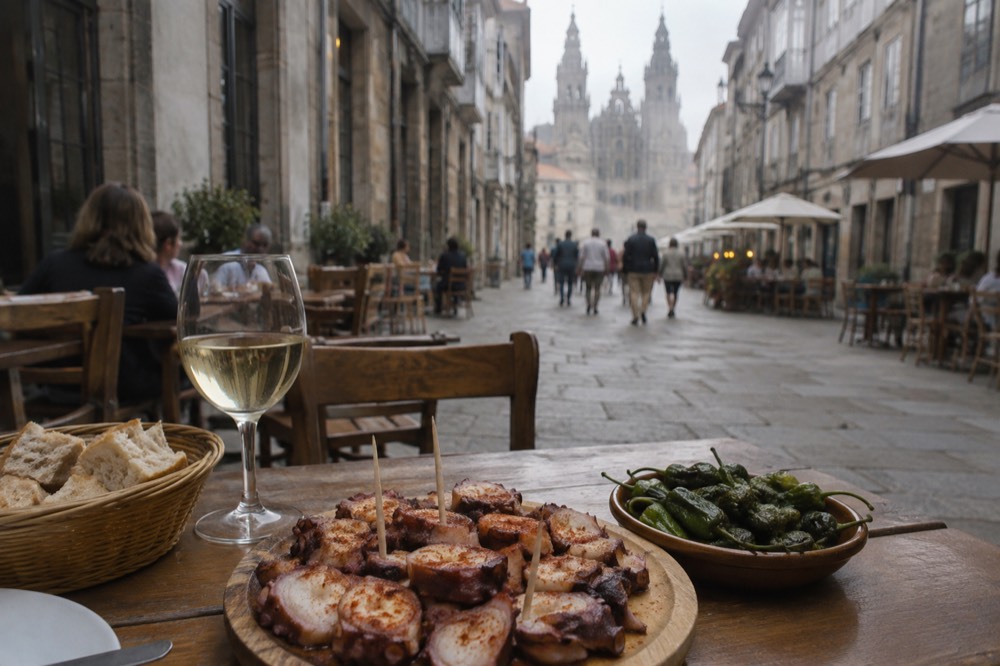
For the Camino crowd the same advice doubles as recovery food. Pilgrims arriving off the trail eat the same canon as everyone else, just with more of it, and the walking scale of the arrival is covered in depth on the arriving in Santiago on the Camino page. A tapas counter is the most forgiving possible first meal after a long walk: no reservation, no table politics, and a plate of octopus in front of you within minutes.
Where Do Locals Actually Go For Tapas In Santiago de Compostela?
Locals eat mostly off the main strip: the lanes around Praza de Cervantes and Rua da Rainha, the side streets running off Rua do Franco, and the blocks around the Mercado de Abastos carry most of the everyday traffic. Rua do Franco itself stays busy and earns it, but the deepest local wine lists and the quietest tables sit one street away on either side.
Rua do Franco is the street with the cathedral gate at the top and a string of tapas bars running down its length, and every visitor walks it at least once. Nothing here says avoid it. The honest reading is that it splits the same way any high street splits: the bars with long local lists and serious kitchens hold their end up, and the volume of one night traffic keeps the whole street loud.
The quieter weight sits in the surrounding quarters. Rua da Rainha runs parallel and carries the wine bar culture, small rooms built around the glass rather than the plate. The blocks around Praza de Cervantes and the lanes toward Porta Faxeira hold the sit down tapas kitchens, the rooms where a media racion is a dinner and not a snack. And around the Mercado de Abastos, the city's own market, a small cluster of market side kitchens cooks what the stalls sold that morning.
| Quarter | Character | When It Works Best |
|---|---|---|
| Rua do Franco | Classic tapas strip, highest energy, most choice in one street | Start of the evening, groups |
| Rua da Rainha and Rua da Vileria | Wine led counters, quieter, more local | Second and third stops |
| Praza de Cervantes lanes | Chef driven small rooms, bookable dinners | A planned sit down evening |
| Around the Mercado de Abastos | Market kitchens, produce driven, lunch weight | Lunchtime and early evening |
How Much Does An Evening Of Tapas In Santiago de Compostela Cost?
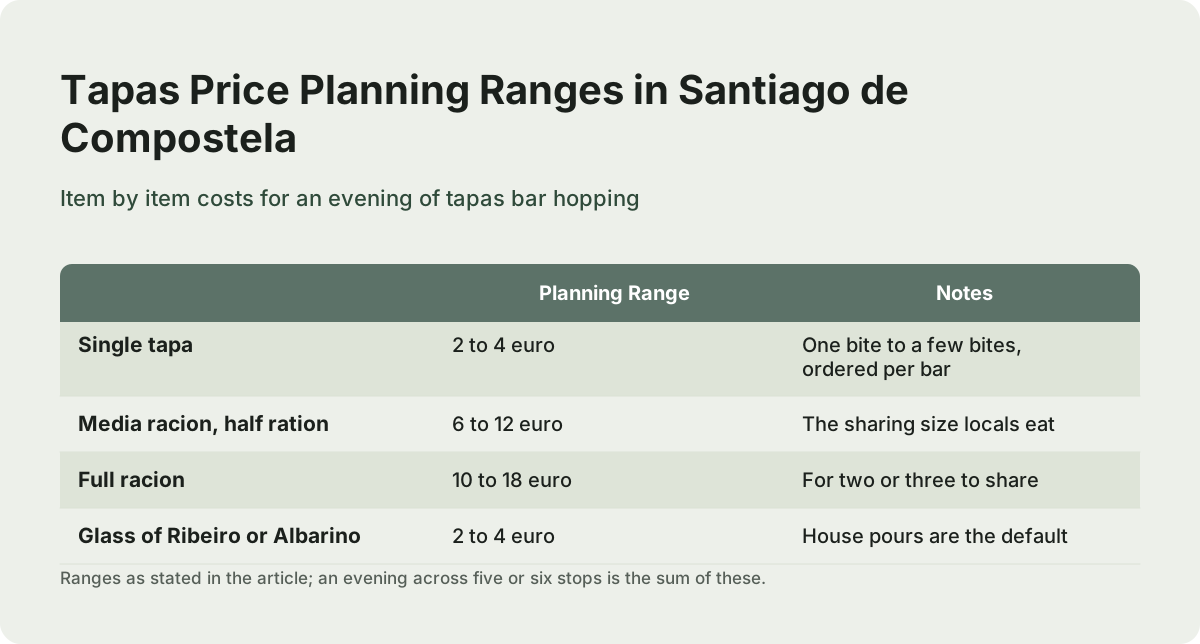
A realistic evening is priced item by item rather than as a menu: a single tapa usually lands between 2 and 4 euro, a media racion between 6 and 12, a full racion between 10 and 18, and a glass of Ribeiro or Albarino between 2 and 4. An evening across five or six stops is simply the sum of those, and it is almost always less than a booked sit down dinner. Treat every number here as a planning range, not a promise.
Those ranges are the honest planning spread rather than anyone's menu, and they hold because the format itself is modular. An evening built from tapas at the bar costs less than the same evening built from half rations at a table, and both cost less than the booked chef driven rooms, where a full small plates dinner sits a level above the counters. The savings mechanic is simple: eat standing at more bars rather than sitting at one.
| Item | Planning Range | Notes |
|---|---|---|
| Single tapa | 2 to 4 euro | One bite to a few bites, ordered per bar |
| Media racion, half ration | 6 to 12 euro | The sharing size locals eat |
| Full racion | 10 to 18 euro | For two or three to share |
| Glass of Ribeiro or Albarino | 2 to 4 euro | House pours are the default |
The other honest cost note: Santiago de Compostela has charged a municipal tourist tax since 1 October 2025 (a surcharge on Galicia's tourist-stay tax), from 1 EUR per person per night in private albergues, campsites and tourist apartments up to 2.50 EUR in five-star hotels, for a maximum of 5 nights, with under-18s and stays in Xunta-run public albergues exempt. Compared with the rest of a Santiago de Compostela budget, the tapas evening is the cheapest big night out in the city, which is exactly why locals build their weeks around it.
When Is The Best Time To Go Tapas Bar Hopping In Santiago de Compostela?
The scene runs hardest from Thursday to Saturday, and the pre dinner window is the sweet spot, when kitchens have opened but the peak crowd has not yet arrived. Santiago de Compostela is wet and cool from October to March and at its driest in July and August, so in the wetter months the indoor counters fill quickly and booking the small chef driven rooms well in advance matters far more.
The season shapes the evening more here than in drier Spanish cities. AEMET's climate data for the city shows a wet, temperate oceanic pattern, wet year round and wetter from October to March, with July and August the driest months. The full climate picture, including how it should shape a whole trip, is on the Santiago de Compostela weather and best time to visit pages.
What that means at bar level is concrete. In the rainy half of the year, standing outside with a glass stops being an option and the indoor counters get tight earlier, so the late window shifts earlier too. In the dry summer months, and above all around the feast of St James on 25 July, the old town is at its fullest and the bar scene is at its loudest, and the two busiest counters on any street have queues worth planning around. The festival context sits on the Feast of St James, July 25 page.
The weekly rhythm matters as much as the seasonal one. Sunday lunch is a family racion affair rather than a crawl, Monday and Tuesday are the quietest nights and the nights some kitchens rest, and the Thursday to Saturday run is when the whole city eats standing up. None of these rhythms is a timetable, and individual bars shift their days seasonally, so the working rule is to check the specific bar's own channels for the night you have in mind.
What Is A Realistic Tapas Route Through The Old Town?
A realistic first evening runs four or five stops in under a kilometre of walking: begin with a glass and a tapa at a Rua do Franco counter, move to a wine bar counter on Rua da Rainha, take a media racion stop in the Cervantes lanes, finish at a market side kitchen or a booked small room, and close with tarta de Santiago wherever the kitchen still has a slice.
The route below is the shape that works, not a timetable. Swap any stop for its neighbour and the evening still functions, because the whole thing is held together by the old town's scale rather than by any single bar.
| Stop | Order | Why This Stop |
|---|---|---|
| 1. Rua do Franco counter | Pulpo tapa, glass of Ribeiro | The classic opening, loudest room of the night |
| 2. Rua da Rainha wine bar | Pementos de Padron, Albarino | Wine list depth, pace drops, conversation starts |
| 3. Cervantes lanes | Media racion of zamburinas or empanada | The sharing stop, where the evening becomes dinner |
| 4. Market side kitchen | Whatever arrived that morning | The honest plate, lightest crowd |
| 5. Any counter with tarta left | Tarta de Santiago, coffee or a liqueur | The close, and the only sweet worth saving room for |
Two practical notes hold the route together. First, order less at each stop than instinct suggests, since five stops of two items each is a full evening's food. Second, pay as you go rather than running a tab, because the standing format expects it and it keeps the moving easy.
Should You Take A Guided Tapas Tour In Santiago de Compostela?
A guided tapas tour earns its keep on a first night, when you do not yet know which counters to trust: a local guide books the route, reads the chalkboards, orders the canonical dishes at the right size, and explains the Ribeiro versus Albarino split bar by bar. On a second or third visit the same money is better spent at the counters yourself, choosing as you go.
The honest case against is that the city makes independent crawling easy. Everything in this article is doable alone, the bars are used to visitors pointing at the glass case, and the walking distances are trivial. The honest case for is that the first night in an unfamiliar bar culture is where most people order badly: too much at one stop, the wrong wine for the plate, or a street of lookalike facades and no way to tell the long list from the short one.
A guided walk front loads the competence. The tapas walk run as a private experience is the strongest version of this for a first evening, and pairing it with a sightseeing half day gives a full first day in the city. The Cathedral centered half day with tickets included covers the monument half, and either of the Rias Baixas or coastal day trips covers the countryside half when the city needs breathing room.
Between the trio, the practical split is simple: the tapas walk for the evening, the half day Cathedral and city visit for the sightseeing core, and the Rias Baixas day trip for the coast and the wineries once the plates and the pilgrimage monument have both been covered. All three can be reserved with pay later options, so nothing has to be locked in before arrival.
For the wine dimension specifically, the Albarino country of the Rias Baixas is an hour's world away and covered on its own page. The full day out to Arousa Island, Combarro and a mussel boat puts the coastal half of the Galician table, the mussels and the Albarino, into one trip, and it pairs naturally with an evening of the city counters.
Common Questions About Tapas In Santiago de Compostela
Are tapas free in Santiago de Compostela?
No. Unlike parts of southern Spain where a small plate arrives with a drink, tapas in Santiago de Compostela are ordered and paid for individually, as a tapa, a media racion or a full racion. A glass of wine on its own is just the glass.
What is the difference between a tapa and a racion?
A tapa is a deliberately small portion, one to a few bites, meant for one person at the bar. A media racion is a half ration for sharing, and a full racion is a plate for two or three. Most locals build an evening from tapas and media racions across several bars.
Is Rua do Franco a tourist trap?
Partly busy, not a trap. Rua do Franco is the classic tapas street and every visitor walks it, which keeps it loud, but the bars with long Galician lists on it hold up well. For quieter weight, the lanes around Rua da Rainha and Praza de Cervantes sit one street away.
What wine should you drink with tapas in Galicia?
The local whites: Ribeiro, often poured from the small flat sided bottle, and Albarino from the Rias Baixas coast. Both are made for the region's octopus, peppers and shellfish. Bars with deep lists will also pour Ribeira Sacra reds, worth trying at least once.
Do you need to book tapas bars in Santiago de Compostela?
Counters and wine bars work on a walk in basis. The small chef driven rooms with limited tables do need booking, especially in the July and August dry season and around the 25 July feast of St James, and in the wet October to March months the indoor counters fill earlier than you might expect.
Can you do a tapas crawl as a vegetarian?
Yes, with more ease than in much of northern Spain. Empanada with vegetable fillings, tetilla cheese, Padron peppers, pimientos, and the market side kitchens cooking whatever arrived that morning give a vegetarian crawl real range, though the canon's most famous dish, octopus, is off the table by definition.
The counters of Santiago de Compostela reward exactly one thing, showing up hungry and moving slowly, and the city has spent centuries arranging itself so that neither takes any effort at all.