Is Santiago de Compostela Safe?
Is Santiago de Compostela safe? A practical, sourced answer for visitors and pilgrims: old-town risks, night safety, solo walking, scams to watch for and what the official sources actually say.
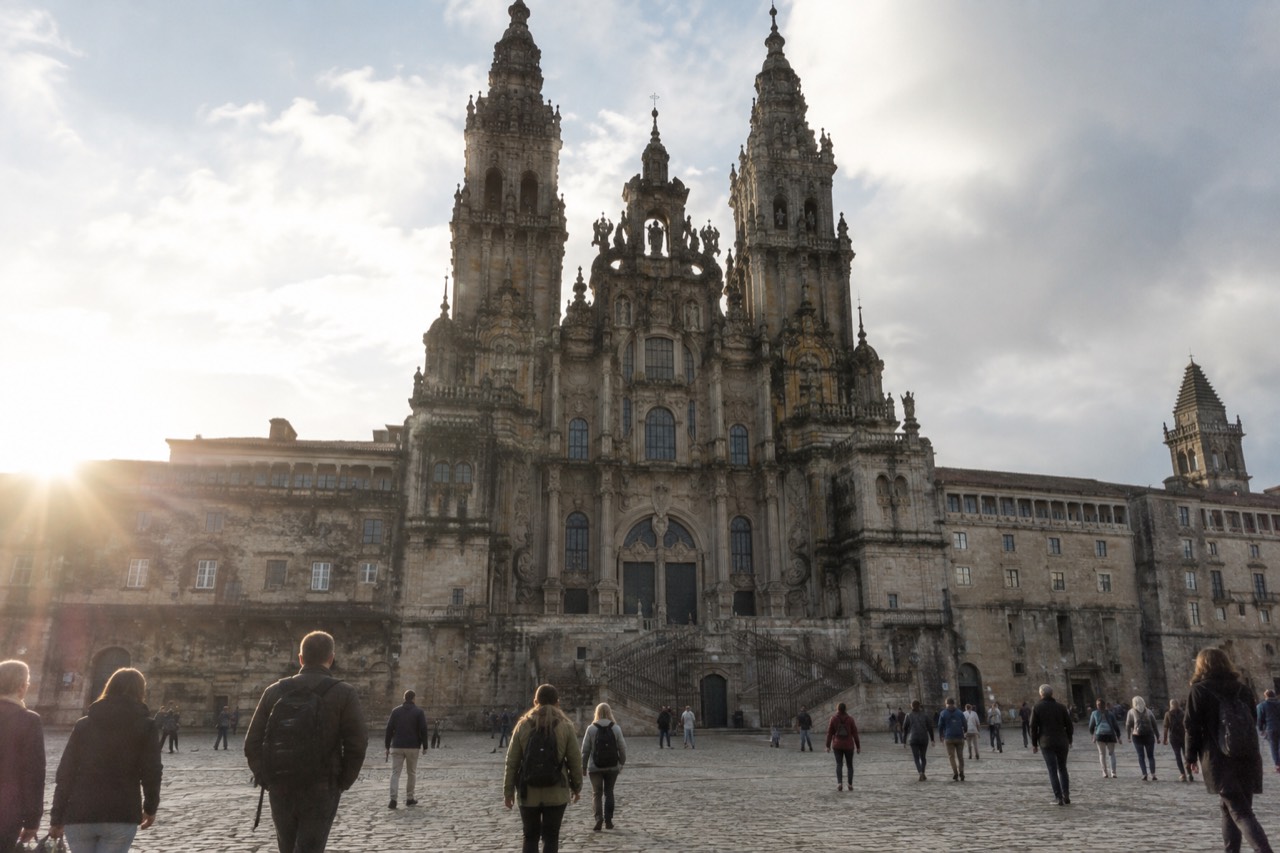
Santiago de Compostela in Galicia, Spain, is a small cathedral city built around the end point of the Camino de Santiago, and its safety profile matches that scale. The Old Town has been UNESCO-listed since 1985, the Camino routes themselves carry a separate 1993 UNESCO inscription, and the whole place is organized around the arrival of hundreds of thousands of walkers each year, with a record 530,987 Compostela certificates issued in 2025 alone. A city whose core business is receiving tired pedestrians on foot has strong incentives to stay legible, lit and calm.
That is the honest headline. Below it sit a few real, specific things worth knowing, none of which are reasons not to come. The editorial desk at Santiago de Compostela Travel Guide has pulled together what the primary sources actually state, from the Cathedral's own liturgy page to the city's transport page, rather than recycled generic safety advice.
Is Santiago de Compostela Safe?
Yes, Santiago de Compostela is broadly safe for visitors and pilgrims. It is a compact Galician city where violent crime against tourists is rare, streets in the Old Town stay busy well into the evening, and the city's whole economy depends on receiving walkers politely. The realistic risks are pickpocketing in crowds, wet stone underfoot, and fatigue on the final Camino stages, not anything a normal visitor would classify as danger.
Two things shape that answer more than any crime statistic. First, scale: this is a city you cross on foot, and the areas a visitor actually uses are a handful of squares and lanes centred on Praza do Obradoiro. Second, population: the streets at any hour are a mix of residents, students, and pilgrims in hiking boots, which is about the least intimidating street crowd in Spain. The Oficina del Peregrino operates on the assumption that strangers walk in alone and need help, and the city's services are built around that same assumption.
None of this means you leave your brain at the airport. The rest of this page covers the specific things that actually go wrong, the areas and hours where they happen, and the practical routines, from 112 to the airport bus, that keep a trip smooth.
What Are The Main Safety Risks In Santiago de Compostela?
The main risks in Santiago de Compostela are petty, not violent: pickpocketing in dense crowds around the Cathedral and Praza do Obradoiro, bag and phone snatching on crowded streets, and slip-and-fall injuries on wet granite paving, which rains a lot given the city's wet, cool October-to-March stretch. Scam-level risks are low but real, mostly taxi overcharging and fake petition or bracelet approaches common across Spanish tourist cities.
Notice what is absent from that list. There is no neighborhood a visitor is realistically warned away from. The Old Town's lanes between Rua do Franco and Praza da Quintana are tourist infrastructure, and the streets beyond it, toward the market and the Alameda, are ordinary Galician city streets where the evening paseo is the main activity.
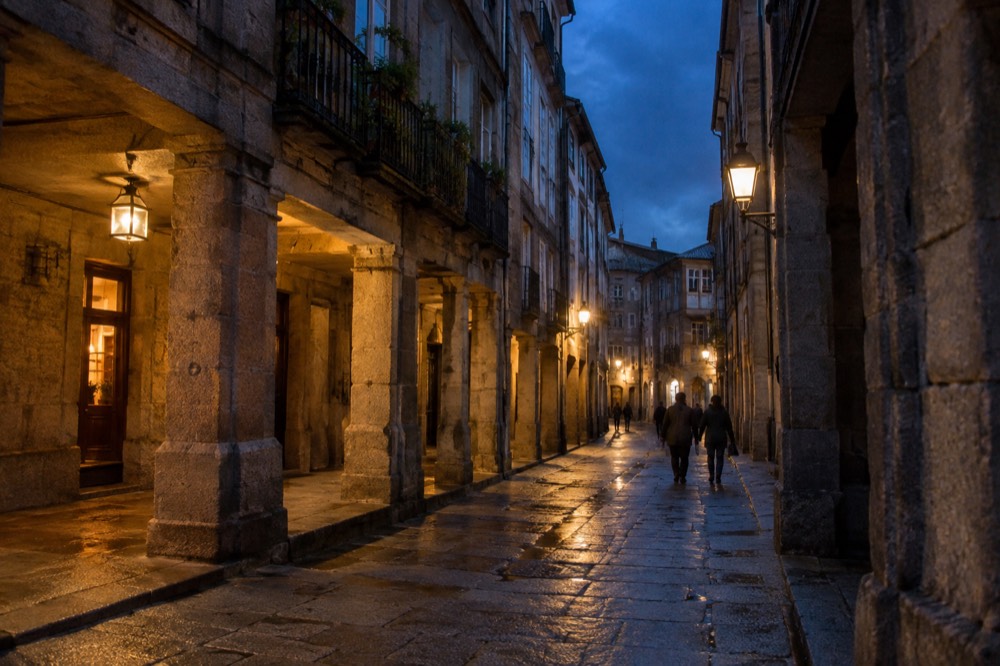
Wet stone deserves its own sentence. AEMET's climate data for the Santiago station shows a temperate oceanic pattern, wet year-round and wetter from October to March, with annual precipitation on the order of 1,690 to 1,890mm. That is genuinely rainy by Spanish standards, and polished granite setts in the old town become slick within minutes of a shower. Most visitor injuries here are ankles and elbows, not encounters with criminals. Shoes with real grip matter more than any safety precaution you will read online.
The table below puts the realistic risks in proportion, with what the primary sources say to do about each.
| Risk in Santiago de Compostela | How likely for a visitor | What the official advice amounts to |
|---|---|---|
| Pickpocketing at Cathedral doors, Praza do Obradoiro, busy masses | Low but the top real risk | Keep valuables in front pockets or a closed day bag in crowds |
| Snatched phone or bag on a crowded lane | Low | Don't leave phones on café tables; keep bags off chair backs |
| Slip on wet granite paving | Moderate, most common actual injury | Proper-soled footwear; handrails where fitted on stairs |
| Taxi or transfer overcharging | Low | Agree the fare or confirm the meter before setting off |
| Fake petition or bracelet approaches | Low | Decline and keep walking, standard Spanish-city advice |
| Getting lost | Very low | The Old Town is small and every lane trends back to Obradoiro |
Is The Old Town At Night Safe In Santiago de Compostela?
Yes, the Old Town at night in Santiago de Compostela is safe by any normal standard. The streets around Rua do Franco and the tapas quarter stay busy with diners until late, the squares remain lit and walked, and the city's nightlife is a drinking-and-tapas culture rather than a large-club district. The realistic night-time issues are noise if your room faces a tapas street, and the ordinary caution of not walking alone down an unfamiliar empty lane at 3am.
The city's own character does a lot of the work. Pilgrims go to bed early because they walked 20km that day; students fill the bars around the university quarter; tourists eat late and stroll afterward. A nightlife mix like that keeps foot traffic steady without pushing it into anything aggressive. The Rua do Franco strip is loud and social rather than edgy, and the squares feeding into it, Praza da Quintana and Praza do Obradoiro, stay populated.
If your plan runs past midnight, the standard routines apply and nothing extra. Move in the lit, walked lanes. The tapas and bar culture in Santiago de Compostela is covered in detail in the tapas bars guide, and the nightlife overview maps which streets stay busy until what hours.
One dated note that affects night-time plans more than safety: the pilgrim masses are moving. From 16 October 2026, the 9:30am, noon and 7:30pm masses relocate from the Cathedral's High Altar to the nearby Church of San Agustin, with only the 7:30am mass staying in the Cathedral's own Communion chapel. Before that date all four masses, 7:30am, 9:30am, noon and 7:30pm, are held at the main altar. Late-evening plans that assumed a Cathedral visit around the 7:30pm mass should check which arrangement applies on the date of travel.
Is Santiago de Compostela Safe For Solo Travellers And Women Walking Alone?
Yes, Santiago de Compostela is safe for solo travellers and for women walking alone, in the city and on the final Camino stages into it. The city end of the Camino is the busiest, best-walked stretch of the whole route, the Pilgrim's Office at Rua das Carretas 33 is set up for people arriving on their own, and solo walking is so normal here that nobody remarks on it. The realistic solo risks are the same petty-theft and weather items as for anyone else.
The question gets asked constantly, and the Camino context changes the answer. A woman walking alone on the Camino is not an unusual sight, she is roughly the median pilgrim. The last 100km from Sarria, the minimum distance that qualifies for the Compostela with two stamps per day, is the most populated section of any route: albergues, cafés and other walkers sit at regular intervals, and daylight hours are full of company going the same direction at the same speed.
The deeper answer for solo women is on the dedicated page: is it safe for a woman to walk the Camino de Santiago alone. For the city itself, the practical routines are unglamorous: keep your passport somewhere pickpocket-proof at the Cathedral doors, keep your Compostela paperwork together, and if arriving late, book accommodation inside the Old Town rather than dragging a pack through empty streets at 11pm after a late flight.
Is It Safe To Arrive In Santiago de Compostela By Bus, Train Or Plane?
Yes, arriving in Santiago de Compostela is safe and simple. The airport sits about 12km from the Old Town, city bus line 6A connects it to the centre in roughly 25 to 45 minutes for 1 EUR paid to the driver as of late September 2026, trains run direct from Madrid in roughly 3 to 4 hours, and all arrival points are ordinary, small, well-used Spanish transport hubs with nothing risky about them beyond the usual luggage vigilance.
The airport caveat is the one worth printing in full. The city's transport page currently lists Tussa line 6A at 1 EUR to the driver, or 0.36 EUR on a rechargeable card, but a new Monbus contract with an unsubsidised fare of around 6 EUR is expected to take over in autumn 2026, possibly by December. Anyone travelling in that window should check the live fare rather than trusting either number as permanent. The full arrival picture is in the airport guide.
A few standard arrival numbers and facts, all from the verified pack:
| Arrival route to Santiago de Compostela | What the sources say |
|---|---|
| Airport bus (SCQ to centre) | Tussa line 6A, 1 EUR to the driver, 0.36 EUR by card, roughly every 30 minutes, subject to the Monbus change in autumn 2026 |
| Airport to Old Town distance | About 12km, a 20 to 30 minute drive |
| Train from Madrid | Direct high-speed services, roughly 3 to 4 hours |
| Train from Vigo | Direct regional services, roughly 1 hour |
| Train to Porto, Portugal | No direct line; change at Vigo |
| Emergency number | 112, EU-wide, applies across Spain |
| Tourist tax | Santiago de Compostela has charged a municipal tourist tax since 1 October 2025, from 1 EUR to 2.50 EUR per person per night for up to 5 nights, with under-18s and stays in Xunta-run public albergues exempt |
None of that table is safety-critical, and that is the point: the arrival experience here is a short bus ride or a short train hop, and the things a new arrival might worry about, directionless stations, long unlit transfer walks, do not exist at this scale.
How Do You Stay Safe And Comfortable On Your First Day In Santiago de Compostela?
The main safety-adjacent decisions on a first day in Santiago de Compostela are about crowds, tickets and weather: expect dense crowds at the Cathedral doors around mass times, book any rooftop or museum visit in advance because timed slots sell out, wear shoes with real grip on wet granite, and keep your Compostela paperwork and valuables organized before you join the busiest squares. Rooftop tours on the Cubiertas route cost EUR15 general or EUR12 reduced and run about 60 minutes with roughly 140 steps.
The rooftop figure comes from the Cathedral's own ticketing site, which is also where advance booking happens; slots in peak season sell out, and the visit includes about 140 steps and roughly 72m of height, which is worth knowing before you commit if knees or vertigo are a factor. The reduced rate covers accredited pilgrims, students, over-65s, under-12s and several other categories with proof at entry.
A guided visit early in the stay solves two problems at once: orientation and the ticket queue. The complete city and Cathedral tour bundles the walking introduction with tickets included, and the Cathedral tickets and opening hours guide covers what to book yourself if you would rather go alone. Either way, the first-day plan should leave the busiest squares for mid-morning rather than the mass-time crush at the doors.
Two closures-and-works notes complete the practical picture, both confirmed as of late September 2026. The Botafumeiro is currently suspended, with cimborrio restoration scaffolding covering its hanging mechanism and no return date published, so no plan should promise seeing it swing. The Berenguela clock tower is in an exterior-focused restoration phase spanning 2026 and 2027, and the Cathedral itself remains fully open, roughly 7:00am to 9:00pm via the Praterias door, with free general entry.
Common Questions About Safety In Santiago de Compostela
Is Santiago de Compostela safe?
Yes. It is a small, walkable pilgrim city in Galicia, Spain, with low violent crime, busy Old Town streets into the evening, and a local economy built around receiving solo walkers. The realistic risks are pickpocketing in crowds, slick granite in the frequent rain, and ordinary travel fatigue.
Is Santiago de Compostela safe at night?
Yes. The tapas streets around Rua do Franco stay busy and social until late, the main squares remain lit and walked, and the nightlife culture is bars and tapas rather than large clubs. Normal late-night city habits are sufficient here.
Is Santiago de Compostela safe for solo female travellers?
Yes, in the city and on the final Camino stages. Solo walking is the norm on the Camino, the last 100km from Sarria is the busiest and best-serviced section of any route, and the Pilgrim's Office at Rua das Carretas 33 exists precisely to help people who arrive alone.
What should I be most careful about in Santiago de Compostela?
Wet stone and crowds, in that order. The climate is wet year-round and wetter October to March, and polished granite paving gets slick fast. At the Cathedral doors and on packed squares, keep valuables in front pockets and bags closed and off chair backs.
Is there a dangerous area of Santiago de Compostela to avoid?
No area a visitor would realistically use carries a credible avoid-it warning. The Old Town, the Alameda park, the market district and the university quarter are all ordinary, walked, central areas, and the city is small enough that every lane trends back toward Praza do Obradoiro.
What number do I call in an emergency in Santiago de Compostela?
112, the EU-wide emergency number, which applies across Spain. For non-emergency needs, staff at the Pilgrim's Office and the tourist information points in the Old Town are the most practical first stop.