Does It Rain A Lot In Santiago de Compostela?
A direct answer to whether it rains a lot in Santiago de Compostela, Galicia, using AEMET climate data: annual rainfall, the wettest months, and what the rain means for visiting the cathedral city.
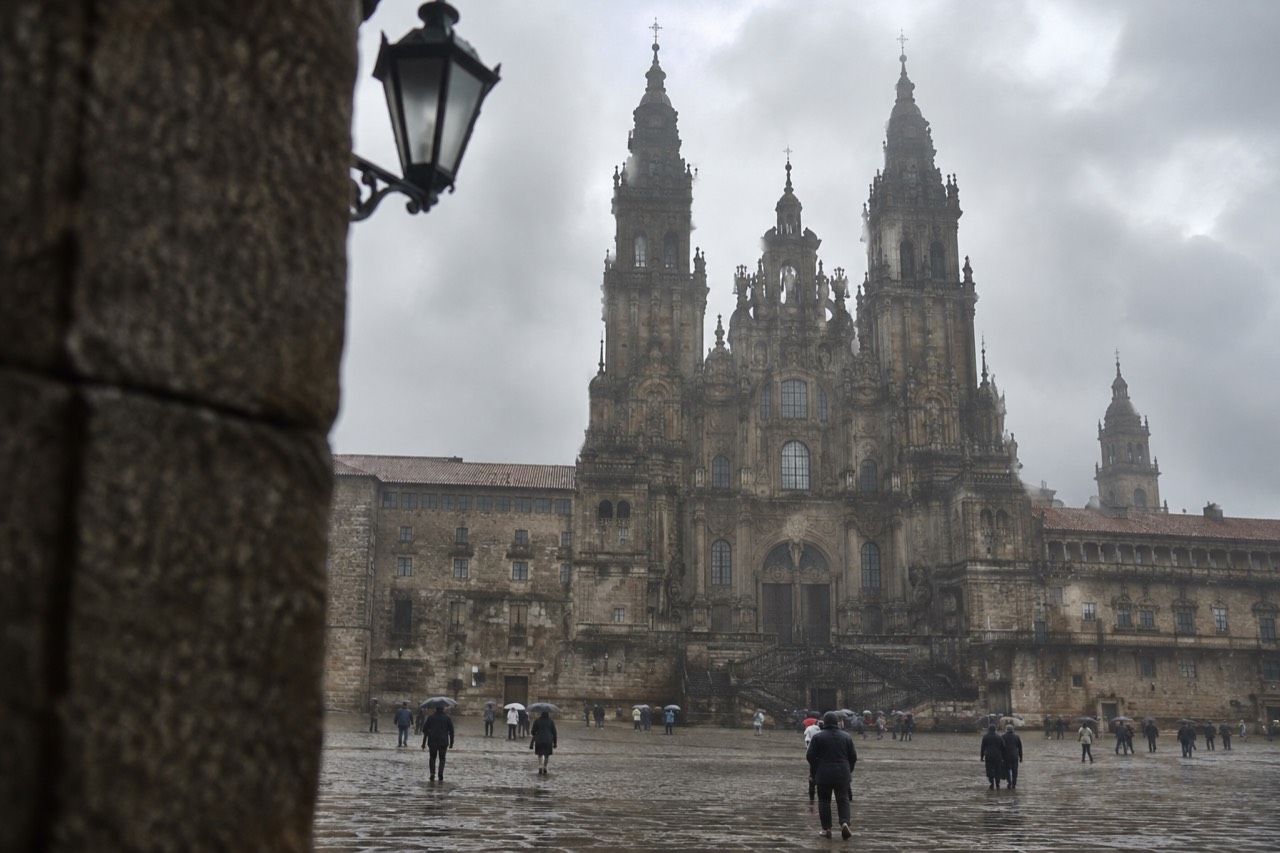
Galicia's cathedral city sits under some of the wettest skies in Spain, and the question of rain shapes almost every plan made there, from Camino packing lists to rooftop tour bookings. AEMET, the Spanish national weather agency, maintains a climate station at Santiago de Compostela itself, station 1475X at Labacolla, and its long-term records put annual precipitation on the order of 1,690 to 1,890mm depending on the station and the year measured. That is the honest headline number, and it is a large one for a country most visitors picture as sunny. Santiago de Compostela has a temperate oceanic climate: wet year-round, distinctly wetter from October to March, and at its driest in July and August.
The practical side of that number matters more than the number itself. Rain here rarely arrives as an all-day downpour that cancels a trip; it arrives as showers that pass through, sometimes several in a day, often with bright spells between them. Locals plan around it rather than against it, and this guide, Santiago de Compostela Travel Guide, is built to help a visitor do the same.
Does It Rain A Lot In Santiago de Compostela?
Yes, by Spanish standards it rains a lot in Santiago de Compostela. AEMET's climate records for the city's own station put annual precipitation on the order of 1,690 to 1,890mm, spread across a wet year-round oceanic climate rather than a short rainy season. The city is wetter from October to March and driest in July and August, but no month is reliably dry. A visitor at any time of year should carry rain gear and expect at least the possibility of showers.
That figure deserves context, because "1,690 to 1,890mm" means little on its own. It comes from AEMET's climatological records for station 1475X, Santiago de Compostela / Labacolla, and the range exists because the total varies with the station position and the years included in the measurement. What is consistent across the record is the pattern: a temperate oceanic climate, the same regime that gives green landscapes to Galicia generally. The region's famous greenness is not decorative; it is a direct product of this rainfall, and the fields, forests and eucalyptus the Camino passes through for its final hundred kilometres exist because of it.
The character of the rain matters for planning. Atlantic frontal systems sweep in from the west, and they can sit over the city for a day or more in the wet season, but equally a forecast of rain often translates to one or two passing showers rather than continuous drizzle. Summer days can start grey and clear completely by afternoon. The best time to visit Santiago de Compostela depends on how a traveler weighs rain against crowds and heat, and the trade-offs shift through the year.
One more framing helps: rain is the reason the city looks the way it does. Granite streets that gleam when wet, moss on stone walls, the covered arcades around Praza da Quintana built partly because of the weather, all of it belongs to the same climate story.
| Climate feature (AEMET station 1475X, Labacolla) | What the data shows |
|---|---|
| Climate type | Temperate oceanic, wet year-round |
| Annual precipitation | On the order of 1,690-1,890mm depending on station/year measured |
| Wettest stretch | October to March |
| Driest stretch | July and August |
| A reliably dry month | None in the long-term record |
Which Months Are The Wettest In Santiago de Compostela?
The wettest months in Santiago de Compostela run from October through March, with the Atlantic wet season at its most persistent from late autumn through winter. The driest period is July and August, when the Azores high tends to keep fronts away from Galicia. April through June sits between the two, mixing wet days with genuinely warm, bright ones. AEMET's monthly breakdown for the city's station was not extracted for this guide, so exact per-month rainfall figures are not printed here.
That last sentence is deliberate. Many guides publish tidy monthly rainfall tables, and the temptation is to reproduce one from memory, but a verified month-by-month table for this station was not extracted in the research behind this page, and inventing monthly normals would be worse than admitting the gap. What is verified is the seasonal shape: wet and cool from October to March, driest in July and August, and a wet year-round baseline in between. Ranges and named seasons describe the city honestly; a fabricated millimetre count does not.
For Camino walkers the seasonal shape is the single most important planning input. The vast majority of the 530,987 Compostelas the Pilgrim's Office issued in 2025, a record year, were earned in the warmer half of the year, and weather is a large part of the reason. Spring walkers get the green landscapes and the mud; summer walkers get the crowds and the best odds of staying dry. The question of what is the best month to walk the Camino de Santiago is really a question about this rainfall pattern plus crowd levels and heat.
Visitors with fixed dates can work with whatever the season gives them. A wet October day still fits a cathedral visit, a museum afternoon and a long lunch under cover; a dry one is a gift to be spent outdoors.
Does Rain Stop You Sightseeing In Santiago de Compostela?
No, rain does not stop sightseeing in Santiago de Compostela, because the city's core indoor attractions carry a full wet day on their own. The Cathedral itself is open daily from about 7:00am to 9:00pm with free general entry, the Cathedral Museum runs roughly 10:00am to 8:00pm with tickets from EUR 9 to EUR 23 depending on type, and the rooftop tour costs EUR 15 general or EUR 12 reduced. Between them, a rainy day fills easily.
The point is worth making plainly, because visitors from drier climates sometimes assume a rainy forecast in Santiago de Compostela is a lost day. The old town is compact enough that most distances between sights are measured in minutes, and several of the best attractions are buildings you would visit rain or shine. The Cathedral of Santiago de Compostela needs hours rather than minutes anyway; the Cathedral Museum and the Portico da Gloria sit within the same complex. Even the rooftop tour runs in light rain, and low cloud after a shower can put the whole city under a dramatic sky that photographers actively want.
There are practical caveats. Guided visits with timed tickets should be booked ahead on wet days because every visitor in town has the same indoor idea at the same time. And some experiences genuinely do suffer in rain: a planned afternoon in Alameda Park, or a slow wander through the Mercado de Abastos stalls, is better moved to a dry window. The question of how many days to spend in Santiago de Compostela should assume at least one of them arrives wet.
| Rainy-day option in the old town | Verified detail |
|---|---|
| Cathedral interior, naves and tomb | Open daily about 7:00am-9:00pm, free general entry |
| Cathedral Museum and Gelmirez Palace | About 10:00am-8:00pm, ticket office closes 30 minutes earlier, EUR 9-23 by ticket type |
| Rooftop and Torre de la Carraca guided tour | EUR 15 general, EUR 12 reduced, about 60 minutes, about 140 steps, bookable online |
| Covered walking routes | Arcades and narrow lanes around Praza da Quintana and Rua do Franco give shelter between stops |
A guided option solves the wet-day problem neatly, because a guide routes around the weather in real time. The historic walking tour in a small group, from $29 per person and rated 4.9 from 16 reviews, keeps the group small enough to duck into covered spots, and the combined cathedral, museum and old city tour, from $34 per person and rated 4.9 from 115 reviews, spends much of its time under the cathedral roof. For a day too wet for town at all, the Sil river cruise day trip to Ribeira Sacra and Ourense, from $64 per person, moves the day onto a covered boat.
What Should You Pack For Rain In Santiago de Compostela?
Pack for rain in Santiago de Compostela with a proper waterproof shell rather than an umbrella, waterproof shoes with grip for the city's granite paving, and a dry-bag or pack cover for anything carried all day. Umbrellas work on calm days but Atlantic fronts bring wind that defeats them, and the city's narrow streets funnel gusts. Layering matters more than heavy insulation, because wet days are cool rather than cold most of the year.
The granite detail is not cosmetic. Santiago de Compostela's old town is paved in polished stone that becomes genuinely slippery when wet, and footwear with tread matters more here than in most Spanish cities. The same stone, incidentally, is why the city photographs so well in rain: whole streets turn reflective, and the Cathedral towers take on a different mood under low cloud.
Camino walkers should treat this packing advice as a floor, not a ceiling. The final approach into the city crosses open ground with no shelter, and arriving pilgrims regularly do so in rain, which is one reason the question of what the new rules for the Camino de Santiago mean and the packing list around it get so much attention. A full Camino packing list covers the whole range; for a short city visit the short version is shell, shoes, and a bag that keeps its contents dry.
One habit worth copying from locals: check the sky, not just the forecast. A morning of steady rain can clear into a bright afternoon, and plans made flexibly around the weather succeed more often than plans made rigidly against it.
How Does Rain Affect The Camino de Santiago?
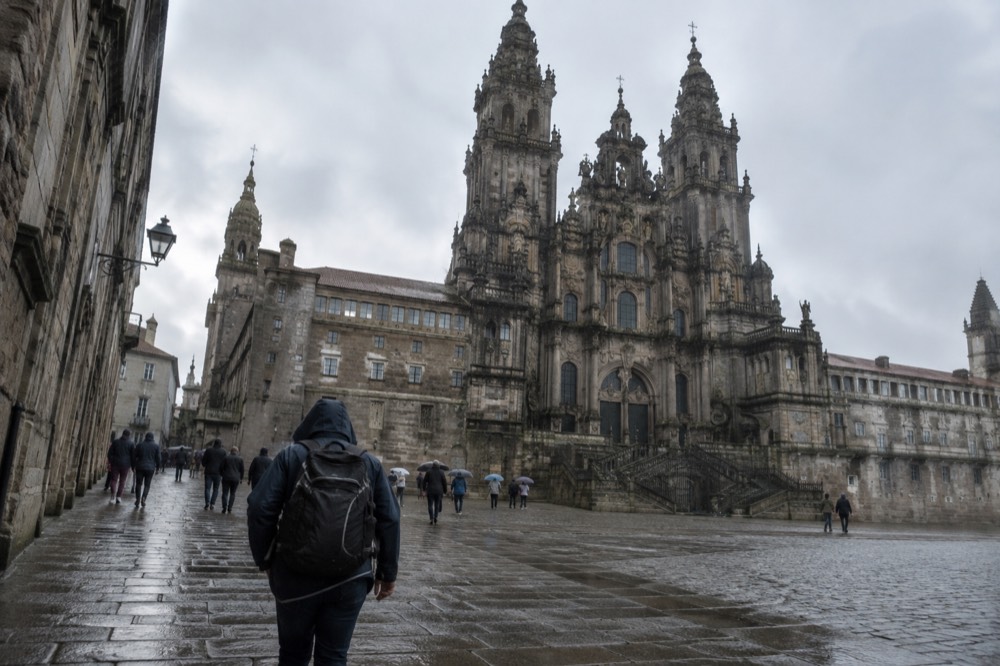
Rain affects the Camino de Santiago most in its final stages, where wet weather from October to March turns trail surfaces to mud and makes waterproof footwear and a pack cover as important as anything else in a pack. The record 530,987 Compostelas issued in 2025 were overwhelmingly earned in the drier months, and the wet season thins crowds on the trail but raises the physical demands. Summer walkers trade mud for heat and company.
The final stretch into Santiago de Compostela matters for two reasons. First, the Compostela certificate requires the last 100km walked, or the last 200km cycled, on a recognized route, so nearly everyone earning the certificate walks through whatever the Galician sky delivers on those final days. Second, the terrain close to the city is a mix of forest track, farm lane and open hill, all of which hold water differently; the forest sections drain well, the farm sections can become clay-heavy and slick. Walkers coming in from Sarria to Santiago meet exactly this mix in the last week of a walk.
The seasonal trade-offs are stark enough to be worth stating plainly. An October or March walk gets empty albergues, low prices and muddy boots. A July walk gets the driest ground the climate offers, along with the busiest trails and the hottest afternoons of the year. Neither is wrong; they are different trips. The question of how long it takes to walk the Camino de Santiago interacts with this too, because a wet-season walker covering the same distance moves slower over soft ground and arrives more tired each evening.
Arrival day itself deserves a mention. Pilgrims reach Praza do Obradoiro in every kind of weather, and rain on the final approach is a common and, walkers often say, a fitting ending to a route across Galicia. The practical advice for that day is simple: have a dry layer reserved in the pack, and something dry waiting at the destination.
A wet week in the city is also, honestly, a good week for guided experiences, and the small-group historic walk, bookable via the operator's live listing, turns grey streets into quiet ones. Anyone still weighing the trip itself can start with whether Santiago de Compostela is worth visiting; the rain is a factor, but it is far from the whole verdict.
Common Questions About Rain In Santiago de Compostela
Does it rain a lot in Santiago de Compostela?
Yes. AEMET's climate record for the city's own station shows annual precipitation on the order of 1,690-1,890mm, in a temperate oceanic climate that is wet year-round. It is one of the wetter cities in Spain.
What is the driest month in Santiago de Compostela?
July and August together form the driest stretch of the year, when the Azores high tends to keep Atlantic fronts away. No month is reliably dry, but the summer odds are the best the climate offers.
What is the rainiest time of year in Santiago de Compostela?
October through March is the wettest period, when Atlantic fronts arrive frequently and can sit over the city for a day or more at a time.
Should I bring an umbrella to Santiago de Compostela?
A waterproof jacket is more useful than an umbrella, because rain often arrives with wind that makes umbrellas awkward. Waterproof shoes with grip matter too, since the granite paving in the old town is slippery when wet.
Is Santiago de Compostela worth visiting if it rains?
Yes. The Cathedral is open daily with free general entry, the Cathedral Museum and rooftop tour fill hours indoors, and the compact old town means short covered hops between sights. Rain is part of the city's character rather than a reason to stay away.
Does rain stop the Camino de Santiago?
No, walkers continue in rain throughout the wet season. The last 100km, required for the Compostela certificate, crosses surfaces that hold water, so wet-season walkers should budget more time and better footwear for the same distance.
The rain in Santiago de Compostela is real, measurable and year-round, and planning for it is simply part of visiting Galicia well.